2010 CHEVROLET IMPALA ECU
[x] Cancel search: ECUPage 264 of 432

6. Secure the vehicle to the dolly following the
manufacturer’s instructions.
7. Release the parking brake only after the vehicle
being towed is firmly attached to the towing
vehicle.
8. Turn the ignition to LOCK/OFF and remove the key.Towing a Trailer
{
WARNING:
The driver can lose control when pulling a trailer if
the correct equipment is not used or the vehicle is
not driven properly. For example, if the trailer is
too heavy, the brakes may not work well — or
even at all. The driver and passengers could be
seriously injured. The vehicle may also be
damaged; the resulting repairs would not be
covered by the vehicle warranty. Pull a trailer only
if all the steps in this section have been followed.
Ask your dealer/retailer for advice and information
about towing a trailer with the vehicle.Notice:Pulling a trailer improperly can damage the
vehicle and result in costly repairs not covered
by the vehicle warranty. To pull a trailer correctly,
follow the advice in this section and see your
dealer/retailer for important information about
towing a trailer with the vehicle.
The vehicle can tow a trailer if it is equipped with the
proper trailer towing equipment. To identify the trailering
capacity of the vehicle, read the information in “Weight of
the Trailer” that appears later in this section. Trailering is
different than just driving the vehicle by itself. Trailering
means changes in handling, acceleration, braking,
durability and fuel economy. Successful, safe trailering
takes correct equipment, and it has to be used properly.
The following information has many time-tested,
important trailering tips and safety rules. Many of these
are important for the safety of the driver and the
passengers. So please read this section carefully before
pulling a trailer.
Load-pulling components such as the engine,
transmission, axles, wheel assemblies and tires are
forced to work harder against the drag of the added
weight. The engine is required to operate at relatively
higher speeds and under greater loads, generating extra
heat. The trailer also adds considerably to wind
resistance, increasing the pulling requirements.
5-28
Page 265 of 432
Pulling A TrailerHere are some important points:•
There are many different laws, including speed limit
restrictions, having to do with trailering. Make sure
the rig will be legal, not only where you live but
also where you will be driving. A good source for
this information can be state or provincial police.
•
Do not tow a trailer at all during the first 1,000 miles
(1600 km) the new vehicle is driven. The engine,
transmission or other parts could be damaged. The
repairs would not be covered by the vehicle’s
warranty.
•
Then, during the first 500 miles (800 km) that a
trailer is towed, do not drive over 50 mph (80 km/h)
and do not make starts at full throttle. This helps
the engine and other parts of the vehicle wear in at
the heavier loads.
•
Obey speed limit restrictions when towing a trailer.
Do not drive faster than the maximum posted
speed for trailers, or no more than 55 mph
(90 km/h), to save wear on the vehicle’s parts.
•
Do not tow a trailer when the outside temperature is
above 100°F (38°C).Three important considerations have to do with weight:
•
the weight of the trailer,
•
the weight of the trailer tongue
•
and the total weight on the vehicle’s tires.
Weight of the TrailerHow heavy can a trailer safely be?
It should never weigh more than 1,000 lbs (454 kg). But
even that can be too heavy.
It depends on how the rig is used. For example, speed,
altitude, road grades, outside temperature and how
much the vehicle is used to pull a trailer are all
important. It can depend on any special equipment on
the vehicle, and the amount of tongue weight the vehicle
can carry. See “Weight of the Trailer Tongue” later in
this section for more information.
Maximum trailer weight is calculated assuming only the
driver is in the tow vehicle and it has all the required
trailering equipment. The weight of additional optional
equipment, passengers and cargo in the tow vehicle
must be subtracted from the maximum trailer weight.
Ask your dealer/retailer for trailering information or
advice, or write us at our Customer Assistance Offices.
SeeCustomer Assistance Offices on page 8-6for
more information.
5-29
Page 268 of 432
Driving with a TrailerTowing a trailer requires a certain amount of experience.
Get to know the rig before setting out for the open
road. Get acquainted with the feel of handling and
braking with the added weight of the trailer. And always
keep in mind that the vehicle you are driving is now
longer and not as responsive as the vehicle is by itself.
Before starting, check all trailer hitch parts and
attachments, safety chains, electrical connectors, lamps,
tires and mirror adjustments. If the trailer has electric
brakes, start the vehicle and trailer moving and
then apply the trailer brake controller by hand to be sure
the brakes are working. This checks the electrical
connection at the same time.
During the trip, check occasionally to be sure that the
load is secure, and that the lamps and any trailer brakes
are still working.Following DistanceStay at least twice as far behind the vehicle ahead as
you would when driving the vehicle without a trailer. This
can help to avoid situations that require heavy braking
and sudden turns.
PassingMore passing distance is needed when towing a trailer.
Because the rig is longer, it is necessary to go much
farther beyond the passed vehicle before returning to
the lane.Backing UpHold the bottom of the steering wheel with one hand.
Then, to move the trailer to the left, move that hand
to the left. To move the trailer to the right, move your
hand to the right. Always back up slowly and, if possible,
have someone guide you.Making TurnsNotice:Making very sharp turns while trailering
could cause the trailer to come in contact with the
vehicle. The vehicle could be damaged. Avoid
making very sharp turns while trailering.
When turning with a trailer, make wider turns than
normal. Do this so the trailer will not strike soft
shoulders, curbs, road signs, trees or other objects.
Avoid jerky or sudden maneuvers. Signal well in
advance.
5-32
Page 270 of 432
Leaving After Parking on a Hill1. Apply and hold the brake pedal while you:
•
start the engine,
•
shift into a gear, and
•
release the parking brake.
2. Let up on the brake pedal.
3. Drive slowly until the trailer is clear of the chocks.
4. Stop and have someone pick up and store the
chocks.
Maintenance When Trailer TowingThe vehicle needs service more often when pulling a
trailer. SeeScheduled Maintenance on page 7-3for more
information. Things that are especially important in traileroperation are automatic transmission fluid, engine oil,
belts, cooling system and brake system. It is a good idea
to inspect these before and during the trip.
Check periodically to see that all hitch nuts and bolts
are tight.
Engine Cooling When Trailer TowingThe cooling system may temporarily overheat during
severe operating conditions. SeeEngine Overheating on
page 6-29.Changing a Tire When Trailer TowingIf the vehicle gets a flat tire while towing a trailer,
be sure to secure the trailer and disconnect it from the
vehicle before changing the tire.
5-34
Page 299 of 432
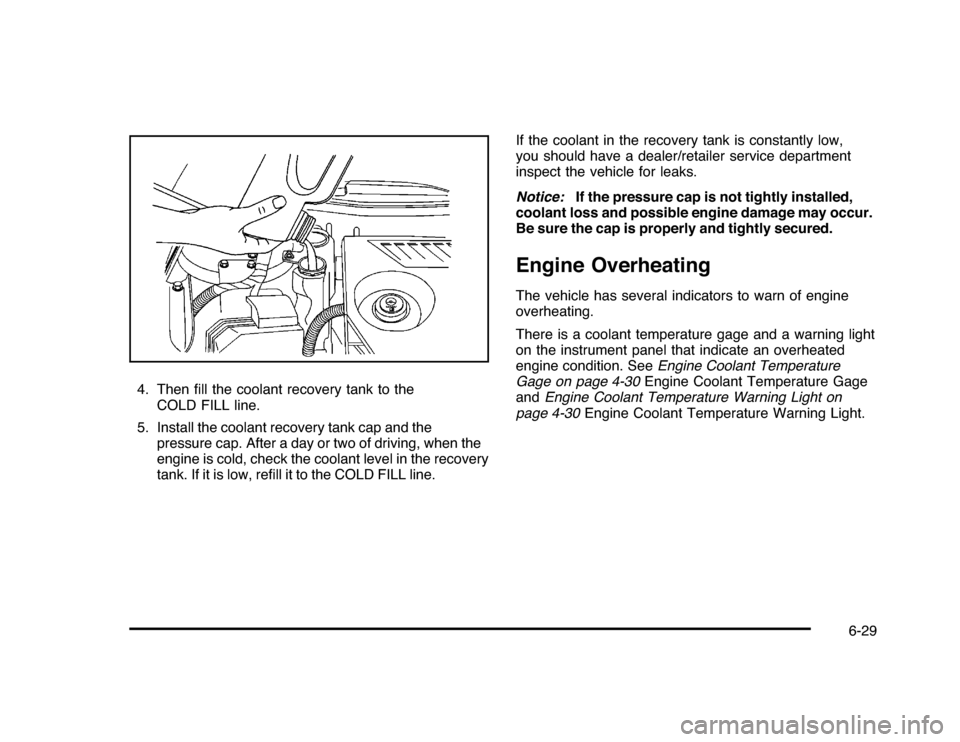
4. Then fill the coolant recovery tank to the
COLD FILL line.
5. Install the coolant recovery tank cap and the
pressure cap. After a day or two of driving, when the
engine is cold, check the coolant level in the recovery
tank. If it is low, refill it to the COLD FILL line.If the coolant in the recovery tank is constantly low,
you should have a dealer/retailer service department
inspect the vehicle for leaks.
Notice:If the pressure cap is not tightly installed,
coolant loss and possible engine damage may occur.
Be sure the cap is properly and tightly secured.
Engine OverheatingThe vehicle has several indicators to warn of engine
overheating.
There is a coolant temperature gage and a warning light
on the instrument panel that indicate an overheated
engine condition. SeeEngine Coolant Temperature
Gage on page 4-30Engine Coolant Temperature Gage
andEngine Coolant Temperature Warning Light on
page 4-30Engine Coolant Temperature Warning Light.
6-29
Page 343 of 432
Tire Chains
{
WARNING:
If your vehicle has P225/55R17 or P235/50R18
size tires, do not use tire chains, there is not
enough clearance.
Tire chains used on a vehicle without the proper
amount of clearance can cause damage to the
brakes, suspension, or other vehicle parts. The
area damaged by the tire chains could cause you
to lose control of your vehicle and you or others
may be injured in a crash.
Use another type of traction device only if its
manufacturer recommends it for use on your
vehicle and tire size combination and road
WARNING: (Continued)
WARNING: (Continued)conditions. Follow that manufacturer’s instructions.
To help avoid damage to your vehicle, drive
slowly, readjust, or remove the device if it is
contacting your vehicle, and do not spin your
wheels.
If you do find traction devices that will fit, install
them on the front tires.
Notice:If your vehicle has a tire size other than
P225/55R17 or P235/50R18 size tires, use tire chains
only where legal and only when you must. Use
only SAE Class S-type chains that are the proper
size for your tires. Install them on the front tires and
tighten them as tightly as possible with the ends
securely fastened. Drive slowly and follow the chain
manufacturer’s instructions. If you can hear the
chains contacting your vehicle, stop and retighten
them. If the contact continues, slow down until
it stops. Driving too fast or spinning the wheels with
chains on will damage your vehicle.
6-73
Page 353 of 432
Notice:Wheel covers will not fit on your vehicle’s
compact spare. If you try to put a wheel cover
on the compact spare, the cover or the spare could
be damaged.Storing a Flat or Spare Tire and
Tools
{
WARNING:
Storing a jack, a tire, or other equipment in the
passenger compartment of the vehicle could
cause injury. In a sudden stop or collision, loose
equipment could strike someone. Store all these in
the proper place.After the compact spare tire has been installed on the
vehicle, store the flat tire in the trunk.
When storing a full-size tire, use the extension with the
extension protector, located in the foam holder, to
help avoid wheel surface damage.
To store a full-size tire:
1. Install the tools in their original location in the trunk
area and secure.
2. Place the tire valve stem facing down and the
protector/guide placed through a wheel bolt hole
and threaded onto the bolt screw.
3. Remove the protector and attach the retainer
securely
4. Store the cover as far forward as possible.
When storing a compact spare tire in the trunk, put the
protector back in the foam holder.
The compact spare is for temporary use only. Replace
the compact spare tire with a full-size tire as soon as you
can. SeeCompact Spare Tire on page 6-86. Use this as
a guide for storing the compact spare tire and tools.
6-83
Page 397 of 432

Services Provided•
Emergency Fuel Delivery:Delivery of enough fuel
for the vehicle to get to the nearest service station.
•
Lock-Out Service:Service is provided to unlock the
vehicle if you are locked out. A remote unlock may
be available if you have OnStar
®. For security
reasons, the driver must present identification
before this service is given.
•
Emergency Tow From a Public Road or
Highway:Tow to the nearest Chevrolet dealer for
warranty service, or if the vehicle was in a crash
and cannot be driven. Assistance is also given when
the vehicle is stuck in the sand, mud, or snow.
•
Flat Tire Change:Service is provided to change a
flat tire with the spare tire. The spare tire, if equipped,
must be in good condition and properly inflated.
It is the owner’s responsibility for the repair or
replacement of the tire if it is not covered by the
warranty.
•
Battery Jump Start:Service is provided to jump
start a dead battery.
Services Not Included in Roadside
Assistance•
Impound towing caused by violation of any laws.
•
Legal fines.
•
Mounting, dismounting or changing of snow tires,
chains, or other traction devices.
•
Towing or services for vehicles driven on a
non-public road or highway.
8-9