2010 CHEVROLET IMPALA ECU
[x] Cancel search: ECUPage 97 of 432

{
WARNING:
A child in a rear-facing child restraint can be
seriously injured or killed if the right front passenger
airbag inflates. This is because the back of the
rear-facing child restraint would be very close to the
inflating airbag. A child in a forward-facing child
restraint can be seriously injured or killed if the right
front passenger airbag inflates and the passenger
seat is in a forward position.
Even if the passenger sensing system has turned
off the right front passenger frontal airbag, no
system is fail-safe. No one can guarantee that
an airbag will not deploy under some unusual
circumstance, even though the airbag is turned off.
Secure rear-facing child restraints in a rear
seat, even if the airbag is off. If you secure a
forward-facing child restraint in the right front seat,
always move the front passenger seat as far back
as it will go. It is better to secure the child restraint in
a rear seat.The passenger sensing system is designed to turn off
the right front passenger frontal airbag if:
•
The right front passenger seat is unoccupied.
•
The system determines that an infant is present in
a child restraint.
•
A right front passenger takes his/her weight off of
the seat for a period of time.
•
Or, if there is a critical problem with the airbag
system or the passenger sensing system.
When the passenger sensing system has turned off the
right front passenger frontal airbag, the off indicator
will light and stay lit to remind you that the airbag is off.
SeePassenger Airbag Status Indicator on page 4-25.
2-67
Page 99 of 432

If the On Indicator is Lit for a Child
RestraintIf a child restraint has been installed and the on
indicator is lit:
1. Turn the vehicle off.
2. Remove the child restraint from the vehicle.
3. Remove any additional items from the seat such as
blankets, cushions, seat covers, seat heaters, or
seat massagers.
4. Reinstall the child restraint following the directions
provided by the child restraint manufacturer and
refer toSecuring a Child Restraint in the Right Front
Seat Position on page 2-52.5. If, after reinstalling the child restraint and restarting
the vehicle, the on indicator is still lit, turn the
vehicle off. Then slightly recline the vehicle seatback
and adjust the seat cushion, if adjustable, to
make sure that the vehicle seatback is not pushing
the child restraint into the seat cushion.
Also make sure the child restraint is not trapped
under the vehicle head restraint. If this happens,
adjust the head restraint. SeeHead Restraints
on page 2-2.
6. Restart the vehicle.
The passenger sensing system may or may not turn off
the airbag for a child in a child restraint depending
upon the child’s seating posture and body build. It is
better to secure the child restraint in a rear seat.
2-69
Page 103 of 432
Adding Equipment to Your
Airbag-Equipped VehicleQ:
Is there anything I might add to or change
about the vehicle that could keep the airbags
from working properly?
A:
Yes. If you add things that change the vehicle’s
frame, bumper system, height, front end or side
sheet metal, they may keep the airbag system from
working properly. Changing or moving any parts
of the front seats, safety belts, the airbag sensing
and diagnostic module, steering wheel, instrument
panel, roof-rail airbag modules, ceiling headliner
or pillar garnish trim, front sensors, side impact
sensors, or airbag wiring can affect the operation of
the airbag system.
In addition, the vehicle has a passenger sensing
system for the right front passenger position, which
includes sensors that are part of the passenger’s
seat. The passenger sensing system may not
operate properly if the original seat trim is replaced
with non-GM covers, upholstery or trim, or with
GM covers, upholstery or trim designed for a
different vehicle. Any object, such as an aftermarket
seat heater or a comfort enhancing pad or device,
installed under or on top of the seat fabric,could also interfere with the operation of the
passenger sensing system. This could either
prevent proper deployment of the passenger
airbag(s) or prevent the passenger sensing system
from properly turning off the passenger airbag(s).
SeePassenger Sensing System on page 2-66.
If you have any questions, call Customer
Assistance. The phone numbers and addresses
for Customer Assistance are in Step Two of
the Customer Satisfaction Procedure in this manual.
SeeCustomer Satisfaction Procedure on page 8-2.
Q:
Because I have a disability, I have to get
my vehicle modified. How can I find out whether
this will affect my airbag system?
A:
If you have questions, call Customer Assistance.
The phone numbers and addresses for Customer
Assistance are in Step Two of the Customer
Satisfaction Procedure in this manual. See
Customer Satisfaction Procedure on page 8-2.
In addition, your dealer/retailer and the service manual
have information about the location of the airbag
sensors, sensing and diagnostic module and airbag
wiring.
2-73
Page 107 of 432

Keys...............................................................3-3
Remote Keyless Entry (RKE) System................3-4
Remote Keyless Entry (RKE) System
Operation . . .................................................3-4
Remote Vehicle Start......................................3-7
Doors and Locks.............................................3-9
Door Locks....................................................3-9
Power Door Locks........................................3-10
Delayed Locking...........................................3-10
Automatic Door Lock.....................................3-10
Programmable Automatic Door Unlock.............3-11
Rear Door Security Locks..............................3-11
Lockout Protection........................................3-12
Trunk . . . . . . ....................................................3-12
Windows........................................................3-14
Power Windows............................................3-15
Sun Visors...................................................3-16
Theft-Deterrent Systems..................................3-16
Content Theft-Deterrent.................................3-17
PASS-Key
®
III+ Electronic Immobilizer.............3-18
PASS-Key
®
III+ Electronic Immobilizer
Operation . . ...............................................3-18Starting and Operating Your Vehicle................3-19
New Vehicle Break-In....................................3-19
Ignition Positions..........................................3-20
Retained Accessory Power (RAP)...................3-21
Starting the Engine.......................................3-21
Engine Coolant Heater ..................................3-23
Automatic Transmission Operation...................3-24
Parking Brake..............................................3-27
Shifting Into Park..........................................3-28
Shifting Out of Park......................................3-29
Parking Over Things That Burn.......................3-30
Engine Exhaust............................................3-31
Running the Vehicle While Parked..................3-32
Mirrors...........................................................3-33
Manual Rearview Mirror.................................3-33
Automatic Dimming Rearview Mirror................3-33
Outside Power Mirrors . . .................................3-34
Outside Convex Mirror . . .................................3-34
Outside Heated Mirrors ..................................3-34
Universal Home Remote System......................3-35
Universal Home Remote System Operation
(With Three Round LED)............................3-35
Section 3 Features and Controls
3-1
Page 117 of 432
Programmable Automatic Door
UnlockThe vehicle is programmed so that when the shift lever
is moved into P (Park) all doors will unlock.
With the vehicle stopped and the engine running, door
unlocking can be programmed through prompts displayed
on the Driver Information Center (DIC). These prompts
allow the driver to choose various unlock settings. For
programming information, seeDIC Vehicle Customization
on page 4-51.Rear Door Security LocksRear door security locks prevent passengers from
opening the rear doors from the inside.
The rear door security locks are located on the inside
edge of each rear door. The rear doors must be opened
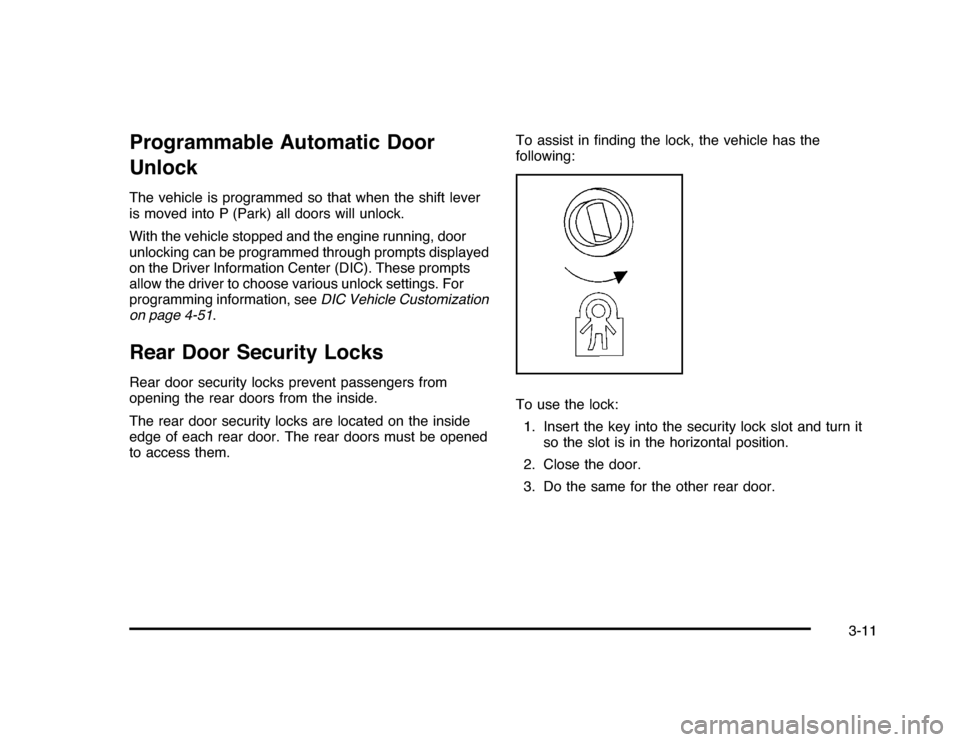
to access them.To assist in finding the lock, the vehicle has the
following:
To use the lock:
1. Insert the key into the security lock slot and turn it
so the slot is in the horizontal position.
2. Close the door.
3. Do the same for the other rear door.
3-11
Page 118 of 432

To open a rear door when the security lock is on, do the
following:
1. Unlock the door using the Remote Keyless Entry
(RKE) transmitter, if the vehicle has one, the
power door lock switch, or by lifting the rear door
manual lock.
2. Open the door from the outside.
To cancel the rear door security lock:
1. Unlock the door and open it from the outside.
2. Insert the key into the security lock slot and turn it
so the slot is in the vertical position.
3. Do the same for the other rear door.Lockout ProtectionThis feature helps prevent you from locking the doors
while the key is in the ignition. Always remember to take
your key with you when exiting the vehicle.
If the lock switch is pressed on the door that is open
and the key is in the ignition, all of the doors will
lock and then the open door will unlock. A chime sounds
continuously until the driver door is closed.
Trunk
{
WARNING:
Exhaust gases can enter the vehicle if it is driven
with the liftgate, trunk/hatch open, or with any
objects that pass through the seal between the
body and the trunk/hatch or liftgate. Engine
exhaust contains Carbon Monoxide (CO) which
cannot be seen or smelled. It can cause
unconsciousness and even death.
If the vehicle must be driven with the liftgate, or
trunk/hatch open:
•
Close all of the windows.
•
Fully open the air outlets on or under the
instrument panel.
•
Adjust the Climate Control system to a setting
that brings in only outside air and set the fan
speed to the highest setting. See Climate
Control System in the Index.
•
If the vehicle is equipped with a power liftgate,
disable the power liftgate function.
For more information about carbon monoxide, see
Engine Exhaust on page 3-31.
3-12
Page 119 of 432

Trunk ReleaseTo open the trunk from the outside, press the trunk
release button on the RKE transmitter, if equipped.Remote Trunk Release
G
(Remote Trunk Release):Press the button
located next to the exterior lamps control on the left side
of the instrument panel to open the trunk. The shift
lever must be in P (Park).
The trunk can also be opened by lowering the rear seat
and pulling the emergency trunk release handle located
inside the trunk. SeeSplit Folding Rear Seat on
page 2-10and “Emergency Trunk Release Handle”
following.
Emergency Trunk Release HandleNotice:Do not use the emergency trunk release
handle as a tie-down or anchor point when securing
items in the trunk as it could damage the handle.
The emergency trunk release handle is only
intended to aid a person trapped in a latched trunk,
enabling them to open the trunk from the inside.There is a glow-in-the-dark trunk release handle located
on the latch inside the trunk. This handle will glow
following exposure to light. Pull the release handle to
open the trunk from the inside.
3-13
Page 124 of 432

PASS-Key
®
III+ Electronic
Immobilizer
SeeRadio Frequency Statement on page 8-20for
information regarding Part 15 of the Federal
Communications Commission (FCC) Rules and
RSS-210/211 of Industry and Science Canada.PASS-Key
®
III+ Electronic
Immobilizer Operation
Your vehicle has PASS-Key
®III+ (Personalized
Automotive Security System) theft-deterrent system.
PASS-Key
®III+ is a passive theft-deterrent system.
The system is automatically armed when the key
is removed from the ignition.
The system is automatically disarmed when the key is
turned to ON/RUN, ACC/ACCESSORY or START
from the LOCK/OFF position.
You do not have to manually arm or disarm the system.
The security light will come on if there is a problem
with arming or disarming the theft-deterrent system.When the PASS-Key
®III+ system senses that someone
is using the wrong key, it prevents the vehicle from
starting. Anyone using a trial-and-error method to start
the vehicle will be discouraged because of the high
number of electrical key codes.
If the engine does not start and the security light on the
instrument panel cluster comes on when trying to
start the vehicle, there may be a problem with your
theft-deterrent system. Turn the ignition off and try again.
If the engine still does not start, and the key appears
to be undamaged, try another ignition key. At this time,
you may also want to check the fuse, seeFuses
and Circuit Breakers on page 6-96. If the engine still
does not start with the other key, your vehicle needs
service. If your vehicle does start, the first key may be
faulty. See your dealer/retailer who can service the
PASS-Key
®III+ to have a new key made. In an
emergency, contact Roadside Assistance.
It is possible for the PASS-Key
®III+ decoder to learn
the transponder value of a new or replacement key.
Up to 10 keys may be programmed for the vehicle.
The following procedure is for programming additional
keys only. If all the currently programmed keys are
lost or do not operate, you must see your dealer/retailer
or a locksmith who can service PASS-Key
®III+ to
have keys made and programmed to the system.
3-18