Page 419 of 616

{WARNING:
Snow can trap engine exhaust under the vehicle.
This may cause exhaust gases to get inside.
Engine exhaust contains carbon monoxide (CO)
which cannot be seen or smelled. It can cause
unconsciousness and even death.
If the vehicle is stuck in the snow:
.Clear away snow from around the base of
your vehicle, especially any that is blocking
the exhaust pipe.
.Check again from time to time to be sure
snow does not collect there.
.Open a window about 5 cm (two inches) on
the side of the vehicle that is away from the
wind to bring in fresh air.
.Fully open the air outlets on or under the
instrument panel.
.Adjust the Climate Control system to a setting
that circulates the air inside the vehicle and
set the fan speed to the highest setting.
See Climate Control System in the Index.
(Continued)
WARNING: (Continued)
For more information about carbon monoxide, see
Engine Exhaust on page 3!41.
Snow can trap exhaust gases under your vehicle.
This can cause deadly CO (carbon monoxide) gas
to get inside. CO could overcome you and kill you.
You cannot see it or smell it, so you might not
know it is in your vehicle. Clear away snow from
around the base of your vehicle, especially any
that is blocking the exhaust.
Run the engine for short periods only as needed tokeep warm, but be careful.
To save fuel, run the engine for only short periods asneeded to warm the vehicle and then shut the engineoff and close the window most of the way to save heat.Repeat this until help arrives but only when you feelreally uncomfortable from the cold. Moving about tokeep warm also helps.
If it takes some time for help to arrive, now and thenwhen you run the engine, push the accelerator pedalslightly so the engine runs faster than the idle speed.This keeps the battery charged to restart the vehicleand to signal for help with the headlamps. Do this aslittle as possible to save fuel.
6-29
Page 422 of 616

Loading the Vehicle
It is very important to know how much weight your
vehicle can carry. This weight is called the vehicle
capacity weight and includes the weight of all
occupants, cargo, and all nonfactory-installed
options. Two labels on your vehicle show how
much weight it was designed to carry, the
Tire and Loading Information label and the
Certification/Tire label.
{WARNING:
Do not load the vehicle any heavier than
the Gross Vehicle Weight Rating (GVWR),
or either the maximum front or rear Gross
Axle Weight Rating (GAWR). If you do, parts
on the vehicle can break, and it can change
the way the vehicle handles. These could
cause you to lose control and crash.
Also, overloading can shorten the life
of the vehicle.
Tire and Loading Information Label
Label Example
A vehicle specific Tire and Loading Information
label is attached to the center pillar (B-pillar).
With the driver's door open, you will find the
label attached below the door lock post (striker).
The tire and loading information label shows the
number of occupant seating positions (A), and
the maximum vehicle capacity weight (B) in
kilograms and pounds.
6-32
Page 428 of 616

The system is activated when the ignition key
is turned to RUN and will automatically adjust
vehicle height thereafter. The system may exhaust
(lower vehicle height) for up to 10 minutes after
the ignition key has been turned to LOCK. You
may hear the air compressor operating when the
height is being adjusted.
If a weight-distributing hitch is being used, it is
recommended to allow the shocks to inflate,
thereby leveling the vehicle prior to adjusting the
height. See“Weight distributing Hitches and
Weight Carrying Hitches”underTowing a Trailer
on page 6!42.
Towing
Towing Your Vehicle
To avoid damage, the disabled vehicle should betowed with all four wheels off the ground. Consult yourdealer/retailer or a professional towing service if thedisabled vehicle must be towed. SeeRoadside Serviceo n p a g e 9!8.
To tow the vehicle behind another vehicle forrecreational purposes (such as behind a motorhome),see“Recreational Vehicle Towing”following.
Recreational Vehicle Towing
If the vehicle has a two–mode hybrid engine, see theTwo–mode Hybrid manual for more information.
Recreational vehicle towing means towing the vehiclebehind another vehicle–such as behind a motorhome.The two most common types of recreational vehicletowing are known as“dinghy towing”(towing the vehiclewith all four wheels on the ground) and“dolly towing”(towing the vehicle with two wheels on the ground andtwo wheels up on a device known as a“dolly”).
Here are some important things to consider beforerecreational vehicle towing:
.What is the towing capacity of the towing vehicle?Be sure to read the tow vehicle manufacturer'srecommendations.
.What is the distance that will be travelled? Somevehicles have restrictions on how far and how longthey can tow.
.Is the proper towing equipment going to be used?See your dealer/retailer or trailering professionalfor additional advice and equipmentrecommendations.
.Is the vehicle ready to be towed? Just as preparingthe vehicle for a long trip, make sure the vehicle isprepared to be towed. SeeBefore Leaving on aLong Trip on page 6!26.
6-38
Page 431 of 616
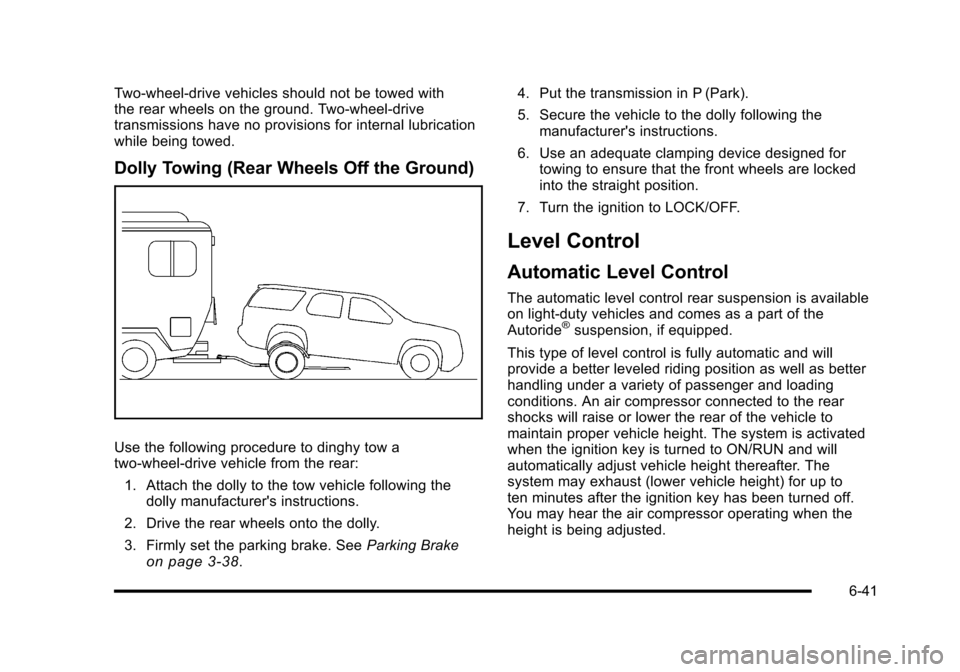
Two-wheel-drive vehicles should not be towed withthe rear wheels on the ground. Two-wheel-drivetransmissions have no provisions for internal lubricationwhile being towed.
Dolly Towing (Rear Wheels Off the Ground)
Use the following procedure to dinghy tow atwo-wheel-drive vehicle from the rear:
1. Attach the dolly to the tow vehicle following thedolly manufacturer's instructions.
2. Drive the rear wheels onto the dolly.
3. Firmly set the parking brake. SeeParking Brakeon page 3!38.
4. Put the transmission in P (Park).
5. Secure the vehicle to the dolly following themanufacturer's instructions.
6. Use an adequate clamping device designed fortowing to ensure that the front wheels are lockedinto the straight position.
7. Turn the ignition to LOCK/OFF.
Level Control
Automatic Level Control
The automatic level control rear suspension is availableon light!duty vehicles and comes as a part of theAutoride®suspension, if equipped.
This type of level control is fully automatic and willprovide a better leveled riding position as well as betterhandling under a variety of passenger and loadingconditions. An air compressor connected to the rearshocks will raise or lower the rear of the vehicle tomaintain proper vehicle height. The system is activatedwhen the ignition key is turned to ON/RUN and willautomatically adjust vehicle height thereafter. Thesystem may exhaust (lower vehicle height) for up toten minutes after the ignition key has been turned off.You may hear the air compressor operating when theheight is being adjusted.
6-41
Page 437 of 616
Weight!Distributing Hitch Adjustment
A:Body to Ground Distance
B:Front of Vehicle
When using a weight-distributing hitch, the spring barsshould be adjusted so the distance (A) is the sameafter coupling the trailer to the tow vehicle and adjustingthe hitch.
Hitch Cover
The vehicle may have a hitch cover. To remove thehitch cover:
1. Turn the fasteners on the lower tabs 90 degreescounterclockwise.
2. Lift the lower edge of the cover about 45 degrees.
3. Pull the cover downward to disengage the upperattachments.
6-47
Page 438 of 616

To reinstall the hitch cover:
1. Hold the cover at a 45 degree angle to the vehicleand push the upper tabs in the hitch cover into thechrome slots in the fascia.
2. Move the bottom of the cover forward until thelower tabs line up with the lower fascia slots.
3. Snap the hitch cover into place by pushing theupper corners forward.
4. Turn the fasteners on the lower tabs 90 degreesclockwise to lock the cover in place.
Safety Chains
Always attach chains between the vehicle and thetrailer. Cross the safety chains under the tongue of thetrailer to help prevent the tongue from contacting theroad if it becomes separated from the hitch. Instructionsabout safety chains may be provided by the hitchmanufacturer or by the trailer manufacturer. If the trailerbeing towed weighs up to 5,000 lbs (2 271 kg) with afactory-installed step bumper, safety chains may beattached to the attaching points on the bumper,otherwise, safety chains should be attached to holes onthe trailer hitch platform. Always leave just enoughslack so the combination can turn. Never allow safetychains to drag on the ground.
6-48
Page 449 of 616
Section 7 Service and Appearance Care
Electrical System. . . . . . . . . . . . . . . . . . . . . . . . . . . . . . . . 7-108Add-On Electrical Equipment . . . . . . . . . . . . . . . . . 7-108Windshield Wiper Fuses . . . . . . . . . . . . . . . . . . . . . . 7-108Power Windows and Other Power Options . . . 7-108Fuses and Circuit Breakers . . . . . . . . . . . . . . . . . . . 7-108
Instrument Panel Fuse Block . . . . . . . . . . . . . . . . . 7-109Center Instrument Panel Fuse Block . . . . . . . . . . 7-110Underhood Fuse Block . . . . . . . . . . . . . . . . . . . . . . . 7-111
Capacities and Specifications. . . . . . . . . . . . . . . . . . 7-115
7-3
Page 450 of 616
Service
For service and parts needs, visit your dealer/retailer.You will receive genuine GM parts and GM-trained andsupported service people.
Genuine GM parts have one of these marks:
Accessories and Modifications
When non!dealer/non!retailer accessories are added tothe vehicle, they can affect vehicle performance andsafety, including such things as airbags, braking,stability, ride and handling, emissions systems,aerodynamics, durability, and electronic systems likeantilock brakes, traction control, and stability control.Some of these accessories could even causemalfunction or damage not covered by the vehiclewarranty.
Damage to vehicle components resulting from theinstallation or use of non!GM certified parts, includingcontrol module modifications, is not covered under theterms of the vehicle warranty and may affect remainingwarranty coverage for affected parts.
7-4


