2010 CADILLAC ESCALADE ESV wheel
[x] Cancel search: wheelPage 24 of 620

Black plate (18,1)Cadillac Escalade/Escalade ESV Owner Manual - 2010
Bluetooth ®
For vehicles with an in-vehicle Bluetooth system, it
allows users with a Bluetooth enabled cell phone to
make and receive hands-free calls using the vehicle ’ s
audio system and controls.
The Bluetooth enabled cell phone must be paired with
the in-vehicle Bluetooth system before it can be used in
the vehicle. Not all phones will support all functions. For
more information visit www.gm.com/bluetooth.
For more information, see Bluetooth ®
on page 4 ‑ 68 .
Navigation System The vehicle's navigation system provides detailed maps
of most major freeways and roads throughout the
United States and Canada. After a destination has been
set, the system provides turn-by-turn instructions for
reaching the destination. In addition, the system can
help locate a variety of points of interest (POI), such as
banks, airports, restaurants, and more.
See Navigation System in the owner's manual for more
information. Driver Information Center (DIC) The DIC display is located at the bottom of the
instrument panel cluster. It shows the status of many
vehicle systems and enables access to the
personalization menu.
The DIC buttons are
located on the instrument
panel, next to the steering
wheel.
3 (Trip/Fuel): Press this button to display the
odometer, trip odometer, fuel range, average economy,
fuel used, timer, and transmission temperature. The
compass and outside air temperature will also be shown
in the display. The temperature will be shown in °F or
°C depending on the units selected.
1-18
Page 25 of 620

Black plate (19,1)Cadillac Escalade/Escalade ESV Owner Manual - 2010
T (Vehicle Information): Press this button to display
the oil life, units, side blind zone system on/off, tire
pressure readings for vehicles with the Tire Pressure
Monitor System (TPMS), Remote Keyless Entry (RKE)
transmitter programming, compass zone setting, and
compass recalibration.
U (Customization): Press this button to customize the
feature settings on your vehicle. See DIC Vehicle
Customization
on page 4 ‑ 58 for more information.
V (Set/Reset) : Press this button to set or reset certain
functions and to turn off or acknowledge messages on
the DIC.
For more information, see Driver Information Center
(DIC) on page 4 ‑ 41 . Vehicle Customization Some vehicle features can be programmed by using the
DIC buttons next to the steering wheel. These features
include: .
Language .
Door Lock and Unlock Settings .
RKE Lock and Unlock Feedback .
Lighting .
Chime Volume .
Memory Features .
Remote Start .
Digital Speedometer Display
See DIC Vehicle Customization on page 4 ‑ 58 .
1-19
Page 26 of 620

Black plate (20,1)Cadillac Escalade/Escalade ESV Owner Manual - 2010
Cruise Control
Cruise Control shown with
Heated Steering Wheel
Button (If Equipped)
The cruise control buttons are located on left side of the
steering wheel.
T : Turns the system on or off. The indicator light is
on when cruise control is on and turns off when cruise
control is off.
+ RES : Press to make the vehicle accelerate or
resume a previously set speed. SET − : Press to set the speed or make the vehicle
decelerate.
[ : Press to cancel cruise control without erasing the
set speed from memory.
See Cruise Control on page 4 ‑ 8 .
Side Blind Zone Alert (SBZA) This feature may alert you to vehicles located in your
side blind zone. When the system detects a vehicle in
the side blind zone, an amber SBZA display will light up
in the corresponding outside side mirror.
The system is enabled at every vehicle startup. It can
be disabled through the Driver Information Center (DIC).
If the message SIDE BLIND ZONE SYSTEM
UNAVAILABLE appears on the DIC, the system has
been disabled because the sensor is blocked and
cannot detect vehicles in the blind zone. The sensor
may be blocked by mud, dirt, snow, ice, slush, or even
heavy rainstorms. This message may also activate
during heavy rain or due to road spray. The vehicle
does not need service.
See Side Blind Zone Alert (SBZA) on page 3 ‑ 48 for
more information.
1-20
Page 28 of 620

Black plate (22,1)Cadillac Escalade/Escalade ESV Owner Manual - 2010
Performance and Maintenance StabiliTrak ®
SystemThe vehicle may have a traction control system that
limits wheel spin and the StabiliTrak system that assists
with directional control of the vehicle in difficult driving
conditions. Both systems turn on automatically every
time the vehicle is started. .
To turn off traction control, press and release
5 on
the instrument panel.
F illuminates and the
appropriate DIC message displays. See DIC
Warnings and Messages on page 4 ‑ 49 ..
To turn off both traction control and Electronic
Stability Control, press and hold
5 until
Filluminates and the appropriate DIC message
displays. See DIC Warnings and Messages on
page 4 ‑ 49
..
Press and release the button again to turn on both
systems.
For more information, see StabiliTrak ®
System on
page 6 ‑ 6
. Tire Pressure Monitor This vehicle may have a Tire Pressure Monitor
System (TPMS).
The TPMS warming light
alerts you to a significant
loss in pressure of one of
the vehicles tires.
If the warning light comes on, stop as soon as possible
and inflate the tires to the recommended pressure
shown on the tire loading information label. See
Loading the Vehicle on page 6 ‑ 32 . The warning light
will remain on until the tire pressure is corrected.
During cooler conditions, the low tire pressure warning
light may appear when the vehicle is first started and
then turn off. This may be an early indicator that the tire
pressures are getting low and the tires need to be
inflated to the proper pressure.
The TPMS does not replace normal monthly tire
maintenance. It is the driver ’ s responsibility to maintain
correct tire pressures.
See Tire Pressure Monitor System on page 7 ‑ 67 and
Tire Pressure Monitor Operation on page 7 ‑ 68 .
1-22
Page 32 of 620

Black plate (26,1)Cadillac Escalade/Escalade ESV Owner Manual - 2010
The OnStar system can record and transmit vehicle
information. This information is automatically sent to an
OnStar call center when
Q is pressed,
] is pressed,
or if the airbags or ACR system deploy. This information
usually includes the vehicle's GPS location and, in the
event of a crash, additional information regarding the
crash that the vehicle was involved in (e.g. the direction
from which the vehicle was hit). When the virtual
advisor feature of OnStar hands-free calling is used, the
vehicle also sends OnStar the vehicle's GPS location
so they can provide services where it is located.
Location information about the vehicle is only available
if the GPS satellite signals are unobstructed and
available.
The vehicle must have a working electrical system,
including adequate battery power, for the OnStar
equipment to operate. There are other problems OnStar
cannot control that may prevent OnStar from providing
OnStar service at any particular time or place. Some
examples are damage to important parts of the vehicle
in a crash, hills, tall buildings, tunnels, weather or
wireless phone network congestion. OnStar Steering Wheel Controls This vehicle may have a Talk/Mute button that can be
used to interact with OnStar hands-free calling. See
Audio Steering Wheel Controls
on page 4 ‑ 106 for more
information.
On some vehicles, the mute button can be used to dial
numbers into voice mail systems, or to dial phone
extensions. See the OnStar Owner's Guide for more
information.
Your Responsibility Increase the volume of the radio if the OnStar advisor
cannot be heard.
If the light next to the OnStar buttons is red, the system
may not be functioning properly. Press
Q and request a
vehicle diagnostic. If the light appears clear (no light is
appearing), your OnStar subscription has expired and
all services have been deactivated. Press
Q to confirm
that the OnStar equipment is active.
1-26
Page 38 of 620

Black plate (6,1)Cadillac Escalade/Escalade ESV Owner Manual - 2010
This symbol will appear on the climate control display to
indicate that the feature is on. Press the button to cycle
through the temperature settings of high, medium, and
low and to turn the cooled seat off. Indicator bars next
to the symbol designate the level of cooling selected:
three for high, two for medium, and one for low.
+ (Heated Seatback): To heat only the seatback,
press the button with the heated seatback symbol.
This symbol will appear on the climate control display to
indicate that the feature is on. Press the button to cycle
through the temperature settings of high, medium, and
low and to turn the heated seatback off. Indicator bars
next to the symbol designate the level of heat selected:
three for high, two for medium, and one for low.
z (Heated Seat and Seatback): To heat the entire
seat, press the button with the heated seat and
seatback symbol.
This symbol will appear on the climate control display to
indicate that the feature is on. Press the button to cycle
through the temperature settings of high, medium, and
low and to turn the heated seat off. Indicator bars next
to the symbol designate the level of heat selected: three
for high, two for medium, and one for low. The heated and cooled seats will be canceled after the
ignition is turned off. If you want to use the heated and
cooled seat feature after you restart your vehicle, you
will need to press the appropriate seat button again.
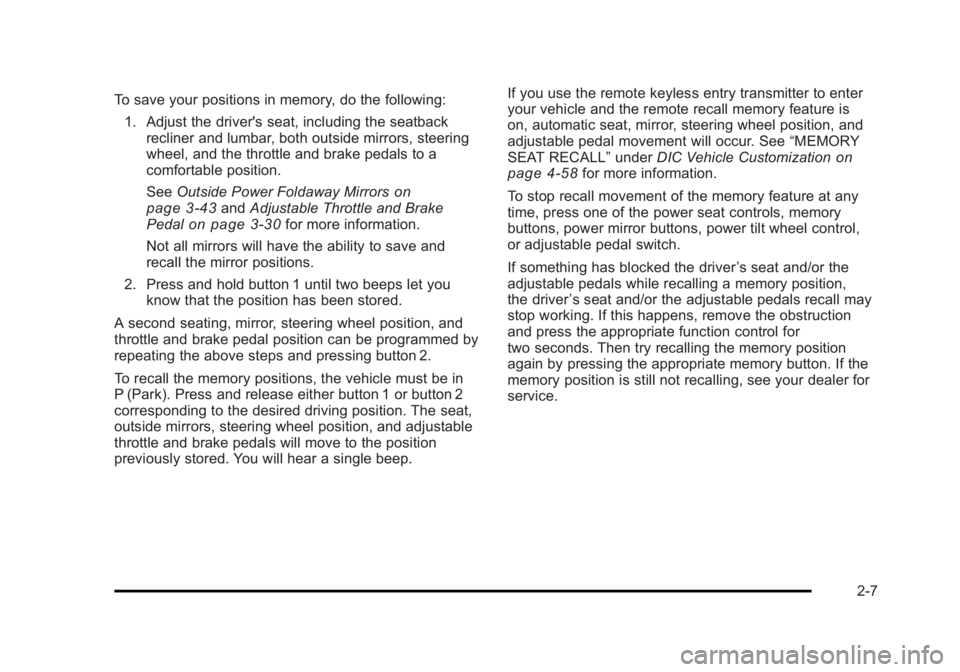
Memory Features Your vehicle has the memory package.
The controls for this
feature are located on
the driver's door, and are
used to program and
recall memory settings for
the driver's seat, outside
mirrors, steering wheel
position, and the
adjustable throttle and
brake pedal feature,
if your vehicle has it.
2-6
Page 39 of 620
Black plate (7,1)Cadillac Escalade/Escalade ESV Owner Manual - 2010
To save your positions in memory, do the following:
1. Adjust the driver's seat, including the seatback
recliner and lumbar, both outside mirrors, steering
wheel, and the throttle and brake pedals to a
comfortable position.
See Outside Power Foldaway Mirrors
on
page 3 ‑ 43 and Adjustable Throttle and Brake
Pedal on page 3 ‑ 30 for more information.
Not all mirrors will have the ability to save and
recall the mirror positions.
2. Press and hold button 1 until two beeps let you
know that the position has been stored.
A second seating, mirror, steering wheel position, and
throttle and brake pedal position can be programmed by
repeating the above steps and pressing button 2.
To recall the memory positions, the vehicle must be in
P (Park). Press and release either button 1 or button 2
corresponding to the desired driving position. The seat,
outside mirrors, steering wheel position, and adjustable
throttle and brake pedals will move to the position
previously stored. You will hear a single beep. If you use the remote keyless entry transmitter to enter
your vehicle and the remote recall memory feature is
on, automatic seat, mirror, steering wheel position, and
adjustable pedal movement will occur. See “ MEMORY
SEAT RECALL ” under DIC Vehicle Customization on
page 4 ‑ 58
for more information.
To stop recall movement of the memory feature at any
time, press one of the power seat controls, memory
buttons, power mirror buttons, power tilt wheel control,
or adjustable pedal switch.
If something has blocked the driver ’ s seat and/or the
adjustable pedals while recalling a memory position,
the driver ’ s seat and/or the adjustable pedals recall may
stop working. If this happens, remove the obstruction
and press the appropriate function control for
two seconds. Then try recalling the memory position
again by pressing the appropriate memory button. If the
memory position is still not recalling, see your dealer for
service.
2-7
Page 56 of 620

Black plate (24,1)Cadillac Escalade/Escalade ESV Owner Manual - 2010
4. Pull the seat down until it latches to the floor. The
seatback cannot be raised if the seat is not latched
to the floor.
5. Pull up on the seatback until it locks into the
upright position.
{ WARNING: If either seatback is not locked, it could move
forward in a sudden stop or crash. That could
cause injury to the person sitting there. Always
push and pull on the seatbacks to be sure they
are locked.
6. Push and pull on the seatback to make sure it is
locked. Removing the Third Row Seat To remove the seat, do the following:
1. Open the liftgate to access the controls for
the seat.
2. Fold the seatback forward using the instructions
listed under “ Folding the Seatbacks ” previously.
The seat cannot be removed unless the seatback
is folded.
3. Unlatch the seat from
the floor by pulling the
carrying handle,
located at the rear of
the seat, rearward.
4. Roll the seat out of the vehicle. There is a track in
the floor to guide the seat wheels out of the
vehicle.
2-24