2010 AUDI S8 flat tire
[x] Cancel search: flat tirePage 324 of 384

-Tires and wheels
PW-------------------
0 Note
• For techn ica l reasons, it is not generally poss ible to use the wheel
rims from other vehicles. This can hold true for whee ls of the same
vehicle type.
• If the spare tire is different from the tires that you have mounted
on your vehicle (for example w inter tires or wide profile tires), then
use the spare tire for a short period of time only and drive with extra
care . Replace the flat tire with the tire match ing the others on your
vehicle as soon as possible.
• If you should put different wheels and tires on your vehicle (e.g.
winter wheels and tires), you must be certain that the wheels and
tires are compatib le with the tir e pressure monito ring system*.
Otherwise the system will register a malfunction and a fault message
w ill be displayed . For more info rmation, contact your Audi dealer .
0 Note
• When install ing new tires, be careful not to damage the valves or
tire pressure monitoring system* sensors.
• Never drive without the valve stem cap. The valves could get
damaged .
• If the sensors must be replaced, then the valve must also be
replaced at the same time.
<£> For the sake of the environment
Dispose of old tires in accordance with the local requirements. •
Uniform tire quality grading
• Tread wear
• Traction AA A B C
• T emperatu re A B C Quality grades can be found where applicable on the tire side wall
between tread sho
ulder and maximum section width =>
page 318,
fig. 256.
Fo r example: Tread wear 200, Traction AA, Temperature A.
All passenger car tires must conform to Federal Safety Requirements
in addition to these grades.
Tread wear
The tread wear grade is a comparative rating based on the wear rate
of the tir e when tested under controlled conditions on a specified
government test course.
For example, a tire graded 150 would wear one and one half (11/2)
times as well on the government course as a tire graded 100.
The relative performance of tires depends upon the actua l conditions
of their use, however, and may depart significantly from the norm
due to variations in driving habits, service practices and differences in
road characte ristics and climate .
Traction
The traction grades, from highest to lowest, are AA, A, Band C. Those
grades represent the tire's ability to stop on wet pavement as
measured under con trolled conditions on specified government test
surfaces of asphalt and concrete . A tire marked C may have poor trac
tion performance =>& .
Temperature
The temperature grades are A (the highest), B, and C, representing
the tire's resistance to the generation of heat and its ability to dissi
pate heat when tested under controlled conditions on a specified
indoor laboratory test wheel.
Susta ined high temperature can cause the materia l of the tire to
degenerate and reduce tire life, and excessive temperature can lead
to sudden tire failure=>& .
The grade C corresponds to a level of performance which all
passenger car tires must meet under the Federal Motor Vehicle
Page 325 of 384

Tires and wheels -________________ f!ffl
Safety Standa rd No. 109 . G rades Ba nd A rep resent higher levels of
p erf or ma nce on t he laborato ry tes t w hee l than t he mini mum
r e q uir ed by law .
& WARNING
The traction grade assigned to this tire is based on straight-ahead
braking traction tests, and does not include acceleration,
cornering, hydroplaning or peak traction characteristics.
& WARNING
The temperature grade for this tire is established for a tire that is
properly inflated and not overloaded. Excessive speed, underinfla
tion, or excessive loading, either separately or in combination, can
cause heat buildup and possible tire failure. •
Winter tires
Winter tir es co n imp rove ve hi cle ha ndlin g on sno w an d
ice. At temp eratur es be low 45 °F (7 °C) w e rec ommen d
ch angin g to wi nte r tires .
In some heavy snow areas, loca l gover nme nts may requ ire t rue
w inter o r "snow" tires, those with very deep ly cut trea d. These tires
sho uld only be used in pairs and be installed on all four wheels . Make
s ur e you pu rc h ase snow ti res t hat a re the same size and const ruction
type as the ot he r tir es o n your veh icle .
If your ve hicle is equ ipped w ith all-whee l drive* , this will improve
tra ction durin g w inte r dr iving, even wi th th e sta ndard ti re s . Ho wever,
we st rongly recomme nd that you a lways equip all four w heels on your
vehicle wi th co rrec tly fitte d win ter tires o r all- season tires, when
w inter road conditions are expected . T hi s also improves the veh icle 's
bra king perfo rma nce and re duces stop ping distances .
S um mer tir es p rovide less gr ip on ice and s now .
Safety first
Wi nter tires (snow tires) m ust always be fitted on all fo ur whee ls .
Compat ible tire press ure monitor ing sensors * must be installe d on
all four w in te r tir es fo r the tire pr essure mo nitoring sys te m * to func
tion pro per ly ~
page 320.
Ask your a uthor iz e d Audi dealer or qualified wor ksho p fo r per mitt ed
winter tire sizes . Use only rad ia l w inte r tires .
W inter tires lose their effectiveness w he n the trea d is wor n down to
a dep th of0 .1 57 inch (4 mm) .
Only drive w ith w inte r tires under w inte r con ditions. S ummer ti res
h and le be tter w he n t here is n o sno w or ic e on t he ro ads and the
temperature is above 45
°F (7 °().
If you have a flat tire, see notes on s pa re w hee l~ page 318 .
Please always re m em ber tha t win ter tires may have a lower speed
rating t han the t ires originally insta lled on yo ur veh icle at t he t ime it
w as manuf act ur ed . P lease see ~
page 320, "Spee d ratin g (le tter
code)" for a listing of the speed rating lette r codes and the maxim um
s peed a t whi ch the tires can b e driven.
T he spe ed rat ing letter code(~
page 309) is on the s ide wall of the
ti re ~
page 318.
& WARNING
Winter tires have maximum speed limit s that may be lower than
your veh icle's maximum speed. Always know the maximum speed
before driving off. Never drive faster than the speed permitted for
your specific winter tires. This will cause damage to the tires
leading to an accident and serious personal injury to you and your
passengers.
& WARNING
Driving faster than the maximum speed for which the winter tires
on your vehicle were designed can cause tire failure including a
blowout and sudden deflation, loss of control, crashes and serious _,,
Vehicle care Technical data
Page 327 of 384

Tires and wheels -_______________________________ f!:f'II
[I) Tips
Where snow cha ins a re mandatory on certain roads, this no rmally
also applies to vehicles with All W heel Dr ive .•
Wheel bolts
Wheel b olts must al ways be tig hten ed to the correct
torque.
Th e design of whee l bo lts is matc hed to the facto ry installed rims. If
different r ims are fitted, the correct wheel bolts wi th t he r igh t lengt h
and correctly s haped bolt heads must be used . Thi s ensures that
w heels are fi tted secure ly and tha t the br ake system f unc tion s
correctly.
I n cert ain circumst ances, yo u may not us e wheel bolts from a
different veh icle -even if it is the same model=>
page 363.
& WARNING
Improperly tightened or maintained wheel bolts can become
loose causing lo ss of control, a collision and serious per sonal
injury .
• Always keep the wheel bolts and the thread s in the wheel hub s
clean so the wheel bolts can turn easily and be properly tightened .
• Never grease or oil the wheel bolts and the threads in the wheel
hubs. They can become loose while d riving if greased or oiled , even
if tightened to the specified torque.
• Only use wheel bolts that belong to the rim being installed.
• Never use different wheels bolts on your vehicle.
• Always maintain the correct tightening torque for the wheel
bolts to reduce the risk of a wheel loss. If the tightening torque of
the wheel bolts is too low , they can loo sen and come out when the
vehicle is moving. If the tightening torque is too high, th e wheel
Safety first
& WARNING (co ntinued )
bolts and threads can be damaged and the wheel can become
loose .
0 Note
The speci fied tor que f or th e wheel bolts is 90 ft lb (1 2 0 Nm) wi th a
tolerance of ± 7,4 ft lb( ± 10 Nm). Torque wheel bolts diagonally.
After ch anging a wheel, the to rque mu st be checked a s so on as
poss ible with a torque w rench -prefe rab ly by an authorized Aud i
dealer or qualified workshop. •
Low aspect ratio tires
Your Audi is fa cto ry -equ ip ped wi th low aspec t ratio tires. These tire s
have been thorough ly tested and been selected specifically for your
mode l for the ir supe rb perfo rmance, roa d fee l an d han dling un der a
var iety of driv ing cond it ions. Ask your author ized Audi dea ler for
more deta ils.
Th e low a spect rat io of these tires is indica ted by a nu meral of
55 or
less
in the tire's size designation. The numeral represents the ratio of
t he t ire's s idewall heigh t in relat io n t o its t re ad wi dth expressed in
percentage. Conventiona l tires have a height/width ratio of 60 or
more .
The performance of low -aspect -ratio tires is particularly sen sitive to
improper inflation pressure. It is therefore important that low
aspect ratio tires are inflated to the specified pressure and that the
inflation pressure is regularly checked and mainta ined. Tire pres
s ure s should be checked at lea st once a month and always before a
long trip =>
page 313, "Checking tire pressure".
What you can do to avoid tire and rim damage
Low aspect ratio ti res can be damaged more easi ly by impact w ith
potholes, curbs, gull ies or ridges on the road, p articular ly if the tire is
underinflated. .,_
Vehicle care Technical data
Page 328 of 384

-~_T_ ir_e_ s_ a_ n_ d_ w_ h_e_ e_ ls _______________________________________________ _
In order to minimize the occurrence of impact damage to the tires of
your vehicle, we recommend that you observe the following precau
tions:
• Always maintain recommended inflation pressures. Check your
tire pressure every 2,000 miles (3 ,000 km) and add air if necessary.
• Drive carefully on roads with potholes, deep gullies or ridges. The
impact from driving through or over such obstacles can damage your
tires. Impact with a curb may also cause damage to your tires.
• After any impact, immediately inspect your tires or have them
inspected by the nearest authorized Audi dealer. Replace a damaged
tire as soon as possible .
• Inspect your tires every 2,000 miles (3,000 km) for damage and
wear . Damage is not always easy to see . Damage can lead to loss of
air and underinflation, which could eventually cause tire failure. If
you believe that a tire may have been damaged, replace the tire as
soon as possible.
• These tires may wear more quickly than others .
• Please also remember that, while these tires deliver responsive
handling, they may ride less comfortably and make more noise than
other choices.
Reduced performance in winter/cold season
conditions
All tires are designed for certain purposes. The low aspect ratio, ultra high performance tires originally installed on your vehicle are
intended for maximum dry and wet road performance and handling.
They are not suitable for cold, snowy or icy weather conditions. If you
drive under those circumstances, you should equip your vehicle with
all-season or winter tires, which offer better traction under those
conditions . We suggest you use the recommended snow or all-season
tires specified for your vehicle, or their equivalent.
Refer to~
page 323 for more detailed information regarding winter
tires. •
Tire pressure monitoring system
Applies to veh icles : wit h Tire p ress ure m onitor ing sy ste m
General notes .. '
Each tire, including the spare (if provided) , should be checked
monthly when cold and inflated to the inflation pressure recom
mended by the vehicle manufacturer on the vehicle placard or tire
inflation pressure label. (If your vehicle has tires of a different size
than the size indicated on the vehicle placard or tire inflation pressure
label, you should determine the proper tire inflation pressure for
those tires.)
As an added safety feature, your vehicle has been equipped with a tire
pressure monitoring system (TPMS) that illuminates a low tire pres
sure telltale when one or more of your tires is significantly under
inflated . Accordingly, when the low tire pressure telltale illuminates,
you should stop and check your tires as soon as possible, and inflate
them to the proper pressure. Driving on a significantly under-inflated
tire causes the tire to overheat and can lead to tire failure . Under
inflation also reduces fuel efficiency and tire tread life, and may
affect the vehicle's handling and stopping ability.
Please note that the TPMS is not a substitute for proper tire mainte
nance, and it is the driver's responsibility to maintain correct tire
pressure, even if under-inflation has not reached the level to trigger
illumination of the TPMS low tire pressure telltale.
Your vehicle has also been equipped with a TPMS malfunction indi
cator to indicate when the system is not operating properly. The
TPMS malfunction indicator is combined with the low tire pressure
telltale. When the system detects a malfunction, the telltale will
flash for approximately one minute and then remain continuously illuminated. This sequence will continue upon subsequent vehicle
start-ups as long as the malfunction exists .
When the malfunction indicator is illuminated, the system may not
be able to detect or signal low tire pressure as intended. TPMS
malfunctions may occur for a variety of reasons, including the instal-..,_
Page 329 of 384

________________________________________________ T_i_re _ s_ a _ n_d_ w_ h_ e_ e_l_s __ __
lation of replacement or alternate tires or wheels on the vehicle that
prevent the TPMS from functioning properly. Always check the TPMS
malfunction telltale after replacing one or more tires or wheels on
your vehicle to ensure that the replacement or alternate tires and
wheels allow the TPMS to continue to function properly .•
App lies to veh icles: with Tire pressure monitoring syste m
Introduction
The tire pressure monitoring system monitors air pres
sure in all four road wheels and the spare tire* while the
vehicle is moving.
As soon as the tire pressure monitoring system senses a significant
loss of air pressure in one or several tires, text messages and yellow
symbols appear in the instrument cluster display to alert the driver.
The
1warning light in the instrument cluster comes on when the tire
is significantly underinflated
=> page 17.
The warning light
L also illuminates in the case of a system malfunc
tion.
The system continuously receives radio signals from sensors located
inside each tire.
Be aware that tire pressure is also dependent on the temperature of
the tire. For every 18 °F (10 °C) increase in tire temperature, tire pres
sure increases by about 1.5 psi (0.1 bar). The tire warms up while the
vehicle is moving and tire pressure rises. So you should adjust tire
pressure only when the tires are
cold, when the temperature of the
tires is roughly the same as the ambient air temperature.
In order to keep the tire pressure monitoring system properly cali
brated, tire pressure on all four tires and on the spare tire* should be
checked at regular intervals, adjusted if necessary and saved in the
proper setting (recommended pressure)=>
page 330.
The tire pressure is shown on the tire pressure label. On USA vehicles,
the tire pressure label is located on the driver's side B-pillar. On
Canada vehicles, the tire pressure label is located either on the
Safety first
driver's side B-pillar or inside the fuel filler flap. The tire pressure
label lists the recommended cold tire inflation pressures for the
vehicle at its maximum capacity weight and the tires that were on
your vehicle at the time it was manufactured. For recommended tire
pressures for normal load conditions, please see chapter
=> page 310.
The current temperatures and pressure of your tires can be viewed in
the MMI
=> page 329.
& WARNING
• When the tire pressure monitoring system warning light is lit,
one or more of your tires is significantly under-inflated. You
should stop and check your tires as soon as possible, and inflate
them to the proper pressure as indicated on the vehicle's tire pres sure label =>
page 310. Driving on a significantly under-inflated
tire causes the tire to overheat and can lead to tire failure. Under
inflation also is likely to impair the vehicle's handling and stop
ping ability.
• Do not adjust tire pressure when tire temperature is excessive.
This could lead to serious tire damage and even cause the tire to
burst, with the additional danger of an accident.
<£> For the sake of the environment
Driving with under-inflated tires reduces fuel efficiency and tire tread
life.
(I) Tips
• Each tire, including the spare*, should be checked monthly when
cold and set to the recommended inflation pressure as specified on
the tire pressure label=>
page 310.
• The tire pressure monitoring system helps the driver to keep an
eye on tire pressures. But the driver still has the responsibility for
maintaining the correct tire pressure. .,,,
Vehicle care Technical data
Page 330 of 384
___ T_ i_ r _e _s_ a_n_ d_ w_ h_ e_e_ l_ s _______________________________________________ _
• Tire pressure must only be adjusted when the temperature of the
tires is about the same as ambient air temperature .
• When tires are replaced, the sensors and valves should not be
detached or exchanged . Only the valve core needs to be replaced and,
if necessary, the valve and the wheel electronics replaced .
• The tire pressure monitoring system on your Audi was calibrated
usiing tires with the "AO" or "RO" identification. We recommend
using these tires.
• If you should put different wheels and tires on your vehicle (e.g.
winter wheels and tires), you must be certain that the wheels and
tires are compatible with the tire pressure monitoring system. Other
wise the system will register a malfunction and a fault message will be displayed. For more information, contact your authorized Audi
dealer.
• Adjust the tire pressure and store the pressure in the tire pressure
monitoring system to the load you are carrying=:>
page 310.
• For Declaration of Compliance to United States FCC and Industry
Canada regulations =:>
page 364. •
Applies to veh icles: with Tire pressure monitoring system
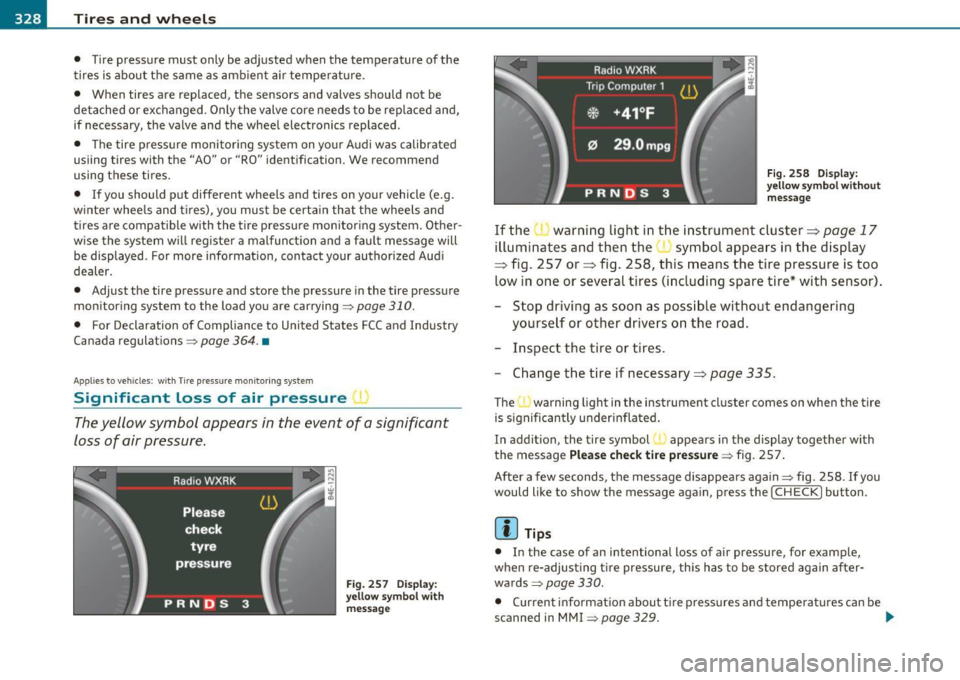
Significant loss of air p ressure I
The yellow symbol appears in the event of a significant
loss of air pressure.
Fig. 257 Display:
yellow symbol with
message Fig.
258 Display:
yellow symbol without
message
If the warning light in the instrument cluster=> page 17
illuminates and then the symbol appears in the display
=:> fig. 257 or=> fig. 258, this means the tire pressure is too
low in one or several tires (including spare tire* with sensor).
- Stop driving as soon as possible without endangering
yourself or other drivers on the road.
- Inspect the tire or tires.
- Change the tire if necessary=>
page 335.
The"' warning light in the instrument cluster comes on when the tire
is significantly underinflated.
In addition, the tire symbol { appears in the display together with
the message
Please check tire pressure=:> fig. 25 7.
After a few seconds, the message disappears again=:> fig. 258 . If you
would like to show the message again, press the
I CHECK] button.
[ i] Tips
• In the case of an intentional loss of air pressure, for example,
when re-adjusting tire pressure, this has to be stored again after
wards:::::,
page 330.
• Current information about tire pressures and temperatures can be
scanned in MMI
=:> page 329. .,,.
Page 332 of 384

-~_T_ i_ re _ s_ a_n _ d_ w_ h _e_ e_ ls _________________________________________________ _
• The tire pressure monitoring system helps the driver to keep an
eye on tire pressures. B ut the driver still has the responsibility for
maintaining the correct tire pressure .•
A pplie s to v ehi cle s: w ith Tire pre ssure moni toring syst em
Storing tire pressures
Correct storage of specified pressure is the basic require
ment for reliable tire pressure monitoring.
In order for the tire pressure monitoring system to operate
appropriately, you have to re-save the specified pressures
whenever you adjust tire pressure, for example when the load
condition of your vehicle changes . Proceed as follows:
Corr ecting tir e pr essure
- Check the pressure in the tires (including the spare t ire*) .
- Adjust air pressure as needed in accordance with t he infor -
mation on the label located e ither on the driver's side B
pillar (visible when the door is open), inside the fuel filler
flap and additionally in the manual.
Saving tire p ressures
- Turn on the ignition.
- Press the [
CAR] function button .
- Select
Systems in the CAR menu .
- Select
Tire pressure mon itoring .
-Select Sto re curr. tire pressure s~ page 329, fig . 259 .
All pressure warning indicators in the display will be canceled.
Following each intentional change in specified pressures, tire pres
sures must be resaved . After the
pressures are saved, the tire pressure monitoring system
measures the c urrent tire pressures and saves them as the new spec
ified pressures .
(I] Tips
• The tire pressure is shown on the tire pressure label. On USA vehi
cles, the tire pressure label is located on the driver's side B-pillar. On
Canada veh icles, the tire pressure label is located either on the
driver's side B-pillar or inside the fuel filler flap . The tire pressure
label lists the recommended cold t ire inflation pressures for the
vehicle at its maximum capacity weight and the tires that were on
your vehicle at the time it was manufactured. For recommended tire
pressures for normal load conditions, please see chapter
=> page 310.
• The tire pressure monitoring system helps the driver to keep an
eye on tire p ressures. But the driver still has the responsib ility for
maintaining the correct tire pressure .
• If your veh icle is eq uipped w ith a standard spare ti re*, it must be
inflated to the maximum pressure specified for the vehicle .•
A pp lies to vehicles: with T ire pressu re monitor ing system
Changing a wheel
When you change a wheel, the new tire must be initial
ized.
Turn on the ignit ion .
- Press the
I CAR I function but ton .
- Select
Systems in the CAR menu.
- Select
Tire pre ssure mon itoring .
-Select Initialize wheels~ page 329, fig. 259 .
Programming is necessary:
Page 335 of 384
![AUDI S8 2010 Owners Manual What do I do now? -_______________ __.EWII
(]] Tips
If you no longer have your or iginal warn ing triangle and need to equip
your vehicle with a new one, contact your authori](/manual-img/6/57617/w960_57617-334.png "AUDI S8 2010 Owners Manual What do I do now? -_______________ __.EWII
(]] Tips
If you no longer have your or iginal warn ing triangle and need to equip
your vehicle with a new one, contact your authori")
What do I do now? -_______________ __.EWII
(]] Tips
If you no longer have your or iginal warn ing triangle and need to equip
your vehicle with a new one, contact your authorized Aud i dealer for
a rep lacement. •
Jack, tools and spare wheel
Jack
The jack is stored underneath the floor panel in the
luggage compartment.
Fig. 26 5 Luggag e
c ompart ment vehicl e
jack
Be fore stori ng the jack, ma ke sure it is wound back down as far as it
w ill go .
& WARNING
Improper use of the vehicle jack can cause serious personal inju
ries.
• Never use the jack suppl ied with your Audi on another vehicle ,
particularly on a heavier one . The jack is only suitable for use on
the vehicle it came with .
Vehicle OP-eration
& WARNI NG (continued )
• Using a bumper jack to raise the veh icle will dam age the
bumper system . The ja ck may slip, causing injury .
• Never support your vehicle on cinder blocks , bricks or other
objects . These may not be able to support the load and could cause
injury when they fail.
• Never sta rt or run the engine while the vehicle is suppo rted by
the jack.
• If you must work under the vehicle , always use safety stands
specifically designed for this purpo se.
• Never use the he xagonal so cket in the handle of the screw
driver to loosen or tight en the wheel bolts .
• Always make sure the sp are tire and even a flat tire are secured
in pla ce and not loose, otherwis e they could fly forward, causing
personal injury to passengers in the vehicle in an accident or
sudden maneuver .
(]] Tips
Before you c an raise your vehi cle us ing t he jack, you mus t activate the
jack ing mode~
page 179 . •
Vehicle care Do-it-yourself service iTechnical data