2010 AUDI A5 COUPE ignition
[x] Cancel search: ignitionPage 212 of 360

___ A_ ir_b _a_ g;:::;_ s--:.. y_s _t _e _m _________________________________________________ _
Side curtain airbags
Description of side curtain airbags
The side curtain airbag system can provide supplemental
protection to p roperly restrained occup ants.
Fig. 202 Si de cu rtai n
sys te m , d riv er' s s ide:
s ide curtai n airb ag
l oca tio n
The side curtain airbags are located on both sides of the interior
above the front and rear side windows=:> fig . 202 . They are identi
fied by the word "AIRBAG" on the windshield frame and the center
roof pillar.
The side curtain airbag system supplements the sa fety be lts and
can help to reduce the risk of injury for occupants' heads and upper
t orso on the side of the vehicle that is struck in a side collision . The
side curtain airbag inflates only in side impacts and on ly when the
vehic le acceleration registered by the control unit is high enough. If
this rate is below the reference value programmed into the control
unit, the side airbags will not be triggered, even though the car may
be badly damaged as a result of the collision. It is not possib le to
define an airbag triggering range that will cover every possible
angle of impact, since the circums tances will vary considerab ly
between one col lision and another. Important factors include, for
examp le, the nature (hard or soft) of the impacting object, the angle
of impact, vehicle speed, etc.=:>
page 211, "How side curtain airbags
work" . Aside from their normal safety function, safety belts work
to help
keep the driver or fron t passenger in position in the event of a colli
sion so that the side curtain airbags can provide protection.
The airbag system is not a substitute for your safety belt . Rather, it
is part of the overall occupant restraint system in your vehicle .
Always remember that the airbag system can only help to protect
you if you are wearing your safety belt and wearing it properly. This
is another reason why you should always wear your safety belts, not
just because the law requires you to do so=:>
page 179, "General
notes".
I t is important to remember that while the s ide curtain airbag
system is designed to he lp reduce the like lihood of ser ious injuries,
other injuries, for examp le, swelling, bruising, and minor ab rasions
can a lso be associated wi th t hese airbags. Remember too, these
airbags will deploy only once and only in certain kinds of accidents
- your safety belts are a lways there to offer protection.
The sid e curtain airbag system b asically con sist s of :
• The electronic control module and externa l s ide impact sensors
• The side curtain airbags above the front and rear side windows
• The airbag indicator light in the instrument panel
The airbag system is monitored e lectronically to make certain it is
funct ioning proper ly at all t imes. Each time you turn on the ignition,
the airbag system indicator light will come on for a few seconds (self diagnostics) .
The sid e curtain airb ag i s not activated:
• if the ignition is turned off,
• in side collisions when the acceleratio n measured by the sensor
is too low,
• in front -end co llisions,
• in rear -end collisions.
Page 218 of 360

___ C_h_ i_ ld _ S_ a_ f_ e_ t_y ____________________________________________ _
C. Forward-facing convertible child restraint systems,
manufactured on or after September 1, 2004:
• Britax Roundabout 161
• Britax Expressway
• Century Encore 4612
• Century STE 1000 4416
• Cosco Olympian 02803
• Cosco Touriva 02519
• Evenflo Horizon V 425
• Evenflo Medallion 254
• Safety First Comfort Ride 22-400
& WARNING
To reduce the risk of serious injury, make sure that the PASSENGER
AIR BAG OFF light comes on and stays on whenever a child
restraint is installed on the front passenger seat and the ignition
is switched on.
• Take the child restraint off the front passenger seat and install
it properly at one of the rear seat positions if the PASSENGER AIR
BAG OFF light does not stay on.
• Have the airbag system inspected by your authorized Audi
dealer immediately.
[ i] Tips
The child seats listed in categories A to C have been tested by Audi
only for the Advanced Airbag function. •
Important safety instructions for using child
safety seats
Correct use of child safety seats substantially reduces the
risk of injury in an accident!
As the driver, you are responsible for the safety of every
body in the vehicle, especially children:
- Always use the right child safety seat for each child and
always use it properly ::::>
page 218.
-Always carefully follow the child safety seat manufac
turer's instructions on how to route the safety belt prop
erly through the child safety seat.
- When using the vehicle safety belt to install a child safety
seat, you must first activate the convertible locking
retractor on the safety belt to prevent the child safety
seat from moving ::::>
page 223.
-Push the child safety seat down with your full weight to
get the safety belt really tight so that the seat cannot
move forward or sideways more than one inch (2.5 cm).
- If a strap or tether is being used to tie the child safety
seat to the front passenger seat, make sure that it is not
so tight that it causes the weight-sensing mat to
measure more weight than is actually on the seat.
Always remember: Even though your vehicle is equipped with an
Advanced Airbag system, all children, especially those 12 years and
younger, should always ride in the back seat properly restrained for
their age and size. _,,
Page 220 of 360
___ C_h_ i_ld _ S_ a_ f_ e_ t-= y'------------------------------------------------
& WARNING (continued)
- Always move the front passenger seat into the rearmost
position of the passenger seat's fore and aft adjustment range ,
and as far away from the airbag as possible before installing
the child restraint .
- Always make sure that nothing prevents the front
passenger's seat from being moved to the rearmost position in
its fore and aft adjustment range .
- Always make sure that the backrest is in the upright posi
tion.
• Always buckle the child safety seat firmly in place even if a
child is not sitting in it. A loose child safety seat can fly around
during a sudden stop or in a collision .
• Always read and heed all WARNINGS whenever using a child
restrained in a vehicle is being used=>
page 179, "Safety belts ",
=> page 188, "Airbag system" and => page 213, "Child Safety".
& WARNING
To reduce the risk of serious injury, make sure that the PASSENGER
AIR BAG OFF light comes on and stays on whenever a child
restraint is installed on the front passenger seat and the ignition
is switched on .
• Take the child restraint off the front passenger seat and install
it properly at one of the rear seat positions if the PASSENGER AIR
BAG OFF light does not stay on.
• Have the airbag system inspected by your authorized Audi
dealer immediately.
& WARNING
A child in a child restraint installed with the LATCH lower anchor
ages or with the standard safety belt on the rear seat may play
& WARNING (continued)
with unused rear seat safety belts and become entangled
resulting in serious personal injury and even death.
• Always buckle unused rear seat safety belts out of reach of chil
dren in child seats and properly activate the convertible locking
retractor so that the child cannot unreel the safety belt from the
retractor. •
Child safety seats
Infant seats
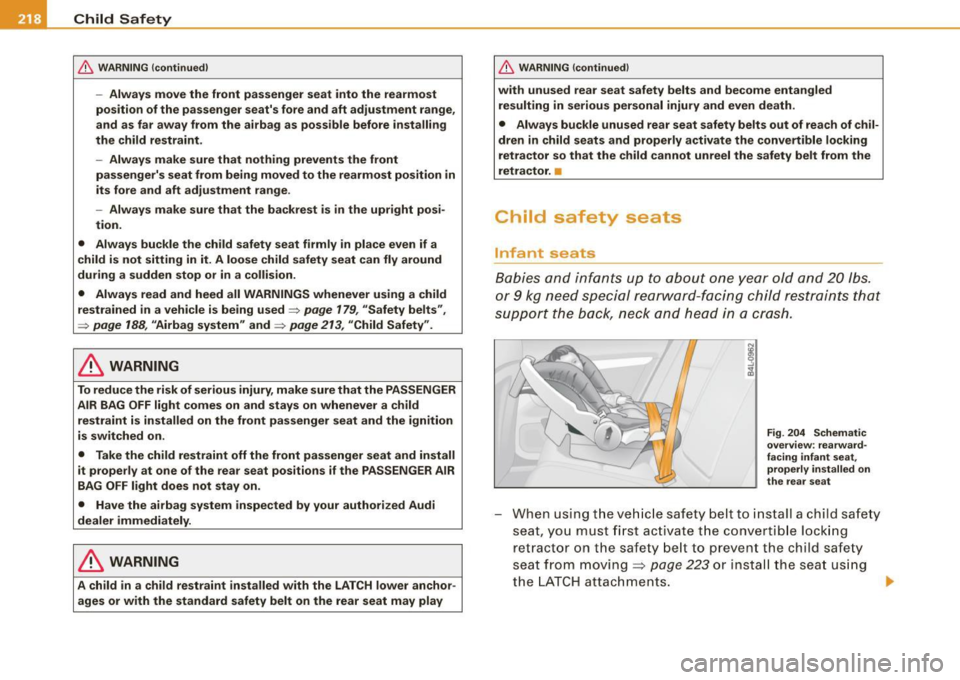
Babies and infants up to about one year old and 20 lbs.
or 9 kg need special rearward-facing child restraints that
support the back, neck and head in a crash.
Fig . 204 Schematic
overview: rearward
facing infant seat,
properly installed on
the rear seat
-When using the vehicle safety belt to install a child safety
seat, you must first activate the convertible locking
retractor on the safety belt to prevent the child safety
seat from moving=> page
223 or insta ll the seat using
the LATCH attachments. ..,_
Page 223 of 360

& WARNING !continued)
• Always follow the manufacturer's instructions provided with
the child safety seat or infant carrier.
• Always move the front passenger seat into the rearmost posi
tion of the passenger seat's fore and aft adjustment range, and as
far away from the airbag as possible before installing the child
restraint.
• Always make sure that nothing prevents the front passenger's
seat from being moved to the rearmost position in its fore and aft
adjustment range .
• Always make sure the backrest is in an upright position .
• Make sure that the PASSENGER AIR BAG OFF light comes on
and stays on all the time whenever the ignition is switched on.
• If the light does not stay on, perform the checks~
page 199,
uMonitoring the Advanced Airbag System ".
• Take the child restraint off the front passenger seat and install
it properly at one of the rear seat positions if the PASSENGER AIR
BAG OFF light does not stay on whenever the ignition is switched
on. •
Safety first
Child Safety
Booster seats and safety be lts
Properly used booster seats can help protect children
weighing between about 40 lbs. and 80 lbs. (18 kg and
36 kg) who are less than 4
ft. 9 in. (57 inches/1.45 meters)
tall.
Fig . 207 Rear seat :
child properly
restrained in a booster
seat
The vehicle 's safety belts alone will not fit most children
until they are at least 4 ft. 9 in. (57 inches/1.45 meters) tall
and weigh about 80 lbs. (36 kg). Booster seats raise these
children up so that the safety belt will pass properly over the
stronger parts of their bodies and the safety belt can help
protect them in a crash.
- Do not use the convertible locking retractor when using
the vehicle 's safety belt to restrain a child on a booster
seat.
- Always position the shoulder portion of the safety belt midway over the child's shoulder. If you must transport
an older child in a booster seat on the front passenger
seat , you can use the safety belt height adjustment to
help adjust the shoulder portion properly.
- Always make sure that the shoulder portion of the safety
belt never rests against or across the child's neck.
I)),
Vehicle care I I irechnical data
Page 225 of 360

Child Safety -
--------------------''----
& WARNING (continued )
• If you must install a booster seat on the front passenger seat
because of exceptional c ircumstances the PASSENGER AIR BAG
OFF light must come on and stay on , whenever the ignition is
switched on.
• If the PASSENGER AIR BAG OFF light does not come on and stay
on , perform the checks described
=> page 199 , "Monitoring the
Advanced A irbag System ".
• Take the ch ild restraint off the front passenger seat and install
it properly at one of the rear seat positions if the PASSENGER AIR
BAG OFF light does not stay on wheneve r the ignition is switched
on .
• Always read and heed all WARNINGS whenever using a child
restrained in a vehicle is being used=>
page 179, "Safety belts",
=> page 188, "Airbag system " and => page 213 , "Important things
to know ".•
Installing a child safety seat
Securing a child safety seat using a safety
belt
S a fety belt s fo r the rear seats and the front passen ger 's
sea t can be l ocked with t he convert ib le lock ing retra cto r
t o prope rly s ecure child saf ety s ea ts .
The s afe ty bel ts e merge ncy lo cking re trac to rs fo r th e rea r sea ts
safety belts and for the front pass enger's seat safety belt have a
c o nve rtible loc king re tr ac tor fo r child r estrai nts. The sa fe ty b elt
must be loc ked so that be lt webbin g cannot unr eel. The re trac tor
c an be activa te d to lock the safety be lt and prevent the safet y belt
w ebbi ng fr om l oos en ing up dur in g n orm al dr ivi ng . A chi ld sa fety
seat can only be properly insta lled when t he safety be lt is locked so
th at th e child and chil d sa fet y seat will sta y in p lace .
Controls and equip ment Safety first Vehicle operation A
lways remember: Even though your vehic le is equipped with an
A dva nce d Airb ag sys tem, all chi ld re n, e sp ec ially those 12 yea rs a nd
youn ger, should a lways ride in the back seat prop erly restrained for
t hei r age and weigh t.
& WARNING
Improperly installed child safety seats increase the risk of serious
personal injury and death in a collision .
• Always make sure that the safety belt retractor is locked when
installing a child safety seat . An unlocked safety belt retractor
cannot hold the child safety seat in place during normal driving or
in a crash .
• Always buckle the child safety seat firmly in place even if a
child is not sitting in it . A loose child safety seat can fly around
during a sudden stop or in a collision .
• Always make sure that the rear seat backrest to which the
center rear safety belt is attached is securely latched whenever
the rear center safety belt is being used to secure a child restraint.
• If the backrest is not securely latched , the child and the child
restraint will be thrown forward together with the backrest and
will strike parts of the vehicle interior. The child can be seriously injured or killed.
• Never install rearward -facing child safety seats or infant
carriers on the front passenger seat . A child will be seriously
injured and can be killed when the passenger airbag inflates.
• The inflating airbag will hit the child safety seat or infant
carrier with great force and will smash the child safety seat and
child against the backrest , center armrest , door or roof .
• Always install rearward -facing child safety seats or infant
c arriers on the rear seat .
• Forward-facing child safety seats or infant carriers installed on
the front passenger's seat may interfere with the deployment of
the airbag and cause serious injury to the child . ..
Vehicle care Do-it-yourself service Technical data
Page 226 of 360

-Child Safety -------=---------------------------------------
& WARNING (continued )
• It is safer to install a forward-f acing child safety seat on the rear
seat.
• Always read and heed all WARNINGS whenever using a child
restrained in a vehicle is being used=>
page 213 . Special precau
tions apply when installing a child safety seat on the front
passenger seat:::::,
page 190 , "Child restraints on the front seat -
some important thing s to know ".
& WARNING
Always take special precautions if you must install a forward or
rearward-facing child restraint on the front passenger's seat in
exceptional situations :
• Whenever a forward or rearward -facing child restraint is
installed on the front passenger seat , the PASSENGER AIR BAG
OFF light must come on and stay on whenever the ignition is
switched on.
• If the PASSENGER AIR BAG OFF light does not come on and stay
on , perform the checks described=>
page 199, "Monitoring the
Advanced Airbag System ".
• Take the child restraint off the front passenger seat and install
it properly at one of the rear seat positions if the PASSENGER AIR
BAG OFF light does not stay on whenever the ignition is switched
on .
• Improper installation of child restraints can reduce their effec
tiveness or even prevent them from providing any prote ction .
• An improperly installed child restraint can interfere with the
airbag as it deploys and seriously injure or even kill the child .
• Always carefully follow the manufacturer's instructions
provided with the child safety seat or carrier .
• Never place additional items on the seat that can increase the
total weight registered by the weight-sensing mat and can cause
injury in a crash .
& WARNING
Forward-facing ch ild restraints :
• Always make sure the forward-facing seat has been designed
and certified by its manufa cturer for use on a front seat with a
passenger front and side airbag .
• Never put the forward-facing child restraint up , against or very
near the instrument panel.
• Always move the passenger seat into its rearmost position in
the seat's fore and aft adjustment range , as far away from the
airbag as possible before installing the forward-facing child
re straint. The backrest must be adjusted to an upright position.
• Make sure that the PASSENGER AIR BAG OFF light comes on
and stays on all the time whenever the ignition is switched on.
& WARNING
Re arward -facing child restraints :
• A child in a rearward -facing child safety seat installed on the
front passenger seat will be seriously injured and can be killed if
the front airbag inflates -even with an Advanced Airbag System.
• The inflating airbag will hit the child safety seat or infant
carrier with great force and will smash the child safety seat and
child against the backrest , center armrest , door or roof .
• Always be e specially careful if you must install a rearward
facing child safety seat on the front passenger seat in exceptional
circumstances .
• A tight tether strap on a rearward-facing child restraint
attached to the front pas senger seat can put too much pres sure
on the weight -m at in the seat and register a heavier weight in the
Advanced Airbag System. The heavier weight registered can make
the system work as though an adult were on the seat and deploy
the Advanced Airbag when it must be suppressed causing ser ious
or even fatal injury to the child.
Ill-
Page 227 of 360

Child Safety -
--------------------''---
& WARNING (continued)
• Make sure that the PASSENGER AIR BAG OFF light comes on
and stays on all the time whenever the ignition is switched on.
• If the PASSENGER AIR BAG OFF light does not come on and stay
on, immediately install the rearward-facing child safety seat in a
rear seating position and have the airbag system inspected by
your authorized Audi dealer. •
Activating the convertible locking retractor
Use the convertible locking retractor to secure a child
restraint.
Always heed the child safety seat manufacturer 's instruc
tions when installing a child restraint in your vehicle. To
activate the convertible locking retractor:
- Place the child restraint on a seat, preferably on the rear
seat.
- Slowly pull the belt
all the way out.
- Route it around or through the child restraint belt path
=>& .
- Push the child safety seat down with your full weight to
get the safety belt really tight .
- Insert the belt tongue into the buckle for that seating
position.
- Gu ide the safety belt back into the retractor until the belt
lies flat and snug on the child safety seat.
Controls and equip
ment Safety first Vehicle operation
- You should
hear a "clicking" noise as the belt winds back
into the inertia reel. Test the convertible locking retractor
by pul ling on the belt. You should no longer be able to
pull the belt out of the retractor. The convertible locking
retractor is now activated .
- Make sure that the red release button is facing away from
the child restraint so that it can be unbuckled quickly.
- Pull on the belt to make sure the safety belt is properly
tight and fastened so that the seat cannot move forward
or sideways more than one inch (2.5 cm).
& WARNING
Using the wrong child restraint or an improperly installed child
restraint can cause serious personal injury or death in a crash.
• Always make sure that the safety belt retractor is locked when
installing a child safety seat. An unlocked safety belt retractor
cannot hold the child safety seat in place during normal driving or
in a crash.
• Always buckle the child safety seat firmly in place even if a
child is not sitting in it. A loose child safety seat can fly around
during a sudden stop or in a crash.
• Always make sure the seat backrest to which the child restraint
is installed is in an upright position and securely latched into place
and cannot fold forward. Otherwise, the seat back with the child
safety seat attached to it could fly forward in the event of an acci
dent or other emergency situation.
• Always read and heed all WARNINGS whenever using a child
restrained in a vehicle is being used=>
page 213. Special precau
tions apply when installing a child safety seat on the front
passenger seat=>
page 190, "Child restraints on the front seat -
some important things to know". •
Vehicle care Do-it-yourself service Technical data
Page 243 of 360

& WARNING (continued)
vehicle. Always drive at speeds which are suited to the road condi
tions -risk of crash. •
Energy management
Starting ability is optimized
Energy management controls the distribution of electrical
energy and thus optimizes the availability of electrical
energy for starting the engine .
If a vehicle with a conventional energy system is not driven for a
long period of time , the battery is discharged by idling current
consumers (e.g . immobilizer) . In certain circumstances it can result
in there being insufficient energy available to start the engine.
Intelligent energy management in your vehicle handles the distribu
tion of electrical energy. Starting ability is markedly improved and
the life of the battery is extended.
Basically, energy management consists of
battery diagnosis, idling
current management
and dynamic energy management .
Battery diagnosis
Battery diagnosis continuously determines the state of the battery.
Sensors determine battery voltage, battery current and battery
temperature. This determines the current state of charge and the
power of the battery.
Idling current management
Idling current management reduces energy consumption while the
vehicle is standing . With the ignition switched off, it controls the
energy supply to the various electrical components. Data from
battery diagnosis is considered.
Controls and equip ment Safety first Vehicle operation
Intelligent technology
Depending
on the battery's state of charge, individual consumers
are gradually turned off to prevent excessive discharge of the
battery and thus maintain starting capability.
Dynamic energy management
While the vehicle is being driven, dynamic energy management
distributes the energy generated according to the needs of the indi
vidual components. It regulates consumption, so that more elec
trical energy is not being used than is being generated and ensures
an optimal state of charge for the battery.
[ i] Tips
• But even energy management cannot negate the limits of
physics. Consider that the power and life of a battery are limited.
• If starting ability is threatened, you are informed by a warning
~ page 242, "Driver notification in the instrument cluster
display". •
What you should know
The highest priority is given to maintaining starting capa
bility.
The battery is severely taxed in short-distance driving, in city traffic
and during the cold time of year. Abundant electrical energy is
required, but only a little is generated. It is also critical if the engine
is not running and electrical components are turned on. In this
instance energy is being consumed but none is being generated.
It is in precisely these situations that you will notice energy manage
ment actively regulating the distribution of energy.
Vehicle stands for an extended period
If you do not drive your vehicle over a period of several days or
weeks, electrical components are gradually cut back or switched off.
This reduces energy consumption and maintains starting capability
over a longer period.
Vehicle care Do-it-yourself service Technical data