Page 46 of 120

6-7
the following points in mind:Never exceed the weight limits shown. An over-
loaded ATV can be unstable.If you are carrying cargo and towing a trailer, in-
clude the tongue weight in the maximum ATV
load limit.Load cargo on the carriers as close to the center
of the ATV as possible. Put cargo at the rear of
the front carrier, at the front of the rear carrier,
and center it.Tie down cargo securely to the carriers. Make
sure cargo in the trailer cannot move around. A
shifting load can cause an accident.Make sure the load does not interfere with con-
trols or your ability to see where you are going.Ride more slowly than you would without a load.
The more weight you carry, the slower you
should go.Allow more braking distance. A heavier ATV
takes longer to stop.Avoid making sharp turns unless at very slowspeeds.
Avoid hills and rough terrain. Choose terrain
carefully. Added weight affects the stability and
handling of the ATV.
6
MAXIMUM LOADING LIMIT
ATV loading limit (total weight of rider, cargo,
accessories, and tongue):70.0 kg (154 lb)
WARNING
Never exceed the stated load capacity for this
ATV. Overloading this ATV or carrying or tow-
ing cargo improperly could cause changes in
ATV handling which could lead to an accident.
Cargo should be properly distributed and se-
curely attached. Reduce speed when carrying
cargo or pulling a trailer. Allow greater dis-tance for braking.
Page 48 of 120

7-2
GETTING TO KNOW YOUR ATV
This ATV is for recreation use. This section, Riding
your ATV, provides general ATV riding instructions
for recreational riding. The skills and techniques
described in this section, however, are appropriate
for all types of riding. Riding your ATV requires
special skills acquired through practice over a pe-
riod of time. Take the time to learn the basic tech-
niques well before attempting more difficult
maneuvers.
Riding your new ATV can be a very enjoyable ac-
tivity, providing you with hours of pleasure. But it is
essential to familiarize yourself with the operation
of the ATV to achieve the skill necessary to enjoy
riding safely. Before you begin to ride, be sure you
have read this Owner’s Manual completely and un-
derstand the operation of the controls. Pay partic-
ular attention to the safety information on pages
1-1–1-4. Please also read all notice and warning
labels on your ATV.RIDE WITH CARE AND GOOD JUDGEMENT
Get training if you are inexperienced.
Beginners should get training from a certified in-
structor.
Become familiar with this ATV at slow speeds first,
even if you are an experienced operator. Do not at-
tempt to operate at maximum performance until
you are totally familiar with the ATV’s handling and
performance characteristics.
7
Page 49 of 120
7-3
Riding your ATV requires skills acquired
through practice over a period of time.
Take the time to learn the basic techniques well
before attempting more difficult maneuvers.Not recommended for children under 12 years
of age.
7
WARNING
Never operate this ATV without proper instruc-
tion. Beginning and inexperienced operators
should regularly practice the skills and the op-
erating techniques described in this Owner’s
Manual. The risk of an accident is greatly in-
creased if the operator does not know how to
operate the ATV properly in different situationsand on different types of terrain.
WARNING
A child under 12 should never operate an ATV
with engine size greater than 70 cc. Use by chil-
dren of ATVs that are not recommended for
their age can lead to severe injury or death ofthe child.
Page 50 of 120
This ATV is designed to carry operator only –
passengers prohibited.
7
7-4
WARNING
Never carry a passenger. The long seat is to al-
low the operator to shift position as needed
during operation. It is not for carrying passen-
gers. Carrying a passenger on this ATV greatly
reduces your ability to balance and control this
ATV. It could cause an accident, resulting inharm to you and/or your passenger.
Page 51 of 120
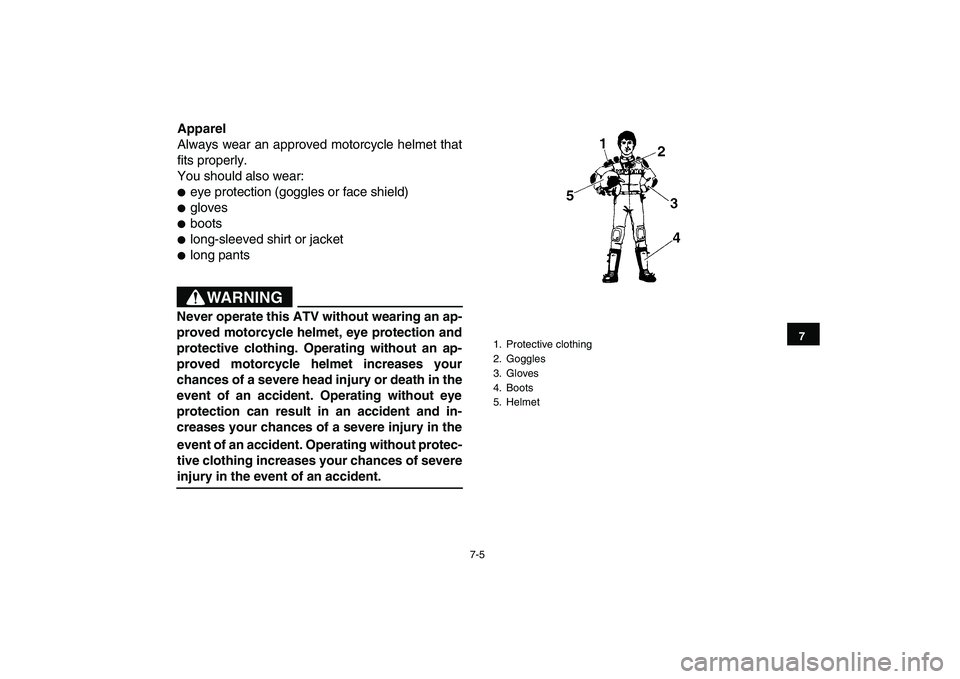
7-51. Protective clothing
2. Goggles
3. Gloves
4. Boots
5. Helmet
7
WARNING
Never operate this ATV without wearing an ap-
proved motorcycle helmet, eye protection and
protective clothing. Operating without an ap-
proved motorcycle helmet increases your
chances of a severe head injury or death in the
event of an accident. Operating without eye
protection can result in an accident and in-
creases your chances of a severe injury in the
event of an accident. Operating without protec-
tive clothing increases your chances of severeinjury in the event of an accident.Apparel
Always wear an approved motorcycle helmet that
fits properly.
You should also wear:
eye protection (goggles or face shield)glovesbootslong-sleeved shirt or jacketlong pants
Page 52 of 120
7-6
Do not operate after consuming alcohol or
drugs.
The operator’s performance capability is reduced
by the influence of alcohol or drugs.Pre-operation checks
Always perform the pre-operation checks listed on
page 5-1 before riding for proper care of the ATV
and to ensure safety.
7
WARNING
Never consume alcohol or drugs before orwhile driving this ATV.
WARNING
Always inspect your ATV each time you use it
to make sure the ATV is in safe operating con-
dition. Always follow the inspection and main-
tenance procedures and schedules described
in the Owner’s Manual. Failure to inspect the
ATV before operating or failure to properly
maintain the ATV increases the possibility ofan accident or equipment damage.
Page 53 of 120

7-7
Do not operate at speeds too fast for your
skills or the conditions.Speed limiters
For riders less experienced with this model, the
throttle lever housing is equipped with a vehicle
speed limiter. This speed limiter keeps the throttle
from fully opening, even when the throttle lever is
pushed to the maximum. Turning in the adjusting
screw limits the maximum engine power available
and decreases the maximum speed of the ATV.
Turning in the adjusting screw decreases top speed,
and turning it out increases top speed.
(See pages 4-3 and 4-4.)
7
This model also has an engine speed limiter plate
to limit the amount of engine power available.
WARNING
Always use the size and type tires specified in
the Owner’s Manual for this ATV on page 5-4.
Always maintain proper tire pressure as de-
scribed in the Owner’s Manual on page 5-5.
Use of improper tires on this ATV, or operation
of this ATV with improper or uneven tire pres-
sure, may cause loss of control, increasingyour risk of an accident.
WARNING
Always go at a speed that is proper for the ter-
rain, visibility and operating conditions, and
your experience. Operating this ATV at speeds
too fast for your skills or the conditions in-
creases your chances of losing control of theATV, which can result in an accident.
Yamaha recommends that all beginning riders start
off with the vehicle speed limiter turned in and the
engine speed limiter plate installed to limit the amount
of speed available while they learn. The vehicle speed
limiter may be gradually adjusted to increase maximum
speed as the beginner becomes more familiar with
operating the ATV. Parents should decide when to
adjust the ATV for more power as their youngster’s
riding skills improve. Once the ATV rider can operate
with skill at the top speed permitted by adjusting the
vehicle speed limiter alone, the engine speed limiter
plate can be removed. Since removal of this plate will
Page 54 of 120
7-8
result in a significant increase in power, turn the vehicle
speed limiter adjusting screw back in again; adjust it
out in stages as you did before. For engine speed
limiter plate removal instructions, see page 4-4.Loading and accessories
Use extra caution when riding the ATV with addi-
tional loads, such as accessories or cargo. The
ATV’s handling may be adversely affected. Re-
duce your speed when adding additional loads.
2. Adjusting screw
MAXIMUM LOADING LIMIT
ATV loading limit (total weight of cargo, rider,
accessories, and tongue):70.0 kg (154 lb)
7
1. Locknut
1
2
WARNING
Never exceed the stated load capacity for
this ATV.Cargo should be properly distributed and se-
curely attached.Reduce speed when carrying cargo or pull-
ing a trailer. Allow greater distance for brak-
ing.Always follow the instructions in your Own-
er’s Manual for carrying cargo or pulling atrailer.