Page 75 of 120

8-2
it for you.
1. Owner ’s manual
2. Low-pressure tire gauge
3. Owner ’s tool kitThe service information included in this manual
and the tools provided in the owner’s tool kit are in-
tended to assist you in the performance of preven-
tive maintenance and minor repairs. However,
additional tools such as a torque wrench may be
necessary to perform certain maintenance work
correctly.
TIPIf you do not have the tools or experience required
for a particular job, have a Yamaha dealer perform
5TH-28199-66YFM90ROWNER'S MANUAL
1626-21-38This ATV
shoul
d not be ridden by anyone under
years.
e
g
a
f
o
WARNING
READ THIS MANUAL CAREFULLY!
It contains important safety information.
8
1
23
WARNING
Never modify this ATV through improper in-
stallation or use of accessories, as it may
cause changes in handling, which in some sit-
uations could lead to an accident. All parts and
accessories added to this ATV should be gen-
uine Yamaha or equivalent components de-
signed for use on this ATV and should be
installed and used according to instructions. If
you have questions, consult an authorizedYamaha ATV dealer.
Page 90 of 120
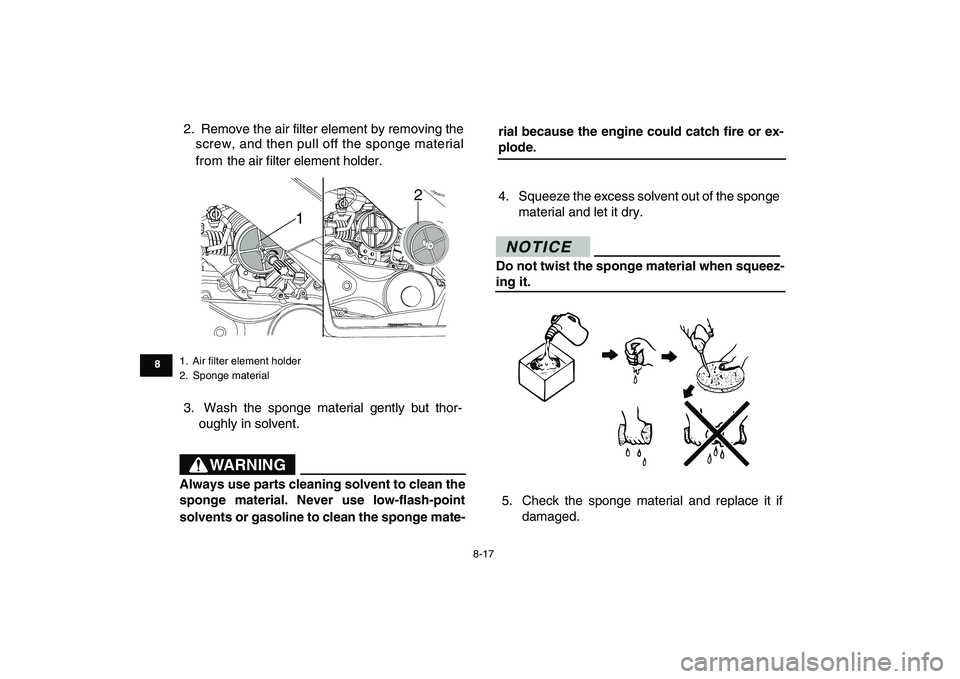
N O T I C EDo not twist the sponge material when squeez-ing it.5. Check the sponge material and replace it if damaged.
1. Air filter element holder
2. Sponge material
1
2
8
8-17
2. Remove the air filter element by removing the
3. Wash the sponge material gently but thor- oughly in solvent. 4. Squeeze the excess solvent out of the sponge
material and let it dry.
screw, and then pull off the sponge material
from the air filter element holder.
WARNING
Always use parts cleaning solvent to clean the
sponge material. Never use low-flash-point
solvents or gasoline to clean the sponge mate- rial because the engine could catch fire or ex-
plode.
Page 93 of 120

8-20
Adjusting the carburetor The carburetor should be checked and, if neces-
sary, adjusted at the intervals specified in the peri-
odic maintenance and lubrication chart. The
carburetor is an important part of the engine and
requires very sophisticated adjustment. Therefore,
most carburetor adjustments should be left to a
Yamaha dealer, who has the necessary profes-
sional knowledge and experience. The adjustment
described in the following section, however, may
be performed by the owner as part of routine main-
tenance.N O T I C E The carburetor has been set and extensively
tested at the Yamaha factory. Changing these
settings without sufficient technical knowl-
edge may result in poor performance of ordamage to the engine. Adjusting the engine idling speed The engine idling speed must be checked and, if
necessary, adjusted as follows at the intervals
specified in the periodic maintenance and lubrica-
8
WARNING
Do not start the engine when cleaning the
spark arrester, otherwise it could cause injury
to the eyes, burns, carbon monoxide poison-
ing, possibly leading to death, and start a fire.
Always let the exhaust system cool prior totouching exhaust components.
Page 95 of 120

8-22
The throttle cable free play should measure 1.0–
3.0 mm (0.04–0.12 in) at the throttle lever. Period-
ically check the throttle cable free play and, if nec-
essary, have a Yamaha dealer adjust it. Timing chainThe timing chain stretches with use, resulting in im-
proper valve timing and engine noise. To prevent
this from occurring, the timing chain tensioner
must be adjusted by a Yamaha dealer at the inter-
vals specified in the periodic maintenance and lu-
brication chart.
Valve clearanceThe valve clearance changes with use, resulting in
improper air-fuel mixture and/or engine noise. To
prevent this from occurring, the valve clearance
must be adjusted by a Yamaha dealer at the inter-
vals specified in the periodic maintenance and lu-
brication chart.
1. Throttle lever free play
1
BrakesReplacement of brake components requires
professional knowledge.Brake service should be
performed by a Yamaha dealer.
WARNING
Operating with improperly serviced or adjusted
brakes could lead to a loss
in braking ability
and an accident.
8
Checking the front brake shoesThe front brake shoes must be checked for wear at
the intervals specified in the periodic maintenance
and lubrication chart. Front brake is provided with a
wear indicator on front brake lever, which allows you
Page 97 of 120
4. Tighten the lower locknut.
5. While applying the front brake, turn out the up-per adjusting bolt until the upper and lower ca-
ble lengths are equal. The cable joint will
become vertical.1. Upper locknut
2. Upper adjusting bolt
3. Lower locknut
4. Lower adjusting bolt
12
4
3 (a)(b)
(a)
(b)
11. Cable joint6. Tighten the upper locknut.
8-24
8
WARNING
Operating with improperly serviced or adjust-
ed brakes could cause loss of braking ability,
which could lead to an accident.
Page 100 of 120

8-27
Checking and lubricating the cables The operation and the condition of all control ca-
bles should be checked before each ride, and the
cables and cable ends should be lubricated if nec-
essary. If a cable is damaged or does not move
smoothly, have a Yamaha dealer check or replace
it.
Checking and lubricating the front and
rear brake levers The operation of the front and rear brake levers
should be checked before each ride, and the lever
pivots should be lubricated if necessary.Recommended lubricant:
Engine oil
8
WARNING
Operating with improperly serviced or adjust-
ed brakes could cause loss of braking ability,
which could lead to an accident.
After servicing:Make sure the brakes operate smoothly and
that the free play is correct.Make sure the brakes do not drag.Make sure the brakes are not spongy. All air
must be bled from the brake system.
Replacement of brake components requires
professional knowledge. These proceduresshould be performed by a Yamaha dealer.
WARNING
Inspect cables frequently and replace if dam-
aged. Corrosion can result when the cable
sheaths become damaged, and cables can
also become frayed or kinked, which could re-
strict the operation of controls and lead to anaccident or injury.
Page 101 of 120

8-28
8
Checking the wheel hub bearings The front and rear wheel hub bearings must be
checked at the intervals specified in the periodic
maintenance and lubrication chart. If there is play
in a wheel hub or if a wheel does not turn smoothly,
have a Yamaha dealer check the wheel hub bearings.1. Lever pivot
BatteryT h i s m o d e l i s e q u i p p e d w i t h a V R L A ( V a l v e
Regulated Lead Acid) battery. There is no need to
check the electrolyte or to add distilled water.
However, the battery lead connections need to be
checked and, if necessary, tightened.
Recommended lubricant:Front brake lever: Lithium-soap-based grease
N O T I C E Never attempt to remove the battery cell seals,
as this would permanently damage the battery.
1
WARNING
Battery electrolyte is poisonous and danger-
ous, as it contains sulfuric acid, which can
cause severe burns. Avoid contact with skin,
eyes or clothing. Always shield your eyes
when working near batteries.
Antidote:
EXTERNAL: Flush with water.
INTERNAL: Drink large quantities of water or
milk. Follow with milk of magnesia, beaten egg
or vegetable oil. Call a physician immediately.
Rear brake lever:
Silicone grease
Page 103 of 120

8-30
1. Turn the key to “OFF” and turn off all electricalcircuits.N O T I C E To prevent accidental short-circuiting, turn off
the main switch when checking or replacing afuse.
2. Remove the blown fuse, and then install a new fuse of the specified amperage.
Specified fuse: 10 A
The fuse holder is located under the seat.
8
(See page 4-9.)
If the fuse is blown, replace it as follows.
1. Fuse
2. Spare fuseN O T I C EAlways keep the battery charged. Storing a
discharged battery can cause permanent
battery damage.To charge a VRLA (Valve Regulated Lead Acid)
battery, a special (constant-voltage) battery
charger is required. Using a conventional
battery charger will damage the battery. If you
do not have access to a constant-voltage
battery charger, have a Yamaha dealer charge
your battery.
1
2
Replacing the fuse
WARNING
Always use a fuse of the specified rating, and
never use a substitute object in place of the
proper fuse. An improper fuse or a substitute
object can cause damage to the electrical sys-tem, which could lead to a fire.