2009 YAMAHA MAJESTY 125 warning
[x] Cancel search: warningPage 37 of 84
EAU16830
Engine break-in
There is never a more important
period in the life of your engine than
the period between 0 and 1000 km
(600 mi). For this reason, you should
read the following material carefully.
Since the engine is brand new, do not
put an excessive load on it for the first
1000 km (600 mi). The various parts in
the engine wear and polish themsel-
ves to the correct operating clearan-
ces. During this period, prolonged
full-throttle operation or any condition
that might result in engine overhea-
ting must be avoided.
EAU16951
0–150 km (0–90 mi)
●Avoid prolonged operation above
1/3 throttle.
●After every hour of operation,
stop the engine, and then let it
cool for five to ten minutes.
●Vary the engine speed from time
to time. Do not operate the engi-
ne at one set throttle position.150–500 km (90–300 mi)
●Avoid prolonged operation above
1/2 throttle.
●Rev the engine freely through the
gears, but do not use full throttle
at any time.
500–1000 km (300–600 mi)
●Avoid prolonged operation above
3/4 throttle. NOTICE: After 1000
km (600 mi) of operation, the
engine oil must be changed
and the oil strainer cleaned.
[ECA10351]
1000 km (600 mi) and beyond
●Avoid prolonged full-throttle ope-
ration. Vary the speed occasio-
nally.
ECA10270
NOTICE
If any engine trouble should occur
during the engine break-in period,
immediately have a Yamaha dealer
check the vehicle.
EAU17201
Parking
When parking, stop the engine, and
then remove the key from the main
switch.
EWA10311
s s
WARNING
●Since the engine and exhaust
system can become very hot,
park in a place where pedes-
trians or children are not likely
to touch them and be burned.
●Do not park on a slope or on
soft ground, otherwise the
vehicle may overturn, increa-
sing the risk of a fuel leak and
fire.
●Do not park near grass or other
flammable materials which
might catch fire.
OPERATION AND IMPORTANT RIDING POINTS
5-4
5
5D8-F8199-E1.QXD 10/7/08 07:39 Página 37
Page 38 of 84

EAU17281
Periodic inspection, adjustment, and
lubrication will keep your vehicle in
the safest and most efficient condi-
tion possible. Safety is an obligation
of the vehicle owner/operator. The
most important points of vehicle ins-
pection, adjustment, and lubrication
are explained on the following pages.
The intervals given in the periodic
maintenance and lubrication chart
should be simply considered as a
general guide under normal riding
conditions. However, depending on
the weather, terrain, geographical
location, and individual use, the main-
tenance intervals may need to be
shortened.
EWA10321
s s
WARNING
Failure to properly maintain the
vehicle or performing maintenance
activities incorrectly may increase
your risk of injury or death during
service or while using the vehicle. If
you are not familiar with vehicle
service, have a Yamaha dealer per-
form service.
EWA15121
s s
WARNING
Turn off the engine when perfor-
ming maintenance unless otherwi-
se specified.
●A running engine has moving
parts that can catch on body
parts or clothing and electrical
parts that can cause shocks or
fires.
●Running the engine while servi-
cing can lead to eye injury,
burns, fire, or carbon monoxide
poisoning – possibly leading to
death. See page 1-1 for more
information about carbon
monoxide.
EWA10330
s s
WARNING
This scooter is designed for use on
paved roads only. If this scooter is
operated in abnormally dusty,
muddy or wet conditions, the air fil-
ter element should be cleaned or
replaced more frequently, otherwi-
se rapid engine wear may result.
Consult a Yamaha dealer for proper
maintenance intervals.
EAU17451
Owner’s tool kit
1. Owner’s tool kit
The owner’s tool kit is located inside
the storage compartment. (See page
3-12).
The service information included in
this manual and the tools provided in
the owner’s tool kit are intended to
assist you in the performance of pre-
ventive maintenance and minor
repairs. However, additional tools
such as a torque wrench may be
necessary to perform certain mainte-
nance work correctly.
1
PERIODIC MAINTENANCE AND ADJUSTMENT
6-1
6
5D8-F8199-E1.QXD 10/7/08 07:39 Página 38
Page 50 of 84

1. Coolant level check window
2. Maximum level mark
3. Minimum level mark
3. If the coolant is at or below the
minimum level mark, remove
panel A (See page 6-7), remove
the reservoir cap, add coolant to
the maximum level mark, and
then install the reservoir cap and
the panel. WARNING! Remove
only the coolant reservoir cap.
Never attempt to remove the
radiator cap when the engine is
hot.
[EWA15161]. NOTICE: If coolant
is not available, use distilled
water or soft tap water instead.
Do not use hard water or salt
water since it is harmful to theengine. If water has been used
instead of coolant, replace it
with coolant as soon as possi-
ble, otherwise the cooling sys-
tem will not be protected
against frost and corrosion. If
water has been added to the
coolant, have a Yamaha dealer
check the antifreeze content of
the coolant as soon as possi-
ble, otherwise the effective-
ness of the coolant will be
reduced.
[ECA10472]
1. Coolant reservoir cap
2. Maximum level mark
3. Minimum level mark
EAU33031
Changing the coolant
The coolant must be changed at the
intervals specified in the periodic
maintenance and lubrication chart.
Have a Yamaha dealer change the
coolant. WARNING! Never attempt
to remove the radiator cap when
the engine is hot.
[EWA10381]
Coolant reservoir capacity (up to
the maximum level mark):
0.30 L (0.32 US qt, 0.26 Imp.qt)
23
1
MAXMAX
MINMIN
2 1
3
PERIODIC MAINTENANCE AND ADJUSTMENT
6-13
6
5D8-F8199-E1.QXD 10/7/08 07:39 Página 50
Page 53 of 84
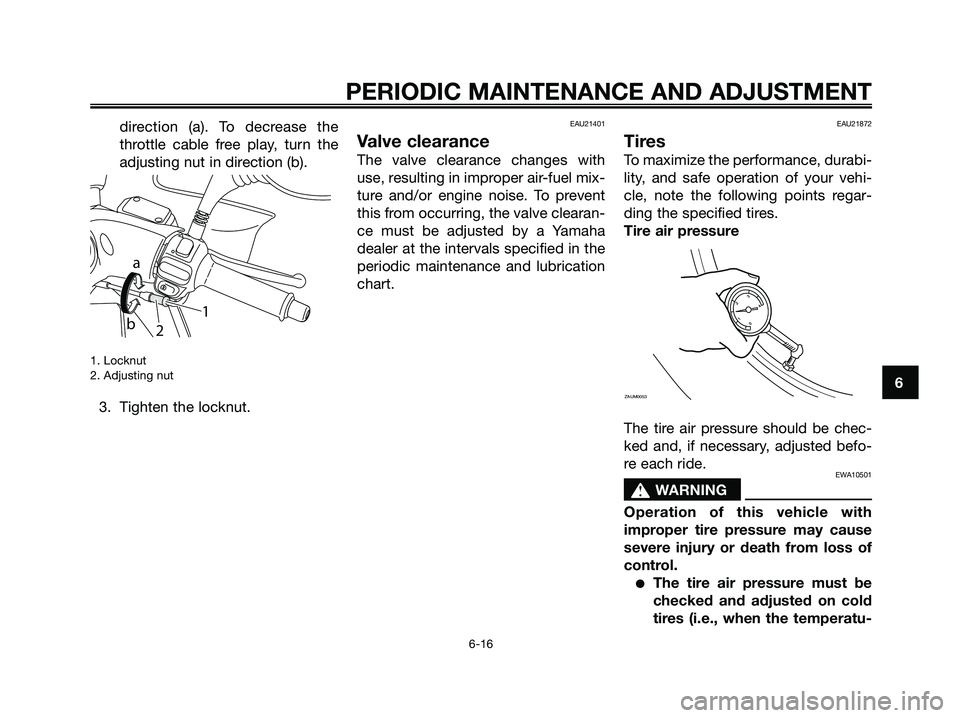
direction (a). To decrease the
throttle cable free play, turn the
adjusting nut in direction (b).
1. Locknut
2. Adjusting nut
3. Tighten the locknut.
EAU21401
Valve clearance
The valve clearance changes with
use, resulting in improper air-fuel mix-
ture and/or engine noise. To prevent
this from occurring, the valve clearan-
ce must be adjusted by a Yamaha
dealer at the intervals specified in the
periodic maintenance and lubrication
chart.
EAU21872
Tires
To maximize the performance, durabi-
lity, and safe operation of your vehi-
cle, note the following points regar-
ding the specified tires.
Tire air pressure
The tire air pressure should be chec-
ked and, if necessary, adjusted befo-
re each ride.
EWA10501
s s
WARNING
Operation of this vehicle with
improper tire pressure may cause
severe injury or death from loss of
control.
●The tire air pressure must be
checked and adjusted on cold
tires (i.e., when the temperatu-
ZAUM0053
a
b
21
PERIODIC MAINTENANCE AND ADJUSTMENT
6-16
6
5D8-F8199-E1.QXD 10/7/08 07:39 Página 53
Page 54 of 84

re of the tires equals the
ambient temperature).
●The tire air pressure must be
adjusted in accordance with
the riding speed and with the
total weight of rider, passenger,
cargo, and accessories appro-
ved for this model.
EWA10511
s s
WARNING
Never overload your vehicle. Ope-
ration of an overloaded vehicle
could cause an accident.
Tire inspection
1. Tire tread depth
2. Tire sidewall
The tires must be checked before
each ride. If the center tread depth
reaches the specified limit, if the tire
has a nail or glass fragments in it, or if
the sidewall is cracked, have a Yama-
ha dealer replace the tire immediately.
TIP
The tire tread depth limits may differ
from country to country. Always
comply with the local regulations.
Tire information
This model is equipped with tubeless
tires.
After extensive tests, only the tires lis-
ted below have been approved for
this model by Yamaha Motor España,
S.A.
Front tire:
Size:
120 / 70 - 12 51L
Manufacturer/model:
PIRELLI / SL66
MICHELIN / BOOPER
CONTINENTAL / ZIPPY 1
Rear tire:
Size:
130 / 70 - 12 56L
Manufacturer/model:
PIRELLI / SL66
MICHELIN / BOOPER
CONTINENTAL /ZIPPY 1
Minimum tire tread depth (front
and rear):
1.6 mm (0.06 in)
1
2
ZAUM0054
Tire air pressure (measured on
cold tires):
0–90 kg (0–198 lb):
Front:
190 kPa (1.90 kgf/cm
2, 28 psi,
1.90 bar)
Rear:
220 kPa (2.20 kgf/cm
2, 32 psi,
2.20 bar)
90 Kg – maximum load:
Front:
190 kPa (1.90 kgf/cm
2, 28 psi,
1.90 bar)
Rear:
240 kPa (2.40 kgf/cm
2, 35 psi,
2.40 bar)
Maximum load*:
177 kg (390 lb)
* Total weight of rider, passenger,
cargo and accessories
PERIODIC MAINTENANCE AND ADJUSTMENT
6-17
6
5D8-F8199-E1.QXD 10/7/08 07:39 Página 54
Page 55 of 84
EWA10470
s s
WARNING
●Have a Yamaha dealer replace
excessively worn tires. Besides
being illegal, operating the
vehicle with excessively worn
tires decreases riding stability
and can lead to loss of control.
●The replacement of all wheel
and brake related parts, inclu-
ding the tires, should be left to
a Yamaha dealer, who has the
necessary professional know-
ledge and experience.
EAU21960
Cast wheels
To maximize the performance, durabi-
lity, and safe operation of your vehi-
cle, note the following points regar-
ding the specified wheels.
●The wheel rims should be chec-
ked for cracks, bends or warpage
before each ride. If any damage
is found, have a Yamaha dealer
replace the wheel. Do not
attempt even the smallest repair
to the wheel. A deformed or crac-
ked wheel must be replaced.
●The wheel should be balanced
whenever either the tire or wheel
has been changed or replaced.
An unbalanced wheel can result
in poor performance, adverse
handling characteristics, and a
shortened tire life.
●Ride at moderate speeds after
changing a tire since the tire sur-
face must first be “broken in” for
it to develop its optimal characte-
ristics.
EAU33453
Front and rear brake lever
free play
Front
Rear
There should be no free play at the
brake lever ends. If there is free play,
PERIODIC MAINTENANCE AND ADJUSTMENT
6-18
6
5D8-F8199-E1.QXD 10/7/08 07:39 Página 55
Page 56 of 84
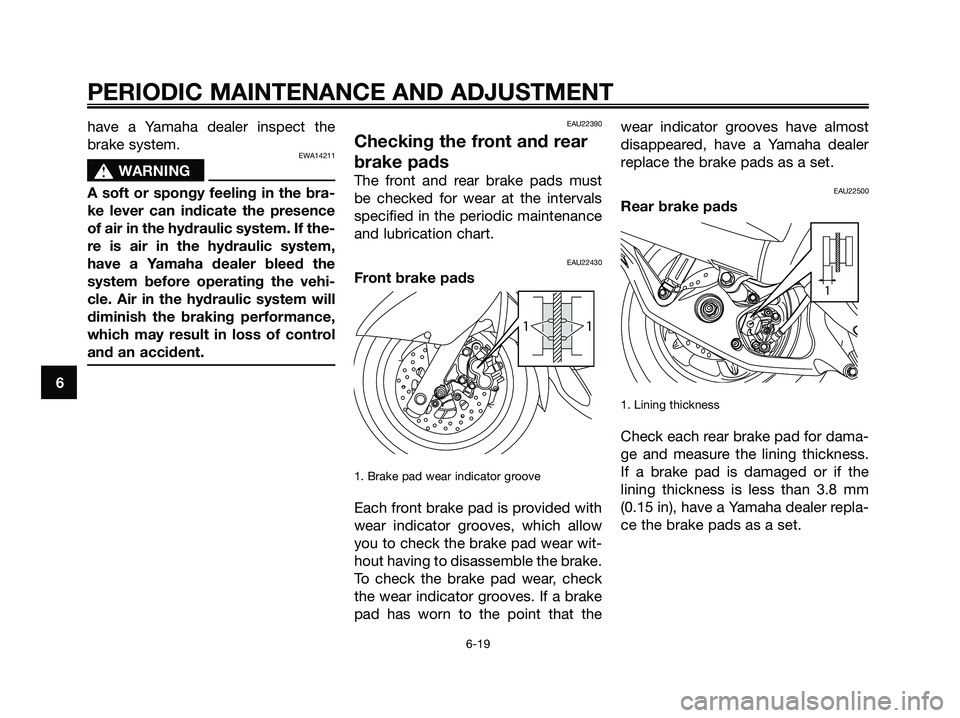
have a Yamaha dealer inspect the
brake system.
EWA14211
s s
WARNING
A soft or spongy feeling in the bra-
ke lever can indicate the presence
of air in the hydraulic system. If the-
re is air in the hydraulic system,
have a Yamaha dealer bleed the
system before operating the vehi-
cle. Air in the hydraulic system will
diminish the braking performance,
which may result in loss of control
and an accident.
EAU22390
Checking the front and rear
brake pads
The front and rear brake pads must
be checked for wear at the intervals
specified in the periodic maintenance
and lubrication chart.
EAU22430
Front brake pads
1. Brake pad wear indicator groove
Each front brake pad is provided with
wear indicator grooves, which allow
you to check the brake pad wear wit-
hout having to disassemble the brake.
To check the brake pad wear, check
the wear indicator grooves. If a brake
pad has worn to the point that thewear indicator grooves have almost
disappeared, have a Yamaha dealer
replace the brake pads as a set.
EAU22500
Rear brake pads
1. Lining thickness
Check each rear brake pad for dama-
ge and measure the lining thickness.
If a brake pad is damaged or if the
lining thickness is less than 3.8 mm
(0.15 in), have a Yamaha dealer repla-
ce the brake pads as a set.
1
11
PERIODIC MAINTENANCE AND ADJUSTMENT
6-19
6
5D8-F8199-E1.QXD 10/7/08 07:39 Página 56
Page 58 of 84

EAU22721
Changing the brake fluid
Have a Yamaha dealer change the
brake fluid at the intervals specified in
the TIP after the periodic maintenan-
ce and lubrication chart. In addition,
have the oil seals of the brake master
cylinder and caliper as well as the
brake hose replaced at the intervals
listed below or whenever they are
damaged or leaking.
●Oil seals: Replace every two
years.
●Brake hose: Replace every four
years.
EAU23101
Checking and lubricating the
cables
The operation of all control cables
and the condition of the cables
should be checked before each ride,
and the cables and cable ends should
be lubricated if necessary. If a cable is
damaged or does not move smoothly,
have a Yamaha dealer check or repla-
ce it. WARNING! Damage to the
outer sheath may interfere with
proper cable operation and will
cause the inner cable to rust.
Replace a damaged cable as soon
as possible to prevent unsafe con-
ditions.
[EWA10721]EAU23172
Lubricating the front and
rear brake levers
Front brake lever
Rear brake lever
The pivoting points of the front and
rear brake levers must be lubricated
Recommended lubricant:
Engine oil
PERIODIC MAINTENANCE AND ADJUSTMENT
6-21
6
5D8-F8199-E1.QXD 10/7/08 07:39 Página 58