2009 VOLVO XC60 tow
[x] Cancel search: towPage 181 of 297

04 Comfort and driving pleasure
Distance alert04
}}
179
Introduction
Distance Alert is part of Adaptive Cruise Con-
trol and is a function that provides information
about the time interval to the vehicle ahead.
Time interval information is only given for a
vehicle that is driving ahead of your vehicle, in
the same lane, and in the same direction. No
information is provided for vehicles driving
toward you, moving very slowly, or at a stand-
still.
A smaller section of the red warning light in the
windshield glows steadily if your vehicle is
closer to the vehicle ahead than the set time
interval.
NOTE Distance Alert is in active mode while Adap-
tive Cruise Control is active.
Distance Alert is active at speeds above
approximately 20 mph (30 km/h).
WARNING
Distance Alert only indicates the distance to
the vehicle ahead. It does not affect the
speed of your vehicle.
Operation
–
Press the button in the center instrument
panel to switch this function on or off. > The indicator light in the button illumi-
nates when the function is on.
Setting a time intervalThe buttons for setting a time interval are
located on the left side of the steering wheel.
– Press to increase the interval or to
decrease it.
Five different time intervals
can be selected and are
shown in the display as 1–5
horizontal bars. The greater
the number of bars, the longer
the time interval. No. of bars Approx. time interval
(in seconds) 1 1.0
2 1.4
3 1.8
4 2.2
5 2.6
The number of bars indicating the selected
time interval are shown while the setting is
being made and for several seconds afterward. G031394 G031396
Page 190 of 297

04 Comfort and driving pleasurePark assist* 04
188
* Option/accessory, for more information, see Introduction.
Signals from the park assist system
Views in the display
Visual indicatorThe audio system’s display gives an overview
of the vehicle’s position in relation to a
detected object.
The markers in the display indicate that one or
more of the four sensors has detected an
object. The greater the number of markers, the
closer the vehicle is to the object.
Display in a vehicle with rear park assist
only. Here, an object has been detected by
both of the right rear sensors. Display in a vehicle with both front and rear
park assist. The solid marker in this example
indicates that an object is closer than approx-
imately 1 foot (30 cm) to the right front sensor. Display in a vehicle with both front and rear
park assist. Reverse gear is selected and no
objects have been detected in front of or
behind the vehicle.
Audible signalThe Park Assist system uses an intermittent
tone that pulses faster as you come close to an
object, and becomes constant when you are
within approximately 1 ft (30 cm) of an object
in front of or behind the vehicle (example 2 in
the illustration). If there are objects within this
distance both behind and in front of the vehicle,
the tone alternates between front and rear
speakers.
If the volume of another source from the audio
system is high, this will be automatically low-
ered.
Rear park assist The distance monitored behind the vehicle is
approximately 5 ft (1.5 m). The audible signal
comes from the rear speakers.
The system must be deactivated when towing
a trailer, carrying bicycles in a rear-mounted
carrier, etc, which could trigger the rear park
assist system\fs sensors.
NOTE
Rear park assist is deactivated automati-
cally when towing a trailer if Volvo genuine
trailer wiring is used.
A c t i ve
A c t i v e
A c t i v e
1
2
3 G031400
Page 196 of 297

04 Comfort and driving pleasureBlind Spot Information System* 04
194
* Option/accessory, for more information, see Introduction.
When does BLIS function
The system functions when your vehicle is
moving at speeds above 6 mph (10 km/h).
When you pass another vehicle:The system reacts when you pass another
vehicle at a speed of up to 6 mph (10 km/h)
faster than that vehicle.
When you are passed by another vehicle:The system reacts if your vehicle is passed by
another vehicle at a speed of up to 43 mph
(70 km/h) faster than your vehicle.
WARNING
\b
BLIS does not function in sharp curves.
\b BLIS does not function when your vehi-
cle is backing up.
\b If you are towing a wide trailer, this may
prevent the BLIS cameras from detect-
ing other vehicles in adjacent lanes.
How BLIS functions in daylight and
darkness
Daylight
BLIS reacts to the shape of surrounding vehi-
cles. The system is designed to help detect
motor vehicles such as cars, trucks, buses,
motorcycles, etc.
DarknessBLIS reacts to the headlights of surrounding
vehicles. In order to be detected by BLIS, a
vehicle in the blind area must have its head-
lights on. This means, for example, that the
system will not detect a trailer without head-
lights that is being towed behind a car or truck.WARNING \b
BLIS does not react to cyclists or
mopeds.
\b BLIS does not react to vehicles that are
standing still.
\b The function of the BLIS cameras may
be affected by intense light, or when
driving at night in areas where there are
no external sources of light (e.g., street
lights, other vehicles, etc.). In such
cases, the system may react as if the
cameras were obscured.
\b In both of the above mentioned condi-
tions, a message will appear in the infor-
mation display.
\b When driving in such conditions, the
system\fs function will be limited or it
may be temporarily switched off, see
page 195 for instructions.
\b When the message is no longer dis-
played, BLIS will return to normal func-
tion.
\b The BLIS cameras have the same limi-
tation as the human eye. In other words,
their "vision is impaired" by adverse
weather conditions such as heavy
snowfall, dense fog, etc.
Page 202 of 297

200 Driving recommendations
..................................................................... 202
Refueling ........................................................................\
....................... 206
Loading ........................................................................\
......................... 210
Cargo area ........................................................................\
.................... 213
Towing a trailer
........................................................................\
.............. 217
Emergency towing ........................................................................\
........ 220
Page 205 of 297

05 During your trip
Driving recommendations05
}}
203
Driving through water
\b
The vehicle can be driven through water up
to a depth of approximately 10 in. (25 cm),
at a maximum speed of 6 mph (10 km/h).
\b Take particular care when driving through
flowing water.
\b Clean the electrical connections for trailer
wiring after driving in mud or water.
\b When driving through water, maintain low
speed and do not stop in the water.
WARNING After driving through water, press lightly on
the brake pedal to ensure that the brakes
are functioning normally. Water or mud can
make the brake linings slippery, resulting in
delayed braking effect.
CAUTION \b
Engine damage will occur if water is
drawn into the air cleaner.
\b If the vehicle is driven through water
deeper than 10 in (25 cm), water may
enter the differential and the transmis-
sion. This reduces the oil\fs lubricating
capacity and may shorten the service
life of these components.
\b Do not allow the vehicle to stand in
water up to the door sills longer than
absolutely necessary. This could result
in electrical malfunctions.
\b If the engine has been stopped while the
vehicle is in water, do not attempt to
restart it. Have the vehicle towed out of
the water.
Engine and cooling systemUnder special conditions, for example when
driving in hilly terrain, extreme heat or with
heavy loads, there is a risk that the engine and
cooling system will overheat. Proceed as fol-
lows to avoid overheating the engine.
\b
Maintain a low speed when driving with a
trailer up long, steep hills.
\b Do not turn the engine off immediately
when stopping after a hard drive.
WARNING The cooling fan may start or continue to
operate (for up to 6 minutes) after the engine
has been switched off.
\b
Remove any auxiliary lights from in front of
the grille when driving in hot weather con-
ditions.
\b Do not exceed engine speeds of 4500 rpm
if driving with a trailer in hilly terrain. The oil
temperature could become too high.
Conserving electrical currentKeep the following in mind to help minimize
battery drain:
\bWhen the engine is not running, avoid
using ignition mode
II. Many electrical sys-
tems (the audio system, the optional navi-
gation system, power windows, etc) will
function in ignition modes 0 and I. These
modes reduce drain on the battery.
\b Please keep in mind that using systems,
accessories, etc., that consume a great
deal of current when the engine is not run-
ning could result in the battery being com-
pletely drained.
\b The optional 12 volt socket in the cargo
area provides electrical current even with
the ignition switched off, which drains the
battery.
Page 209 of 297
05 During your trip
Refueling05
}}
207
Octane rating
Minimum octane
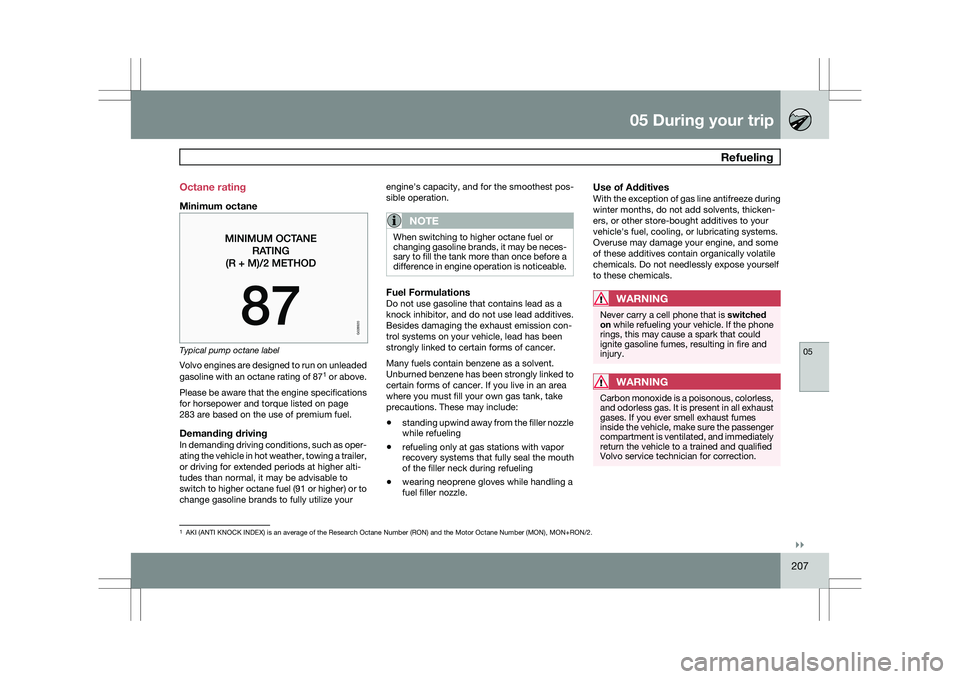
Typical pump octane label
Volvo engines are designed to run on unleaded
gasoline with an octane rating of 87
1
or above.
Please be aware that the engine specifications
for horsepower and torque listed on page
283 are based on the use of premium fuel.
Demanding drivingIn demanding driving conditions, such as oper-
ating the vehicle in hot weather, towing a trailer,
or driving for extended periods at higher alti-
tudes than normal, it may be advisable to
switch to higher octane fuel (91 or higher) or to
change gasoline brands to fully utilize your engine\fs capacity, and for the smoothest pos-
sible operation.
NOTE When switching to higher octane fuel or
changing gasoline brands, it may be neces-
sary to fill the tank more than once before a
difference in engine operation is noticeable.
Fuel FormulationsDo not use gasoline that contains lead as a
knock inhibitor, and do not use lead additives.
Besides damaging the exhaust emission con-
trol systems on your vehicle, lead has been
strongly linked to certain forms of cancer.
Many fuels contain benzene as a solvent.
Unburned benzene has been strongly linked to
certain forms of cancer. If you live in an area
where you must fill your own gas tank, take
precautions. These may include:
\b
standing upwind away from the filler nozzle
while refueling
\b refueling only at gas stations with vapor
recovery systems that fully seal the mouth
of the filler neck during refueling
\b wearing neoprene gloves while handling a
fuel filler nozzle.
Use of AdditivesWith the exception of gas line antifreeze during
winter months, do not add solvents, thicken-
ers, or other store-bought additives to your
vehicle\fs fuel, cooling, or lubricating systems.
Overuse may damage your engine, and some
of these additives contain organically volatile
chemicals. Do not needlessly expose yourself
to these chemicals.
WARNING Never carry a cell phone that is
switched
on while refueling your vehicle. If the phone
rings, this may cause a spark that could
ignite gasoline fumes, resulting in fire and
injury.
WARNING Carbon monoxide is a poisonous, colorless,
and odorless gas. It is present in all exhaust
gases. If you ever smell exhaust fumes
inside the vehicle, make sure the passenger
compartment is ventilated, and immediately
return the vehicle to a trained and qualified
Volvo service technician for correction.
1
AKI (ANTI KNOCK INDEX) is an average of the Research Octane Number (R\
ON) and the Motor Octane Number (MON), MON+RON/2.
G028920
Page 215 of 297
05 During your trip
Cargo area05
}}
* Option/accessory, for more information, see Introduction. 213
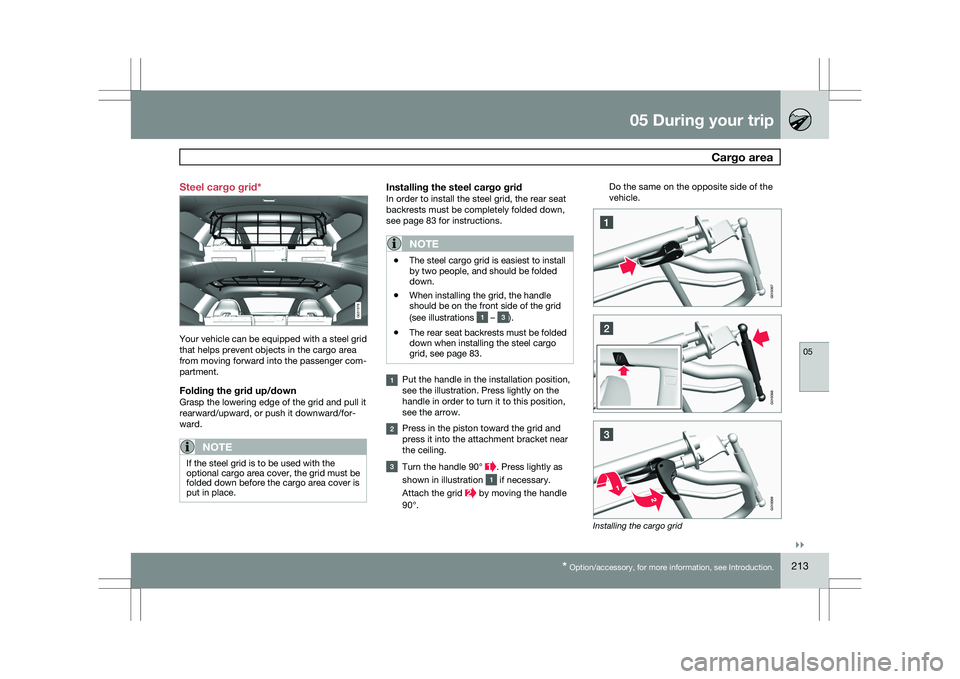
Steel cargo grid*
Your vehicle can be equipped with a steel grid
that helps prevent objects in the cargo area
from moving forward into the passenger com-
partment.
Folding the grid up/downGrasp the lowering edge of the grid and pull it
rearward/upward, or push it downward/for-
ward.
NOTE
If the steel grid is to be used with the
optional cargo area cover, the grid must be
folded down before the cargo area cover is
put in place.
Installing the steel cargo gridIn order to install the steel grid, the rear seat
backrests must be completely folded down,
see page 83 for instructions.
NOTE \b
The steel cargo grid is easiest to install
by two people, and should be folded
down.
\b When installing the grid, the handle
should be on the front side of the grid
(see illustrations – ).
\b The rear seat backrests must be folded
down when installing the steel cargo
grid, see page 83. Put the handle in the installation position,
see the illustration. Press lightly on the
handle in order to turn it to this position,
see the arrow.
Press in the piston toward the grid and
press it into the attachment bracket near
the ceiling.
Turn the handle 90° . Press lightly as
shown in illustration if necessary.
Attach the grid by moving the handle
90°. Do the same on the opposite side of the
vehicle.
Installing the cargo grid G031978 G018367 G018368 G018369
Page 216 of 297
05 During your tripCargo area 05
214
* Option/accessory, for more information, see Introduction.
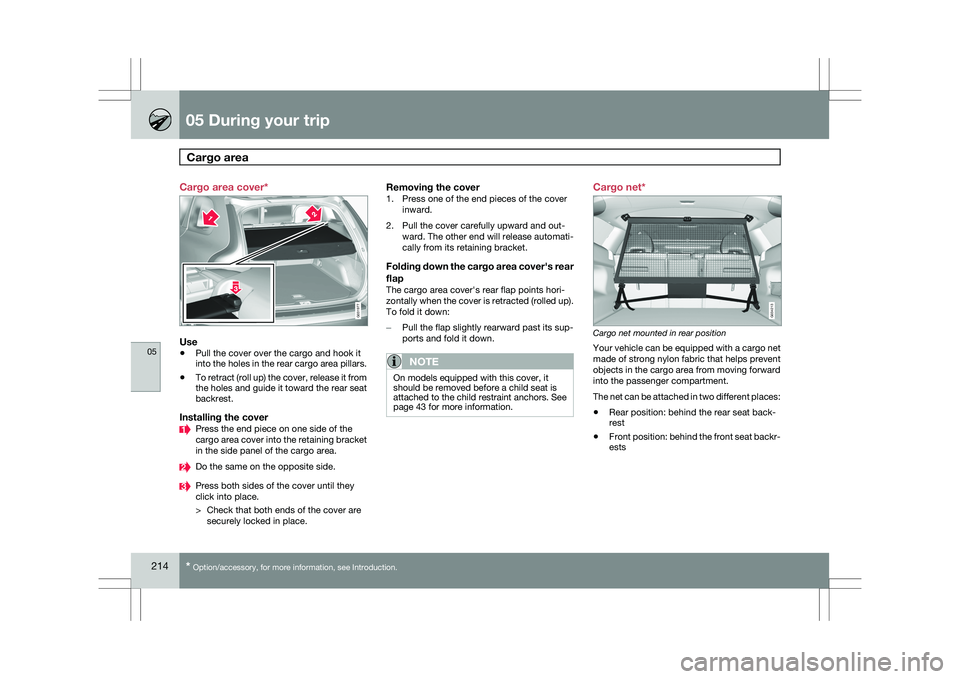
Cargo area cover*
Use
\b
Pull the cover over the cargo and hook it
into the holes in the rear cargo area pillars.
\b To retract (roll up) the cover, release it from
the holes and guide it toward the rear seat
backrest.
Installing the cover Press the end piece on one side of the
cargo area cover into the retaining bracket
in the side panel of the cargo area.
Do the same on the opposite side.
Press both sides of the cover until they
click into place.
> Check that both ends of the cover are
securely locked in place.
Removing the cover1. Press one of the end pieces of the cover inward.
2. Pull the cover carefully upward and out- ward. The other end will release automati-
cally from its retaining bracket.
Folding down the cargo area cover\fs rear
flap
The cargo area cover\fs rear flap points hori-
zontally when the cover is retracted (rolled up).
To fold it down:
–Pull the flap slightly rearward past its sup-
ports and fold it down.
NOTE On models equipped with this cover, it
should be removed before a child seat is
attached to the child restraint anchors. See
page 43 for more information. Cargo net*
Cargo net mounted in rear position
Your vehicle can be equipped with a cargo net
made of strong nylon fabric that helps prevent
objects in the cargo area from moving forward
into the passenger compartment.
The net can be attached in two different places:
\b
Rear position: behind the rear seat back-
rest
\b Front position: behind the front seat backr-
ests G031977 G034213