Page 132 of 520

132
2-1. Driving procedures
Driving the vehicle
Starting on a steep uphillWith the brake pedal depressed, firmly set the parking brake
and shift the shift lever to D.
Gently depress the accelerator pedal.
Release the parking brake.
The following procedures should be observed to ensure safe driv-
ing.
■ Starting the engine ( P. 140)
■ Driving
With the brake pedal depressed, shift the shift lever to D. ( P. 143)
Release the parking brake. ( P. 146)
Gradually release the brake pedal and gently depress the
accelerator pedal to accelerate the vehicle.
■ Stopping
With the shift lever in D, depress the brake pedal.
If necessary, set the parking brake.
When the vehicle is stopped for an extended period of time, shift
the shift lever to P or N. (
P. 1 4 3)
■Parking the vehicle
With the shift lever in D, depress the brake pedal.
Set the parking brake. ( P. 146)
Shift the shift lever to P. ( P. 143)
When parking on a hill, if necessary, block the wheels.
Turn the engine switch off to stop the engine.
Lock the door, making sure that you have the key on your
person.
Page 136 of 520

136 2-1. Driving procedures
CAUTION
■When driving on slippery road surfaces
●After driving through a puddle, lightly depress the brake pedal to make
sure that the brakes are functioning properly. Wet brake pads may prevent
the brakes from functioning properly. If the brakes on only one side are wet
and not functioning properly, steering control may be affected, resulting in
an accident.
■ When shifting the shift lever
Be careful not to shift the shift lever with the accelerator pedal depressed.
This may lead to unexpected rapid acceleration of the vehicle that may
cause an accident and result in death or serious injury.
■ When the vehicle is stopped
●Do not race the engine.
If the vehicle is in any gear other than P or N, the vehicle may accelerate
suddenly and unexpectedly, and may cause an accident.
● Do not leave the vehicle with the engine running for a long time.
If such a situation cannot be avoided, park the vehicle in an open space
and check that exhaust fumes do not enter the vehicle interior.
● Always keep a foot on the brake pedal while the engine is running to pre-
vent an accident caused by the vehicle moving.
■ When the vehicle is parked
●Do not leave glasses, cigarette lighters, spray cans, or soft drink cans in
the vehicle when it is in the sun.
Doing so may result in the following.
• Gas may leak from a cigarette lighter or spray can, and may lead to a
fire.
• The temperature inside the vehicle may cause the plastic lenses and plastic material of eye glasses to deform or crack.
• Soft drink cans may fracture, causing the contents to spray over the interior of the vehicle, and may also cause a short circuit in the vehi-
cle’s electrical components.
● Always apply the parking brake, shift the shift lever to P, stop the engine
and lock the vehicle.
Do not leave the vehicle unattended while the engine is running.
Page 140 of 520
140
2-1. Driving procedures
Engine (ignition) switch
■Engine switch
LOCK
The steering wheel is locked
and the key can be removed.
(The key can be removed only
when the shift lever is in P.)
ACC
Some electrical components
such as the audio system can
be used.
ON
All electrical components can
be used.
START
For starting the engine.
■Starting the engine
Check that the parking brake is set.
Check that the shift lever is set in P.
Sit in the driver’s seat and firmly depress the brake pedal.
Turn the engine switch to the START position and start the
engine.
The engine will crank until it starts or for up to 25 seconds, which-
ever is less. If you turn the engine switch, the engine will keep
cranking for about 30 seconds maximum.
Continue depressing the brake pedal until the engine is com-
pletely started.
Page 141 of 520
141
2-1. Driving procedures
2
When driving
■
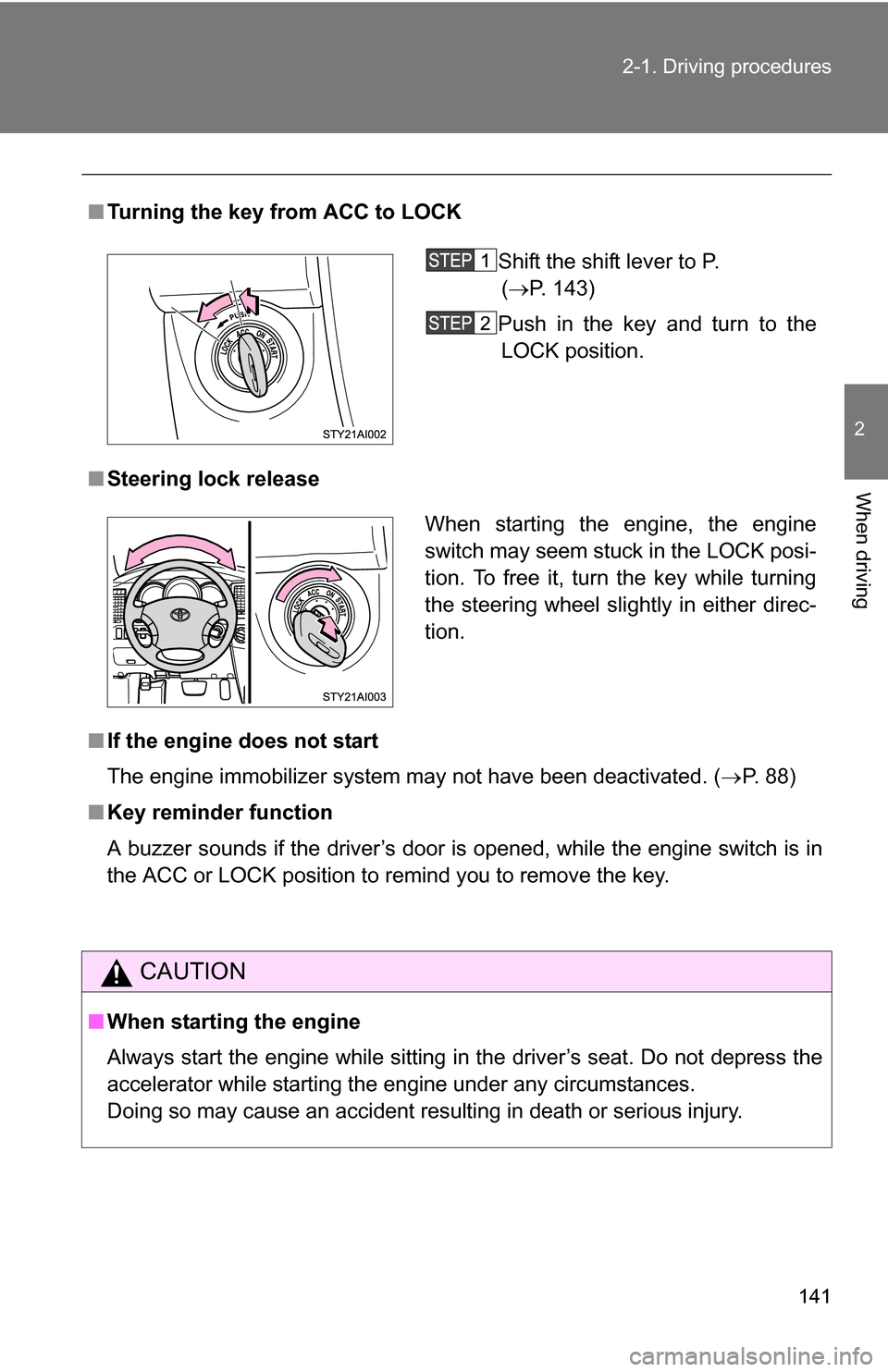
Turning the key from ACC to LOCK
■ Steering lock release
■ If the engine does not start
The engine immobilizer system may not have been deactivated. ( P. 88)
■ Key reminder function
A buzzer sounds if the driver’s door is opened, while the engine switch is in
the ACC or LOCK position to remind you to remove the key.
CAUTION
■When starting the engine
Always start the engine while sitting in the driver’s seat. Do not depress the
accelerator while starting the engine under any circumstances.
Doing so may cause an accident resulting in death or serious injury.
Shift the shift lever to P.
( P. 143)
Push in the key and turn to the LOCK position.
When starting the engine, the engine
switch may seem stuck in the LOCK posi-
tion. To free it, turn the key while turning
the steering wheel slightly in either direc-
tion.
Page 142 of 520
142 2-1. Driving procedures
CAUTION
■Caution while driving
Do not turn the engine switch to the LOCK position.
If in an emergency, you must turn the engine off while the vehicle is moving,
turn the engine switch only to the ACC position.
NOTICE
■To prevent battery discharge
Do not leave the engine switch in the ACC or ON position for long periods if
the engine is not running.
■ When starting the engine
●Do not crank for more than 30 seconds at a time. This may overheat the
starter and wiring systems.
● Do not race a cold engine.
● If the engine becomes difficult to start or stalls frequently, have the engine
checked immediately.
Page 147 of 520
147
2-1. Driving procedures
2
When driving
Hor n
■After adjusting the steering wheel
Make sure that the steering wheel is securely locked.
The horn may not sound if the steering wheel is not securely locked.
(P. 69)
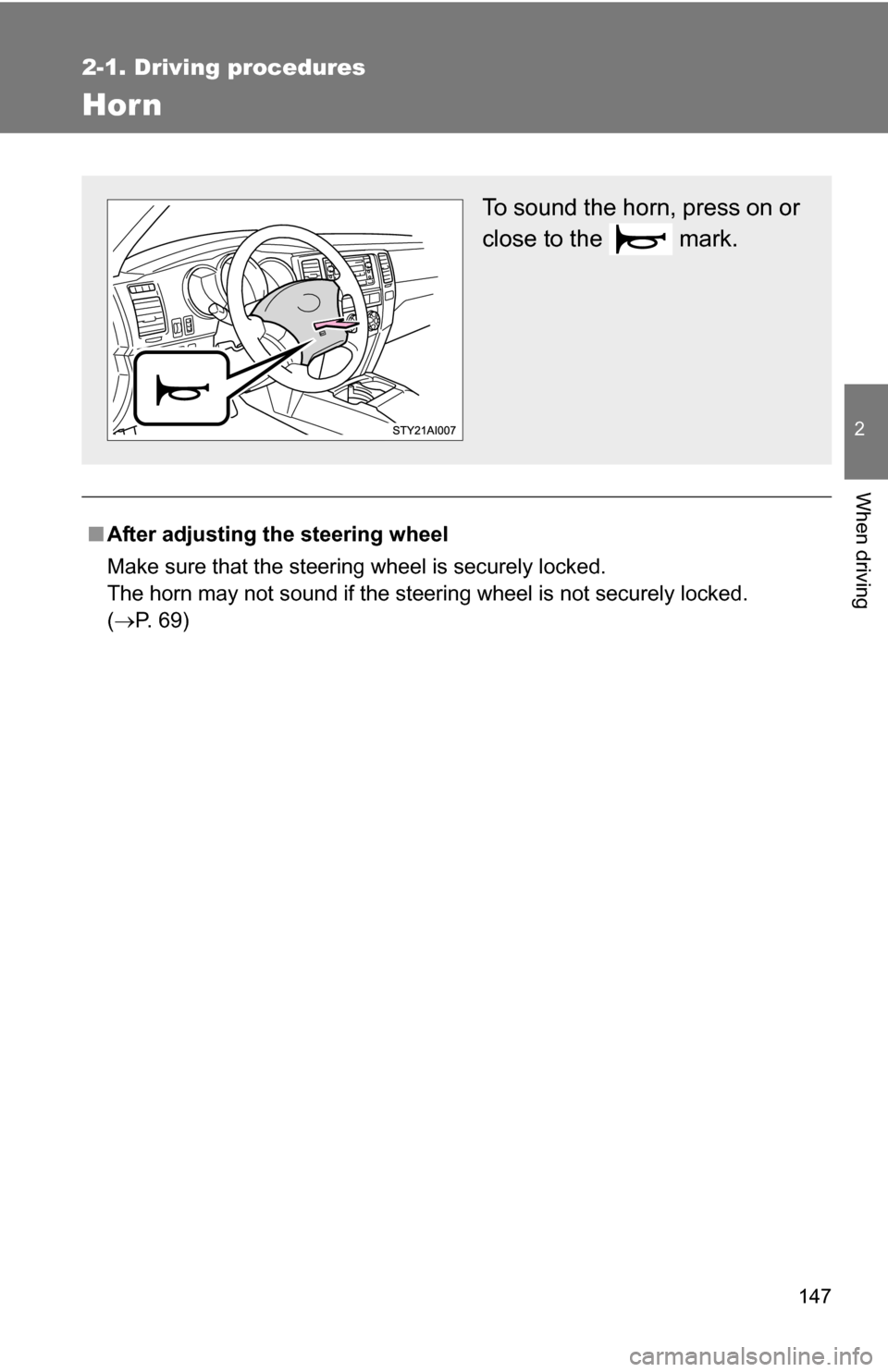
To sound the horn, press on or
close to the mark.
Page 153 of 520
153
2-2. Instrument cluster
2
When driving
■
Indicators
The indicators inform the driver of the operating state of the
vehicle’s various systems.
Turn signal indicator
(P. 145)*Slip indicator
( P. 175, 183, 189)
Headlight high beam
indicator ( P. 159)*VSC OFF indicator
(P. 179, 191)
(U.S.A.)
Headlight indicator
(P. 158)
(if equipped)
Active traction control
indicator ( P. 182)
(Canada)
Tail light indicator
(P. 158) *AUTO LSD indicator
( P. 175, 190)
(if equipped)
Front fog light indicator
(P. 162)
(if equipped)
Four-wheel drive
indicator( P. 177)
Security indicator
(P. 88)
(4WD models)
Center differential lock
indicator ( P. 179)
Shift position and shift
range indicators
(P. 143)(4WD models)
4LO indicator ( P. 177)
*
(if equipped)
Rear differential lock
indicator (P. 184)
Cruise control indicator
(P. 166) *
(if equipped)
Downhill assist control
indicator ( P. 186)
Page 155 of 520
155
2-2. Instrument cluster
2
When driving
Accessor y meter
RESET button
MODE button
Trip information display (air conditioning system without DUAL
button)
Displays the trip information. ( P. 156)
Outside temperature and trip information display (air condition-
ing system with DUAL button)
Displays the outside temperature and trip information. ( P. 156, 326)
Clock
(P. 325)
Outside temperature display (air conditioning system without
DUAL button)
Displays the outside air temperature. ( P. 326)
:00 button (P. 325)
M (Minute) button ( P. 325)
H (Hour) button (P. 325)