2009 SUBARU TRIBECA battery
[x] Cancel search: batteryPage 1654 of 2453
GD(H6DO)-42
Diagnostic Trouble Code (DTC) Detecting Criteria
GENERAL DESCRIPTION
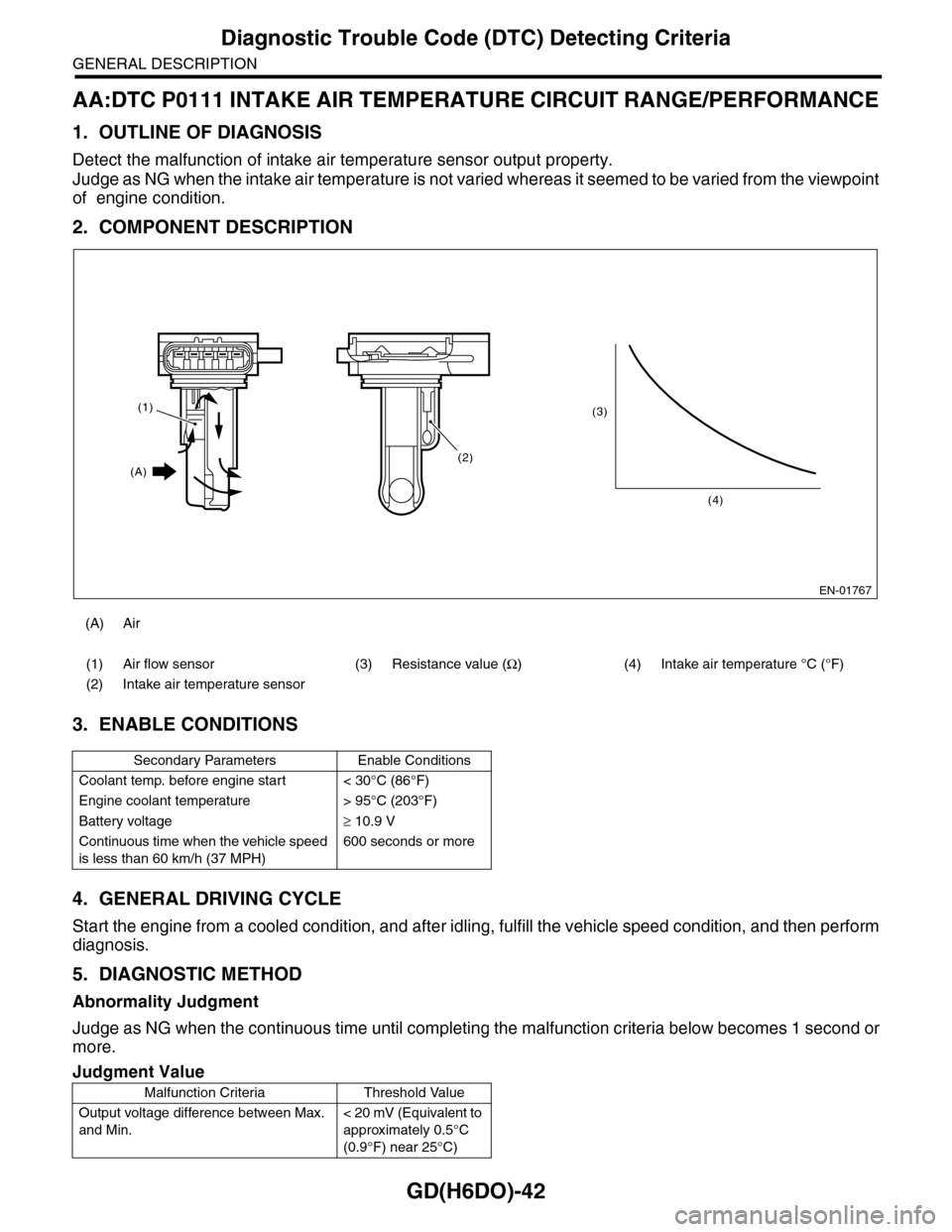
AA:DTC P0111 INTAKE AIR TEMPERATURE CIRCUIT RANGE/PERFORMANCE
1. OUTLINE OF DIAGNOSIS
Detect the malfunction of intake air temperature sensor output property.
Judge as NG when the intake air temperature is not varied whereas it seemed to be varied from the viewpoint
of engine condition.
2. COMPONENT DESCRIPTION
3. ENABLE CONDITIONS
4. GENERAL DRIVING CYCLE
Start the engine from a cooled condition, and after idling, fulfill the vehicle speed condition, and then perform
diagnosis.
5. DIAGNOSTIC METHOD
Abnormality Judgment
Judge as NG when the continuous time until completing the malfunction criteria below becomes 1 second or
more.
(A) Air
(1) Air flow sensor (3) Resistance value (Ω)(4)Intake air temperature °C (°F)
(2) Intake air temperature sensor
Secondary Parameters Enable Conditions
Coolant temp. before engine start < 30°C (86°F)
Engine coolant temperature > 95°C (203°F)
Battery voltage≥ 10.9 V
Continuous time when the vehicle speed
is less than 60 km/h (37 MPH)
600 seconds or more
Judgment Value
Malfunction Criteria Threshold Value
Output voltage difference between Max.
and Min.
< 20 mV (Equivalent to
approximately 0.5°C
(0.9°F) near 25°C)
EN-01767
(3)
(4)
(2)
(1)
(A)
Page 1668 of 2453
GD(H6DO)-56
Diagnostic Trouble Code (DTC) Detecting Criteria
GENERAL DESCRIPTION
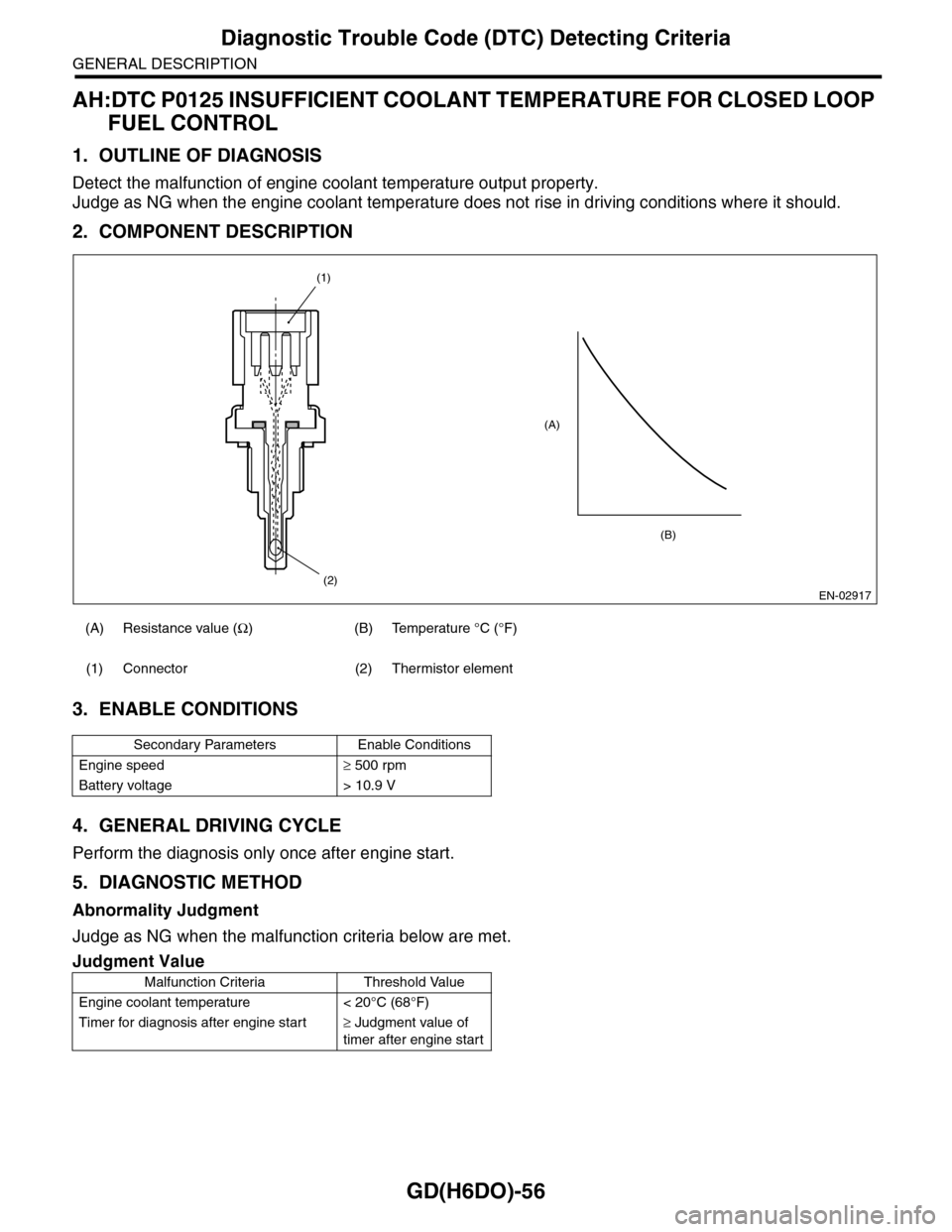
AH:DTC P0125 INSUFFICIENT COOLANT TEMPERATURE FOR CLOSED LOOP
FUEL CONTROL
1. OUTLINE OF DIAGNOSIS
Detect the malfunction of engine coolant temperature output property.
Judge as NG when the engine coolant temperature does not rise in driving conditions where it should.
2. COMPONENT DESCRIPTION
3. ENABLE CONDITIONS
4. GENERAL DRIVING CYCLE
Perform the diagnosis only once after engine start.
5. DIAGNOSTIC METHOD
Abnormality Judgment
Judge as NG when the malfunction criteria below are met.
(A) Resistance value (Ω) (B) Temperature °C (°F)
(1) Connector (2) Thermistor element
Secondary Parameters Enable Conditions
Engine speed≥ 500 rpm
Battery voltage > 10.9 V
Judgment Value
Malfunction Criteria Threshold Value
Engine coolant temperature < 20°C (68°F)
Timer for diagnosis after engine star t≥ Judgment value of
timer after engine start
EN-02917
(A)
(2)
(1)
(B)
Page 1670 of 2453
GD(H6DO)-58
Diagnostic Trouble Code (DTC) Detecting Criteria
GENERAL DESCRIPTION
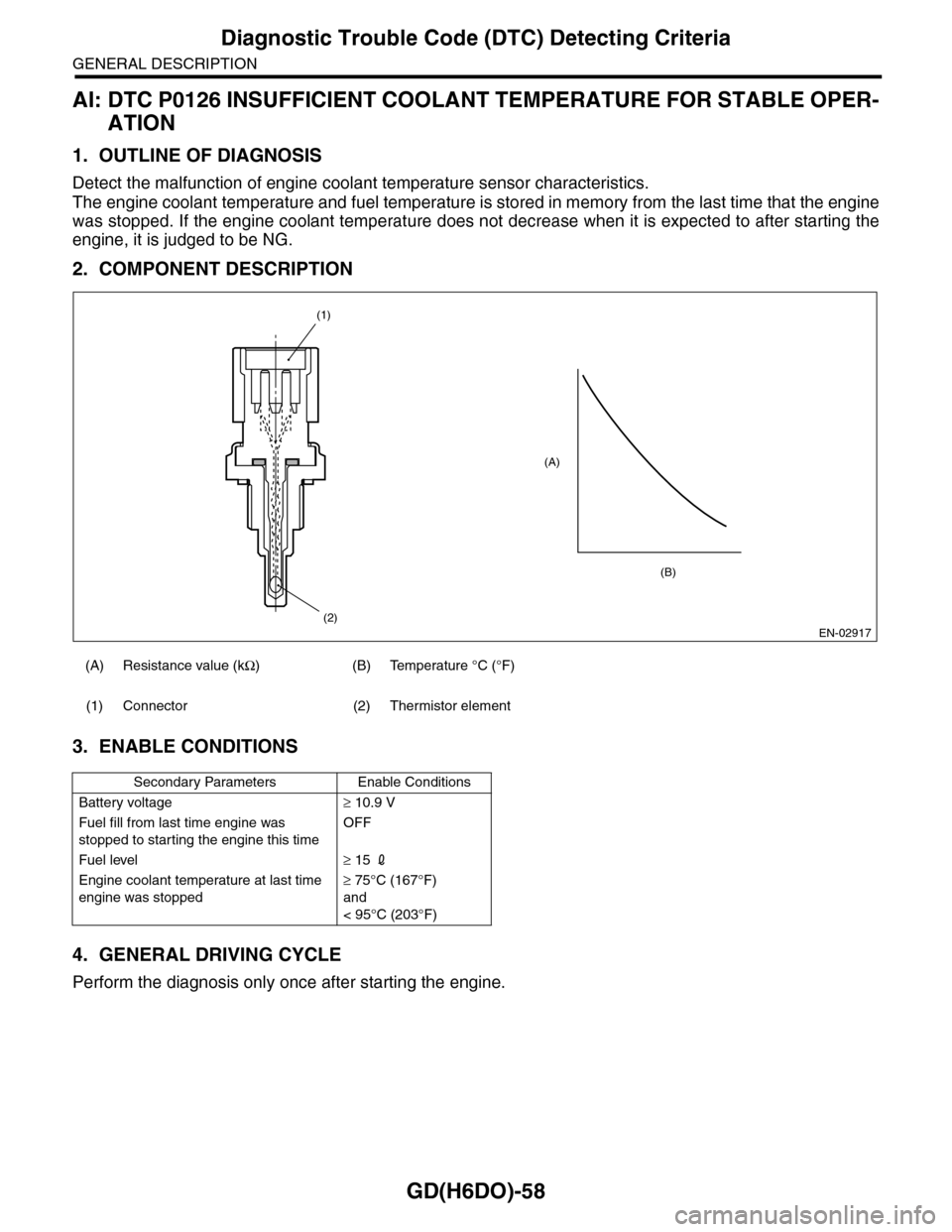
AI: DTC P0126 INSUFFICIENT COOLANT TEMPERATURE FOR STABLE OPER-
ATION
1. OUTLINE OF DIAGNOSIS
Detect the malfunction of engine coolant temperature sensor characteristics.
The engine coolant temperature and fuel temperature is stored in memory from the last time that the engine
was stopped. If the engine coolant temperature does not decrease when it is expected to after starting the
engine, it is judged to be NG.
2. COMPONENT DESCRIPTION
3. ENABLE CONDITIONS
4. GENERAL DRIVING CYCLE
Perform the diagnosis only once after starting the engine.
(A) Resistance value (kΩ)(B)Temperature °C (°F)
(1) Connector (2) Thermistor element
Secondary Parameters Enable Conditions
Battery voltage≥ 10.9 V
Fuel fill from last time engine was
stopped to starting the engine this time
OFF
Fuel level≥ 15 2
Engine coolant temperature at last time
engine was stopped
≥ 75°C (167°F)
and
< 95°C (203°F)
EN-02917
(A)
(2)
(1)
(B)
Page 1673 of 2453
GD(H6DO)-61
Diagnostic Trouble Code (DTC) Detecting Criteria
GENERAL DESCRIPTION
5. DIAGNOSTIC METHOD
Abnormality Judgment
Judge as NG when the continuous time until completing the malfunction criteria below becomes 23 second
or more.
Time Needed for Diagnosis: 23 seconds
Malfunction Indicator Light Illumination: Illuminates when malfunctions occur in 2 continuous driving cy-
cles.
Normality Judgment
Judge as OK and clear the NG when the malfunction criteria below are met.
6. DTC CLEAR CONDITION
•When the OK idling cycle is completed 40 times in a row
•When “Clear Memory” is performed
7. MALFUNCTION INDICATOR LIGHT CLEAR CONDITIONS
•When the OK driving cycle is completed 3 times in a row
•When “Clear Memory” is performed
8. FAIL SAFE
None
9. ECM OPERATION AT DTC SETTING
Memorize the freeze frame data. (For test mode $02)
Judgment Value
Malfunction Criteria Threshold Value
Battery voltage≥ 10.9 V
Estimate ambient temperature≥ –7°C (19.4°F)
Thermostat malfunction diagnosis Incomplete
Engine coolant temperature at engine
starting
< 55°C (131°F)
Estimated coolant temperature≥ 75°C (167°F)
Engine coolant temperature≤ 75°C (167°F)
(Estimated – measured) coolant temper-
ature
> 20°C (68°F)
Ve h i c l e s p e e d≥ 20 km/h (12 MPH)
Judgment Value
Malfunction Criteria Threshold Value
Battery voltage≥ 10.9 V
Estimate ambient temperature≥ –7°C (19.4°F)
Thermostat malfunction diagnosis Incomplete
Engine coolant temperature at engine
starting
< 55°C (131°F)
Engine coolant temperature≥ 75°C (167°F)
(Estimated – measured) coolant temper-
ature
≤ 20°C (68°F)
Page 1679 of 2453
GD(H6DO)-67
Diagnostic Trouble Code (DTC) Detecting Criteria
GENERAL DESCRIPTION
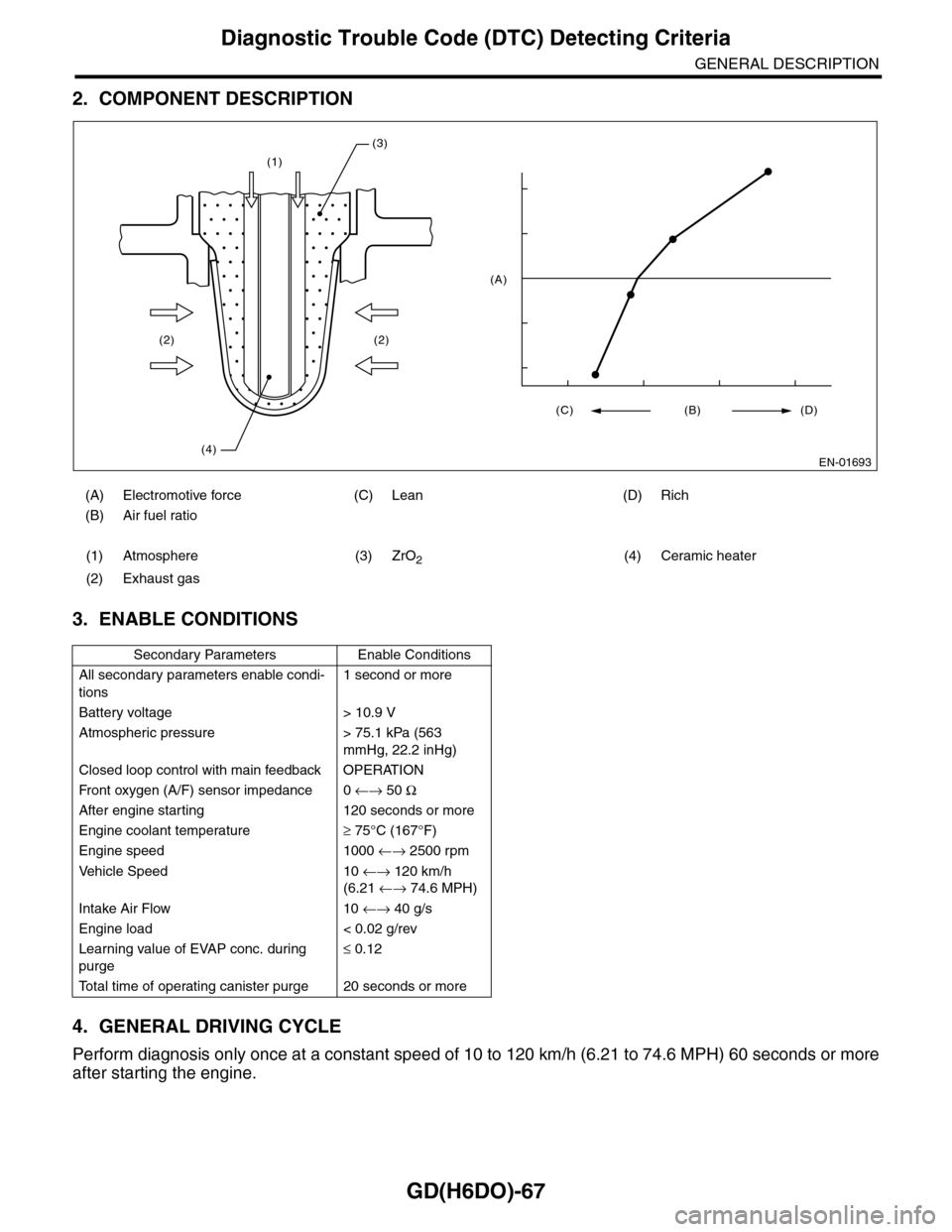
2. COMPONENT DESCRIPTION
3. ENABLE CONDITIONS
4. GENERAL DRIVING CYCLE
Perform diagnosis only once at a constant speed of 10 to 120 km/h (6.21 to 74.6 MPH) 60 seconds or more
after starting the engine.
(A) Electromotive force (C) Lean (D) Rich
(B) Air fuel ratio
(1) Atmosphere (3) ZrO2(4) Ceramic heater
(2) Exhaust gas
Secondary Parameters Enable Conditions
All secondary parameters enable condi-
tions
1 second or more
Battery voltage > 10.9 V
Atmospheric pressure > 75.1 kPa (563
mmHg, 22.2 inHg)
Closed loop control with main feedback OPERATION
Fr o nt ox yg e n ( A / F) s en so r im pe d an c e 0 ←→ 50 Ω
After engine starting 120 seconds or more
Engine coolant temperature≥ 75°C (167°F)
Engine speed 1000 ←→ 2500 rpm
Ve h i c l e S p e e d 1 0 ←→ 120 km/h
(6.21 ←→ 74.6 MPH)
Intake Air Flow 10 ←→ 40 g/s
Engine load < 0.02 g/rev
Learning value of EVAP conc. during
purge
≤ 0.12
To t a l t i m e o f o p e r a t i n g c a n i s t e r p u r g e 2 0 s e c o n d s o r m o r e
(1)
(2)
(4)
(2)
(3)
EN-01693
(C) (B) (D)
(A)
Page 1684 of 2453
GD(H6DO)-72
Diagnostic Trouble Code (DTC) Detecting Criteria
GENERAL DESCRIPTION
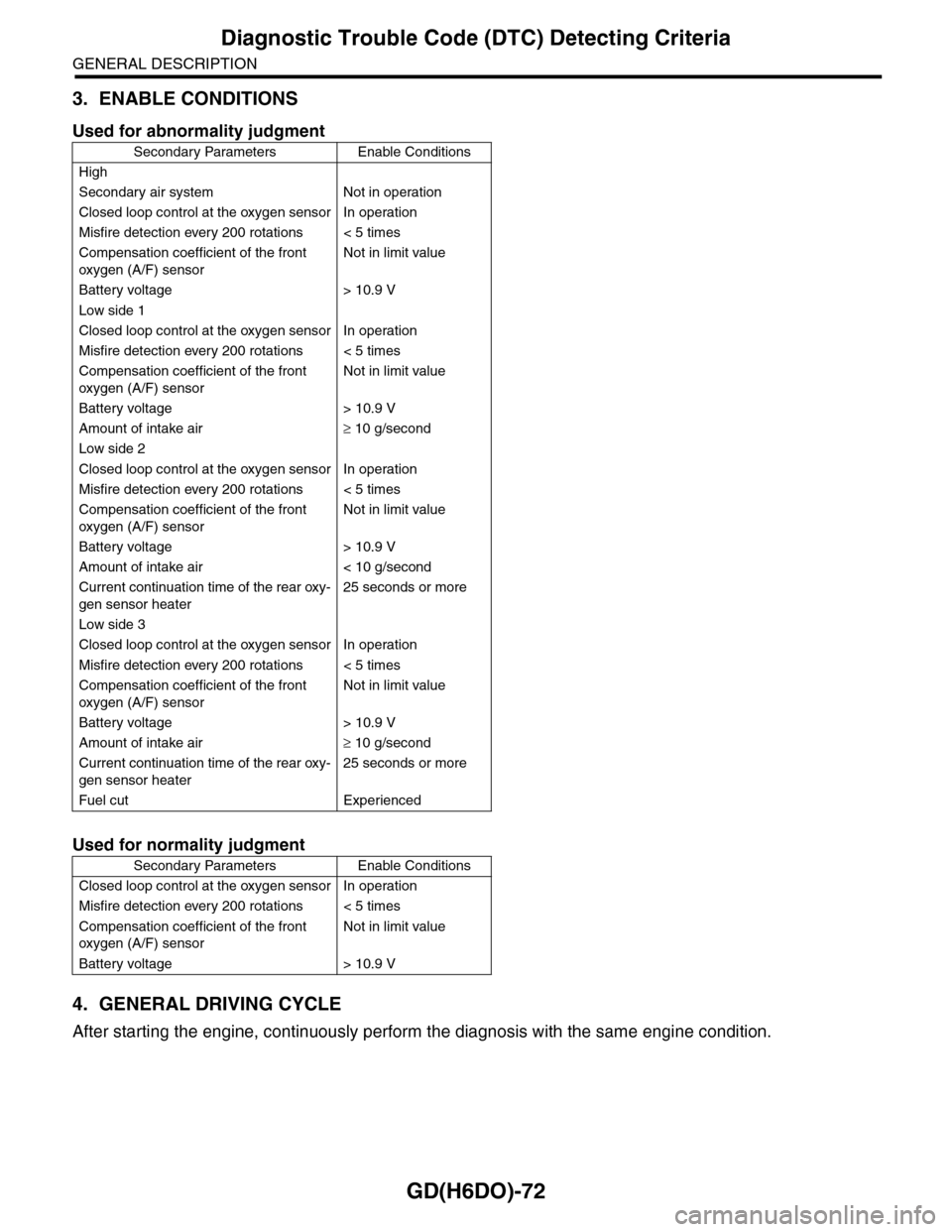
3. ENABLE CONDITIONS
4. GENERAL DRIVING CYCLE
After starting the engine, continuously perform the diagnosis with the same engine condition.
Used for abnormality judgment
Secondary Parameters Enable Conditions
High
Secondary air system Not in operation
Closed loop control at the oxygen sensor In operation
Misfire detection every 200 rotations < 5 times
Compensation coefficient of the front
oxygen (A/F) sensor
Not in limit value
Battery voltage > 10.9 V
Low side 1
Closed loop control at the oxygen sensor In operation
Misfire detection every 200 rotations < 5 times
Compensation coefficient of the front
oxygen (A/F) sensor
Not in limit value
Battery voltage > 10.9 V
Amount of intake air≥ 10 g/second
Low side 2
Closed loop control at the oxygen sensor In operation
Misfire detection every 200 rotations < 5 times
Compensation coefficient of the front
oxygen (A/F) sensor
Not in limit value
Battery voltage > 10.9 V
Amount of intake air < 10 g/second
Current continuation time of the rear oxy-
gen sensor heater
25 seconds or more
Low side 3
Closed loop control at the oxygen sensor In operation
Misfire detection every 200 rotations < 5 times
Compensation coefficient of the front
oxygen (A/F) sensor
Not in limit value
Battery voltage > 10.9 V
Amount of intake air≥ 10 g/second
Current continuation time of the rear oxy-
gen sensor heater
25 seconds or more
Fuel cut Experienced
Used for normality judgment
Secondary Parameters Enable Conditions
Closed loop control at the oxygen sensor In operation
Misfire detection every 200 rotations < 5 times
Compensation coefficient of the front
oxygen (A/F) sensor
Not in limit value
Battery voltage > 10.9 V
Page 1687 of 2453
GD(H6DO)-75
Diagnostic Trouble Code (DTC) Detecting Criteria
GENERAL DESCRIPTION
AQ:DTC P0139 O2 SENSOR CIRCUIT SLOW RESPONSE (BANK 1 SENSOR 2)
1. OUTLINE OF DIAGNOSIS
Detect the slow response of the oxygen sensor.
Judge as NG if either the rich to lean response diagnosis or lean to rich response diagnosis is NG, and Judge
as OK if both are OK.
[Rich → Lean diagnosis response]
1. Measure the response time for oxygen sensor output changes when the A/F ratio changes to rich to lean.
If the measured response time is larger than the threshold value, it is NG. If it is smaller, it is OK.
2. Judge as NG when the oxygen sensor voltage is large (rich) when recovering from a deceleration fuel cut.
[Lean → Rich diagnosis response]
1. Measure the response time for oxygen sensor output changes when the A/F ratio changes to lean to rich.
If the measured response time is larger than the threshold value, it is NG.
2. Judge as NG when the oxygen sensor voltage remains small when recovering from a deceleration fuel cut.
Diagnostic method
Measure the response time of the output change of the oxygen sensor when the A/F ratio changes to rich to
lean. And Judge as NG when the measured response time is larger than the threshold value.
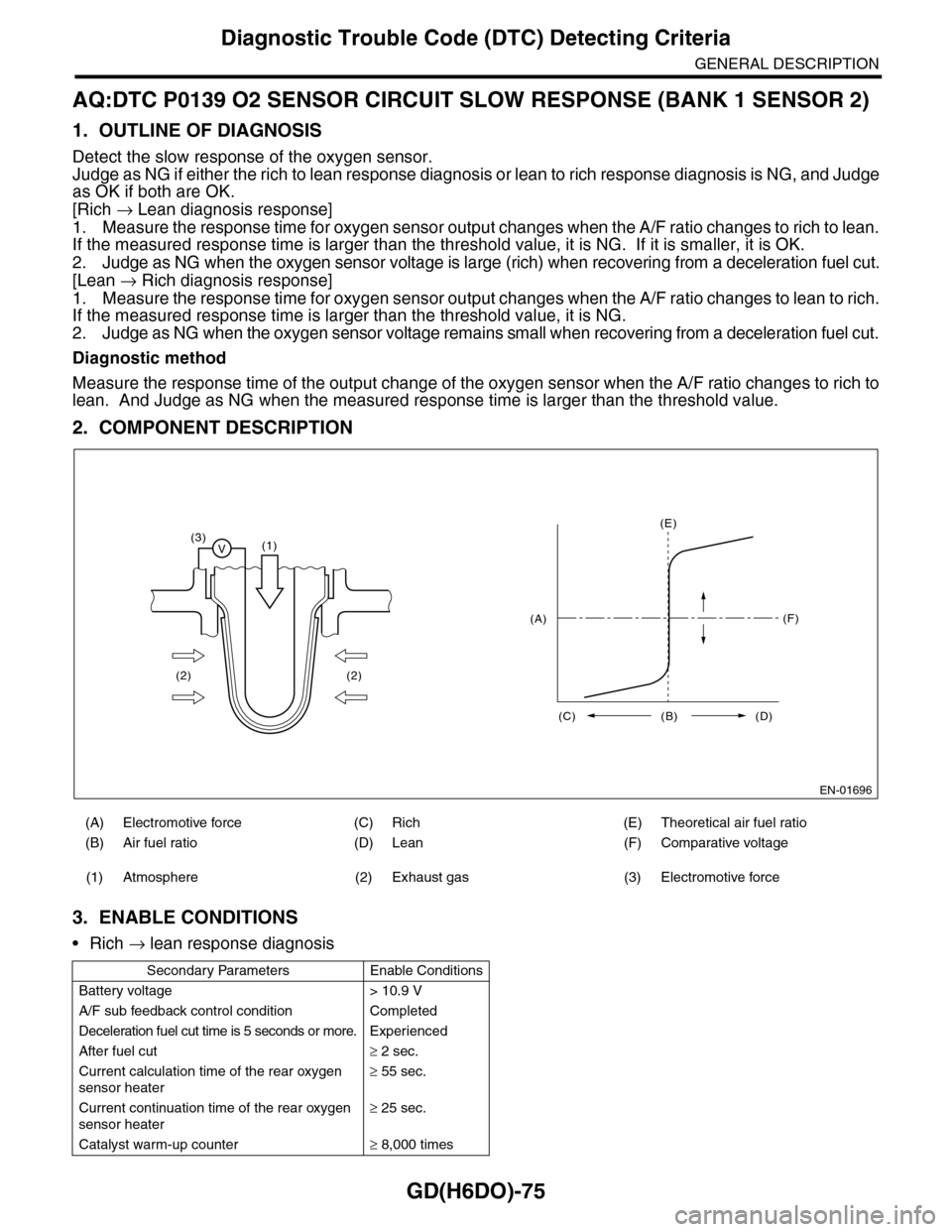
2. COMPONENT DESCRIPTION
3. ENABLE CONDITIONS
•Rich → lean response diagnosis
(A) Electromotive force (C) Rich (E) Theoretical air fuel ratio
(B) Air fuel ratio (D) Lean (F) Comparative voltage
(1) Atmosphere (2) Exhaust gas (3) Electromotive force
Secondary Parameters Enable Conditions
Battery voltage > 10.9 V
A/F sub feedback control condition Completed
Deceleration fuel cut time is 5 seconds or more. Experienced
After fuel cut≥ 2 sec.
Current calculation time of the rear oxygen
sensor heater
≥ 55 sec.
Current continuation time of the rear oxygen
sensor heater
≥ 25 sec.
Catalyst warm-up counter≥ 8,000 times
EN-01696
(3)V(1)
(2) (2)
(E)
(F)
(C) (B) (D)
(A)
Page 1689 of 2453
GD(H6DO)-77
Diagnostic Trouble Code (DTC) Detecting Criteria
GENERAL DESCRIPTION
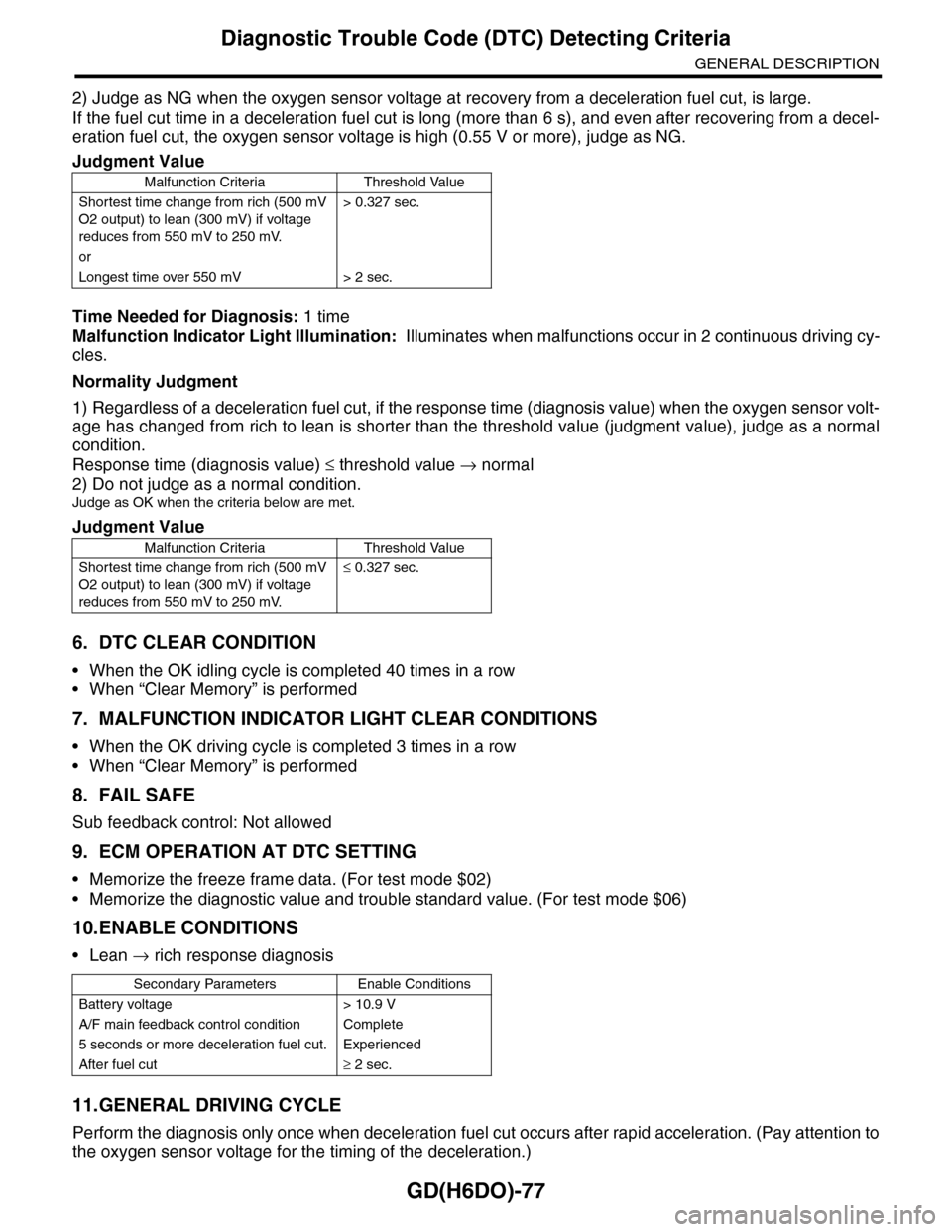
2) Judge as NG when the oxygen sensor voltage at recovery from a deceleration fuel cut, is large.
If the fuel cut time in a deceleration fuel cut is long (more than 6 s), and even after recovering from a decel-
eration fuel cut, the oxygen sensor voltage is high (0.55 V or more), judge as NG.
Time Needed for Diagnosis: 1 time
Malfunction Indicator Light Illumination: Illuminates when malfunctions occur in 2 continuous driving cy-
cles.
Normality Judgment
1) Regardless of a deceleration fuel cut, if the response time (diagnosis value) when the oxygen sensor volt-
age has changed from rich to lean is shorter than the threshold value (judgment value), judge as a normal
condition.
Response time (diagnosis value) ≤ threshold value → normal
2) Do not judge as a normal condition.
Judge as OK when the criteria below are met.
6. DTC CLEAR CONDITION
•When the OK idling cycle is completed 40 times in a row
•When “Clear Memory” is performed
7. MALFUNCTION INDICATOR LIGHT CLEAR CONDITIONS
•When the OK driving cycle is completed 3 times in a row
•When “Clear Memory” is performed
8. FAIL SAFE
Sub feedback control: Not allowed
9. ECM OPERATION AT DTC SETTING
•Memorize the freeze frame data. (For test mode $02)
•Memorize the diagnostic value and trouble standard value. (For test mode $06)
10.ENABLE CONDITIONS
•Lean → rich response diagnosis
11.GENERAL DRIVING CYCLE
Perform the diagnosis only once when deceleration fuel cut occurs after rapid acceleration. (Pay attention to
the oxygen sensor voltage for the timing of the deceleration.)
Judgment Value
Malfunction Criteria Threshold Value
Shortest time change from rich (500 mV
O2 output) to lean (300 mV) if voltage
reduces from 550 mV to 250 mV.
> 0.327 sec.
or
Longest time over 550 mV > 2 sec.
Judgment Value
Malfunction Criteria Threshold Value
Shortest time change from rich (500 mV
O2 output) to lean (300 mV) if voltage
reduces from 550 mV to 250 mV.
≤ 0.327 sec.
Secondary Parameters Enable Conditions
Battery voltage > 10.9 V
A/F main feedback control condition Complete
5 seconds or more deceleration fuel cut. Experienced
After fuel cut≥ 2 sec.