2009 SUBARU TRIBECA fuse
[x] Cancel search: fusePage 380 of 2453

AC(diag)-3
General Description
HVAC SYSTEM (AUTO A/C) (DIAGNOSTICS)
2. General Description
A: CAUTION
1) Never connect the battery in reverse polarity.
•Auto A/C control module may be destroyed in-
stantly.
2) Do not disconnect the battery terminals while the
engine is running.
•A large counter electromotive force will be gener-
ated in the generator, and this voltage may damage
electronic parts such as auto A/C control module
etc.
3) Before disconnecting the connectors of each
sensor and the auto A/C control module, be sure to
turn the ignition switch to OFF.
•Auto A/C control module may be damaged.
4) Every A/C-related part is a precision part. Do not
drop them.
5) Airbag system wiring harness is routed near the
A/C control panel and junction box.
CAUTION:
•For airbag system, yellow-colored wiring har-
ness and connectors are all used. Do not use
the electrical test equipment on these circuits.
•Be careful not to damage the airbag system
wiring harness when servicing the A/C control
panel and junction box.
B: INSPECTION
Before performing the diagnosis, check the follow-
ing items which might affect A/C system problems.
1. BATTERY
1) Measure the battery voltage and specific gravity
of electrolyte.
Standard voltage: 12 V
Specific gravity: 1.260 or more
2) Check the condition of the fuses for A/C system
power supply and other fuses.
3) Check the condition of harness and harness
connector connections.
2. ASPIRATOR HOSE
1) Turn the ignition switch to ON, and press the A/
C switch.
2) Turn the temperature control dial to maximum
hot position.
3) Turn the air flow control dial to “DEF” position.
4) Turn the fan speed control dial to 4th position.
5) Put a strip of paper close to the front side of in-
vehicle sensor suction port (A) located in the driv-
er’s side console side panel, and check that air is
being sucked into the port by seeing the paper
moving towards the port.
NOTE:
Be careful not to let the paper get sucked into the
port.
6) If the paper does not move at all, remove the
driver’s side console side panel
connection of the aspirator hose, in-vehicle sensor
and heater unit, and repair them if necessary.
3. A/C LINE
Check the connection for A/C line (A) and lower
side high-pressure pipe.
AC-01323
AC-01324
(A)
Page 393 of 2453

AC(diag)-16
Diagnostics for A/C System Malfunction
HVAC SYSTEM (AUTO A/C) (DIAGNOSTICS)
Step Check Yes No
1CHECK FUSE.
1) Turn the ignition switch to OFF.
2) Remove the fuse No. 7 from main fuse box.
3) Check the condition of fuse.
Is the fuse blown out? Replace the fuse. Go to step 2.
2CHECK FUSE.
1) Turn the ignition switch to OFF.
2) Remove the fuse No. 22 and No. 31 from
fuse & relay box.
3) Check the condition of fuse.
Is the fuse blown out? Replace the fuse. Go to step 3.
3CHECK A/C CONTROL PANEL POWER CIR-
CUIT.
Measure the voltage between A/C control
panel harness connector terminal and chassis
ground after turning the ignition switch to ON.
Connector & terminal
(i88) No. 1 (+) — Chassis ground (–):
Is the voltage more than 10 V? Go to step 4.Check for open or
short circuit in the
harness between
A/C control panel
and fuse.
4CHECK A/C CONTROL PANEL GROUND
POWER CIRCUIT.
Measure the resistance of harness between A/
C control panel and chassis ground after turn-
ing the ignition switch to OFF.
Connector & terminal
(i88) No. 5 — Chassis ground:
Is the resistance less than 10
Ω?
Go to step 5.Repair the har-
ness for ground
line.
5CHECK AUTO A/C CONTROL MODULE
POWER CIRCUIT.
Measure the voltage between auto A/C control
module connector terminal and chassis ground
after turning the ignition switch to OFF.
Connector & terminal
(B282) No. 1 (+) — Chassis ground (–):
Is the voltage more than 10 V? Go to step 6.Check open or
short circuit of har-
ness between auto
A/C control mod-
ule and fuse.
6CHECK AUTO A/C CONTROL MODULE
POWER CIRCUIT.
Measure the voltage between auto A/C control
module connector terminal and chassis ground
after turning the ignition switch to ACC.
Connector & terminal
(B282) No. 2 (+) — Chassis ground (–):
Is the voltage more than 10 V? Go to step 7.Check open or
short circuit of har-
ness between auto
A/C control mod-
ule and fuse.
7CHECK AUTO A/C CONTROL MODULE
POWER CIRCUIT.
Measure the voltage between auto A/C control
module connector terminal and chassis ground
after turning the ignition switch to ON.
Connector & terminal
(B282) No. 9 (+) — Chassis ground (–):
Is the voltage more than 10 V? Go to step 8.Check open or
short circuit of har-
ness between auto
A/C control mod-
ule and fuse.
8CHECK AUTO A/C CONTROL MODULE
GROUND CIRCUIT.
Measure the resistance of harness between
auto A/C control module and chassis ground.
Connector & terminal
(B282) No. 16 — Chassis ground:
Is the resistance less than 5
Ω?
Go to step 9.Repair the har-
ness for ground
line.
Page 395 of 2453

AC(diag)-18
Diagnostics for A/C System Malfunction
HVAC SYSTEM (AUTO A/C) (DIAGNOSTICS)
B: BLOWER MOTOR DOES NOT ROTATE.
TROUBLE SYMPTOM:
•Blower motor does not rotate.
•Blower motor does not rotate in “HI”.
WIRING DIAGRAM:
AC-01336
B2B3B16
B419
B87
B86
MB-33 FUSE NO. 15
F/B NO. 22
SBF-3MAIN SBF
SBF-6
532
1235
21
B87B86
3412
B283B:
E
M
3
12
BLOWER MOTOR
AUTO A/C CONTROL MODULE
BATTERY
IGNITIONSWITCHBLOWER MOTORRELAY
POWERTRANSISTOR
B283
345678910
16 17 18 19 20
121112132425262122231415
B:B419
12345678121314151610119
Page 396 of 2453

AC(diag)-19
Diagnostics for A/C System Malfunction
HVAC SYSTEM (AUTO A/C) (DIAGNOSTICS)
Step Check Yes No
1CHECK FUSE.
1) Remove the fuse No. 22 in fuse & relay box,
and the fuse No. 15 in main fuse box.
2) Check the condition of fuse.
Is any fuse blown out? Replace the fuse. Go to step 2.
2CHECK POWER SUPPLY FOR BLOWER
MOTOR.
1) Turn the ignition switch to ON.
2) Turn the blower switch to ON.
3) Measure the voltage between blower motor
and chassis ground.
Connector & terminal
(B87) No. 2 (+) — Chassis ground (–):
Is the voltage more than 10 V? Go to step 3.Repair the open
circuit of blower
motor power sup-
ply line harness.
3CHECK BLOWER MOTOR RELAY.
1) Turn the ignition switch to OFF.
2) Remove the blower motor relay.
3) Connect the battery positive (+) terminal to
terminal No. 2 of blower motor relay, and nega-
tive (–) terminal to terminal No. 3.
4) Measure the resistance between terminals
No. 1 and No. 5.
Te r m i n a l s
(B419) No. 1 — (B419) No. 5:
Is the resistance less than 1
Ω?
Go to step 4.Replace the
blower motor relay.
4CHECK BLOWER MOTOR.
1) Disconnect the connector from blower
motor.
2) Connect the battery positive (+) terminal to
terminal No. 2 of blower motor connector, and
negative (–) terminal to terminal No. 1.
3) Make sure the blower motor runs.
Does the blower motor run? Go to step 5.Replace the
blower motor.
Motor.>
5CHECK POOR CONTACT.
Check poor contact of auto A/C control module
connector.
Is there poor contact in con-
nector?
Repair the con-
nector.
Replace the auto
A/C control mod-
ule.
Control Unit (Auto
A/C Model).>
Page 397 of 2453
AC(diag)-20
Diagnostics for A/C System Malfunction
HVAC SYSTEM (AUTO A/C) (DIAGNOSTICS)
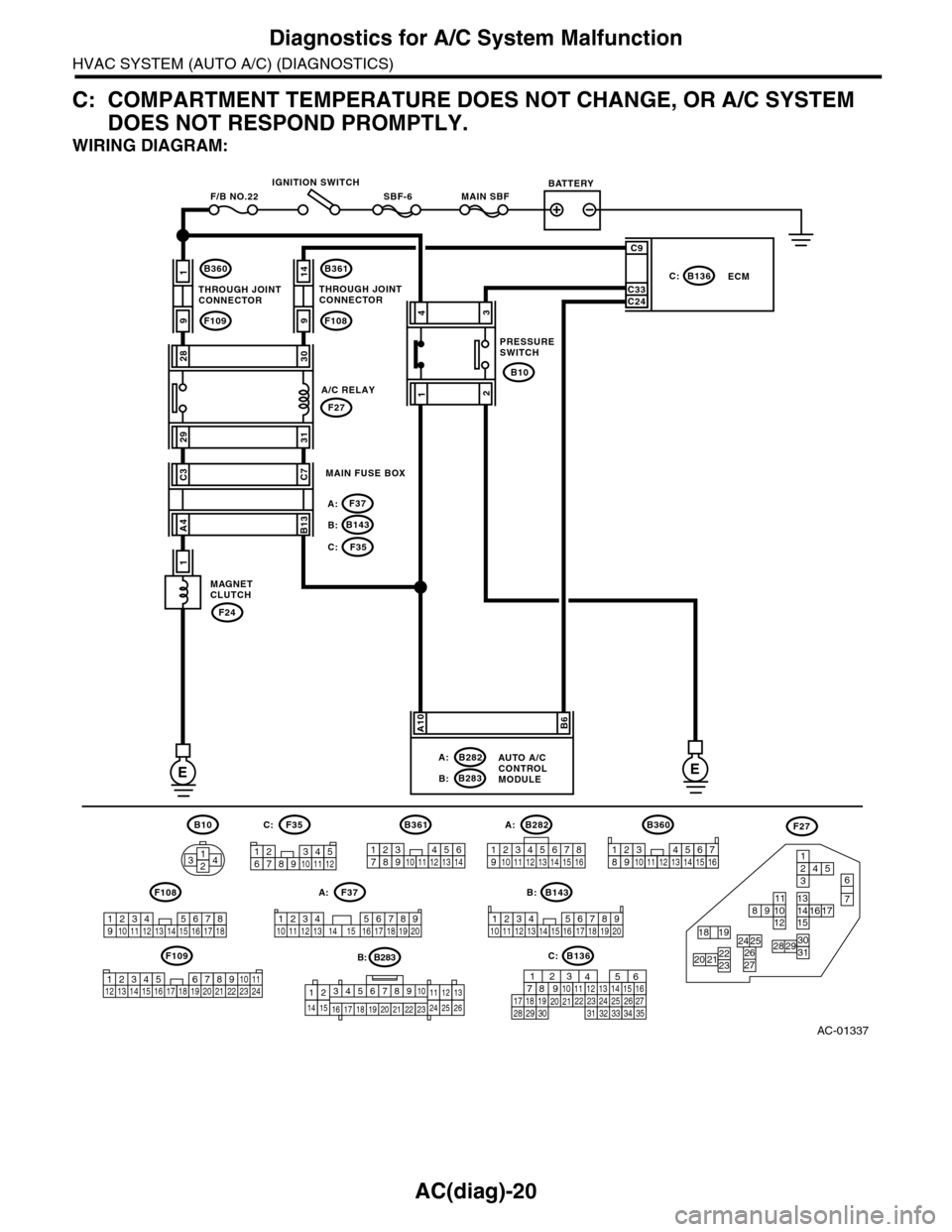
C: COMPARTMENT TEMPERATURE DOES NOT CHANGE, OR A/C SYSTEM
DOES NOT RESPOND PROMPTLY.
WIRING DIAGRAM:
AC-01337
MAIN SBFSBF-6F/B NO.22
B360
F109
B143B:
F37A:
F35C:
1
9
F24
1
B361
F108
B136C:ECM
B283B:
B282A:
F27
B10
14
9
2830
2931
EE
C3C7
A4B13
43
12
C9
C33C24
A10B6
AUTO A/CCONTROLMODULE
MAGNETCLUTCH
MAIN FUSE BOX
THROUGH JOINTCONNECTORTHROUGH JOINTCONNECTOR
IGNITION SWITCHBATTERY
PRESSURESWITCH
A/C RELAY
B282B10 A:
B143
B360
F109
F108B:F37A:
F35F27C:
12345678910 11 12 13 14 15 16
1234 5678910 11 12 13 14 15 16 17 18 19 20
1234567891011122314
234 567891112 13 14 17 18 19 201101516
B361
1234567891011121314
123 8910411 12 13 14 15 165671718
12389104111213 1415165671236
7
45
131415
11
3031
1617891012
2627
18 192928222320 21
24 25
3412 8910 1112 13 14 15 16 17 18 19 20 21 22 23 24567
B136C:
1289563410 11 121920 2129 3031
13 14 15161727281822 2324 25 267
32 3334 35
B283
345678910
16 17 18 19 20
121112132425262122231415
B:
Page 398 of 2453

AC(diag)-21
Diagnostics for A/C System Malfunction
HVAC SYSTEM (AUTO A/C) (DIAGNOSTICS)
Step Check Yes No
1CHECK FUSE.
1) Turn the ignition switch to OFF.
2) Remove the fuse No. 22 from fuse & relay
box.
3) Check the condition of fuse.
Is the fuse blown out? Replace the fuse. Go to step 2.
2CHECK SIGNAL TO A/C RELAY AND A/C
CONTROL MODULE.
1) Disconnect the A/C relay and auto A/C con-
trol module harness connector.
2) Turn the ignition switch to ON.
3) Measure the voltage between A/C relay
connector terminal and chassis ground.
4) Measure the voltage between auto A/C
control module harness connector terminal
and chassis ground.
Connector & terminal
(F27) No. 31 (+) — Chassis ground (–):
(B282) No. 10 (+) — Chassis ground (–):
Is the voltage more than 10 V? Go to step 5.Go to step 3.
3CHECK POWER SUPPLY FOR PRESSURE
SWITCH
1) Turn the ignition switch to OFF.
2) Disconnect the pressure switch harness
connector.
3) Turn the ignition switch to ON.
4) Measure the voltage between pressure
switch harness connector terminal and chassis
ground.
Connector & terminal
(B10) No. 2 (+) — Chassis ground (–):
Is the voltage more than 10 V? Go to step 4.Check for open or
short circuit in the
harness between
fuse and pressure
switch.
4CHECK HARNESS BETWEEN PRESSURE
SWITCH AND A/C RELAY, AUTO A/C CON-
TROL MODULE.
1) Turn the ignition switch to OFF.
2) Measure the resistance of harness
between pressure switch connector and A/C
relay connector.
3) Measure the resistance of harness
between pressure switch connector and auto
A/C control module connector.
Connector & terminal
(B10) No. 1 — (F27) No. 31:
(B10) No. 1 — (B282) No. 10:
Is the resistance less than 1
Ω?
Check the pres-
sure switch.
INSPECTION,
Pressure Switch
(Triple Pressure
Switch).>
Repair the har-
ness.
5CHECK POWER SUPPLY FOR A/C RELAY.
Measure the voltage between A/C relay con-
nector terminal and chassis ground.
Connector & terminal
(F27) No. 28 (+) — Chassis ground (–):
Is the voltage more than 10 V? Go to step 6.Check open or
short circuit of har-
ness between fuse
and A/C relay.
6CHECK A/C RELAY.
Check the A/C relay.
Is there a malfunction in the A/
C relay?
Replace the A/C
relay.
Go to step 7.
Page 402 of 2453
AC(diag)-25
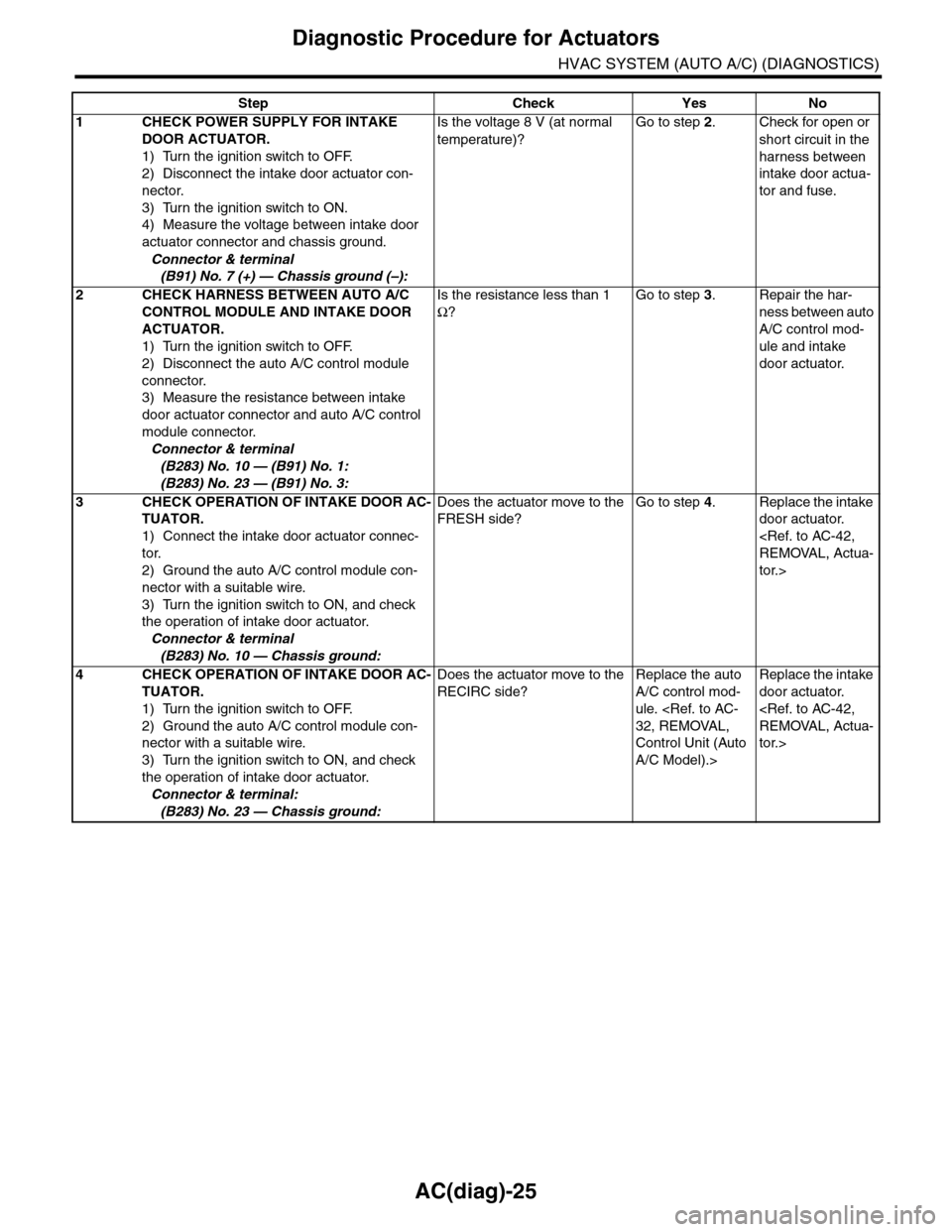
Diagnostic Procedure for Actuators
HVAC SYSTEM (AUTO A/C) (DIAGNOSTICS)
Step Check Yes No
1CHECK POWER SUPPLY FOR INTAKE
DOOR ACTUATOR.
1) Turn the ignition switch to OFF.
2) Disconnect the intake door actuator con-
nector.
3) Turn the ignition switch to ON.
4) Measure the voltage between intake door
actuator connector and chassis ground.
Connector & terminal
(B91) No. 7 (+) — Chassis ground (–):
Is the voltage 8 V (at normal
temperature)?
Go to step 2.Check for open or
short circuit in the
harness between
intake door actua-
tor and fuse.
2CHECK HARNESS BETWEEN AUTO A/C
CONTROL MODULE AND INTAKE DOOR
ACTUATOR.
1) Turn the ignition switch to OFF.
2) Disconnect the auto A/C control module
connector.
3) Measure the resistance between intake
door actuator connector and auto A/C control
module connector.
Connector & terminal
(B283) No. 10 — (B91) No. 1:
(B283) No. 23 — (B91) No. 3:
Is the resistance less than 1
Ω?
Go to step 3.Repair the har-
ness between auto
A/C control mod-
ule and intake
door actuator.
3CHECK OPERATION OF INTAKE DOOR AC-
TUATOR.
1) Connect the intake door actuator connec-
tor.
2) Ground the auto A/C control module con-
nector with a suitable wire.
3) Turn the ignition switch to ON, and check
the operation of intake door actuator.
Connector & terminal
(B283) No. 10 — Chassis ground:
Does the actuator move to the
FRESH side?
Go to step 4.Replace the intake
door actuator.
tor.>
4CHECK OPERATION OF INTAKE DOOR AC-
TUATOR.
1) Turn the ignition switch to OFF.
2) Ground the auto A/C control module con-
nector with a suitable wire.
3) Turn the ignition switch to ON, and check
the operation of intake door actuator.
Connector & terminal:
(B283) No. 23 — Chassis ground:
Does the actuator move to the
RECIRC side?
Replace the auto
A/C control mod-
ule.
Control Unit (Auto
A/C Model).>
Replace the intake
door actuator.
tor.>
Page 416 of 2453

AC(diag)-39
Diagnostics with Phenomenon
HVAC SYSTEM (AUTO A/C) (DIAGNOSTICS)
9. Diagnostics with Phenomenon
A: INSPECTION
Symptom Problem parts
A/C system fails to operate.
•Fuse (M/B No. 15, F/B No. 7, 22, 31)
•Connector (Poor contact)
•Ground
•Auto A/C control module
•Blower fan motor
•Blower fan relay
•A/C relay
•Compressor (Magnet clutch)
•Evaporator sensor
Fuse is blown out.•Fuse (M/B No. 8, F/B No. 22, 31)
•Connector (Poor contact)
Illumination cannot dim.
•Fuse (M/B No. 8, F/B No. 22, 31)
•Connector (Poor contact)
•Illumination control switch
•Auto A/C control module
•Body integrated unit
Blower fan does not rotate or fan speed cannot be controlled.
•Fuse (F/B No. 22, 27, 28)
•Connector (Poor contact)
•Ground
•Auto A/C control module
•Blower fan motor
•Blower fan relay
•Power transistor or blower resistor
Unable to switch suction vents.
•Connector (Poor contact)
•Auto A/C control module
•Intake door actuator
Unable to switch blow vents.
•Connector (Poor contact)
•Auto A/C control module
•Mode door actuator
The compar tment temperature does not rise. (Warm air not
emitted.)
•Connector (Poor contact)
•Auto A/C control module
•Air mix door actuator
•In-vehicle sensor, ambient sensor, evaporator sensor and
sunload sensor
•In-vehicle sensor aspirator hose
•Aspirator body
The compar tment temperature does not lower. (Cold air not
emitted.)
•Connector (Poor contact)
•Auto A/C control module
•Air mix door actuator
•A/C relay
•Compressor (Magnet clutch)
•Radiator fan motor
•Radiator fan relay
•In-vehicle sensor, ambient sensor, evaporator sensor and
sunload sensor
•In-vehicle sensor aspirator hose
•Aspirator body
Compartment temperature is higher or lower than setting tem-
perature.
•Auto A/C control module
•Air mix door actuator
•In-vehicle sensor, ambient sensor, evaporator sensor and
sunload sensor
•In-vehicle sensor aspirator hose
•Aspirator body