2009 SKODA YETI lock
[x] Cancel search: lockPage 81 of 271

Seats and Stowage
80 Move the hook into another position– Fold up the hook in direction of arro
w until an angle of 45° is reached
⇒ page 79, fig. 77
.
– Move the hook in direction of arrow into the desired position and fold down the
hook as far as the stop
in direction of arrow
⇒page 79, fig. 77
.
Remove the hook from the fastening strip– Fold the hook in direction of arrow until it slackens.Install the hook on the fastening strip– Position the hook on the fastening strip in
the vertical position in direction of arrow
and lightly press it on.
– Fold the hook down in opposite direct
ion of the arrow until it locks fully.
WARNING
Please refer to the following guidelines
⇒page 78.
Fixing nets - Net programme*Fig. 78 Fixing net: double horizontal pocket
, floor fixing net / double vertical pockets
Fixing examples of the fixing net as do
uble horizontal pocket, floor fixing net
⇒fig. 78
on the left and double vertical pocket
⇒fig. 78
on the right.
The fixing nets* and the installation inst
ruction are located in the luggage compart-
ment.
WARNING
•
The whole strength of the net makes it possible to load the pocket with
objects of up to 3.5 kg in weight. Heavy
objects are not secured sufficiently - risk
of injury and net damage!•
The load to be transported must be fixed in place in such a way that it cannot
move during the journey and when braking.
Caution
Do not place any objects with sharp edge
s in the nets - risk of net damage.
The luggage compartment cover You can use the luggage compartment cover behind the head restraints for storing
light and soft items.
The luggage compartment cover can be remo
ved as required if one must transport
bulky goods.Removing the luggage compartment cover– Fold the seat backrests a little forward in order to facilitate the removal of the
luggage compartment cover.
– Unhook the support straps on the boot lid
⇒fig. 79
.
A1
A2
A3
A4
A5
A4
Fig. 79 Removing the luggage compart- ment coverA1
sgg.6.book Page 80 Thursday, September 24, 2009 2:32 PM
Page 83 of 271
Seats and Stowage
82 Pack static separation net– Press the red button of the joint - so that it releases. – Put the separation net folded together in the bag and close it. – Attach the bag with the aid of the plastic carabines to the eyes on the left and right
luggage compartment trim panel.
Installing and removing the static separation net behind the rear seats with variable loading floor*
⇒page 82 is carried out analogously as
behind the rear seats without
variable loading floor. Use the lower fixing ey
es on the carrier rails in order to attach
the carabines. The opening
⇒page 81, fig. 80
in the static separation net is designed to feed
through the three-point seat belt
⇒page 144.
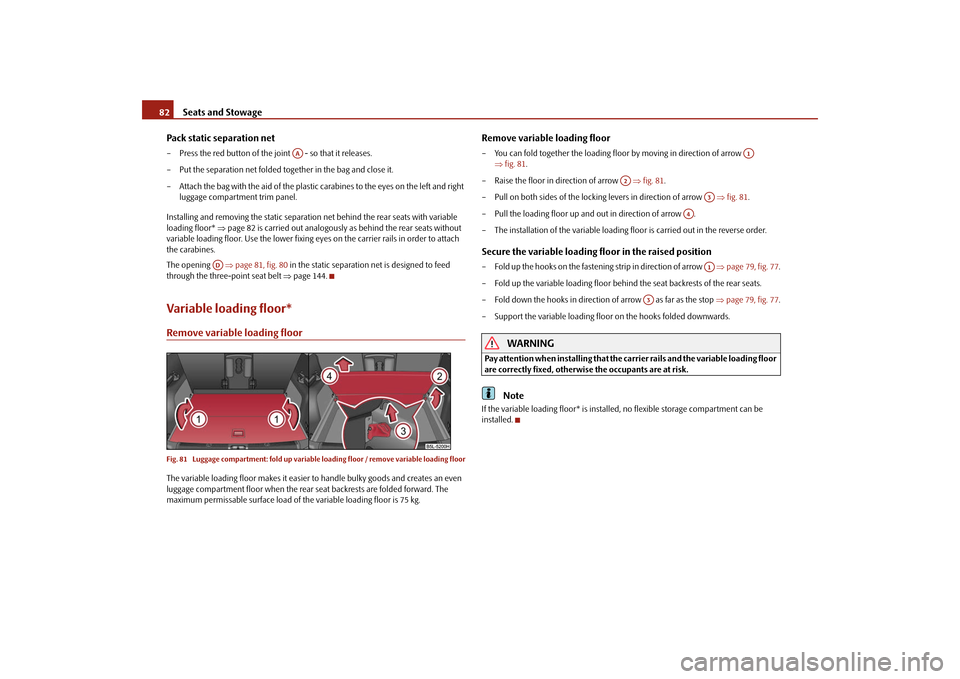
Variable loading floor*Remove variable loading floorFig. 81 Luggage compartment: fold up variable
loading floor / remove variable loading floor
The variable loading floor makes it easier to handle bulky goods and creates an even luggage compartment floor when the rear seat backrests are folded forward. The maximum permissable surface load of the variable loading floor is 75 kg.
Remove variable loading floor– You can fold together the loading floor
by moving in direction of arrow
⇒ fig. 81
.
– Raise the floor in direction of arrow
⇒fig. 81
.
– Pull on both sides of the locking levers in direction of arrow
⇒fig. 81
.
– Pull the loading floor up and out in direction of arrow . – The installation of the variable loading floor is carried out in the reverse order.Secure the variable loading floor in the raised position– Fold up the hooks on the fastening strip in direction of arrow
⇒page 79, fig. 77
.
– Fold up the variable loading floor behind
the seat backrests of the rear seats.
– Fold down the hooks in direction
of arrow as far as the stop
⇒page 79, fig. 77
.
– Support the variable loading floor on the hooks folded downwards.
WARNING
Pay attention when installing that the ca
rrier rails and the variable loading floor
are correctly fixed, otherwis
e the occupants are at risk.
Note
If the variable loading floor* is installed, no flexible storage compartment can be installed.
AA
AD
A1
A2
A3
A4
A1
A3
sgg.6.book Page 82 Thursday, September 24, 2009 2:32 PM
Page 86 of 271

Seats and Stowage
85
Using the system
Safety
Driving Tips
General Maintenance
Breakdown assistance
Technical Data
•
Please note that the handling properties of your vehicle change when you
transport heavy or bulky items on the roof bar system as a result of the displacement of the centre of gravity an
d the increased wind attack area - risk
of accident! You must absolutely adapt your style of driving and the speed of the vehicle to the sp
ecific circumstances.
Cup holderCup holder in front centre consoleYou can place two cups or beverage cans into the recesses
⇒fig. 86
.
WARNING
•
Do not place any hot beverages into the
cup holder. If the vehicle moves, the
hot beverages may spill - risk of scalding!•
Do not use any cups or beakers which are
made of brittle material (e.g. glass,
porcelain). You might be injured by them in the event of an accident.
Caution
Do not open the beverages in the cup hold
er while driving. They may spill when
braking and while doing so damage the vehicle.
Cup holder in rear centre console*– Press on the panel in the area
⇒fig. 87
- the cup holder comes out.
– Pull the cup holder out as far as the stop.– Adjust the cup holder by
moving the locking plate .
WARNING
•
Do not place any hot beverages into the
cup holder. If the vehicle moves, the
hot beverages may spill - risk of scalding!•
Do not use any cups or beakers which are
made of brittle material (e.g. glass,
porcelain). You might be injured by
them in the event of an accident.
Caution
The cup holder in the rear part of the centre
console must be closed
(otherwise it could
get damaged) before folding forward the rear middle seat.
WARNING (continued)
Fig. 86 Front centre console: Cup holder
Fig. 87 Centre console at rear: Cup holder
AA
AB
sgg.6.book Page 85 Thursday, September 24, 2009 2:32 PM
Page 92 of 271

Seats and Stowage
91
Using the system
Safety
Driving Tips
General Maintenance
Breakdown assistance
Technical Data
WARNING
Use the area
⇒page 90, fig. 99
of the storage compartment only for storing
objects which do not project so that the effectiveness of the side airbag is not impaired.Storage compartment below front passenger seat*The storage compartment is foreseen for storing small objects of up to 1.5 kg in weight. – Tilt the lock to open the flap and pull out the flap
⇒fig. 100
.
– Tilt the lock to close the
flap and press flap close.
Front seat armrest with storage compartment*Fig. 101 Armrest: Storage compartment / cooling of storage compartment
The armrest is adjustable for height and length.Opening storage compartment– Open the lid of the armrest in the direction of arrow
⇒fig. 101
.
Closing storage compartment– Open the lid up to the stop, then you can fold it downwards.Setting height– First of all fold the lid to the bottom and li
ft it in the direction of arrow into one of
the 4 fixed positions.
Adjusting in forward/back direction– Push the lid into the desired position.Opening air inlet– Pull the lock in upward direction
⇒fig. 101
.
Closing air inlet– Push the lock as far as the stop downwards. On vehicles fitted with air conditioning, the storage compartment is equipped with a lockable inlet for thermally treated (warmed-up) air. At open air supply, air flows into the storage with a temperature which is as high as the one out of the air outlet nozzles, depending on temperature setting. The air inlet in the storage compar
tment is connected to position
through adjust-
ment of the control dial for air distribution. This position causes the maximum amount of air to flow into the storage compartmen
t (depending on the rotary regulator posi-
tion for the fan). You can use the storage compartment, for
example, to temper drinks cans, etc.
If you do not use the air inlet in the storage compartment, the end cover should always be kept closed.
AA
Fig. 100 Front passenger seat: Storage compartment
A1
AAAA
sgg.6.book Page 91 Thursday, September 24, 2009 2:32 PM
Page 94 of 271

Seats and Stowage
93
Using the system
Safety
Driving Tips
General Maintenance
Breakdown assistance
Technical Data
Removing– Take hold of the flexible storage
compartment at both upper corners.
– Press the upper corners to the inside
and release the storage compartment by
pulling upwards.
– Remove by pulling towards you.Installing– Insert both ends of the flexible storage
compartment into the openings of the right
side trim panel of the luggage compartment and push it downwards until it locks.
Clothes hooksThe clothes hooks are located on the middle
pillar and on the handle of the headliner
above each of the rear doors.
WARNING
•
Ensure that any clothes hanging from the hooks do not impair your vision to
the rear.•
Use the hooks for hanging only light item
s of clothing and ensure that there
are no heavy or sharp-edge
d objects in the pockets.
•
The maximum permissable load of the hooks is 2 kg.
•
Do not use clothes hangers for hanging up items of clothing otherwise this
will interfere with the protection offered by the head airbag*.
Removeable through-loading bag*The removeable through-loading bag
is solely used for transporting
skis.The removeable through-loading bag is foreseen for two pairs of skis. The total weight of the skis which are transported must not exceed 10 kg.Loading– Open a rear side door of the vehicle. – Fold the backrest of the middle seat forwards
⇒page 74.
– Place the empty removeable through-loading bag in the gap between the front and
rear seats in such a way that the end of
the bag with the zip lies in the luggage
compartment.
– Open the boot lid.– Push the skis into the removeable through-loading bag from the luggage compart-
ment
⇒
.
– Close the removeable through-loading bag with the zip.Securing– Pull the securing belt with both lock to
ngues out of the pocket of the removeable
through-loading bag.
– Insert the lock tongues in the belt locks
of the rear middle seat belt , first of
all on the one side and then on the other side
⇒fig. 105
.
Fig. 105 Securing the removeable through-loading bag
AA
AC
sgg.6.book Page 93 Thursday, September 24, 2009 2:32 PM
Page 107 of 271

Heating and air conditioning system
106
WARNING
•
The auxiliary heating must never be op
erated in closed rooms - risk of
poisoning!•
The auxiliary heating must not be runn
ing during refueling - risk of fire.
•
The exhaust pipe of the auxiliary heating is located on the underside of the
vehicle. Therefore do not place the vehicl
e, if you wish to operate the auxiliary
heating, in such a way that the exhaust
gases of the auxiliary heating can come
easily into contact with inflammable materi
als (e.g. dry grass) or easily inflam-
mable substances (e.g. fuel run out).
Note
If the auxiliary heating runs, the fuel co
nsumption comes from the vehicle tank. The
auxiliary heating automatically controls the filling level in the fuel tank. If only a low quantity of fuel is present in the fuel tank, the function of the auxiliary heating is blocked.•
The exhaust pipe of the auxiliary heating, which is located on the underside of the
vehicle, must not be clogged and the exhaust flow must not be blocked.•
If the auxiliary heating and ventilation is
running, the vehicle ba
ttery discharges. If
the auxiliary heating and ventilation has be
en operated several times over a longer
period, the vehicle must be driven a few ki
lometers in order to recharge the vehicle
battery.•
The auxiliary heating only switches the blower on, if it has achieved a coolant
temperature of approx. 50 °C.•
At low outside temperatures, this can result
in a formation of water vapour in the
area of the engine compartment. This is quite normal and is not an operating problem.•
After switching off the auxiliary heating,
the coolant pump runs for a short period.
•
The auxiliary heating and ventilation does no
t switch on or comes on, if the vehicle
battery indicates a low loading state.•
The auxiliary heating (auxilia
ry heating) does not switch on, if the following was
shown in the information display or before switching off the ignition:
Please refuel!.
.
•
The air inlet in front of the windscreen must
be free of ice, snow or leaves in order
to ensure that the auxiliary heating operates properly.
•
So that warm air can flow in
to the vehicle after switching on the auxiliary heating,
you must maintain the temperature normally selected by you (we recommend 22°C for Climatic, Climatronic and for the heat
ing turn the regulator A to the right
⇒ page 96, fig. 108
). It is recommended to put the air flow in the position
.
•
On vehicles with DPF (diesel particle filt
er) the warm coolant heats up the engine.
Direct switching on/offThe auxiliary heating (auxiliary heating and vent
ilation) can be switched on or off at any
time
directly
using the button on the operating part of the Climatic, Climatronic or
heating
⇒fig. 111
.
If the auxiliary heating and ventilation is not
switched off earlier, it switches off auto-
matically after the expiration of the set operating period, in the menu
Running time
.
Note
A radio remote control for the auxiliary heating can be obtained from Škoda original accessories.
Fig. 111 Button for direct switching on/off of the auxiliary heating (auxiliary heating and ventilation) on the operating part of the Climatic
sgg.6.book Page 106 Thursday, September 24, 2009 2:32 PM
Page 110 of 271

Starting-off and Driving
109
Using the system
Safety
Driving Tips
General Maintenance
Breakdown assistance
Technical Data
Starting-off and DrivingSetting steering wheel positionFig. 113 Adjustable steering wheel: Lever below
steering column / safe
distance to steering
wheelYou can set the height and the forward/back
position of the steering wheel to the
desired position. – Adjust the driver seat
⇒page 12.
– Pull the lever below the steering column
⇒fig. 113
down
⇒
.
– Set the steering wheel to the desired position (concerning height and forward/back
position).
– Push the lever upwards as far as the stop.
WARNING
•
You must not adjust the steering wheel when the vehicle is moving!
•
The driver must maintain a distance of
at least 25 cm to
the steering wheel
⇒ fig. 113
. Not maintaining this minimum distance will mean that the airbag
system will not be able to properly protect you - hazard!•
For safety reasons the lever must always be firmly pushed up to avoid the
steering wheel altering its po
sition unintentionally when driving - risk of acci-
dent!
•
If you adjust the steering wheel furthe
r towards the head, you will reduce
the protection offered by the driver airbag in the event of an accident. Check that the steering wheel is
aligned to the chest.
•
When driving, hold the steering wheel
with both hands firmly on the outer
edge in the 9 o'clock and 3 o'clock po
sition. Never hold the steering wheel
firmly in the 12 o'clock position or in another way (e.g. in the middle of the steering wheel or at the inne
r steering wheel edge). In such
cases, injuries to the
arms, the hands and the head can occur
when the driver airbag is deployed.
Ignition lockPetrol engines - ignition switched off, engine
off, the steering can be locked
- ignition switched on - start engine Diesel engines - interruption of fuel supply, ignition swit
ched off, engine off, the steering can be
locked - heating glow plugs on, ignition switched onWARNING (continued)
Fig. 114 Ignition lock positions
A1A2A3A1A2
sgg.6.book Page 109 Thursday, September 24, 2009 2:32 PM
Page 111 of 271

Starting-off and Driving
110
•
You should not switch on any major elec
trical components during the heating
period otherwise
the vehicle battery will
be drained unnecessarily.
- start engine Applies to all models: Position
To lock the steering
, with the ignition key withdrawn, turn the steering wheel until the
steering locking pin is heard to
engage. You should always lock the steering as a general
rule if you leave your vehicle. This acts as
a deterrent against possible theft of your
vehicle
⇒
.
Position
Move the steering wheel back and forward a little if the ignition key cannot, or cannot easily be turned into this position, in order to release the steering lock. Position
The engine is started in this position. At the same time, major electrical components are switched off for short periods. The igni
tion key moves back into position when
one releases the key. The ignition key must be turned back into
position each time before starting the
engine again. The starter repeat lock in th
e ignition lock prevents the starter being
engaged when the engine is r
unning and thus getting damaged.
Ignition key withdrawal lock (automatic gearbox) You can only withdraw the ignition key after switching off the ignition if the selector lever is in position
P.
WARNING
•
When driving, the ignition key must always be in the position (ignition
switched on) without the engine running. This position is indicated by the warning lights coming on. If this is not the case, it could result in unexpected locking of the steering wh
eel - risk of accident!
•
Only remove the ignition key from the ignition lock when the vehicle has
come to a standstill (by applying the handbrake or moving the selector lever into the position P). The
steering lock can engage imme
diately - risk of acci-
dent!
•
Always withdraw the ignition key if yo
u are going to leave the vehicle, even
for a short time. This is particularly important if children are left in the vehicle. The children might otherwise start the engi
ne or switch on el
ectrical equipment
(e.g. power windows) - risk of accident or injury!Starting the engineGeneral You can only start the engine only using an original ignition key.•
Place the gearshift lever into neutral (or
place the selector lever to the position
P or
N in the case of an automatic gearbox) and put on the handbrake firmly before starting the engine.•
The clutch pedal should be fully depressed when starting the engine - the starter
then only has to crank the engine.•
Let go of the key as soon as the engine starts otherwise there may be damage to
the starter. The engine running noises may louder at first be louder for a short time after starting the cold engine until oil pressure can be
built up in the hydraulic valve clearance
compensation. This is quite normal and is not an operating problem. If the engine does not start ... You can use the battery of anothe
r vehicle as a jump-start aid
⇒page 229.
It is only possible to tow-start vehicles fi
tted with a manual gearbox. The tow-starting
distance must not be more than 50 metres
⇒page 231.
WARNING
•
Never run the engine in non ventilated
or enclosed areas. The exhaust gases
of the engine contain besides the odorless and colourless carbon monoxide a poisonous gas - hazard! Carbon mono
xide can cause unconsciousness and
death.
A3
A1A2A3
A2
A1
A2
WARNING (continued)
sgg.6.book Page 110 Thursday, September 24, 2009 2:32 PM