2009 SKODA YETI warning
[x] Cancel search: warningPage 159 of 271
Transporting children safely
158
deployed. Have the airbag (or ai
rbags) deactivated if necessary
⇒page 154,
“Deactivating an airbag”.•
You should have the front passenger airb
ag (or airbags) re
activated just as
soon as you no longer use a child safe
ty seat on the front passenger seat.
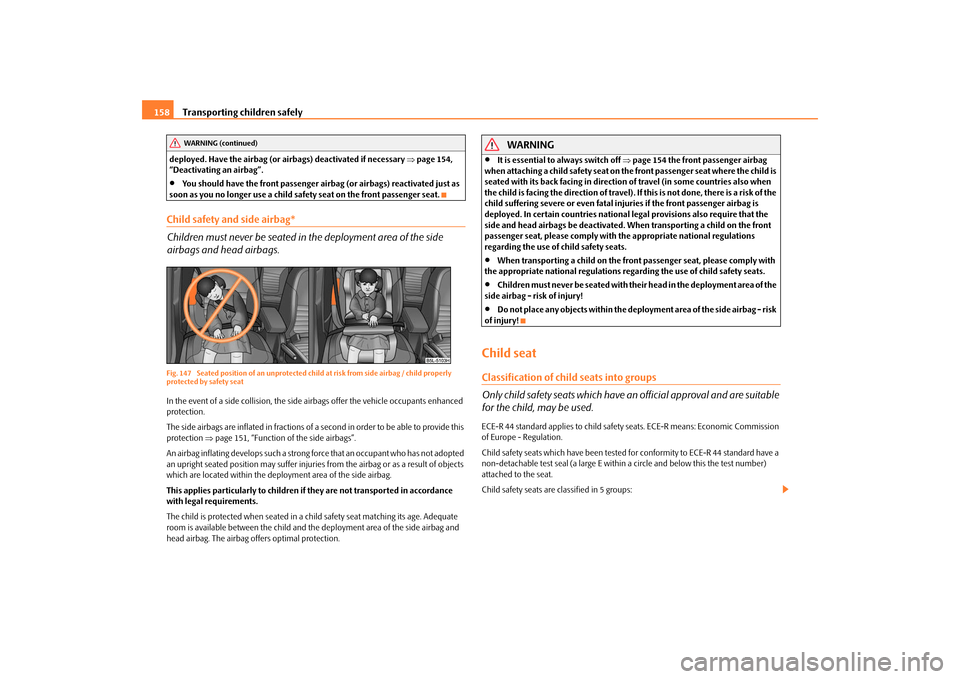
Child safety and side airbag* Children must never be seated in the deployment area of the side airbags and head airbags.Fig. 147 Seated position of an unprotected chil
d at risk from side airbag / child properly
protected by safety seatIn the event of a side collision, the side ai
rbags offer the vehicl
e occupants enhanced
protection. The side airbags are inflated in fractions of a
second in order to be able to provide this
protection
⇒page 151, “Function of the side airbags”.
An airbag inflating develops such a strong force that an occupant who has not adopted an upright seated position may suffer injuries
from the airbag or as a result of objects
which are located within the deployment area of the side airbag. This applies particularly to children if they are not transported in accordance with legal requirements. The child is protected when seated in a chil
d safety seat matching its age. Adequate
room is available between the child and the
deployment area of the side airbag and
head airbag. The airbag offers optimal protection.
WARNING
•
It is essential to always switch off
⇒page 154 the front passenger airbag
when attaching a child safety seat on th
e front passenger seat where the child is
seated with its back facing in direction of travel (in some countries also when the child is facing the direction of travel). If this is not done, there is a risk of the child suffering severe or even fatal inju
ries if the front passenger airbag is
deployed. In certain countries national legal provisions also require that the side and head airbags be deactivated. When transporting a child on the front passenger seat, please comply with
the appropriate national regulations
regarding the use of child safety seats.•
When transporting a child on the fron
t passenger seat, please comply with
the appropriate national regulations r
egarding the use of child safety seats.
•
Children must never be seated with thei
r head in the deployment area of the
side airbag - risk of injury!•
Do not place any objects within the deployment area of the side airbag - risk
of injury!Child seatClassification of child seats into groups Only child safety seats which have an official approval and are suitable for the child, may be used.ECE-R 44 standard applies to child safety seats. ECE-R means: Economic Commission of Europe - Regulation. Child safety seats which have been tested for conformity to ECE-R 44 standard have a non-detachable test seal (a large E within
a circle and below this the test number)
attached to the seat. Child safety seats are classified in 5 groups:
WARNING (continued)
sgg.6.book Page 158 Thursday, September 24, 2009 2:32 PM
Page 160 of 271

Transporting children safely
159
Using the system
Safety
Driving Tips
General Maintenance
Breakdown assistance
Technical Data
Children of more than 150 cm in height may use the seat belts fitted to the vehicle without a seat bolster.Use of child safety seatsAn overview of the usefulness
of child seats on each of the seats according to the ECE-
R44 standard:
Universal category - seat is suitable for all approved types of child safety seats. The seat can be fitted with
fixing eyes for the “
ISOFIX
*”system.
The divided rear seat - seat can be fitt
ed with fixing eyes for the system “
To p
Te t h e r
*” ⇒page 162, “Attaching child seat using the “Top Tether” system”.
Child seats of group 0/0+The optimal solution for babies
of up to about 9 months old weighing up to 10 kg or
babies up to about 18 months old weighing up
to 13 kg is a child safety seat which can
be adjusted into the reclining position
⇒fig. 148
.
In view of the fact that such child seats are installed that the child is seated with its back facing the direction of travel, they mu
st not be used on the front passenger
seat
⇒page 157, “Use of child safety se
ats on the front passenger seat”.
WARNING
•
It is essential to always switch off th
e front passenger airbag (airbags) when
attaching in exceptional circumstances a child safety seat on the front passenger seat where the child is seated
with its back facing in direction of
travel (in some countries also when the child is facing the direction of travel),
− in a specialist garage − or by using the switch for
the front passenger airbag*
⇒page 154,
“Switch for the front passenger airbag”.
•
In certain countries national legal provisions require that besides the front
airbag also the side or head airbags ar
e deactivated. Please comply with any
differing national legal r
egulations regarding the use of child safety seats.
•
If this is not done, a child seated on
the front passenger seat may suffer
severe or even fatal injuries if the
front passenger airbag or airbags are
deployed.
Group
Weight
0
0 - 10 kg
⇒ page 159
0+
up to 13 kg
⇒page 159
1
9 - 18 kg
⇒page 160
2
15 - 25 kg
⇒page 160
3
22 - 36 kg
⇒page 161
Child seat of the group
Front passenger
seat
Rear seat outside
Rear seat middle
0
0+
1
2 and 3
AUA+
AUA+AT
AU
AUA+
AUA+AT
AU
AUA+
AUA+AT
AU
AU
AU
AU
AUA+AT
Fig. 148 Child seats of group 0/0+
sgg.6.book Page 159 Thursday, September 24, 2009 2:32 PM
Page 161 of 271
Transporting children safely
160
•
You should have the front passenger airbag (or airbags) reactivated just as
soon as you no longer use a child safe
ty seat on the front passenger seat.
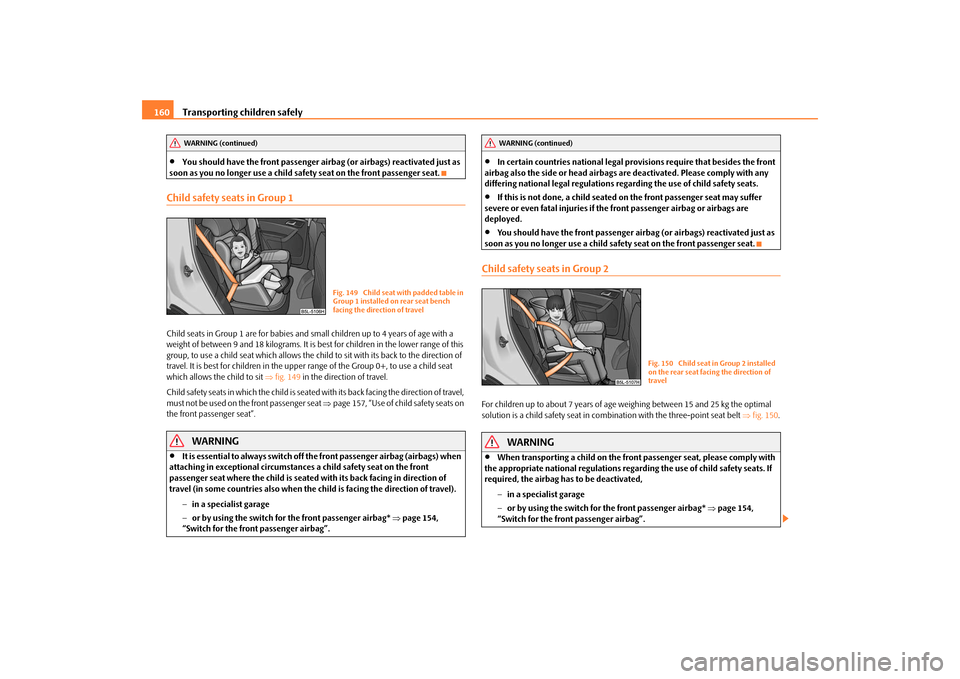
Child safety seats in Group 1Child seats in Group 1 are for babies and small children up to 4 years of age with a weight of between 9 and 18 kilograms. It is best for children in the lower range of this group, to use a child seat which allows the ch
ild to sit with its back to the direction of
travel. It is best for children in the uppe
r range of the Group 0+, to use a child seat
which allows the child to sit
⇒fig. 149
in the direction of travel.
Child safety seats in which the child is seated with its back facing the direction of travel, must not be used on the front passenger seat
⇒page 157, “Use of child safety seats on
the front passenger seat”.
WARNING
•
It is essential to always switch off th
e front passenger airbag (airbags) when
attaching in exceptional circumstances a child safety seat on the front passenger seat where the child is seated
with its back facing in direction of
travel (in some countries also when the child is facing the direction of travel).
− in a specialist garage − or by using the switch for the front passenger airbag*
⇒page 154,
“Switch for the front passenger airbag”.
•
In certain countries national legal provisions require that besides the front
airbag also the side or head airbags ar
e deactivated. Please comply with any
differing national legal r
egulations regarding the use of child safety seats.
•
If this is not done, a child seated on the front passenger seat may suffer
severe or even fatal injuries if the
front passenger airbag or airbags are
deployed.•
You should have the front passenger airbag (or airbags) reactivated just as
soon as you no longer use a child safe
ty seat on the front passenger seat.
Child safety seats in Group 2For children up to about 7 years of age weighing between 15 and 25 kg the optimal solution is a child safety seat in comb
ination with the three-point seat belt
⇒fig. 150
.
WARNING
•
When transporting a child on the fron
t passenger seat, please comply with
the appropriate national regulations regard
ing the use of child safety seats. If
required, the airbag has to be deactivated,
− in a specialist garage − or by using the switch for
the front passenger airbag*
⇒page 154,
“Switch for the front passenger airbag”.
WARNING (continued)
Fig. 149 Child seat with padded table in Group 1 installed on rear seat bench facing the direction of travel
WARNING (continued)
Fig. 150 Child seat in Group 2 installed on the rear seat facing the direction of travel
sgg.6.book Page 160 Thursday, September 24, 2009 2:32 PM
Page 162 of 271

Transporting children safely
161
Using the system
Safety
Driving Tips
General Maintenance
Breakdown assistance
Technical Data
•
The shoulder part of the seat belt mu
st run approximatel
y across the middle
of the shoulder and fit snugly against the chest. It must on no account run across the neck. The lap part of the seat belt must run across the pelvis and fits snugly; it must not run over the belly. Tighten the belt webbing over your hip if necessary.•
Please comply with any differing nati
onal legal regulations regarding the
use of child safety seats.Child safety seats in Group 3For children of about 7 years of age weighing between 22 and 36 kg and of a height of less than 150 cm, the optimal solution is a ch
ild safety seat (seat bolster) in combina-
tion with the three-point seat belt
⇒fig. 151
.
Children of more than 150 cm in height may use the seat belts fitted to the vehicle without a seat bolster.
WARNING
•
When transporting a child on the front passenger seat, please comply with
the appropriate national regu
lations regarding the use of child safety seats. If
required, the airbag has to be deactivated,
− in a specialist garage
− or by using the switch for
the front passenger airbag*
⇒page 154,
“Switch for the front passenger airbag”.
•
The shoulder part of the seat belt
must run approximately across the middle
of the shoulder and fit snugly against the chest. It must on no account run across the neck. The lap part of the seat belt must run across the pelvis and fits snugly; it must not run over the belly. Tighten the belt webbing over your hip if necessary.•
Please comply with any differing nati
onal legal regulations regarding the
use of child safety seats.Attaching a child seat using the “ISOFIX” systemFig. 152 Locking eyes (ISOFIX system) / the IS
OFIX child seat is pushed into the mounting
funnelsThere are two fixing eyes* between the seat backrest and the seat cushion of the front passenger seat for fixing the “ISOFIX” system
child seat in place. The locking eyes on
the rear outside seats are located below th
e upholstery. The places are marked with
signs with the “ISOFIX” logo.Install child seat– Insert the mounting funnels onto the
locking eyes between the seat back-
rest and the seat cushion
⇒fig. 152
.
WARNING (continued)
Fig. 151 Child seat in Group 3 installed on the rear seat facing the direction of travel
WARNING (continued)
AA
AB
sgg.6.book Page 161 Thursday, September 24, 2009 2:32 PM
Page 163 of 271

Transporting children safely
162
– Push the notched arms of the
child seat into the locking eyes in direction of arrow
, until they are heard to lock in place
⇒fig. 152
.
–
Pull on both sides of the child seat!
One can mount a child safety seat using the “I
SOFIX” system quickly, easily and reliably.
Please pay close attention to instructions
from the manufacturer of the child safety
seat when installing and removing the seat. Child seats fitted with the “ISOFIX” system
can only be mounted and fixed in a vehicle
fitted with an “ISOFIX” system when these child seats have been released for this type of vehicle according to
the ECE-R 44 standard.
You can obtain child seats with the “ISOFIX” attachment system from specialist garages who will also installed it as well. Complete installation instructions are enclosed with the child safety seat.
WARNING
•
The locking eyes have just been deve
loped for child safety seats which use
the “ISOFIX” system. You should therefore never attach other child safety seats, seat belts or objects to th
e locking eyes - hazard!
•
Ask a specialist garage whether a child seat which you bought for another
vehicle is recommended for use in your vehicle before using a child seat with “ISOFIX” system.•
Certain child seats which use the “ISO
FIX” system can be attached with
standard three-point seat belts. Please
pay close attention to instructions from
the manufacturer of the child safety seat
when installing and
removing the seat.
Note
•
Child seats which use the “ISOFIX” system are currently available for children
weighing from 9 up to 18 kg. This correspond
s to an age range of from 9 months to 4
years.•
The child seats can also be fitted with the “Top Tether” system
⇒page 162.
Attaching child seat using the “Top Tether” systemThe rear exterior seats and/or the middle seat (only valid for some countries) are equipped as standard with the attachment syst
em “Top Tether” at the rear of the seat
backrest for enhancing the child safety
⇒fig. 153
.
Always perform the installation and removal of the child seat using the “Top Tether” system as stated in the instructions from the manufacturer of the child seat.
WARNING
•
Attach the child seats with the “Top Tether” system only to the points
provided for this purpose
⇒fig. 153
.
•
On no account should you equip your vehicle, e.g. mount screws or other
anchorage points.•
Pay attention to the important safety
information regarding the use of child
seats.
Note
Store the remaining part of the belt for the “Top Tether” system in a textile pocket, which is located at the child seat.
A1
Fig. 153 Rear seat: Top Tether
sgg.6.book Page 162 Thursday, September 24, 2009 2:32 PM
Page 164 of 271

Intelligent Technology
163
Using the system
Safety
Driving Tips
General Maintenance
Breakdown assistance
Technical Data
Driving TipsIntelligent TechnologyElectronic stability programme (ESP)*GeneralGeneral The ESP aids you in maintaining control of
your vehicle in situations in which the
vehicle is driving at its dynamic limits, such as
entering a curve fast. The risk of skidding
is reduced and your vehicle thus offers greater driving stability depending on the conditions of the road surface. The system operates at all speeds. The following systems are integrated into the electronic stability programme:•
electronic Differential Lock (EDL),
•
traction control system (TCS),
•
active driver-steering recommendation (DSR),
•
antilock brake system (ABS),
•
brake Assist,
•
uphill-Start off-Assist.
The ESP system cannot be switched off, the
TCS system can only be switched off by
pressing the button
⇒fig. 154
, then the ESP warning light flashes slowly
.
Operating principle The ESP switches on automatically when the engine is started and then conducts a self-test. The ESP control unit processes data from the individual systems. It also proc- esses additional measurement data which are supplied by highly sensitive sensors: the rotational velocity of the vehicle about its ve
rtical axis, the lateral acceleration of the
vehicle, the braking pressure and the steering angle. The direction which the driver wishes to take is determined based on the steering angle and the speed of the vehicle and is co
nstantly compared with the actual behav-
iour of the vehicle. If
differences exist, such as the vehi
cle beginning to skid, the ESP will
automatically brake the appropriate wheel. The car is stabilised again by the forces wh
ich take effect when the wheel is braked.
Intervention into the brake system takes place primarily on the outer front wheel of a vehicle which tends to oversteer (tendency for the rear of the vehicle to break away) while occurs this is on the inner rear wh
eel of a vehicle whic
h tends to understeer
(tendency to shift out of the curve). This braking control cycle is accompanied by noises. During an intervention of the system, the warning light
flashes quickly in the instru-
ment cluster
⇒page 35.
The ESP operates in combination with the ABS
⇒page 167, “Antilock brake system
(ABS)”. If there is a fault in the ABS system, the ESP also does not operate. The ESP warning light lights up in the inst
rument cluster when there is a fault on the
ESP
⇒page 35.WARNING
It is also not possible for the ESP to overcome the physical limits of the vehicle. Even if a vehicle fitted with ESP you should still always adapt your style of driving to the condition of the road surfac
e and the traffic situation. This partic-
ularly applies when driving on slippery
and wet roads. The increased safety
Fig. 154 ESP switch
sgg.6.book Page 163 Thursday, September 24, 2009 2:32 PM
Page 165 of 271

Intelligent Technology
164
offered must not tempt you to take greater risks than otherwise - risk of an acci- dent!
Note
•
All four wheels must be fitted with the same tyres in order to achieve problem-free
operation of the ESP. Differing rolling circum
ferences of the tyres can lead to an unde-
sirable reduction in the engine output.•
Changes to vehicle (e.g. on engine, on th
e brakes, on chassis or another combina-
tion of tyres and wheels) can influence the function of the ESP
⇒page 221, “Accesso-
ries, changes and replacement of parts”.Electronic Differential Lock (EDL)* The electronic differential lock prev
ents an individual wheel from slip-
ping.Models fitted with ESP ar
e equipped with electronic differential lock (EDL).
General The EDL makes it much easier, and sometimes
at all possible, to start off, accelerate
and climb a steep hill when the conditions of the road surface are unfavourable. Operating principle The EDL is activated automaticall
y, that is without any action
on the part of the driver.
It monitors the speeds of the driven wheels with the aid of the ABS sensors. Should only
one
drive wheel begin spinning on a slippery surface there will be an appreciable
difference in the speed of the driven wheels. The EDL function brakes the slipping wheel and the differential transmits a greate
r driving force to the other driven wheel.
This control process is also accompanied by noises. Overheating of the brakes The EDL switches off automatica
lly if unusually severe stresses exist in order to avoid
excessive heat generation in the disc brake on the wheel which is being braked. The vehicle can continue to be driven and has
the same characteristics as a vehicle not
fitted with EDL.
The EDL switches on again automatically
as soon as the brake has cooled down.
EDL Off-road* After switching on the Off-road mode
⇒page 170, EDL Off-road is activated.
EDL Off-road is matched in such a way that it assists the traction of the vehicle when driving on an unfirm ground. EDL is activated earlier in the Off-road mode than in the normal mode. The brake pres- sure builts up more quickly on the slipping
wheel, on one axle, as well as diagonally.
WARNING
•
Carefully depress the accelerator when
accelerating on uniformly slippery
road surfaces, such as ice and snow. Th
e driven wheels might still spin despite
the EDL and affect the stability of
the vehicle - risk of an accident!
•
You should always adapt your style of driving to the condition of road
surface and to the traffic situation even
when your vehicle is fitted with EDL.
The increased safety offered must not tempt you to take greater risks than otherwise - risk of an accident!
Note
•
If the ABS or ESP warning light comes on, this may also indicate a fault in the EDL.
Please have the vehicle inspected as soon
as possible by a specialist garage.
•
Changes to vehicle (e.g. on engine, on the brakes, on chassis or another combina-
tion of tyres and wheels) can influence the function of the EDL
⇒page 221, “Accesso-
ries, changes and replacement of parts”.
WARNING (continued)
sgg.6.book Page 164 Thursday, September 24, 2009 2:32 PM
Page 166 of 271

Intelligent Technology
165
Using the system
Safety
Driving Tips
General Maintenance
Breakdown assistance
Technical Data
Traction control system (TCS) The traction control system prevents
the driven wheels from spinning
when accelerating.General The TCS makes it much easier, and sometimes at
all possible, to start off, accelerate and
climb a steep hill when th
e conditions of the road
surface are unfavourable.
Operating principle The TCS switches on automatically when th
e engine is started and then conducts a
self-test. The system monitors the speeds of the driven wheels with the aid of the ABS sensors. If the wheels are spinning, the force transmitted to the road surface is auto- matically adapted by reducing the engine speed. The system operates at all speeds. The TCS operates in combination with the ABS
⇒page 167, “Antilock brake system
(ABS)”. The TCS will not function if a fault exists in the ABS system. The TCS warning light lights up in the instru
ment cluster when there is a fault on the
TCS
⇒page 34.
During an intervention of the system, the TCS warning light
flashes quickly in the
instrument cluster
⇒page 34.
Switching off You can switch the TCS off and on again as yo
u wish. On vehicles fitted with ABS, you
can switch off the TCS by pressing the button
⇒fig. 155
, on vehicles fi
tted with ESP*,
you can switch off the TCS wi
th the aid of the button
⇒page 163, fig. 154
. The TCS
warning light
flashes slowly in the instrument cluster if the system is switched off
⇒ page 34. The TCS should normally always
be switched on. It may be good practice in certain
exceptional cases, such as when you wish to
have wheel slip, to switch off the system.
Examples:•
when driving with snow chains
•
when driving in deep snow or on a loose surface
•
when it is necessary to rock a vehicle when it has become stuck.
Then you should switch on the TCS again. TCS Off-road* After switching on the Off-road mode
⇒page 170, TCS Off-road is activated.
TCS Off-road provides a more effective a
cceleration of the vehicle on an unfirm
ground, as it allows higher traction be
tween the slipping wheels and the ground.
The system operates when starting off or at low speeds.
WARNING
You should always adjust your style of driving to the conditions of the road surface and the traffic situation. The increased safety offered must not tempt you to take greater risks than otherwise - risk of an accident!
Note
•
All four wheels must be fitted with the same tyres in order to achieve problem-free
operation of the TCS. Differing rolling circumferences of the tyres can lead to an unde- sirable reduction in the engine output.•
Changes to vehicle (e.g. on engine, on the brakes, on chassis or another combina-
tion of tyres and wheels) can influence the function of the TCS
⇒page 221, “Accesso-
ries, changes and replacement of parts”.
Fig. 155 TCS switch
sgg.6.book Page 165 Thursday, September 24, 2009 2:32 PM