2009 SKODA YETI light
[x] Cancel search: lightPage 153 of 271

Airbag system
152
−Always work with an authorised Škoda dealer or have it carried out by a competent specialist workshop.
•
Only hang light items of clothing on the clothes hooks to the vehicle. Never
leave any heavy or sharp-edged objects in the pockets of the items of clothing.•
Ensure that there are no excessive forc
es, such as violent knocks, kicks etc.,
impact on the backrests of the seats
otherwise the system may be damaged.
The side airbags would not be deployed in such a case!•
Any seat or protective covers which you fit to the driver or front passenger
seats must only be of the type expressly authorised by Škoda Auto. In view of the fact that the airbag inflates out of the backrest of the seat, use of non- approved seat or protective covers would considerably impair the protective function of the side airbag.•
Any damage to the original seat covers in the area of the side airbag module
must be repaired without dela
y by your specialist garage.
•
The airbag modules in the front seats must not display any damage, cracks
or deep scratches. It is not permissible to use force in order to open the modules.•
Any work on the side airbag system including removing and installing
system components because of other repair work (e.g. removing seats) must only be carried out by a specialist garage.
Head airbags*Description of the head airbags The head airbag together with the side airbag offers enhanced occu- pant protection in the event of a side collision.The head airbags are positioned above the door
s on both sides in the interior of the
car
⇒fig. 143
. The installation positions are each marked with the “AIRBAG” logo.
The head airbag together with the three-poin
t seat belts and the side airbags, offers
additional protection for the head and neck ar
ea of the occupants in the event of a side
collision of major severity
⇒page 153.
Apart from their normal protective function, a further task of the
seat belts
is to also
hold the driver and the occupants in a correct seated position in the event of a side collision so as to enable the head airbags to offer the maximum protection. You should therefore always fasten the seat belts, not only because this is required by law, but also for safety reasons and for your own protection
⇒page 141, “Why seat belts?”.
Together with other elements (such as cross ba
rs in the seats, stable vehicle structure)
the head airbags are the consequent further development of occupant protection in the case of side collisions.
WARNING (continued)
Fig. 143 Installation position of the head airbags
sgg.6.book Page 152 Thursday, September 24, 2009 2:32 PM
Page 154 of 271
Airbag system
153
Using the system
Safety
Driving Tips
General Maintenance
Breakdown assistance
Technical Data
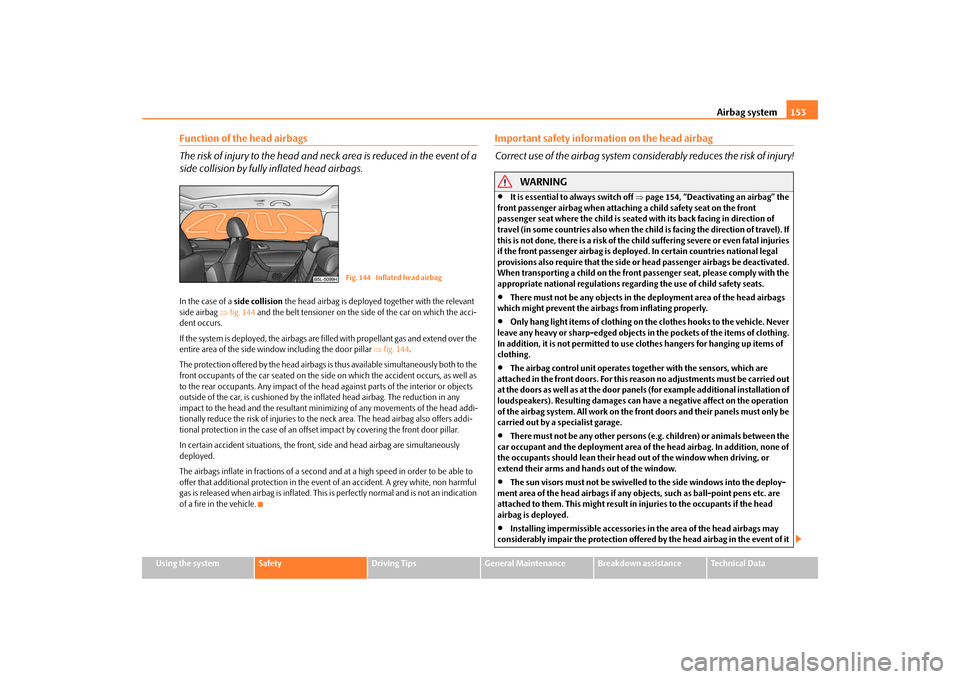
Function of the head airbags The risk of injury to the head and neck area is reduced in the event of a side collision by fully inflated head airbags.In the case of a
side collision
the head airbag is deployed together with the relevant
side airbag
⇒fig. 144
and the belt tensioner on the side of the car on which the acci-
dent occurs. If the system is deployed, the airbags are filled with propellant gas and extend over the entire area of the side wind
ow including the door pillar
⇒fig. 144
.
The protection offered by the head airbags is
thus available simultaneously both to the
front occupants of the car seated on the side on which the accident occurs, as well as to the rear occupants. Any impact of the head against parts of the interior or objects outside of the car, is cushioned by the in
flated head airbag. The reduction in any
impact to the head and the resultant minimi
zing of any movement
s of the head addi-
tionally reduce the risk of injuries to the neck area. The head airbag also offers addi-tional protection in the case of an offset
impact by covering
the front door pillar.
In certain accident situations, the front, side and head airbag are simultaneously deployed. The airbags inflate in fractions of a second an
d at a high speed in order to be able to
offer that additional protection in the even
t of an accident. A grey white, non harmful
gas is released when airbag is inflated. This is perfectly normal and is not an indication of a fire in the vehicle.
Important safety information on the head airbag Correct use of the airbag system cons
iderably reduces the risk of injury!
WARNING
•
It is essential to always switch off
⇒page 154, “Deactivating an airbag” the
front passenger airbag when attachin
g a child safety seat on the front
passenger seat where the child is seated
with its back facing in direction of
travel (in some countries also when the chil
d is facing the direct
ion of travel). If
this is not done, there is a risk of the ch
ild suffering severe or even fatal injuries
if the front passenger airbag is deploy
ed. In certain countries national legal
provisions also require that the side or
head passenger airbags be deactivated.
When transporting a child on the front passenger seat, please comply with the appropriate national regulations regarding the use of child safety seats.•
There must not be any objects in the deployment area of the head airbags
which might prevent the airbags from inflating properly.•
Only hang light items of clothing on
the clothes hooks to the vehicle. Never
leave any heavy or sharp-edged objects in
the pockets of the items of clothing.
In addition, it is not permitted to use clothes hangers for hanging up items of clothing. •
The airbag control unit operates together with the sensors, which are
attached in the front doors. For this reason no adjustments must be carried out at the doors as well as at the door panels (for example additional installation of loudspeakers). Resulting da
mages can have a negative affect on the operation
of the airbag system. All work on the front doors and their panels must only be carried out by a specialist garage.•
There must not be any other persons (e
.g. children) or animals between the
car occupant and the deployment area of
the head airbag. In addition, none of
the occupants should lean their head out of the window when driving, or extend their arms and hands out of the window.•
The sun visors must not be swivelled to the side windows into the deploy-
ment area of the head airbags if any obje
cts, such as ball-point pens etc. are
attached to them. This might result in injuries to the occupants if the head airbag is deployed.•
Installing impermissible accessories in the area of the head airbags may
considerably impair the protection offered by the head airbag in the event of it
Fig. 144 Inflated head airbag
sgg.6.book Page 153 Thursday, September 24, 2009 2:32 PM
Page 155 of 271

Airbag system
154
being deployed. When the deployed head
airbag is inflated, parts of the acces-
sories fitted may in certain circumstances be thrown into the interior of the car and cause injuries to the occupants
⇒page 221, “Accessories, changes and
replacement of parts”.•
Any work on the head airbag system
including installing and removing
system components because
of other repair work (e.g. removing headliner)
must only be carried out by a specialist garage.Deactivating an airbagDeactivating airbags If any airbags have been deactivated, switch them on again as soon as possible so that they are able to again provide their proper protection.There is the technical means installed within your vehicle to switch off the front, side* or head* airbag (take out of commission). This is why you should have the deactivation
of the airbags carried out by a specialist
garage. On vehicles equipped with the switch for de
activation of the airbags, you can deacti-
vate the front passenger airbag
by means of this switch
⇒page 154.
Deactivation of airbags is envisaged only for particular instances, such as if:•
Yo u m u s t i n
exceptional cases
use a child seat on the front passenger seat where
the child is seated with its back to the dire
ction of travel (in some countries this must
be in the direction of travel due to other legal regulations applying)
⇒page 156,
“Important safety information regarding the use of child safety seats”;•
you are not able to maintain the distance
of at least 25 cm between middle of
steering wheel and chest, despite the driver seat being correctly adjusted;•
special attachments are required in the ar
ea of the steering wheel because of a
physical disability;•
you have installed other seats (e.g. orthopaedic seats without side airbags).
Monitoring the airbag system The functionality of the airbag system is al
so monitored electronically when one airbag
has been switched off. If the airbag was switched off using diagnostic equipment:•
The warning light for the airbag system li
ghts up for 4 seconds after switching on
the ignition and then flashes for 12 seco
nds afterwards in 2 second intervals.
Front passenger airbags sw
itched off using the switch for front passenger
airbags* in storage compartmen
t on the front passenger side:
•
the airbag indicator light in the instrume
nt cluster comes on for about 4 seconds
each time the igniti
on is switched on;
•
switching off the airbag is indicated in the middle of the dash panel by the lighting
up of the yellow indicator light in display
⇒fig. 145
.
Note
A specialist garage will be able to advise you whether national legislation in your country allows airbags in
your vehicle to be deactivated, and which ones.
Switch for the front passenger airbagFig. 145 Storage compartment: Switch for the
front passenger airbag / indicator light for a
switched off front seat passenger airbagThe front passenger airbag is deactivated with the switch.
WARNING (continued)
sgg.6.book Page 154 Thursday, September 24, 2009 2:32 PM
Page 156 of 271

Airbag system
155
Using the system
Safety
Driving Tips
General Maintenance
Breakdown assistance
Technical Data
Deactivating an airbag– Switch off the ignition. – Turn the slot of the airbag switch using the key in the position (
OFF
) ⇒fig. 145
.
– Check whether the yellow airbag indicator light in display
in the middle of the dash panel lights up when the ignition is turned on
⇒fig. 145
.
Switching on an airbag– Switch off the ignition. – Turn the slot of the airbag switch using the key in the position (
ON
) ⇒fig. 145
.
– Check whether the yellow airbag indicator light in display
in the middle of the dash panel lights up when the ignition is turned on
⇒fig. 145
.
The warning light
goes out 65 seconds after th
e ignition is switched on.
The airbag should only be switched off under exceptional circumstances
⇒page 154.
Indicator light in display
(airbag switched off)
The airbag indicator ligh
t is located in the middle of the dash panel
⇒fig. 145
.
If the front passenger airbag is
switched off
, the warning light comes on about 4
seconds after the ignition is switched on. There is a system fault present in the airbag switch off
⇒
if the indicator light
flashes.
Please have the car inspected immediately by a specialist garage.WARNING
•
The driver is responsible
for whether the airbag is switched on or switched
off.•
Only switch off the airbag when the ignition is switched off! Otherwise a
fault can occur in the system for the airbag deactivation.•
If the yellow indicator light in display
(airbag
switched off) flashes:
− Front passenger airbag is not deployed in the event of an accident! − It is also important to have the system inspected without delay by a specialist garage.
A2A1
sgg.6.book Page 155 Thursday, September 24, 2009 2:32 PM
Page 164 of 271

Intelligent Technology
163
Using the system
Safety
Driving Tips
General Maintenance
Breakdown assistance
Technical Data
Driving TipsIntelligent TechnologyElectronic stability programme (ESP)*GeneralGeneral The ESP aids you in maintaining control of
your vehicle in situations in which the
vehicle is driving at its dynamic limits, such as
entering a curve fast. The risk of skidding
is reduced and your vehicle thus offers greater driving stability depending on the conditions of the road surface. The system operates at all speeds. The following systems are integrated into the electronic stability programme:•
electronic Differential Lock (EDL),
•
traction control system (TCS),
•
active driver-steering recommendation (DSR),
•
antilock brake system (ABS),
•
brake Assist,
•
uphill-Start off-Assist.
The ESP system cannot be switched off, the
TCS system can only be switched off by
pressing the button
⇒fig. 154
, then the ESP warning light flashes slowly
.
Operating principle The ESP switches on automatically when the engine is started and then conducts a self-test. The ESP control unit processes data from the individual systems. It also proc- esses additional measurement data which are supplied by highly sensitive sensors: the rotational velocity of the vehicle about its ve
rtical axis, the lateral acceleration of the
vehicle, the braking pressure and the steering angle. The direction which the driver wishes to take is determined based on the steering angle and the speed of the vehicle and is co
nstantly compared with the actual behav-
iour of the vehicle. If
differences exist, such as the vehi
cle beginning to skid, the ESP will
automatically brake the appropriate wheel. The car is stabilised again by the forces wh
ich take effect when the wheel is braked.
Intervention into the brake system takes place primarily on the outer front wheel of a vehicle which tends to oversteer (tendency for the rear of the vehicle to break away) while occurs this is on the inner rear wh
eel of a vehicle whic
h tends to understeer
(tendency to shift out of the curve). This braking control cycle is accompanied by noises. During an intervention of the system, the warning light
flashes quickly in the instru-
ment cluster
⇒page 35.
The ESP operates in combination with the ABS
⇒page 167, “Antilock brake system
(ABS)”. If there is a fault in the ABS system, the ESP also does not operate. The ESP warning light lights up in the inst
rument cluster when there is a fault on the
ESP
⇒page 35.WARNING
It is also not possible for the ESP to overcome the physical limits of the vehicle. Even if a vehicle fitted with ESP you should still always adapt your style of driving to the condition of the road surfac
e and the traffic situation. This partic-
ularly applies when driving on slippery
and wet roads. The increased safety
Fig. 154 ESP switch
sgg.6.book Page 163 Thursday, September 24, 2009 2:32 PM
Page 165 of 271

Intelligent Technology
164
offered must not tempt you to take greater risks than otherwise - risk of an acci- dent!
Note
•
All four wheels must be fitted with the same tyres in order to achieve problem-free
operation of the ESP. Differing rolling circum
ferences of the tyres can lead to an unde-
sirable reduction in the engine output.•
Changes to vehicle (e.g. on engine, on th
e brakes, on chassis or another combina-
tion of tyres and wheels) can influence the function of the ESP
⇒page 221, “Accesso-
ries, changes and replacement of parts”.Electronic Differential Lock (EDL)* The electronic differential lock prev
ents an individual wheel from slip-
ping.Models fitted with ESP ar
e equipped with electronic differential lock (EDL).
General The EDL makes it much easier, and sometimes
at all possible, to start off, accelerate
and climb a steep hill when the conditions of the road surface are unfavourable. Operating principle The EDL is activated automaticall
y, that is without any action
on the part of the driver.
It monitors the speeds of the driven wheels with the aid of the ABS sensors. Should only
one
drive wheel begin spinning on a slippery surface there will be an appreciable
difference in the speed of the driven wheels. The EDL function brakes the slipping wheel and the differential transmits a greate
r driving force to the other driven wheel.
This control process is also accompanied by noises. Overheating of the brakes The EDL switches off automatica
lly if unusually severe stresses exist in order to avoid
excessive heat generation in the disc brake on the wheel which is being braked. The vehicle can continue to be driven and has
the same characteristics as a vehicle not
fitted with EDL.
The EDL switches on again automatically
as soon as the brake has cooled down.
EDL Off-road* After switching on the Off-road mode
⇒page 170, EDL Off-road is activated.
EDL Off-road is matched in such a way that it assists the traction of the vehicle when driving on an unfirm ground. EDL is activated earlier in the Off-road mode than in the normal mode. The brake pres- sure builts up more quickly on the slipping
wheel, on one axle, as well as diagonally.
WARNING
•
Carefully depress the accelerator when
accelerating on uniformly slippery
road surfaces, such as ice and snow. Th
e driven wheels might still spin despite
the EDL and affect the stability of
the vehicle - risk of an accident!
•
You should always adapt your style of driving to the condition of road
surface and to the traffic situation even
when your vehicle is fitted with EDL.
The increased safety offered must not tempt you to take greater risks than otherwise - risk of an accident!
Note
•
If the ABS or ESP warning light comes on, this may also indicate a fault in the EDL.
Please have the vehicle inspected as soon
as possible by a specialist garage.
•
Changes to vehicle (e.g. on engine, on the brakes, on chassis or another combina-
tion of tyres and wheels) can influence the function of the EDL
⇒page 221, “Accesso-
ries, changes and replacement of parts”.
WARNING (continued)
sgg.6.book Page 164 Thursday, September 24, 2009 2:32 PM
Page 166 of 271

Intelligent Technology
165
Using the system
Safety
Driving Tips
General Maintenance
Breakdown assistance
Technical Data
Traction control system (TCS) The traction control system prevents
the driven wheels from spinning
when accelerating.General The TCS makes it much easier, and sometimes at
all possible, to start off, accelerate and
climb a steep hill when th
e conditions of the road
surface are unfavourable.
Operating principle The TCS switches on automatically when th
e engine is started and then conducts a
self-test. The system monitors the speeds of the driven wheels with the aid of the ABS sensors. If the wheels are spinning, the force transmitted to the road surface is auto- matically adapted by reducing the engine speed. The system operates at all speeds. The TCS operates in combination with the ABS
⇒page 167, “Antilock brake system
(ABS)”. The TCS will not function if a fault exists in the ABS system. The TCS warning light lights up in the instru
ment cluster when there is a fault on the
TCS
⇒page 34.
During an intervention of the system, the TCS warning light
flashes quickly in the
instrument cluster
⇒page 34.
Switching off You can switch the TCS off and on again as yo
u wish. On vehicles fitted with ABS, you
can switch off the TCS by pressing the button
⇒fig. 155
, on vehicles fi
tted with ESP*,
you can switch off the TCS wi
th the aid of the button
⇒page 163, fig. 154
. The TCS
warning light
flashes slowly in the instrument cluster if the system is switched off
⇒ page 34. The TCS should normally always
be switched on. It may be good practice in certain
exceptional cases, such as when you wish to
have wheel slip, to switch off the system.
Examples:•
when driving with snow chains
•
when driving in deep snow or on a loose surface
•
when it is necessary to rock a vehicle when it has become stuck.
Then you should switch on the TCS again. TCS Off-road* After switching on the Off-road mode
⇒page 170, TCS Off-road is activated.
TCS Off-road provides a more effective a
cceleration of the vehicle on an unfirm
ground, as it allows higher traction be
tween the slipping wheels and the ground.
The system operates when starting off or at low speeds.
WARNING
You should always adjust your style of driving to the conditions of the road surface and the traffic situation. The increased safety offered must not tempt you to take greater risks than otherwise - risk of an accident!
Note
•
All four wheels must be fitted with the same tyres in order to achieve problem-free
operation of the TCS. Differing rolling circumferences of the tyres can lead to an unde- sirable reduction in the engine output.•
Changes to vehicle (e.g. on engine, on the brakes, on chassis or another combina-
tion of tyres and wheels) can influence the function of the TCS
⇒page 221, “Accesso-
ries, changes and replacement of parts”.
Fig. 155 TCS switch
sgg.6.book Page 165 Thursday, September 24, 2009 2:32 PM
Page 167 of 271

Intelligent Technology
166
Active driver-steering recommendation (DSR)*Vehicles with ESP are equipped with active driver-steering recommendation (DSR). This function indicates to the driver in critical situations a steering recommendation in order to stabilise the vehicle. The active driver-steering recommendation is activated, for example, on the right and left vehicle si
de when braking sharply on different road
surfaces.
WARNING
Even with this function the vehicle canno
t steer itself! The dr
iver is furthermore
responsible for the steering of the vehicle!BrakesWhat has a negative effect on braking efficiency?Wear-and-tear Wear-and-tear to the brake pads is greatly dependent on the operating conditions of the vehicle and your style of driving. Particul
arly if you drive a great deal in towns and
over short distances or if you adopt a sporty style of driving, it may be necessary to have the thickness of the brake pads inspected at a specialist garage between the service inspections. Wet roads or road salt There may be a certain delay before the brakes
take full effect under certain conditions
such as when driving through water, during
heavy rain showers or after the vehicle has
been washed in an automatic vehicle wash
, since the brake discs and brake pads may
be moist or even have a coatin
g of ice on them in winter.
Yo u s h o u l d d r y t h e b r a k e s a s
soon as possible by applying and
releasing the brakes several times.
There also may be a certain delay before the full braking efficiency is available when driving on roads which have been treated with
road salt if you have not used the brakes
for some considerable time beforehand. The layer of salt on the brake discs and brake pads must first be rubbed off when you apply the brakes.
Corrosion Corrosion on the brake discs and dirt on th
e bake pads occur if
the vehicle has been
parked for a long period and if you do
not make much use of the braking system.
We recommend cleaning the brake discs by firm
ly applying the brakes at a fairly high
speed if you do not make much use of the braking system or if surface corrosion is present
⇒
.
Faults in the brake surface If you notice that the braking distance has
suddenly become longer and that the brake
pedal can be depressed further, it is possib
le that a brake circuit of the dual-circuit
brake system has failed. Drive, in such cases, to the nearest specialist garage without delay in order to have the problem rectifie
d. Drive at a reduced speed while on your
way to the dealer and adapt your style of
driving to the higher brake pedal pressure
required. Low brake fluid level An insufficient level of brake fluid may result in problems in the brake system. The level of the brake fluid is monitored electronically
⇒page 37, “Brake system
”.
WARNING
•
Only apply the brakes for the purpose of
drying and cleaning the brake discs
if the traffic conditions permit this. Do not place any other road users in jeop-ardy.•
When retrospectively mounting a front
spoiler, solid wheel hubs etc. one
must ensure that the air supply to the front wheel brakes is not reduced other-wise the braking system could run too hot.•
Allow for the fact that new brake pads
do not achieve their full braking effi-
ciency until approximately 200 kilometres. New brake pads must be first “run in” before they develop their optimal fric
tion force. You can, however, compen-
sate for this slightly reduced braking fo
rce by increasing the pressure on the
brake pedal. This guideline also applie
s to any new brake pads installed at a
future date.
sgg.6.book Page 166 Thursday, September 24, 2009 2:32 PM