2009 SKODA YETI light
[x] Cancel search: lightPage 78 of 271

Seats and Stowage
77
Using the system
Safety
Driving Tips
General Maintenance
Breakdown assistance
Technical Data
– The middle seat backrest can be folded
⇒page 74, “Folding rear seats forwards”
forwards and used as armres
t or table with cup holder
⇒page 76, fig. 73
.
– You can place two cups or beverage cans into the recesses.
Note
If the middle rear seat backrest should be
folded forward for lengthy periods, then
make sure that the belt locks are not located below it - this can result in permanent damage to the upholstery.Seat heating of the front seats*You can electrically heat the seat cushions and the seat backrests of the front seats.Front seats– You can switch on and regulate the seat heating of the driver or front passenger
seat by pressing the surface of the regulator at the point at which the symbol is located
⇒fig. 74
.
– With one press, you can switch the heating to highest intensity which is indicated
by the lighting up of the three warning lights in the switch.
– With repeated pressing of the switch, the intensity of the heating is down-regulated
up to the switch-off. The intensity of the heating is indicated by the number of illu- minated warning lights in the switch.
WARNING
If, as an occupant, you have a subdued pain and/or temperature sensitivity, e.g. through medication, paralysis or because of chronic illness (e.g. diabetes), we recommend not to use the seat heating.
This can lead to burns on the back, the
posterior and the legs which
are difficult to heal. If the seat heating is used, we
recommend to make regular breaks in your journey when driving long distances, so that in specific cases as
mentioned above the body can recuperate
from the stress of the journey. Please consult your doctor, who can evaluate your specific condition.
Caution
•
You should not kneel on the seats or otherwise apply pressure at specific points in
order to avoid damaging the heating elements of the seat heaters.•
Do not use the seat heating if the seats ar
e not occupied by persons or if objects
are fastened or stored on them, for example a child seat, a bag etc. A fault of the heating elements in the seat heating can occur.•
Do not clean the seats moist
⇒page 197.
Note
•
The seat heating should only be switched on when the engine is running. This has
a significant effect of savi
ng on the battery capacity.
•
If the on-board voltage drops, the seat heating is switched off automatically, in
order to provide sufficient electrical energy for the engine control.PedalsConcerning a secure depressing of the peda
l, you should use only footmats from the
Škoda genuine accessories. Operation of the pedals must not be hindered!
WARNING
•
Greater pedal distances may be needed when there is a fault in the brake
system.
Fig. 74 Dash panel: Regulator for front seat heating
sgg.6.book Page 77 Thursday, September 24, 2009 2:32 PM
Page 79 of 271

Seats and Stowage
78•
Do not place any footmats or other additional floor coverings in the area of
the pedals in order to ensure that all the pedals can be fully depressed and are able to return unobstructed to their initial position - risk of accident!•
There must be no objects on the floor
which could roll under the pedals. You
would then no longer be able to apply
the brakes, operate the clutch or acceler-
ator - risk of accident!Luggage compartmentLoading the luggage compartmentPlease observe the following in the interest of having good handling characteristics of your vehicle: – Distribute the items of luggage as evenly as possible. – Place heavy objects as far forward as possible.– Attach the items of luggage to the lashing eyes or the fixing net*
⇒page 79.
In the event of an accident, there is such a
high kinetic energy wh
ich is produced by
small and light objects that they can cause se
vere injuries. The magnitude of the kinetic
energy depends on the speed at which the vehi
cle is travelling and on the weight of the
object. The speed at which the vehicle is travelling is in this case the more significant factor. Example: In the event of a frontal collision at a speed of 50 km/h, an unsecured object with a weight of 4.5 kg produces an ener
gy, which corresponds to 20 times its own
weight. This means that it results in a weight of approx. 90 kg. You can imagine the inju- ries that can occur, if this “bullet” is fl
ying through the interior
compartment and hits
an occupant.
WARNING
•
Store the objects in the luggage compartment and attach them to the
lashing eyes, e.g. with the fixing nets.
•
Loose objects in the passenger compartment can be thrown forward during
a sudden manoeuvre or in case of an a
ccident and can injure the occupants or
other oncoming traffic. This risk is still increased, if the objects which are flying around are hit by a deployed airbag. In this case, the objects which are thrown back can injure the occupants - hazard.•
Please note that the handling properti
es of your vehicle may be affected
when transporting heavy objects as a result
of the displacement of the centre of
gravity. The speed and style of driv
ing must be adjusted accordingly.
•
The items carried in the luggage compartment should be stowed in such a
way that no objects are able to slip forward if there are any sudden driving or braking manoeuvres undertaken - risk of injury!•
Never drive with the boot lid fully open
ed or slightly ajar otherwise exhaust
gases may get into the interior of the vehicle - risk of poisoning!•
On no account exceed the permissible
axle loads and the permissible gross
weight of the vehicle - risk of accident!•
Never transport occupants in the luggage compartment!Caution
Please ensure that the heating elements of the rear window heater are not damaged as a result of objects sliding in this area.
Note
Tyre pressure must be adjusted to the load
⇒page 215.
WARNING (continued)
WARNING (continued)
sgg.6.book Page 78 Thursday, September 24, 2009 2:32 PM
Page 81 of 271

Seats and Stowage
80 Move the hook into another position– Fold up the hook in direction of arro
w until an angle of 45° is reached
⇒ page 79, fig. 77
.
– Move the hook in direction of arrow into the desired position and fold down the
hook as far as the stop
in direction of arrow
⇒page 79, fig. 77
.
Remove the hook from the fastening strip– Fold the hook in direction of arrow until it slackens.Install the hook on the fastening strip– Position the hook on the fastening strip in
the vertical position in direction of arrow
and lightly press it on.
– Fold the hook down in opposite direct
ion of the arrow until it locks fully.
WARNING
Please refer to the following guidelines
⇒page 78.
Fixing nets - Net programme*Fig. 78 Fixing net: double horizontal pocket
, floor fixing net / double vertical pockets
Fixing examples of the fixing net as do
uble horizontal pocket, floor fixing net
⇒fig. 78
on the left and double vertical pocket
⇒fig. 78
on the right.
The fixing nets* and the installation inst
ruction are located in the luggage compart-
ment.
WARNING
•
The whole strength of the net makes it possible to load the pocket with
objects of up to 3.5 kg in weight. Heavy
objects are not secured sufficiently - risk
of injury and net damage!•
The load to be transported must be fixed in place in such a way that it cannot
move during the journey and when braking.
Caution
Do not place any objects with sharp edge
s in the nets - risk of net damage.
The luggage compartment cover You can use the luggage compartment cover behind the head restraints for storing
light and soft items.
The luggage compartment cover can be remo
ved as required if one must transport
bulky goods.Removing the luggage compartment cover– Fold the seat backrests a little forward in order to facilitate the removal of the
luggage compartment cover.
– Unhook the support straps on the boot lid
⇒fig. 79
.
A1
A2
A3
A4
A5
A4
Fig. 79 Removing the luggage compart- ment coverA1
sgg.6.book Page 80 Thursday, September 24, 2009 2:32 PM
Page 82 of 271

Seats and Stowage
81
Using the system
Safety
Driving Tips
General Maintenance
Breakdown assistance
Technical Data
– Place the cover in the horizontal position. – Pull the luggage compartment cover out of the holders to the rear or press on
the bottom side of the luggage compartment cover in the front area.
– Fold the slackened front part of the luggage compartment cover over the head
restraints of the rear seats.
– Slightly tilt the luggage compartment cover and remove it to the rear. – Install again by pushing the luggage compartment cover forwards into the holder
and hanging the support straps on the boot lid.
You can stow the removed luggage compartment cover behind the rear seat backrest. The procedure of installing or removing is identical.The luggage compartment cover is foreseen for storage of small objects of up to 2.5 kg. in weight.
WARNING
No objects should be placed on the luggage compartment cover, the vehicle occupants could be endangered if th
ere is sudden braking or the vehicle
collides with something.
Caution
Please ensure that the heating elements of the rear window heater are not damaged as a result of objects placed in this area.
Static separation net*Fig. 80 Use of the static separation net be
hind the rear seats / behind the front seats
Install the static separation net behind the front seats or the rear seats.Installing the static separation net– Remove the luggage compartment cover
⇒page 80.
– Take the separation net out of the bag.– Unfold both parts of the cross rod until they are heard to engage. – Insert the cross rod into the mount first on the one side and push the cross rod
forward. In the same way, fix the cross rod to the other side of the vehicle, mount ⇒fig. 80
.
– Hang the carabines at the ends of the strap into the fixing eyes behind the rear
or front seats.
– Pull the strap through the tensioning clasp,
first of all on the one side and then on
the other side.
Remove the static separation net behind the rear seats– Slacken the bands on both side
s and take off the carabines
⇒fig. 80
.
– Push the cross rod first of all on the one side and then on the other side towards
the rear.
– Take the cross rod out of the mounts .
A2
A2
A1
AB
AB
AC
AC
AB
sgg.6.book Page 81 Thursday, September 24, 2009 2:32 PM
Page 88 of 271

Seats and Stowage
87
Using the system
Safety
Driving Tips
General Maintenance
Breakdown assistance
Technical Data
Caution
The ashtray in the rear part of the centre
console must be closed
(otherwise it could
get damaged) before folding forward the rear middle seat.Rear ashtray - high centre console*Opening ashtray– Press on the top part of the cover of the ashtray in area
⇒fig. 91
.
Removing ashtray insert– Press the cover of the ashtray do
wn slightly as far as the stop.
– Grasp the ashtray insert at the cover and pull it out.Insert ashtray insert– Insert the ashtray insert into the mount and press it in.
WARNING
Never lay flammable objects in the ashtray basin - risk of fire!
Caution
The ashtray in the rear part of the centre
console must be closed
(otherwise it could
get damaged) before folding forward the rear middle seat.
Cigarette lighter*, power socketsCigarette lighter You can also use the socket on the cigarette lighter for other electrical appliances.Using the cigarette lighter– Press in the button of the cigarette lighter
⇒fig. 92
.
– Wait until the button jumps forward. – Remove the cigarette lighter immediately and use it. – Insert the cigarette lighter again into the socket.Using the socket– Remove the cigarette lighter or the cover of the power socket.– Connect the plug of the electrical appliance to the socket. The 12 volt power socket can also be used
to supply power to additional electrical
accessories with a power uptake up to 120 watts.
WARNING
•
Take care when using the cigarette lighter! Not paying proper attention or
incorrect use the cigarette lighter in an uncontrolled manner may result in burns.
Fig. 91 High centre console: Rear ashtray
AA
AB
Fig. 92 Centre console: Cigarette lighter
sgg.6.book Page 87 Thursday, September 24, 2009 2:32 PM
Page 89 of 271

Seats and Stowage
88•
The cigarette lighter and the power socket
also operates when the ignition is
switched off or the ignition key withdrawn. You should therefore never leave children unattended in the vehicle.
Caution
Always use matching
plugs to avoid damagi
ng the power socket.
Note
•
Connecting electrical components when
the engine is not running will drain
the battery of the vehicle - risk of battery draining!•
Further information
⇒page 221, “Accessories, changes and replacement of
parts”.Power socket in the luggage compartment– Open the cover of the power socket
⇒fig. 93
.
– Connect the plug of the electr
ical appliance to the socket.
You can only use the power socket for the
connection of approved electrical accesso-
ries with a power uptake up to 10 watts. The vehicle battery will be discharged in the
process if the engine is stationary. The same remarks apply here as for
⇒page 87.
Further information
⇒page 221, “Accessories, changes and replacement of parts”.
Storage compartmentsOverviewYou will find the following storag
e facilities in your vehicle:
WARNING
•
Please do not place anything on top of the dash panel. Such objects might
slide or fall down when driving (whe
n accelerating or cornering) and may
distract you from concentrating on the traffic situation - risk of accident!•
Ensure that when driving no objects from the centre console of from other
storage possibilities may get into the fo
otwell of the driver. You would then no
longer be able to apply the brakes, oper
ate the clutch or accelerator - risk of
accident!
WARNING (continued)
Fig. 93 Luggage compartment: Power socket
Storage compartment on the front passenger side
⇒ page 89
Storage compartment on the dash panel*
⇒page 89
Storage compartment in front centre console
⇒page 90
Storage compartment for spectacles*
⇒page 90
Storage compartment in the front and rear doors
⇒page 90
Storage compartment below front passenger seat*
⇒page 91
Front seat armrest with storage compartment*
⇒page 91
Storage compartment in rear centre console*
⇒page 92
Storage compartments in the luggage compartment*
⇒page 92
Flexible storage compartment*
⇒page 92
Clothes hooks
⇒page 93
Through-loading bag*
⇒page 93
sgg.6.book Page 88 Thursday, September 24, 2009 2:32 PM
2
Page 91 of 271
Seats and Stowage
90– Press on the button
⇒page 89, fig. 96
in direction of arrow, the cover then folds
upwards.
Certain model versions are equipped without lid for the storage compartment.
WARNING
•
The storage compartment is not a substi
tute for the ashtray and must also
not be used for such purposes - risk of fire!•
The storage compartment must always be closed when driving for safety
reasons.•
Do not put any highly inflammable obje
cts or objects which are sensitive to
heat (e.g. lighters, spra
ys, spectacles, carbonated
drinks) in the storage
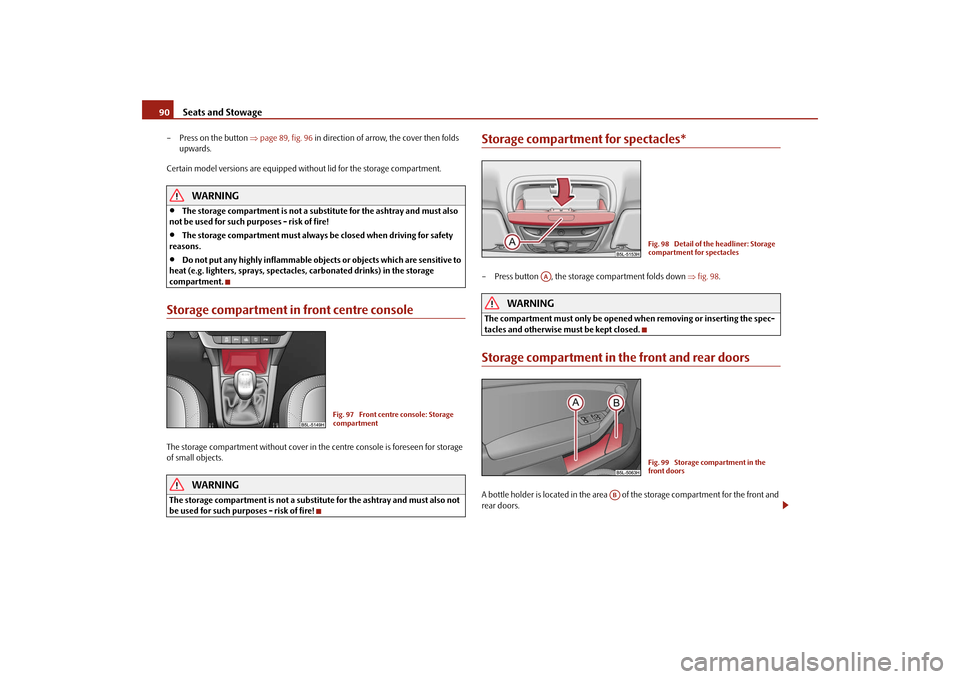
compartment.Storage compartment in front centre consoleThe storage compartment without cover in the centre console is foreseen for storage of small objects.
WARNING
The storage compartment is not a substitu
te for the ashtray and must also not
be used for such purposes - risk of fire!
Storage compartment for spectacles*– Press button , the storage compartment folds down
⇒fig. 98
.
WARNING
The compartment must only be opened
when removing or inserting the spec-
tacles and otherwise mu
st be kept closed.
Storage compartment in the front and rear doorsA bottle holder is located in the area of the storage compartment for the front and rear doors.
Fig. 97 Front centre console: Storage compartment
Fig. 98 Detail of the headliner: Storage compartment for spectacles
AA
Fig. 99 Storage compartment in the front doors
AB
sgg.6.book Page 90 Thursday, September 24, 2009 2:32 PM
Page 94 of 271

Seats and Stowage
93
Using the system
Safety
Driving Tips
General Maintenance
Breakdown assistance
Technical Data
Removing– Take hold of the flexible storage
compartment at both upper corners.
– Press the upper corners to the inside
and release the storage compartment by
pulling upwards.
– Remove by pulling towards you.Installing– Insert both ends of the flexible storage
compartment into the openings of the right
side trim panel of the luggage compartment and push it downwards until it locks.
Clothes hooksThe clothes hooks are located on the middle
pillar and on the handle of the headliner
above each of the rear doors.
WARNING
•
Ensure that any clothes hanging from the hooks do not impair your vision to
the rear.•
Use the hooks for hanging only light item
s of clothing and ensure that there
are no heavy or sharp-edge
d objects in the pockets.
•
The maximum permissable load of the hooks is 2 kg.
•
Do not use clothes hangers for hanging up items of clothing otherwise this
will interfere with the protection offered by the head airbag*.
Removeable through-loading bag*The removeable through-loading bag
is solely used for transporting
skis.The removeable through-loading bag is foreseen for two pairs of skis. The total weight of the skis which are transported must not exceed 10 kg.Loading– Open a rear side door of the vehicle. – Fold the backrest of the middle seat forwards
⇒page 74.
– Place the empty removeable through-loading bag in the gap between the front and
rear seats in such a way that the end of
the bag with the zip lies in the luggage
compartment.
– Open the boot lid.– Push the skis into the removeable through-loading bag from the luggage compart-
ment
⇒
.
– Close the removeable through-loading bag with the zip.Securing– Pull the securing belt with both lock to
ngues out of the pocket of the removeable
through-loading bag.
– Insert the lock tongues in the belt locks
of the rear middle seat belt , first of
all on the one side and then on the other side
⇒fig. 105
.
Fig. 105 Securing the removeable through-loading bag
AA
AC
sgg.6.book Page 93 Thursday, September 24, 2009 2:32 PM