2009 PORSCHE PANAMERA display
[x] Cancel search: displayPage 256 of 343

254
Maintenance and Car Care
Engine OilIt is important to perform oil changes regularly in
accordance with the intervals specified in your
Maintenance Schedule.Engine oil consumptionIt is normal for your engine to consume oil.
The rate of oil consumption depends on the quality
and viscosity of oil, the speed at which the engine
is operated, the climate, road conditions as well
as the amount of dilution and oxidation of the
lubricant.
If the vehicle is used for repeated short trips, and
consumes a normal amount of oil, the engine oil
measurement may not show any drop in the oil
level at all, even afte r 600 miles (1000 km) or
more. This is because the oil is gradually
becoming diluted with fuel or moisture, making it
appear that the oil level has not changed.
The diluting ingredients evaporate out when the
vehicle is driven at high speeds, as on an
expressway, making it then appear that oil is
excessively consumed after driving at high
speeds.
If the conditions you drive your vehicle in are
dusty, humid, or hot, the frequency of the oil
change intervals should be greater. If the vehicle is driven at a high rate of speed,
climatic conditions are warm, and the load is high,
the oil should be checked more frequently, as
driving conditions will de
termine the rate of oil
consumption.
– The engine in your vehicle depends on oil to lubricate and cool all of its moving parts.
Therefore, the engine oil should be checked
regularly and kept at the required level.
– Make it a habit to have the engine oil level checked with every refueling.
– The oil pressure warning light is not an oil level indicator.
The oil pressure warning light indicates serious
engine damage may be occuring when lit, if
engine rpm is above idle speed.
Checking Engine-Oil Levelf Check the oil level on the multi-function display
at regular intervals before refuelling.
f Please see the chapter “OIL LEVEL DISPLAY
AND MEASUREMENT OF THE ENGINE OIL
LEVEL” on page 121.
Warning!
Engine oil is hazardous to your health and
may be fatal if swallowed.
f Keep engine oil out of children's reach.
Used engine oil contains chemicals that have
caused cancer in laboratory animals.
f Always protect your skin by washing thoroughly with soap and water.
Top-up quantity
The difference between the minimum and
maximum marks on the segment display is
approx. 1.06 US quearts (1 liter).
One segment of the display corresponds to
a top-up quantity of approx. 0.26 US quarts
(0.25 liters).
f Never add more engine oil than required to
reach the maximum mark.
Page 257 of 343

Maintenance and Car Care
255
If the oil level is too low, this is indicated by the
oil-warning light on the multi-function display.
f Correct the oil level as soon as possible.
f Please see the chapter “OVERVIEW OF
WARNING MESSAGES” on page 152.
Note on operation
If the engine compartment lid is opened and no
oil is added, the warning message appears again
after at least 6 miles (10 km).
Warning!
Risk of injury. The radiator fans can start
running when a certain temperature is
reached, even with the engine switched off.
Risk of burns from hot parts in the engine
compartment.
f Exercise extreme caution when working in the engine compartment.
Topping Up Engine OilPorsche recommends .1) Generally, you can find details on the
manufacturer approvals on the oil containers or as
a notice displayed by the retailer.
The current approval status is also available from
your authorized Porsche dealer.2) SAE viscosity class - Example: SAE 0W - 40
Specification 0W = Viscos ity specification for low
temperatures (winter).
Specification 40 = Viscosity specification for high
temperatures.3) For all temperature ranges.4) For the temperature range over –13 °F
(–25 °C).
Always observe the following points:
– Use engine oils approved by Porsche only. This is a precondition for optimum and
problem-free driving.
– Regular oil changes are part of servicing. It is important that the service intervals,
particularly the oil change intervals, are
observed in accordance with the specifications
in the “Maintenance” booklet. – Oils approved by Pors
che can be mixed with
each other.
– Porsche engines are designed so that no oil additives may be used.
– A label is located in the engine compartment,
which provides you with information on suitable
oil for your engine.
Your authorized Porsche dealer will be pleased to
advise you.
Caution!
Fire hazard if engine oil comes into contact
with hot engine parts.
Risk of damage if engine oil comes into
contact with the drive belt.
f Exercise extreme caution when topping up
engine oil.
f Top up engine oil only with the engine stopped and ignition switched off.
f Please see the chapter “EXERCISE EXTREME
CAUTION WHEN WORKING ON YOUR VEHICLE”
on page 252.
Oil-level warning
Complies with
approval
1)
Viscosity class
2)
Porsche A40 SAE 0W - 40
3)
SAE 5W - 40
4)
SAE 5W - 50
4)
Page 258 of 343

256
Maintenance and Car Care
1. Unscrew cap on oil filler opening.
2. Top up engine oil according to the display on
the multi-function display.
One segment of the display corresponds to a
top-up quantity of approx. 0.26 US quarts
(0.25 liters).
3. Carefully close cap of the oil filler opening.
After opening the hood, the oil level can only
be measured after driving for at least 6 miles
(10 km).
Oil changeThe engine oil has to be changed regularly at the
intervals listed in your Maintenance Schedule .
f Please see the chapter “FILLING CAPACITIES”
on page 329.
We recommend that you have the engine oil
changed at your Porsche dealer, who has the
required oils and the necessary filling equipment.
If you suspect an oil leak in the engine have your
dealer check it out immediately.
All current engine oils are compatible with each
other, i.e. when making an oil change it is not
necessary to flush the engi ne if you wish to use a
different brand or grade of oil.
Since, however, each brand of oil has a special
composition, you should, if possible, use the
same oil brand if it beco mes necessary to top up
between oil changes.
Porsche engines have long intervals between oil
changes. You can make best use of these long oil
change intervals by usin g multigrade oils since
these are largely independent of seasonal
fluctuations in temperature.
If your vehicle is used frequently in stop-and-go
traffic in cold weather, the engine will not always
be properly warmed up.
Condensation from products of combustion may
accumulate in the oil. In this case, it is advisable
to change the oil more frequently so that your
engine once again has 100% efficient engine oil.
Engine oil performance class Engine oil is not only a lubricant, but also serves
to keep the engine clean, to neutralize the
contaminants which penetrates into the engine
through combustion and to protect the engine
against corrosion.
To perform these functions, the oil is provided with
additives which have been specially developed for
these functions.
The efficiency of an oil is expressed, for example,
by the API, ILSAC or ACEA classifications. Viscosity Like all liquids, engine oil is viscous when cold,
and thin-bodied when warm. The viscosity of an oil
is expressed by its SAE class. For cold viscosity
(measured at temperatures below 32 °
F/0 °
C) the
SAE class is given as a number and the letter “W”
(as in winter), for hot viscosity (measured at
212 °
F/100 °
C) the SAE class is given only as a
number.
The viscosity of an oil is, therefore, always the
same if it has the same number of an SAE class.
Oils with two viscosities are called multigrade oils;
oils with only one viscosity are termed single-
grade oils.
Single-grade oils can not be used in your engine.
The viscosity of the engine oil for your Porsche
has to be chosen according to the ambient
temperature given in the engine oil
recommendation table.
Page 259 of 343

Maintenance and Car Care
257
Checking Coolant Level and
Adding CoolantThe coolant provides year-round protection
from corrosion and freezing down to –31 °F
(–35 °C) (–40 °F (–40 °C) in Nordic countries).
Observe the following points:
fUse only antifreeze authorised by Porsche.
f Check the coolant level regularly.Coolant levelWhen the engine is cold and the vehicle is level,
the red display must be under the arrow between
the minus and plus markings.
f Add coolant if necessary.
The maximum fill level is reached when the red
display is under the plus marking.
f Please see the chapter “OVERVIEW OF
WARNING MESSAGES” on page 152.
f Please see the chapter “EXERCISE EXTREME
CAUTION WHEN WORKING ON YOUR VEHICLE”
on page 252. Checking when engine is cold
1. Open cap on the reservoir carefully and
allow any overpressure to escape.
Then unscrew cap completely.
2. Read off the engine coolant level.
3. Top up with coolant if necessary. Do not top up over the plus marking.
Only add a mixture of antifreeze and water
in equal parts.
Antifreeze in coolant:
50 % provides antifreeze protection
down to –31 °F (–35 °C).
4. Screw the cap on the reservoir closed until it locks securely. Checking the coolant level when a warning
message appears on the multi-function
display in the instrument panel
Warning!
Danger of serious personal injury or death
from scalding. Coolant is hazardous to your
health, and may be fatal if swallowed.
f Do not open the cap of the expansion tank
while the engine is hot.
f Allow the engine to cool down before opening
the cap and protect your hands, arms and face
from any possible escape of hot coolant.
f Keep coolant out of children's reach.
f Also, keep coolant away from your pets. They
can be attracted to it should there be a spill, or
to used coolant left in an open container. Coolant can be deadly to pets if consumed.
Page 261 of 343
Maintenance and Car Care
259
Porsche dealer to do this work as they have
trained workshop personnel and the necessary
parts and tools. Warning!
Brake fluid is hazardous to your health, and
may be fatal if swallowed.
Brake fluid also attacks paintwork.
f Keep brake fluid out of children's reach.
f Immediately rinse off spilled brake fluid with
clean water.
f If brake fluid gets into your eye, immediately
rinse with clean water for a few minutes. Then
see a doctor immediately.
f Please note all the info rmation on the refill container of the brake fluid.
Changing brake fluidBrake fluid absorbs moisture from the air
over time. The absorbed water can impair
braking efficiency.
fIt is important therefore to have the brake fluid
changed in accordance with the change
intervals specified in the “Maintenance”
booklet.
The warning light on the instrument panel and the
warning message on the multi-function display
alert you to the fact that the brake fluid level is
too low and could indicate brake circuit failure
if the pedal travel is greater than normal.
Note on operation
If the warning light and warning message appear
when driving:
f Stop immediately in a suitable place.
f Do not continue driving.
Please contact a qualified specialist workshop.
We recommend that you have an authorized
Porsche dealer to do this work as they have
trained workshop personnel and the necessary
parts and tools.
Washer Fluid We recommend window cleaner concentrates
approved by Porsche for either summer or winter,
depending on the season. Your authorized
Porsche dealer will be pleased to advise you.
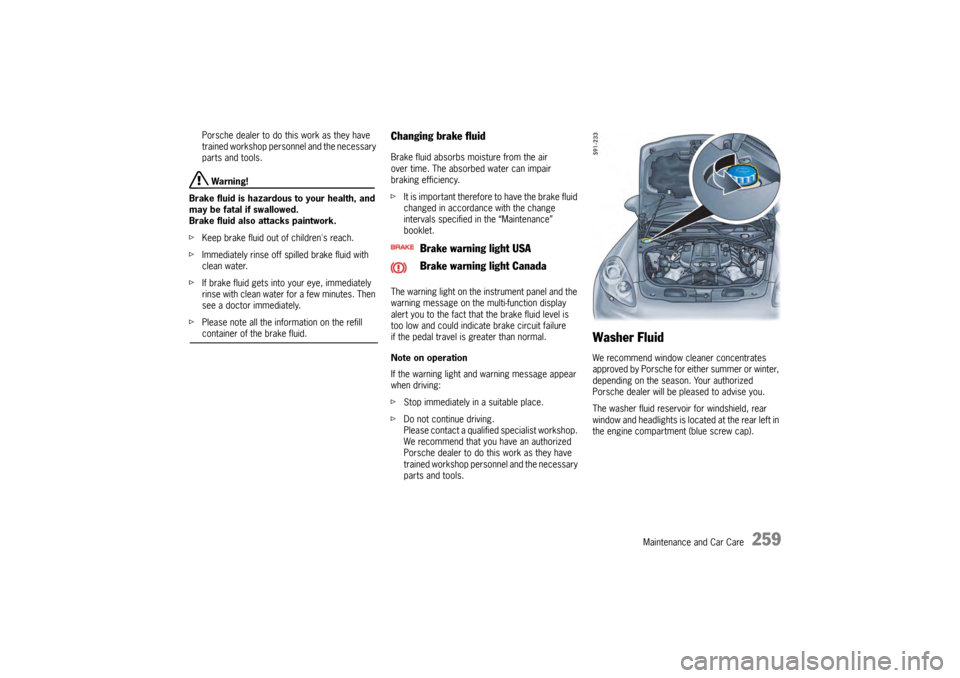
The washer fluid reservoir for windshield, rear
window and headlights is located at the rear left in
the engine compartment (blue screw cap).
Brake warning light USA
Brake warning light Canada
Page 262 of 343

260
Maintenance and Car Care
The warning light on the instrument panel and
the warning message on the multi-function display
alert you to the fact that the washer fluid level
is too low.
f
Add washer fluid at the next opportunity.
In this case, the remaining quantity is only approx.
1 litre. The maximum filling capacity is approx.
5.8USquarts (5.5liters).
Adding washer fluid
1. Open cap on washer fluid reservoir.
2. Add washer fluid.
3. Close cap carefully.
Power Steering
Warning!
Risk of accidents. When the engine is
stationary (e.g. when on tow) or the hydraulic
system fails, there is no power steering
assistance available.
Therefore, substantially more force will have
to be exerted to steer the vehicle.
f Exercise extreme care when your vehicle is
being towed.
f Have the fault corrected. Please contact a
qualified specialist workshop. We recommend
that you have an authorized Porsche dealer to
do this work as they have trained workshop personnel and the necessary parts and tools.
Regular checking of hydraulic fluid is part of
servicing.
The flow noise heard at full steering lock is design-
related and does not indicate a defect in the
steering system. Vehicles with Porsche Dynamic Chassis
Control (PDCC)
If the fluid level is too
low, the message “Check
steering oil level” will appe ar on the multi-function
display.
f Have the fluid level checked immediately.
f Please contact a qualified specialist workshop.
We recommend that you have an authorized
Porsche dealer to do this work as they have
trained workshop personnel and the necessary
parts and tools.
Warning light and warning
message
Page 267 of 343

Maintenance and Car Care
265
FuelWhen the ignition is on, the fuel level is displayed
on the instrument panel.
fPlease see the chapter “FUEL GAUGE” on
page 111.
Warning!
Fuel is highly flammable and harmful to
health.
f Fire, open flame and smoking are prohibited
when handling fuel.
f Avoid contact with skin or clothing, since injury
to your skin may occur.
f Do not inhale fuel vapors, since they may make
you ill and possibly cause death if inhalation is
prolonged and occurs in a closed space.
To prevent damage to the emission control
system and engine:
f Never drive the tank dry.
f Avoid high cornering speeds after the warning lights have come on.
f Please see the chapter “FUEL ECONOMY” on
page 264. To avoid permanent damage
to the functionality of
the catalytic converters and oxygen sensors, use
unleaded fuel only.
The engine is designed to provide optimum
performance and fuel consumption if unleaded
premium fuel with 98 RON/88 MON is used.
If unleaded fuels with octane ratings of less than
98 RON/88 MON are used, the engine’s knock
control automatically adapts the ignition timing.
Porsche recommends that you use fuel with
at least 95 RON/85 MON in your vehicle.
The emission control system can be damaged in
various ways (e.g. fueling incorrectly, shortage of
fuel, tow-starting).
f Please see the chapter “HOW EMISSION
CONTROL WORKS” on page 263. Note on operation
Information on the fuel quality can normally
be found on the pump.
If this is not the case, ask a fuel station attendant.
If the recommended fuel
is not available, you
can also use unleaded regular fuel (91 RON/
82.5 MON) in an emergency.
However, this could reduce performance and
increase fuel consumption.
f Avoiding driving at full throttle.
In some countries the available fuel quality may
not meet requirements and can result in coking
around the inlet valve.
In this case, the fuel may be mixed with the
additive sold and recommended by Porsche after
consulting a authorized Porsche dealer.
Porsche part number 000 043 206 89.
f Observe the instructions and mixture ratios
stated on the container.
It is important that the service intervals,
particularly the oil change intervals, are
observed in accordance with the specifications
in the “Maintenance” booklet.
Page 270 of 343

268
Maintenance and Car Care
Fuel Recommendations Your Porsche is equipped with catalytic
converters and must use UNLEADED FUEL
ONLY .
Your engine is designed to provide optimum
performance and fuel economy using unleaded
premium fuel with an octane rating of 98 RON
(93 CLC or AKI) . Porsche therefore
recommends the use of these fuels in your
vehicle.
Porsche also recognizes that these fuels may not
always be available. Be assured that your vehicle
will operate properly on unleaded premium fuels
with octane numbers of at least 95 RON
(90 CLC or AKI) , since the engine’s “Electronic
Oktane™ knock control” will adapt the ignition
timing, if necessary.
It is important to observe the regular service
intervals, and particularly the oil change intervals,
specified in the “Maintenance” booklet.
T h e u s e o f U N L E A D E D F U E L O N LY i s c r i t i c a l l y
important to the life of the catalytic
converters. Deposits fr om leaded fuels will
ruin the converters and make them
ineffective as an emis sion control device.
Cars with catalytic converters have a smaller fuel
tank opening, and gas station pumps that
dispense unleaded fuel ha ve smaller nozzles. This
will prevent accidental pumping of leaded fuel into
cars with catalytic converters. Unleaded fuels may not be available outside the
continental U.S. and Canada. Therefore, we
recommend you do not take your car to areas or
countries where unleaded fuel may not be
available.
Octane ratings Octane rating indicates a fuel’s ability to resist
detonation. Therefore, buying the correct octane
gas is important to prevent engine “damage”.
The RON octane rating is based on the research
method. The CLC (U.S.
Cost of Living Council
octane rating) or AKI ( anti knock index) octane
rating usually displayed on U.S. fuel pumps is
calculated as research octane number plus motor
octane number, divided by 2, that is written as:
The CLC or AKI octane rating is usually lower than
the RON rating:
For example: 95 RON equals 90 CLC or AKI.
Fuels containing ethanolDo not use any fuels containing more than 10
percent ethanol by volume.
We recommend, however, to change to a different
fuel or station if any of the following problems
occur with your vehicle:
– Deterioration of driveability and performance.
– Substantially reduced fuel economy.
– Vapor lock and non-start problems, especially at high altitude or at high temperature.
– Engine malfunction or stalling.
RON+MON
2 R+M
2
or