2009 PORSCHE PANAMERA display
[x] Cancel search: displayPage 211 of 343
Driving and Driving Safety
209
Porsche Active Suspension
Management (PASM) with Air
Suspension and Level ControlPASM with air suspension is an active shock
absorber adjustment and ride height balancing
system. The adjustable damper system selects
the appropriate damping level for each wheel
according to the driving situation and driving
conditions. The level control system automatically
balances load changes and maintains a constant
ride height. Driving safety , agility and comfort are
optimised.
Three different chassis setups can be selected at
the push of a button:
– “PASM Comfort”
– “PASM Sport”
– “PASM Sport Plus”
Comfort mode ensures comfortable chassis
tuning.
The “PASM Sport” chassis setup offers very
sporty shock absorber tuning.
“PASM Sport Plus” mode offers particularly sporty
shock absorber tuning (e.g. for driving on the race
circuit). The vehicle is also lowered by
approx. 1 in. (25 mm) compared with the normal
level and the spring rate is increased.
In addition to manual mode selection, PASM also
adjusts shock absorber tuning for either sporty
or comfort driving, depending on the driving
situation.
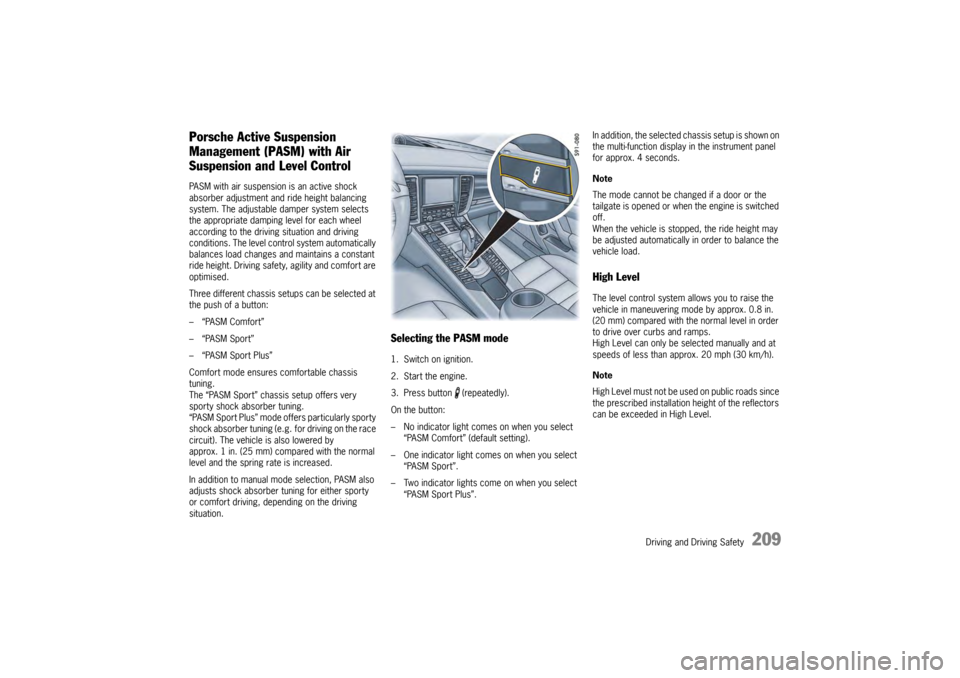
Selecting the PASM mode1. Switch on ignition.
2. Start the engine.
3. Press button (repeatedly).
On the button:
– No indicator light come s on when you select
“PASM Comfort” (default setting).
– One indicator light comes on when you select “PASM Sport”.
– Two indicator lights come on when you select
“PASM Sport Plus”. In addition, the selected chassis setup is shown on
the multi-function display in the instrument panel
for approx. 4 seconds.
Note
The mode cannot be changed if a door or the
tailgate is opened or when the engine is switched
off.
When the vehicle is stopped, the ride height may
be adjusted automatically
in order to balance the
vehicle load.
High LevelThe level control system al lows you to raise the
vehicle in maneuvering mode by approx. 0.8 in.
(20 mm) compared with the normal level in order
to drive over curbs and ramps.
High Level can only be selected manually and at
speeds of less than approx. 20 mph (30 km/h).
Note
High Level must not be us ed on public roads since
the prescribed installation height of the reflectors
can be exceeded in High Level.
Page 212 of 343
210
Driving and Driving Safety
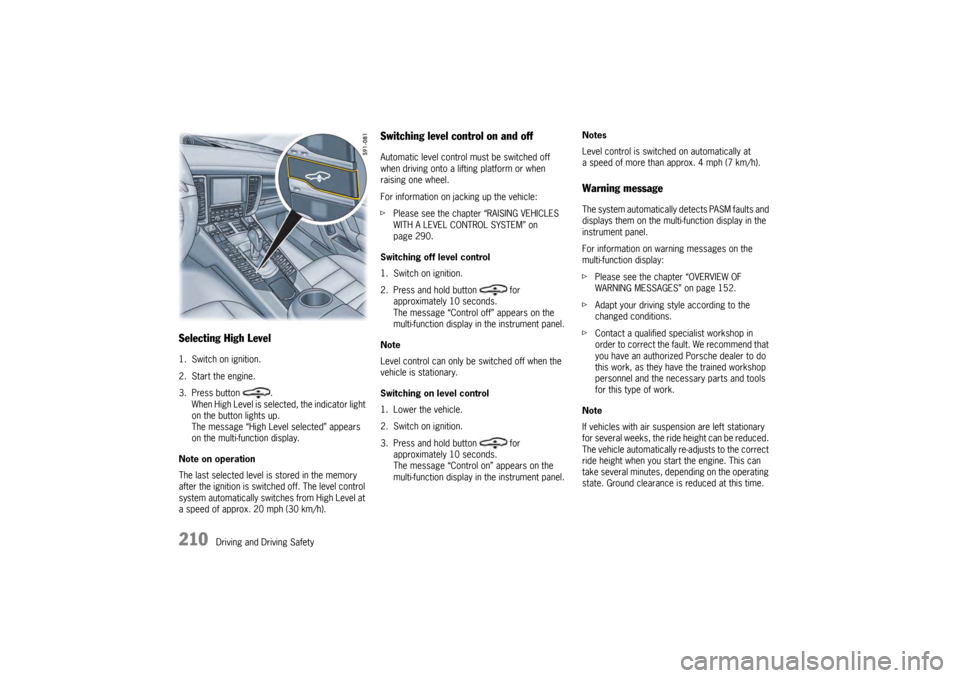
Selecting High Level1. Switch on ignition.
2. Start the engine.
3. Press button .When High Level is selected, the indicator light
on the button lights up.
The message “High Level selected” appears
on the multi-function display.
Note on operation
The last selected level is stored in the memory
after the ignition is switched off. The level control
system automatically switches from High Level at
a speed of approx. 20 mph (30 km/h).
Switching level control on and offAutomatic level control must be switched off
when driving onto a lifting platform or when
raising one wheel.
For information on ja cking up the vehicle:
f Please see the chapter “RAISING VEHICLES
WITH A LEVEL CONTROL SYSTEM” on
page 290.
Switching off level control
1. Switch on ignition.
2. Press and hold button for approximately 10 seconds.
The message “Control off” appears on the
multi-function display in the instrument panel.
Note
Level control can only be switched off when the
vehicle is stationary.
Switching on level control
1. Lower the vehicle.
2. Switch on ignition.
3. Press and hold button for approximately 10 seconds.
The message “Control on” appears on the
multi-function display in the instrument panel. Notes
Level control is switched on automatically at
a speed of more than approx. 4 mph (7 km/h).
Warning messageThe system automatically
detects PASM faults and
displays them on the multi-function display in the
instrument panel.
For information on warning messages on the
multi-function display:
f Please see the chapter “OVERVIEW OF
WARNING MESSAGES” on page 152.
f Adapt your driving style according to the
changed conditions.
f Contact a qualified specialist workshop in
order to correct the fault. We recommend that
you have an authorized Porsche dealer to do
this work, as they have the trained workshop
personnel and the necessary parts and tools
for this type of work.
Note
If vehicles with air suspension are left stationary
for several weeks, the ride height can be reduced.
The vehicle automatically re-adjusts to the correct
ride height when you start the engine. This can
take several minutes, depending on the operating
state. Ground clearance is reduced at this time.
Page 213 of 343

Driving and Driving Safety
211
Porsche Dynamic Chassis Control
(PDCC) FunctionThe Porsche Dynamic Chassis Control (PDCC)
system used on vehicles with air suspension is
a system for roll stabilisation of the vehicle body
when driving.
Driving comfort and driving safety are improved
by active intervention of the anti-roll bars on the
front and rear axles. Ve hicle balance and agility
are optimised.
No separate controls are available for the PDCC
system.
When you select a chassis setup in Porsche Active
Suspension Management (PASM) with air
suspension and level control, the PDCC system
automatically activates the corresponding on-road
driving program.
For information on selecting a chassis setup:
f Please see the chapter “PORSCHE ACTIVE
SUSPENSION MANAGEMENT (PASM) WITH AIR
SUSPENSION AND LEVEL CONTROL” on
page 209.
Warning messageThe warning message “Fault PDCC” or “PDCC
failure” appears on the mult i-function display in the
instrument panel if there is a system fault.
For information on warning messages on the
multi-function display:
f Please see the chapter “OVERVIEW OF
WARNING MESSAGES” on page 152.
f Adapt your driving style according to the
changed conditions.
f Contact a qualified specialist workshop in
order to correct the fa ult. We recommend that
you have an authorized Porsche dealer to do
this work, as they have the trained workshop
personnel and the necessary parts and tools
for this type of work.
Checking hydraulic fluidThe hydraulic fluid is checked and changed
regularly as part of servicing.
For information on maintenance:
f Please see the chapter “EXERCISE EXTREME
CAUTION WHEN WORKING ON YOUR VEHICLE”
on page 252.
Page 215 of 343
Driving and Driving Safety
213
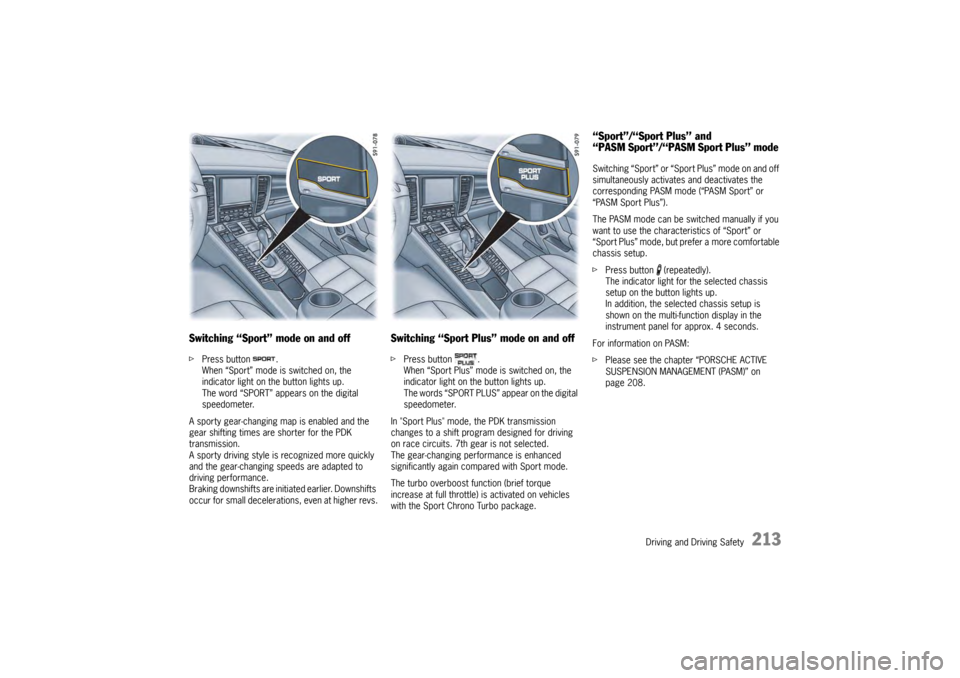
Switching “Sport” mode on and offfPress button .
When “Sport” mode is switched on, the
indicator light on the button lights up.
The word “SPORT” appears on the digital
speedometer.
A sporty gear-changing map is enabled and the
gear shifting times ar e shorter for the PDK
transmission.
A sporty driving style is recognized more quickly
and the gear-changing speeds are adapted to
driving performance.
Braking downshifts are initiated earlier. Downshifts
occur for small decelerations, even at higher revs.
Switching “Sport Plus” mode on and offf Press button .
When “Sport Plus” mode is switched on, the
indicator light on the button lights up.
The words “SPORT PLUS” appear on the digital
speedometer.
In "Sport Plus" mode, the PDK transmission
changes to a shift progra m designed for driving
on race circuits. 7th gear is not selected.
The gear-changing performance is enhanced
significantly again compared with Sport mode.
The turbo overboost function (brief torque
increase at full throttle) is activated on vehicles
with the Sport Chrono Turbo package.
“Sport”/“Sport Plus” and
“PASM Sport”/“PASM Sport Plus” mode Switching “Sport” or “Sport Plus” mode on and off
simultaneously activates and deactivates the
corresponding PASM mode (“PASM Sport” or
“PASM Sport Plus”).
The PASM mode can be sw itched manually if you
want to use the characteristics of “Sport” or
“Sport Plus” mode, but prefer a more comfortable
chassis setup.
f Press button (repeatedly).
The indicator light for the selected chassis
setup on the button lights up.
In addition, the selected chassis setup is
shown on the multi-function display in the
instrument panel for approx. 4 seconds.
For information on PASM:
f Please see the chapter “PORSCHE ACTIVE
SUSPENSION MANAGEMENT (PASM)” on
page 208.
Page 216 of 343
214
Driving and Driving Safety
Warning messages
The warning message “Sport mode error”
appears on the multi-f
unction display in the
instrument panel in the event of a fault.
For information on warning messages on the
multi-function display:
f Please see the chapter “OVERVIEW OF
WARNING MESSAGES” on page 152.
Note
After the ignition is switched off, Sport mode is
automatically reset to Normal mode.
f Please see the chapter “PORSCHE ACTIVE
SUSPENSION MANAGEMENT (PASM)” on
page 208.
f Please see the chapter “PORSCHE DYNAMIC
CHASSIS CONTROL (PDCC)” on page 211.
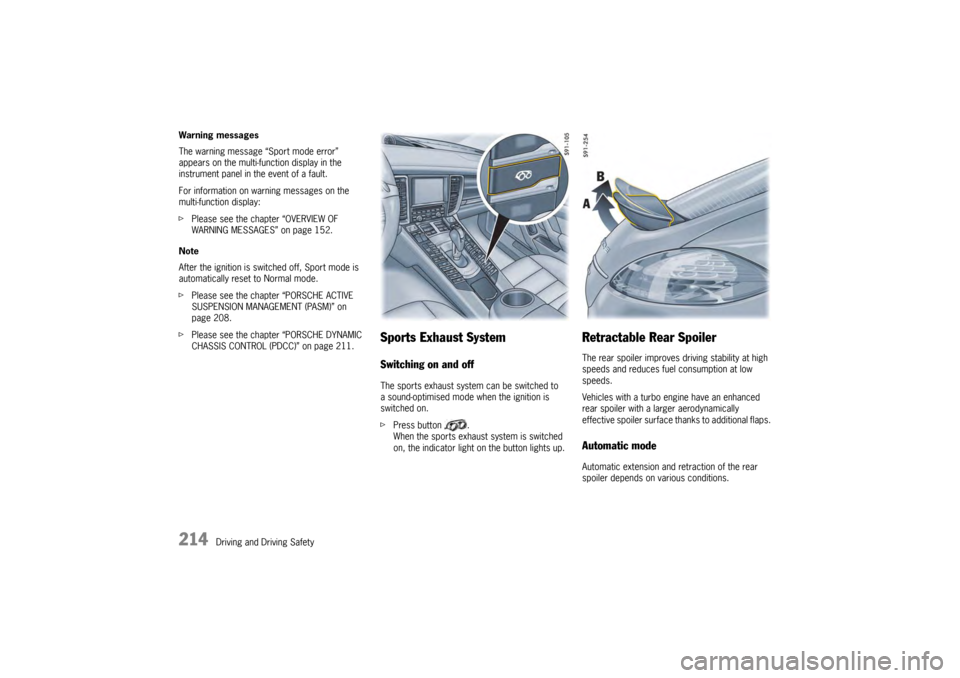
Sports Exhaust SystemSwitching on and offThe sports exhaust system can be switched to
a sound-optimised mode when the ignition is
switched on.
fPress button .
When the sports exhaust system is switched
on, the indicator light on the button lights up.
Retractable Rear SpoilerThe rear spoiler improves driving stability at high
speeds and reduces fuel consumption at low
speeds.
Vehicles with a turbo engine have an enhanced
rear spoiler with a larger aerodynamically
effective spoiler surface thanks to additional flaps.Automatic modeAutomatic extension and retraction of the rear
spoiler depends on various conditions.
Page 217 of 343
Driving and Driving Safety
215
“Sport Plus” mode deactivated
The rear spoiler extends automatically:
– to position A at approx. 55 mph (90 km/h).
– to position B at approx. 130 mph (205 km/h).
The rear spoiler retracts automatically:
–from position B to position A at approx.
110 mph (180 km/h).
–from position A to the end position at
approx. 40 mph (60 km/h).
Additional rear spoiler position on vehicles
without a turbo engine
The rear spoiler also mo ves to an intermediate
position between A and B when extended at
speeds of between appr ox. 100 mph (160 km/h)
and 130 mph (205 km/h) and when retracted at
speeds of between appr ox. 110 mph (180 km/h)
and 90 mph (145 km/h).
“Sport Plus” mode activated
The rear spoiler extends straight to position B at
approx. 55 mph (90 km/h).
The rear spoiler retracts from position B straight
to the end position at approx. 40 mph (60 km/h). If the automatic control system fails, the warning
message “Spoiler failure”
appears on the multi-
function display.
For information on warning messages on the
multi-function display:
f Please see the chapter “OVERVIEW OF
WARNING MESSAGES” on page 152.
Warning!
Risk of accidents if the “Spoiler failure”
warning appears. Driving stability will be
adversely affected if th e rear spoiler retracts
or fails to extend. This is due to increased
rear axle lift at higher speeds. The rear axle
will tend to lift, reducing the road holding
characteristics of the car in higher-speed
turns.
f Adapt your driving style and speed to the
changed driving behavior.
f Have the fault corrected.
Please contact a qualified specialist workshop.
We recommend that you have an authorized
Porsche dealer to do this work as they have
trained workshop personnel and the necessary parts and tools.
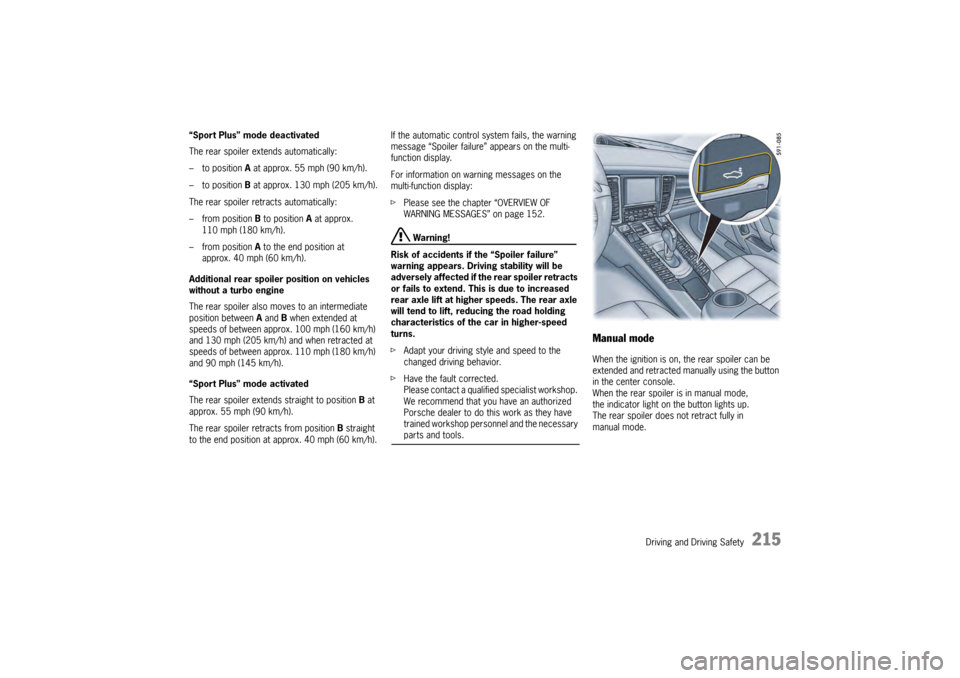
Manual modeWhen the ignition is on, the rear spoiler can be
extended and retracted manually using the button
in the center console.
When the rear spoiler is in manual mode,
the indicator light on the button lights up.
The rear spoiler does not retract fully in
manual mode.
Page 230 of 343

228
Storage, Luggage Compartment and Roof Transport System
Stowing Loads
Danger!
Danger of injury. An unsecured or incorrectly
positioned load can slip out of place or
endanger the vehicle occupants during
braking, direction changes or in accidents.
Never transport objects that are not secured.
f Always transport loads in the luggage
compartment, never in the passenger
compartment (e.g. on or in front of the seats).
f Support the load against the seat backrests
wherever possible. Always lock the backrests
into place.
f Only transport heavy objects with the rear seat
backrests upright and engaged.
f Place the load behind unoccupied seats
whenever possible.
f Stow heavy objects as far forward as possible
on the floor, with lightweight objects behind
them.
f Never load the vehicle higher than the top
edge of the seat backrest.
f Always protect the passenger compartment
with a luggage compartment cover. Do not
drive with objects on top of the luggage
compartment cover. f
If the rear seats are not occupied, the
backrests can be addition ally secured with the
seat belts. Simply cro ss the outer seat belts
and insert each into the opposite buckle.
f Make sure that the load cannot damage the
heating filaments and the TV antenna in the
rear window.
Tie-down belts
f Do not use elastic belt s or straps to tie
down a load.
f Do not route belts and straps over
sharp edges.
f Observe the directions for use and information
for the tie-down equipment.
f Use only belts with a tear strength of at least
1543 lbs (700 kg) and a maximum width of
1 in. (25 mm).
f Cross the belts over the load. Driving
f
Vehicle handling changes depending on the
vehicle load. Adapt your driving style to the
changed driving behavior.
f Do not exceed the maximum gross weight
and axle load.
This information can be found under “Technical
data” in this Owner’s Manual:
f Please see the chapter “WEIGHTS” on
page 328.
f Never drive with the tailgate open. Exhaust
gases can enter the passenger compartment.
f Adapt the tire pressure to the load.
After you change the tire pressure, you must
also update the setting for Tire Pressure
Monitoring.
For information on setting Tire Pressure
Monitoring on the multi-function display:
f Please see the chapter “OVERVIEW OF
WARNING MESSAGES” on page 152.
Information on tire pressures for partially and fully
loaded vehicles can be found under “Technical
data” in this Owner’s Manual:
f Please see the chapter “TIRE PRESSURE FOR
COLD TIRES (68 °F/20 °C)” on page 326.
Page 255 of 343

Maintenance and Car Care
253
Technical ModificationsfModifications may be carried out on your
vehicle only if approved by Porsche.
This ensures that your Porsche will remain
reliable and safe to drive, and that it will not be
damaged as a result of the modifications.
Your authorized Porsche dealer will be pleased
to advise you.
Safety notes!
f Only use genuine Porsche spare parts for your
vehicle or spare parts of similar quality which
have been manufactured according to the
specifications and production requirements of
Porsche. These parts are available from your
authorized Porsche dealer or a qualified
specialist workshop. Safety-related
accessories should only be used if they are
from the Porsche Tequipment range or are
tested and approved by Porsche. Your
authorized Porsche dealer will be pleased to
advise you and answer any questions you may
have.
However, the use of other parts or
accessories may adversel y affect the safety
of your vehicle, and Porsche can take no
responsibility for any loss or damage caused
by their use.
Even if the supplier of other accessories or
parts is a recognized supplier, the safety of
your vehicle may still be affected if such items
are installed.
Due to the large variety of products offered in the accessory market, it is not possible for
Porsche to inspect and approve every one.
f In addition, please note that the use of
replacement parts that are not genuine
Porsche parts or approved parts, or the use of
accessories not approved by Porsche may
also detrimentally affect your vehicle warranty.
f Check your vehicle regularly for signs of
damage. Damaged or missing aerodynamic
components, such as spoilers or underbody
panels, impair vehicle handling and must
therefore be replaced immediately.
Radiator fanFor information on radiator fans:
fPlease see the chapter “RADIATOR FANS” on
page 258.
Warning!
Danger of injury. After the ignition is
switched off, the engine compartment and
coolant temperatures are monitored for
approx. 30 minutes. During this period, and
depending on temperature, the radiator fan
may continue to run or start to run.
f Carry out work in these areas only with the engine off and exercise extreme caution.
Measurements on test standsPerformance test
Performance tests on roller-type test stands are
not approved by Porsche.
Brake tests
Brake tests must be performed only on roller-type
test stands.
The following limit values must not be exceeded
on roller-type test stands:
– Test speed 4.7 mph (7.5 km/h)
– Test duration 20 seconds
Testing the electric parking brake
Electric parking brake tests on the brake test
stand must only be performed with the ignition
switched on and with the manual gearshift lever in
neutral or the Porsche Doppelkupplung selector
lever in position N.
The vehicle switches auto matically to brake test
stand mode, in which the electric parking brake
can be tested.
The message “Electric parking brake in service
mode” appears on the multi-function display in the
instrument panel.
Balancing wheels on the vehicle
During finish balancing of the wheels, the entire
vehicle must be lifted and the wheels must be free
to turn.