2009 PORSCHE PANAMERA display
[x] Cancel search: displayPage 196 of 343
194
Driving and Driving Safety
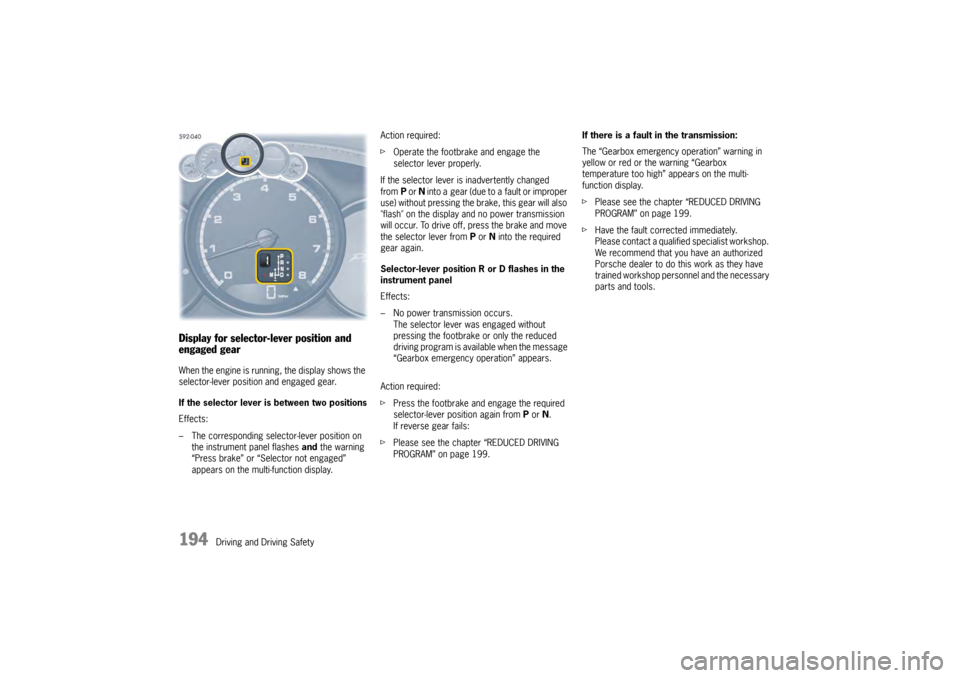
Display for selector-lever position and
engaged gearWhen the engine is running, the display shows the
selector-lever position and engaged gear.
If the selector lever is between two positions
Effects:
– The corresponding selector-lever position on the instrument panel flashes and the warning
“Press brake” or “Selector not engaged”
appears on the multi-function display. Action required:
f
Operate the footbrake and engage the
selector lever properly.
If the selector lever is inadvertently changed
from P or N into a gear (due to a fault or improper
use) without pressing the brake, this gear will also
"flash" on the display and no power transmission
will occur. To drive off, press the brake and move
the selector lever from P or N into the required
gear again.
Selector-lever position R or D flashes in the
instrument panel
Effects:
– No power transmission occurs. The selector lever was engaged without
pressing the footbrake or only the reduced
driving program is available when the message
“Gearbox emergency operation” appears.
Action required:
f Press the footbrake and engage the required
selector-lever position again from P or N.
If reverse gear fails:
f Please see the chapter “REDUCED DRIVING
PROGRAM” on page 199. If there is a fault in the transmission:
The “Gearbox emergency operation” warning in
yellow or red or the warning “Gearbox
temperature too high” appears on the multi-
function display.
f
Please see the chapter “REDUCED DRIVING
PROGRAM” on page 199.
f Have the fault corrected immediately.
Please contact a qualified specialist workshop.
We recommend that you have an authorized
Porsche dealer to do this work as they have
trained workshop personnel and the necessary
parts and tools.
Page 198 of 343

196
Driving and Driving Safety
Driving off with Launch Control
Launch Control allows you to achieve maximum
acceleration from standstill.
Warning!
There is a risk of endangering other road
users if you use this Control in an improper
location or in a situation where other persons
might need to take evas ive action due to the
rapid acceleration that this technology
permits.
Launch Control is designed to be used in a
controlled environment on closed circuit driving
courses where no vehicle cross traffic or
pedestrian traffic is present.
f Use Launch Control only if conditions permit it
to be applied in a safe manner.
f Do not use Launch Control if there is a
possibility it could endanger other persons.
Such a possibility exists if you cannot see that
you have a clear road with no possibility of
cross traffic in your intended direction of driving.
Caution!
Stress on components increases
dramatically when starting with maximum
acceleration in comparison with “normal”
driving off. Use of Launch Control will
inevitably reduce the life of the engaged
engine and transmission components.
Preconditions:
– Launch Control should on ly be used when the
engine has reached operating temperature.
– “Sport Plus” mode must be switched on (indicator light on the button comes on and
“SPORT PLUS” appears on the multi-function
display).
1. Press the brake with your left foot.
2. Quickly press the accelerator down fully (kickdown activated) and hold it.
The engine speed will level off at
around 5,000 rpm on the Panamera S,
around 5,500 rpm on the Panamera 4S,
around 4,550 rpm on the Panamera Turbo.
“Launch Control active” appears on the
multi-function display.
3. Release the brake within a few seconds. Remaining stationary for a long time with
“Launch Control active” can lead to
overloading of the transmission.
To protect the transmi ssion, the engine power
is then reduced and the “Launch Control
active” process is cancelled. Shifting gears on the steering wheel
With the shift buttons on the steering wheel, you
can change temporarily from automatic selection
mode D to manual mode
M.
For example:
– Shifting down before bends and on entering built-up areas.
– Shifting down on downward slopes (engine braking).
– Shifting down for brief spurts of acceleration.
The manual selection mode remains engaged:
– For cornering (depending on the lateral acceleration) and overrunning.
– When the vehicle is stationary (e.g. at a junction).
The system leaves manual selection mode:
– automatically after around 8 seconds (unless cornering or overrunning),
– after driving off.
Page 200 of 343

198
Driving and Driving Safety
Upshift prompt for fuel-economy-optimised
driving
The consumption-oriente
d upshift indicator A in
the tachometer at the ri ght beside the digital
speed display helps you to develop a fuel-saving
driving style.
The upshift indicator lights up - prompting you to
shift up to the next-higher gear - depending on the
selected gear, engine speed and accelerator
pedal position.
The upshift indicator is only active when “Sport” or
“Sport Plus” mode is switched off.
f Change to the next-higher gear when the
upshift indicator lights up. Shifting down –
f
Pull the PDK selector lever or shift button on
the steering wheel back.
You can shift up or down by the corresponding
number of gears by quickly pressing or pulling the
shift buttons or selector lever several times in
succession.
The transmission can be shifted up or down by
several gears in succession by continuously
operating the selector lever or shift buttons.
You can shift up or down at any time depending
on driving speed and engine speed.
Gear changes that would exceed the upper or
lower engine-speed limit are not executed by the
control unit.
There is no automatic upshift at the upper engine-
speed limit in selector-lever position M. Upshift
suppression can be cancelled by kickdown
operation. If, for example, the engine-speed limit
is reached during overtaking and an automatic
upshift does not occur, the transmission shifts up
in this case as a result of kickdown operation.
f Select an appropriately low gear on upward
and downward slopes.
This will ensure optimum use of engine power
and engine braking. To shift up automatically
at the upper engine-
speed limit:
f Press the accelerator pedal beyond the full-
throttle point (kickdown).
Failure of the selector lever display on the
instrument panel
The warning “Gearbox emergency operation”
appears in red on the multi-function display.
Effect:
– No selector-lever position is displayed on the instrument panel.
Vehicle can be driven only until it comes to
astop.
Action required:
f It is not possible to continue driving. Stop the
vehicle immediately in a suitable place. Have
the vehicle towed to a qualified specialist
workshop.
f Please see the chapter “TOWING” on
page 316.
Page 201 of 343

Driving and Driving Safety
199
StoppingfFor a brief stop, e.g. at traffic lights, leave the
selector lever in drive position and hold the
vehicle with the brake pedal.
f Do not hold the vehicle on a slope using the
accelerator. Use the brake pedal or the
electric parking brake instead.
f Before leaving the vehicle, always apply the
electric parking brake and move the selector
lever to position P.Parkingf Go easy on the accelerator!
f When parking or maneuvering in a small
space, control the speed by careful use of
the footbrake.Driving in winterIn wintry road conditions, it is advisable to take
steep inclines in manual mode. This prevents gear
changes occurring that could cause wheel spin.Tow-starting, towingfPlease see the chapter “TOWING” on
page 316.
Reduced driving programIf there is a fault in the transmission
– Depending on priority, either the “Gearbox
emergency operation” warning in yellow or red
or the warning “Gearbox temperature too high”
will appear on the multi-function display.
“Gearbox emergency operation” warning in
yellow
Effects:
– Restricted gearshift comfort, reverse gear may not function.
Action required:
f Have the fault corrected immediately.
Please contact a qualified specialist workshop.
We recommend that you have an authorized
Porsche dealer to do this work as they have
trained workshop personnel and the necessary
parts and tools. “Gearbox emergency operation” warning in red
Effect:
– Vehicle can be driven
only until it comes to
astop.
Action required:
f It is not possible to continue driving. Stop the
vehicle immediately in a suitable place. Have
the vehicle towed to a qualified specialist
workshop.
f Please see the chapter “TOWING” on
page 316.
Warning “Gearbox temperature too high”
–Effects: “Warning jerks” can be fe lt when driving off and
the engine power may be restricted.
Action required:
Do not hold the vehicle with the accelerator on
a hill, for example. Hold the vehicle with the
brake. Reduce engine load. Stop the vehicle in
a suitable place if possib le. Allow the engine to
run in selector-lever position P or N until the
warning disappears.
Page 206 of 343

204
Driving and Driving Safety
– Brake system prefilling:
The brake system is prepared for possible
subsequent emergency braking if the
accelerator pedal is released suddenly and
quickly. The brake system is prefilled and the
brake pads are already applied gently to the
brake discs.
– Brake booster (Hydraulic Brake Assist): In the event of an emergency braking operation
where the pedal force is insufficient, a brake
booster provides the braking pressure
necessary for maximum deceleration at all
4wheels.
Combined operation of PSM and PTM
In order to ensure optimum stabilisation of the
vehicle, torque distribution between the front and
rear wheels is adapted and the rear differential
lock is controlled on vehicles with PDCC.
In the event of a PTM fault, PSM cannot be
switched off.
If PSM is switched off, it is switched on again
automatically. Automatic brake differential (ABD)
The ABD system controls the front and rear axles
separately. If one wheel of an axle starts to spin,
it is braked so that the other wheel on the same
axle can be driven.
ABD recognizes different driving states, and it
features control strategies adapted to these
states. In situations in which little propulsive power
is required, such as when the vehicle moves off on
a level gravel surface, traction control already
becomes active at low engine speeds. If a large
amount of propulsive power is required, e.g. when
driving off on an uph
ill slope or for rapid
acceleration, the ABD system is adapted
accordingly.
Anti-slip control (ASR)
The anti-slip control system prevents the wheels
from spinning by adjusting the engine power,
thereby ensuring good lane-holding ability and
stable handling.
Engine drag torque control (MSR)
In conditions of excessive slip, the engine
drag torque control system prevents all driven
wheels from locking up when the vehicle is
overrunning. This is also the case for downshifts
on a slippery road.
Switching off PSMf Press button for at least 1 second.
PSM is switched off after a short delay.
The indicator light on the button and the
PSM OFF warning light on the instrument
panel light up.
The warning “PSM off” appears on the
multi-function display in the instrument panel.
Page 207 of 343

Driving and Driving Safety
205
When you brake in the ABS control range,
the vehicle is stabilised even when PSM is
switched off.
One-sided spinning of the wheels is prevented,
even with PSM switched off.
PSM should always be switched on during
“normal” driving.
H o w e v e r, i t m a y b e a g o o d i d e a to s w it c h o f f P S M
temporarily in exceptional situations:
– On a loose surface and in deep snow.
– When “rocking the vehicle free”.
– When using snow chains.
Tip on driving
The vehicle retains its enhanced braking readiness
through prefilling of the br ake system even when
PSM is switched off.
When PSM is switched off, wheel-specific brake
interventions and the anti-slip control system (ASR)
are also switched off.
The automatic brake differential (ABD) remains on.
Adaptive cruise control is deactivated when PSM
is switched off.
When PSM is switched off, the slip monitoring
function of Porsche Doppelkupplung (PDK) is also
deactivated.
Switching PSM back onf Press button .
PSM is active immediately.
The indicator light on the button and the
PSM OFF warning light on the instrument
panel go out.
The message “PSM switched on” appears on
the multi-function disp lay in the instrument
panel.“Sport Plus” modeA sportier setup is obtained when “Sport Plus”
mode is switched on.
PSM interventions occur later than in Normal
mode. The vehicle can be maneuvered with
greater agility at its pe rformance limits, without
having to dispense with th e assistance of PSM in
emergency situations. This helps to achieve
optimal lap times, particular ly on race circuits and
on a dry road surface. – The PSM warning light on the instrument panel
lights up for a lamp check when the ignition is
switched on.
– The light indicates a control operation, even when PSM is switched off, e.g. brake control in
the event of one-sided wheel spin.
– The light - in conjunction with the multi-function display - indicates a fault.
The warning message “PSM failure” appears
on the multi-function display in the instrument
panel.
For information on warning messages on the multi-
function display:
f Please see the chapter “OVERVIEW OF
WARNING MESSAGES” on page 152.
f Adapt your driving style according to the
changed conditions.
f Contact a qualified spec ialist workshop in
order to correct the fault. We recommend that
you have an authorized Porsche dealer to do
this work, as they have the trained workshop
personnel and the necessary parts and tools
for this type of work.
To w i n g
For information on towing:
f Please see the chapter “TOWING” on
page 316.
PSM warning light
Page 209 of 343

Driving and Driving Safety
207
ABS Brake System
(Anti-Lock Brake System)
Warning!
In spite of the advantages of ABS, it is still the
driver’s responsibility to adapt his driving style and
maneuvers in line with road and weather
conditions, as well as the traffic situation.
The increased safety that is provided should not
induce you to take greater risks with your safety.
The limits set by the physic s of driving cannot be
overcome, even with ABS.
Risk of accidents due to inappropriate speed
cannot be reduced by ABS.
ABS ensures
– Full steering control
The vehicle remains steerable
– Good driving stability
No skidding due to locked wheels
– Optimum braking distance
Shorter stopping distance in most cases
– Prevention of wheel locking
No flat spots on the tires Function
The decisive advantage of ABS lies in the driving
stability and maneuverability of the vehicle in
hazardous situations.
ABS prevents locking of
the wheels during full
braking, on almost all road surfaces, until just
before the vehicle stops.
ABS begins to control the braking process as
soon as a wheel shows a tendency to lock.
This controlled braking process is comparable
with extremely rapid cadence braking.
The pulsating brake pedal and a “juddering noise”
warn the driver to adapt his driving speed to the
road conditions.
f If full braking is necessary, press the brake
pedal fully during the whole braking operation,
even though the pedal is pulsating. Do not
reduce brake pressure. If the ABS warning light lig
hts up on the instrument
panel while the engine is running, the ABS has
switched off because of a fault.
The warning message “ABS failure” appears on
the multi-function display in the instrument panel.
For information on warning messages on the
multi-function display:
f Please see the chapter “OVERVIEW OF
WARNING MESSAGES” on page 152.
In this case, the brake system will operate without
lock prevention, as on vehicles without ABS.
f Adapt your driving style to the changed
braking behavior.
The ABS must be checked by your authorized
Porsche dealer in order to prevent the
occurrence of further faults with unpredictable
consequences.
Please contact a qualified specialist workshop.
We recommend that you have an authorized
Porsche dealer to do this work as they have
trained workshop personnel and the necessary
parts and tools.
The ABS control unit is adjusted for the approved
tire dimensions.
The use of tires with no n-approved dimensions can
lead to different wheel speeds, causing ABS to
switch off. Warning light USA
Warning light Canada
Page 210 of 343
208
Driving and Driving Safety
Porsche Active Suspension
Management (PASM)The PASM system actively adjusts the shock
absorbers. The adjustable damper system selects
the appropriate damping level for each wheel
according to the driving situation and driving
conditions. Driving safety, agility and comfort are
optimised.
Three different chassis setu ps can be selected at
the push of a button:
– “PASM Comfort”
– “PASM Sport”
– “PASM Sport Plus”
Comfort mode ensures comfortable chassis
tuning.
The “PASM Sport” chassis setup offers very
sporty shock absorber tuning.
“PASM Sport Plus” mode offers particularly
sporty shock absorber tuning (e.g. for driving on
the race circuit).
In addition to manual mode selection, PASM
also adjusts shock absorber tuning for either
sporty or comfort driving, depending on the
driving situation.
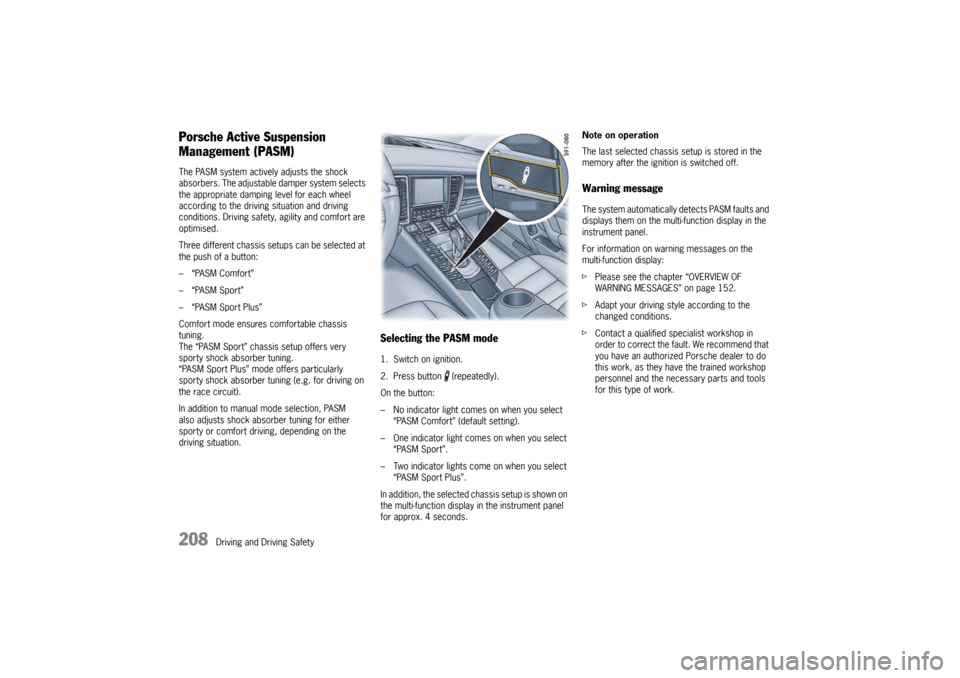
Selecting the PASM mode1. Switch on ignition.
2. Press button (repeatedly).
On the button:
– No indicator light comes on when you select “PASM Comfort” (default setting).
– One indicator light come s on when you select
“PASM Sport”.
– Two indicator lights come on when you select “PASM Sport Plus”.
In addition, the selected chassis setup is shown on
the multi-function display in the instrument panel
for approx. 4 seconds. Note on operation
The last selected chassis setup is stored in the
memory after the ignition is switched off.
Warning messageThe system automatically
detects PASM faults and
displays them on the multi-function display in the
instrument panel.
For information on warning messages on the
multi-function display:
f Please see the chapter “OVERVIEW OF
WARNING MESSAGES” on page 152.
f Adapt your driving style according to the
changed conditions.
f Contact a qualified specialist workshop in
order to correct the fault. We recommend that
you have an authorized Porsche dealer to do
this work, as they have the trained workshop
personnel and the necessary parts and tools
for this type of work.