Page 149 of 228
Driving and operating
149
driving with approx. 2
/3 . Cold starts
and acceleration phases are also
taken into consideration.
The specification of CO 2 emission is
also a constituent of the directive.
The figures given must not be taken
as a guarantee for the actual fuel
consumption of a particular vehicle.
Furthermore, fuel consumption is
dependent on personal driving style
as
well as road and traffic conditions.
All values are based on the EU base
model with standard equipment.
The calculation of fuel consumption
takes account of the vehicle’s kerb
weight, ascertained in accordance
with the regulations. Options may
result in slightly higher fuel
consumption and CO 2 emission
levels and a lower top speed.
Fuel consumption, CO 2 emissions
3 213. Natural gas
The fuel consumption information
was obtained using reference fuel
G20 (methane proportion 99 - 100
mol%) under prescribed driving
conditions. When using natural gas
with a lower proportion of methane,
the fuel consumption can differ from
the specified values.
Towing
General information
Only use towing equipment that has
been approved for your vehicle.
Entrust retrofitting of towing
equipment to a workshop. It may be
necessary to make changes that
affect the cooling system, heat
shields or other equipment.
Installation dimensions of factory-
fitted towing equipment
3 223.
Driving characteristics and
towing tips
Before attaching a trailer, lubricate
the
coupling ball. However, do not do
so if a stabiliser, which acts on the
coupling ball, is being used to reduce
snaking movements.
For trailers with low driving stability
and trailers with a permitted gross
vehicle weight of more than 1300 kg
a speed of 80 km/h must not be
exceeded; the use of a stabiliser is
recommended.
Page 150 of 228
150
Driving and operating
If the trailer starts snaking, drive more
slowly, do not attempt to correct the
steering and brake sharply if
necessary.
When driving downhill, drive in the
same gear as if driving uphill and
drive at a similar speed.
Adjust tyre pressure to the value
specified for full load 3 220.
Trailer towing
Trailer loads
The permissible trailer loads are
vehicle and engine-dependent
maximum values which must not be
exceeded. The actual trailer load is
the difference between the actual
gross weight of the trailer and the
actual coupling socket load with the
trailer coupled.
The permissible trailer loads are
specified
in the vehicle documents. In
general, they are valid for gradients
up to max. 12 % The permitted trailer load applies up
to the specified incline and up to an
altitude of 1000 metres above sea
level. Since engine power decreases
as altitude increases because of the
air becoming thinner, therefore
reducing climbing ability, the
permissible gross train weight also
decreases by 10 % for every 1000
metres of additional altitude. The
gross
train weight does not have to be
reduced when driving on roads with
slight inclines (less than 8 %, e. g.
motorways).
The permissible gross train weight
must not be exceeded. This weight is
specified on the identification plate
3 208.
Vertical coupling load
The vertical coupling load is the load
exerted by the trailer on the coupling
ball. It can be varied by changing the
weight distribution when loading the
trailer.
The maximum permissible vertical
coupling load (75 kg) is specified on
the towing equipment identification
plate and in the vehicle documents. Always aim for the maximum load,
especially in the case of heavy
trailers. The vertical coupling load
should never fall below 25 kg.
Rear axle load
When the trailer is coupled and the
towing vehicle fully loaded, the
permissible rear axle load (see
identification plate or vehicle
documents) may be exceeded by 90
kg
and the gross vehicle weight rating
by 75 kg. If the permissible rear axle
load is exceeded, a maximum speed
of 100 km/h applies.
Towing equipment Caution
When operating without a trailer,
remove the coupling ball bar.
Page 152 of 228
152
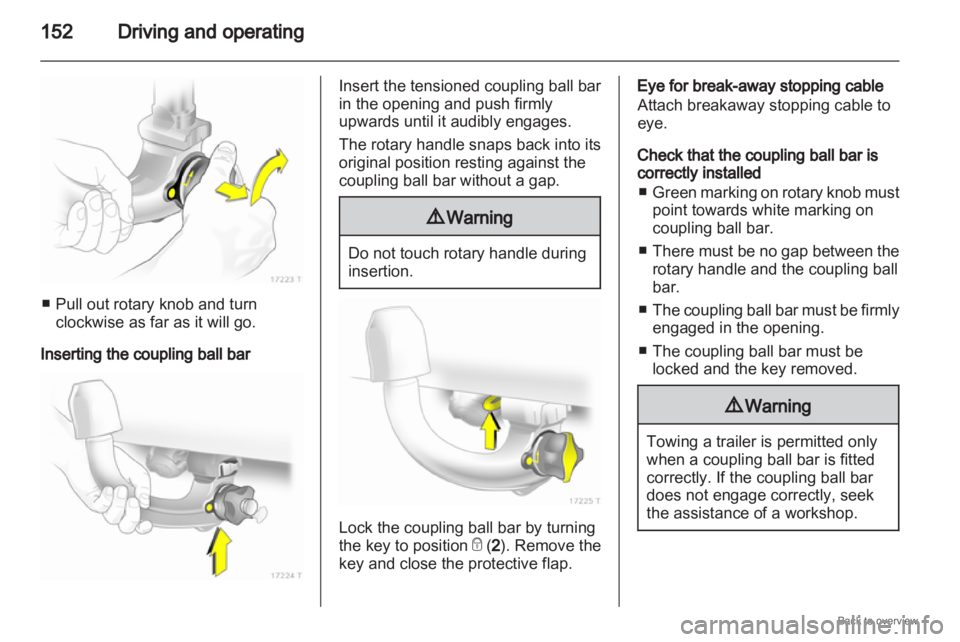
Driving and operating■ Pull out rotary knob and turn
clockwise as far as it will go.
Inserting the coupling ball bar Insert the tensioned coupling ball bar
in the opening and push firmly
upwards until it audibly engages.
The rotary handle snaps back into its
original position resting against the
coupling ball bar without a gap.
9
Warning Do not touch rotary handle during
insertion.
Lock the coupling ball bar by turning
the key to position
e (2). Remove the
key and close the protective flap. Eye for break-away stopping cable
Attach breakaway stopping cable to
eye.
Check that the coupling ball bar is
correctly installed
■ Green
marking on rotary knob must
point towards white marking on
coupling ball bar.
■ There must be no gap between the rotary handle and the coupling ball
bar.
■ The coupling ball bar must be firmly engaged in the opening.
■ The coupling ball bar must be locked and the key removed. 9
Warning Towing a trailer is permitted only
when a coupling ball bar is fitted
correctly. If the coupling ball bar
does not engage correctly, seek
the assistance of a workshop.
Page 154 of 228

154
Vehicle care
Vehicle care
General Information ...................154
Vehicle checks ........................... 155
Bulb replacement .......................160
Electrical system ........................167
Vehicle tools .............................. 173
Wheels and tyres .......................174
Jump starting ............................. 185
Towing ....................................... 187
Appearance care .......................189 General Information
Accessories and vehicle
modifications
We
recommend to use Genuine Parts
and Accessories and factory
approved parts specific for your
vehicle type. We cannot assess or
guarantee for other products - even if
they have a regulatory or otherwise
granted approval.
Do not make any modifications to the
electrical system, e. g. changes of
electronic control units (chip tuning).
Vehicle storage
Storage for a long period of time
Following must be done if the vehicle
should be stored for several months:
■ Wash and wax the vehicle.
■ Have the wax in the engine compartment and underbody
checked.
■ Clean and preserve rubber seals.
■ Change engine oil. ■ Drain washer fluid reservoir.
■
Check coolant anti-freeze andcorrosion protection.
■ Adjust tyre pressure to the value specified for full load.
■ Park vehicle in dry, well ventilated place. Engage first or reverse gear
or set selector lever to P. Prevent
the vehicle from rolling.
■ Do not apply hand brake.
■ Open bonnet, close all doors and lock the vehicle.
■ Disconnect the clamp from the negative terminal of the vehicle
battery. Beware that all systems are
not functional, e.g. anti-theft alarm
system.
Putting back into operation
Following must be done if the vehicle
is putting back into operation: ■ Connect the clamp to the negative terminal of the vehicle battery.
Activate the electronic of the power
windows.
■ Check tyre pressure.
■ Fill up the washer fluid reservoir.
Page 173 of 228
Vehicle care
173
No. Circuit
29
Cigarette lighter, front power
outlet
30 Rear power outlet
31 –
32 –
33 Open&Start system
34 –
35 Rear power outlet
36 Socket for towing equipment
37 –
38 Central locking system, terminal
30
39 Left seat heating
40 Right seat heating
41 –
42 – No. Circuit
43
–
44 – Vehicle tools
Tools
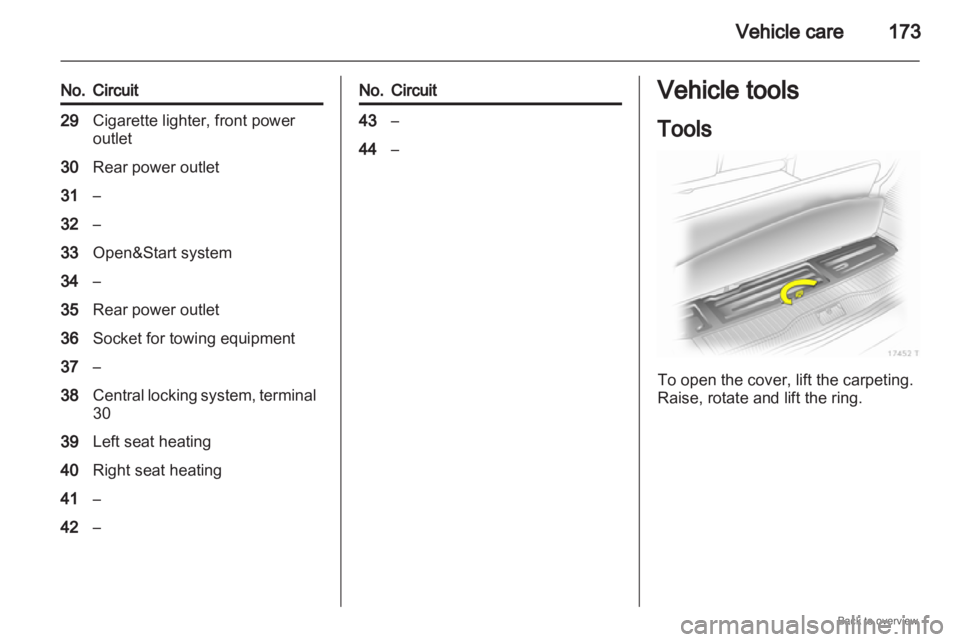
To open the cover, lift the carpeting.
Raise, rotate and lift the ring.
Page 187 of 228
Vehicle care
187
Towing
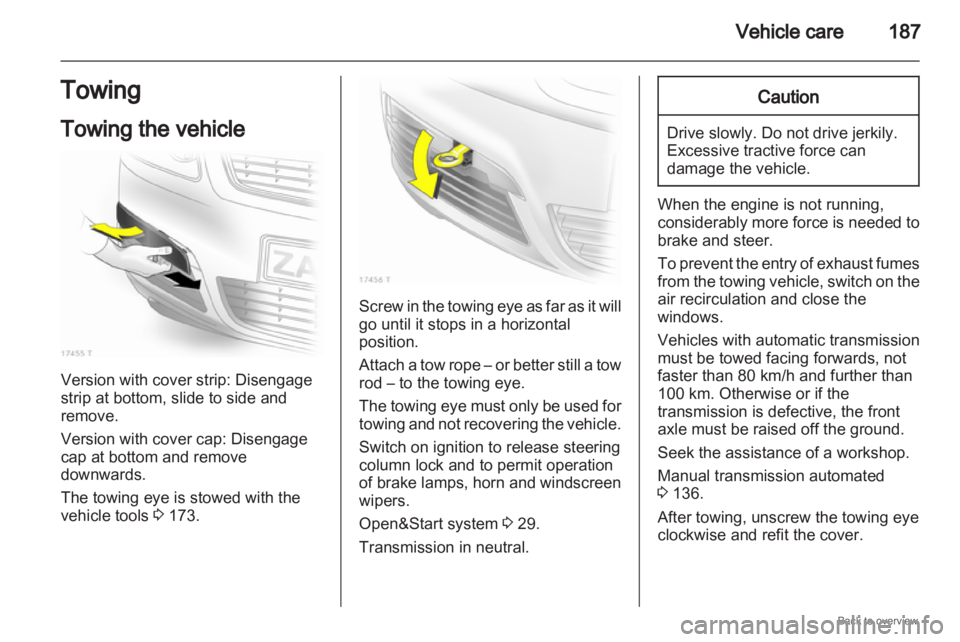
Towing the vehicle Version with cover strip: Disengage
strip at bottom, slide to side and
remove.
Version with cover cap: Disengage
cap at bottom and remove
downwards.
The towing eye is stowed with the
vehicle tools
3 173. Screw in the towing eye as far as it will
go until it stops in a horizontal
position.
Attach
a tow rope – or better still a tow
rod – to the towing eye.
The towing eye must only be used for
towing and not recovering the vehicle.
Switch on ignition to release steering
column lock and to permit operation
of brake lamps, horn and windscreen
wipers.
Open&Start system 3 29.
Transmission in neutral. Caution
Drive slowly. Do not drive jerkily.
Excessive tractive force can
damage the vehicle.
When the engine is not running,
considerably
more force is needed to
brake and steer.
To prevent the entry of exhaust fumes
from the towing vehicle, switch on the
air recirculation and close the
windows.
Vehicles with automatic transmission
must be towed facing forwards, not
faster than 80 km/h and further than
100 km. Otherwise or if the
transmission is defective, the front
axle must be raised off the ground.
Seek the assistance of a workshop.
Manual transmission automated
3 136.
After towing, unscrew the towing eye
clockwise and refit the cover.
Page 188 of 228
188
Vehicle care
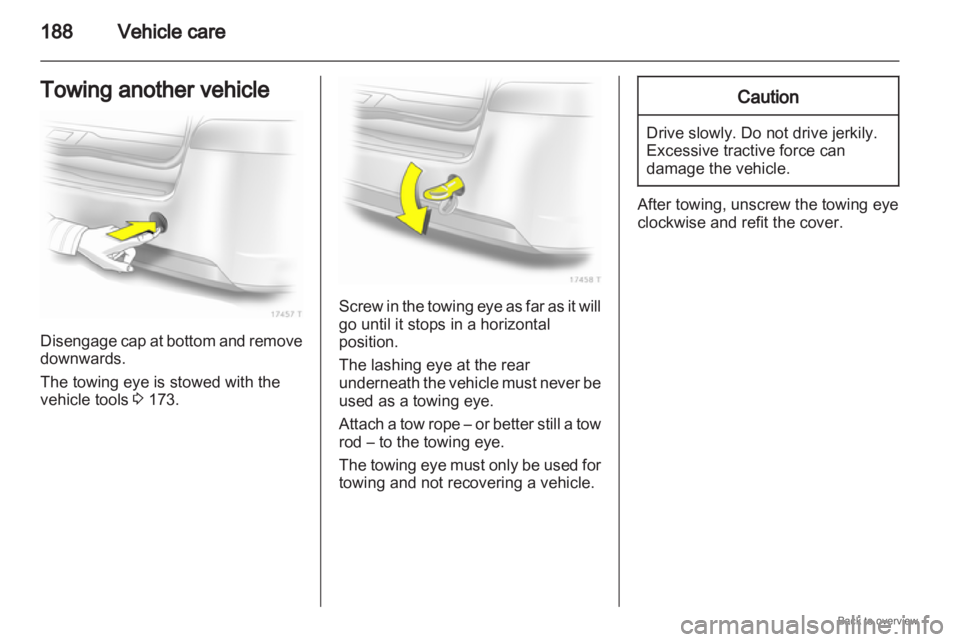
Towing another vehicle Disengage cap at bottom and remove
downwards.
The towing eye is stowed with the
vehicle tools
3 173. Screw in the towing eye as far as it will
go until it stops in a horizontal
position.
The lashing eye at the rear
underneath
the vehicle must never be
used as a towing eye.
Attach a tow rope – or better still a tow
rod – to the towing eye.
The towing eye must only be used for
towing and not recovering a vehicle. Caution
Drive slowly. Do not drive jerkily.
Excessive tractive force can
damage the vehicle.
After towing, unscrew the towing eye
clockwise and refit the cover.
Page 191 of 228
Vehicle care
191
Towing equipment
Do not clean the coupling ball bar with
a steam-jet or high-pressure jet
cleaner.
Interior care
Interior and upholstery
Only clean the vehicle interior,
including the instrument panel fascia
and panelling, with a dry cloth or
interior cleaner.
The instrument panel should only be
cleaned using a soft damp cloth.
Clean fabric upholstery with
a vacuum cleaner and brush.
Remove stains with an upholstery
cleaner.
Clean seat belts with lukewarm water
or interior cleaner. Caution
Close Velcro fasteners as open
Velcro
fasteners on clothing could
damage seat upholstery. Plastic and rubber parts
Plastic and rubber parts can be
cleaned with the same cleaner as
used to clean the body. Use interior
cleaner if necessary. Do not use any
other
agent. Avoid solvents and petrol
in particular. Do not use high-
pressure jet cleaners.