Page 37 of 228
Keys, doors and windows
37
It monitors: ■ Doors, load compartment, bonnet,
■ Passenger compartment,
■ Vehicle tilt, e.g. if it is raised,
■ Ignition.
Unlocking the vehicle deactivates
both systems simultaneously.
Note
Changes to the vehicle interior, such
as the use of seat covers, could
impair the function of passenger
compartment monitoring. Activation without monitoring of
passenger compartment and
vehicle tilt
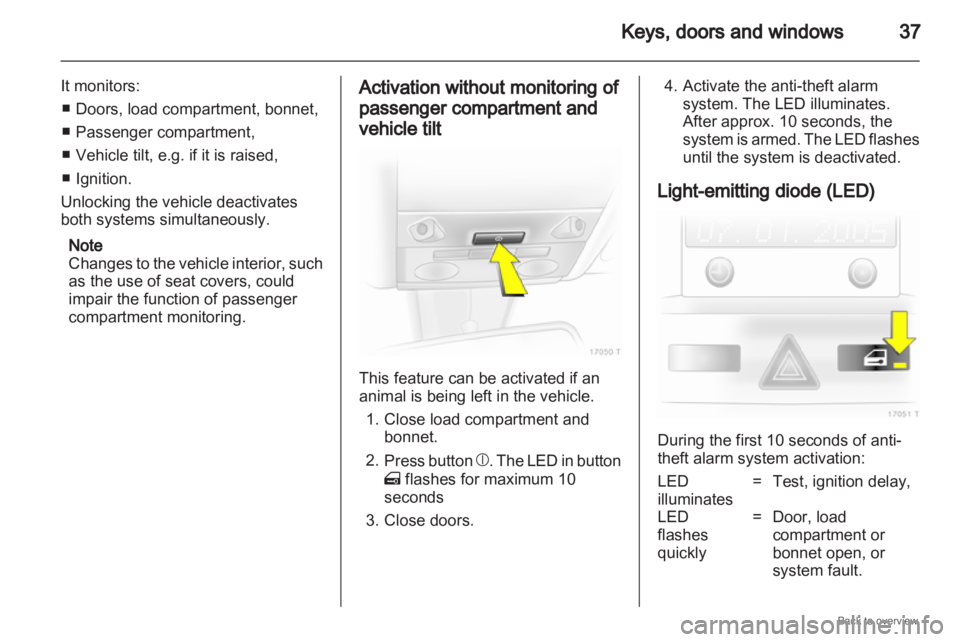
This feature can be activated if an
animal is being left in the vehicle.
1.
Close load compartment andbonnet.
2. Press button b. The LED in button
m flashes for maximum 10
seconds
3. Close doors. 4. Activate the anti-theft alarm
system. The LED illuminates.
After approx. 10 seconds, the
system
is armed. The LED flashes
until the system is deactivated.
Light-emitting diode (LED) During the first 10 seconds of anti-
theft alarm system activation:
LED
illuminates
= Test, ignition delay,
LED
flashes
quickly = Door, load
compartment or
bonnet open, or
system fault.
Page 39 of 228
Keys, doors and windows
39
Exterior mirrors
Convex shape
The convex exterior mirror reduces
blind spots. The shape of the mirror
makes
objects appear smaller, which
will affect the abilty to estimate
distances.
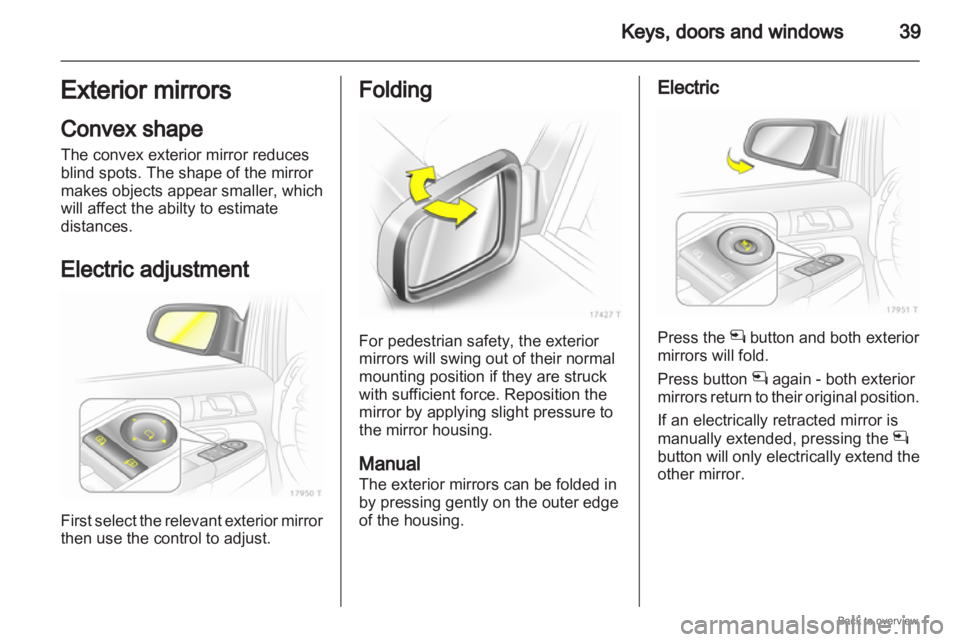
Electric adjustment First select the relevant exterior mirror
then use the control to adjust. Folding
For pedestrian safety, the exterior
mirrors will swing out of their normal
mounting position if they are struck
with sufficient force. Reposition the
mirror by applying slight pressure to
the mirror housing.
Manual
The exterior mirrors can be folded in
by pressing gently on the outer edge
of the housing. Electric
Press the n button and both exterior
mirrors will fold.
Press button n again - both exterior
mirrors
return to their original position.
If an electrically retracted mirror is
manually extended, pressing the n
button will only electrically extend the
other mirror.
Page 45 of 228
Seats, restraints
45
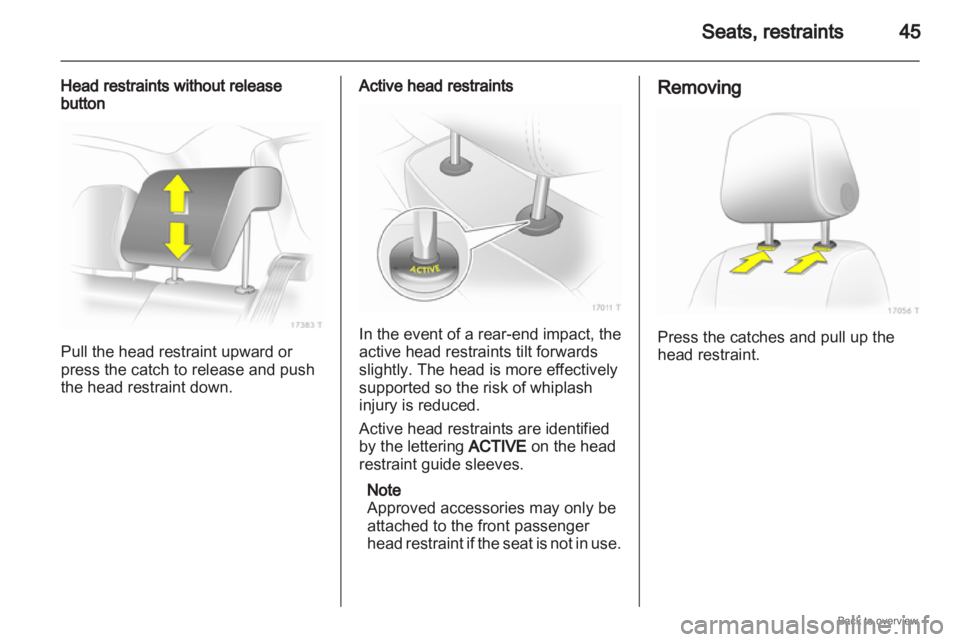
Head restraints without release
button Pull the head restraint upward or
press the catch to release and push
the head restraint down. Active head restraints
In the event of a rear-end impact, the
active head restraints tilt forwards
slightly. The head is more effectively
supported so the risk of whiplash
injury is reduced.
Active head restraints are identified
by the lettering ACTIVE on the head
restraint guide sleeves.
Note
Approved accessories may only be
attached to the front passenger
head
restraint if the seat is not in use. Removing
Press the catches and pull up the
head restraint.
Page 46 of 228

46
Seats, restraints
Front seats
Seat position 9
Warning Only drive with the seat correctly
adjusted.
■ Sit with your buttocks as far back
against the backrest as possible.
Adjust the distance between the
seat and the pedals so that your
legs are slightly angled when tromping the pedals. Slide the
passenger seat as far back as
possible.
■
Sit with your shoulders as far back against the backrest as possible.
Set the backrest rake so that you
can easily reach the steering wheel
with your arms slightly bent.
Maintain contact between your
shoulders and the backrest when
turning the steering wheel. Do not
angle the backrest too far back. We
recommend a maximum rake of
approx. 25 °.
■ Adjust the steering wheel 3 77.
■ Set seat height high enough to have a clear field of vision on all
sides and of all display instruments.
There should be at least one hand
of clearance between your head
and the headlining. Your thighs
should rest lightly on the seat
without pressing into it.
■ Adjust the head restraint 3 44.
■ Adjust the height of the seat belt 3 55. ■ Adjust the thigh support so that
there is a space about two fingers
wide between the edge of the seat
and the hollow of the knee.
■ Adjust
the lumbar support so that it
supports the natural shape of the
spine.
Seat adjustment 9
Warning Never adjust seats while driving as
they could move uncontrollably.
Seat positioning
Page 55 of 228

Seats, restraints
55
Triggered belt tensioners must be
replaced by a workshop. Belt
tensioners can only be triggered
once. Note
Do not affix or install accessories or
other objects that may interfere with
the operation of the belt tensioners.
Do not make any modifications to
belt tensioner components as this
will invalidate the vehicle type
approval.
Three-point seat belt
Fitting Withdraw belt from reel, guide it
untwisted across the body and
engage the latch plate in the buckle.
Tension the lap belt regularly whilst
driving by tugging the shoulder belt.
Loose or bulky clothing prevents the
belt from fitting snugly. Do not place
objects such as handbags or mobile
phones between the belt and your
body.
9
Warning The belt must not rest against hard
or fragile objects in the pockets of
your clothing. Height adjustment
1. Pull belt out slightly.
2.
Press button.
3. Adjust height and engage.
Adjust the height so that the belt lies
across the shoulder. It must not lie
across the throat or upper arm.
Do not adjust while driving.
Page 61 of 228

Seats, restraints
61
The risk of injury to the head in the
event of a side impact is considerably
reduced.
The curtain airbag system does not
protect the third row of seats. 9
Warning Keep the area in which the airbag
inflates clear of obstructions.
The hooks on the handles in the
roof frame are only suitable for
hanging up light articles of
clothing,
without coat hangers. Do
not keep any items in these
clothes. Seat occupancy
recognition
Identified by a label on the lower
panel
of the front passenger seat and
by control indicator y, which
illuminates for approx. 4 seconds
when the ignition is switched on.
The seat occupancy recognition
system deactivates the passenger
front and side airbag if the front
passenger seat is not occupied or is
fitted with an Opel child restraint
system with transponders. The
curtain airbag system remains
activated. 9
Warning Only Opel child restraint systems
with transponders should be fitted
on
the front passenger seats. Use
of systems without transponders
poses a risk of fatal injury. Control indicator
3 87.
Note
Anyone weighing less than 35 kg
should only travel on the rear seats.
Do not place any heavy objects on
the front passenger seat. Otherwise
the
seat will register as occupied and
the airbag system for the front
passenger seat will not be
deactivated.
Do not use protective covers or seat
cushions on the front passenger
seat.
Page 77 of 228
Instruments and controls
77
Instruments and
controls
Controls ....................................... 77
Warning lights, gauges and
indicators ..................................... 83
Information displays .....................93
Vehicle messages
...................... 100
Trip computer ............................. 102 Controls
Steering wheel adjustment
Unlock lever, adjust steering wheel,
then engage lever and ensure it is
fully locked.
Do not adjust steering wheel unless
vehicle is stationary and steering
wheel lock has been released. Steering wheel controls
The infotainment system and the
Info-Display can be operated by the
controls on the steering wheel.
Further information in the
infotainment system manual.
Page 79 of 228
Instruments and controls
79
Automatic wiping with rain sensor $
=
Automatic wiping with rain
sensor
The rain sensor detects the amount of
water on the windscreen and
automatically
regulates the frequency
of the windscreen wipers. Keep the sensor free from dust, dirt
and ice.
Windscreen washer Pull lever. Wiper fluid is sprayed on
the windscreen and the wipers swipe
for a few strokes.
If
the lights are on, washer fluid is also
sprayed on the headlamps. The
headlamp washer system is then
inoperable for 2 minutes.
Rear window wiper/washer Push lever forwards. The rear window
wiper
swipes in interval mode. Switch
off by pushing lever forwards again.
If the lever is held forwards, washer
fluid is sprayed on the rear window.