Page 150 of 228
150
Driving and operating
If the trailer starts snaking, drive more
slowly, do not attempt to correct the
steering and brake sharply if
necessary.
When driving downhill, drive in the
same gear as if driving uphill and
drive at a similar speed.
Adjust tyre pressure to the value
specified for full load 3 220.
Trailer towing
Trailer loads
The permissible trailer loads are
vehicle and engine-dependent
maximum values which must not be
exceeded. The actual trailer load is
the difference between the actual
gross weight of the trailer and the
actual coupling socket load with the
trailer coupled.
The permissible trailer loads are
specified
in the vehicle documents. In
general, they are valid for gradients
up to max. 12 % The permitted trailer load applies up
to the specified incline and up to an
altitude of 1000 metres above sea
level. Since engine power decreases
as altitude increases because of the
air becoming thinner, therefore
reducing climbing ability, the
permissible gross train weight also
decreases by 10 % for every 1000
metres of additional altitude. The
gross
train weight does not have to be
reduced when driving on roads with
slight inclines (less than 8 %, e. g.
motorways).
The permissible gross train weight
must not be exceeded. This weight is
specified on the identification plate
3 208.
Vertical coupling load
The vertical coupling load is the load
exerted by the trailer on the coupling
ball. It can be varied by changing the
weight distribution when loading the
trailer.
The maximum permissible vertical
coupling load (75 kg) is specified on
the towing equipment identification
plate and in the vehicle documents. Always aim for the maximum load,
especially in the case of heavy
trailers. The vertical coupling load
should never fall below 25 kg.
Rear axle load
When the trailer is coupled and the
towing vehicle fully loaded, the
permissible rear axle load (see
identification plate or vehicle
documents) may be exceeded by 90
kg
and the gross vehicle weight rating
by 75 kg. If the permissible rear axle
load is exceeded, a maximum speed
of 100 km/h applies.
Towing equipment Caution
When operating without a trailer,
remove the coupling ball bar.
Page 151 of 228
Driving and operating
151
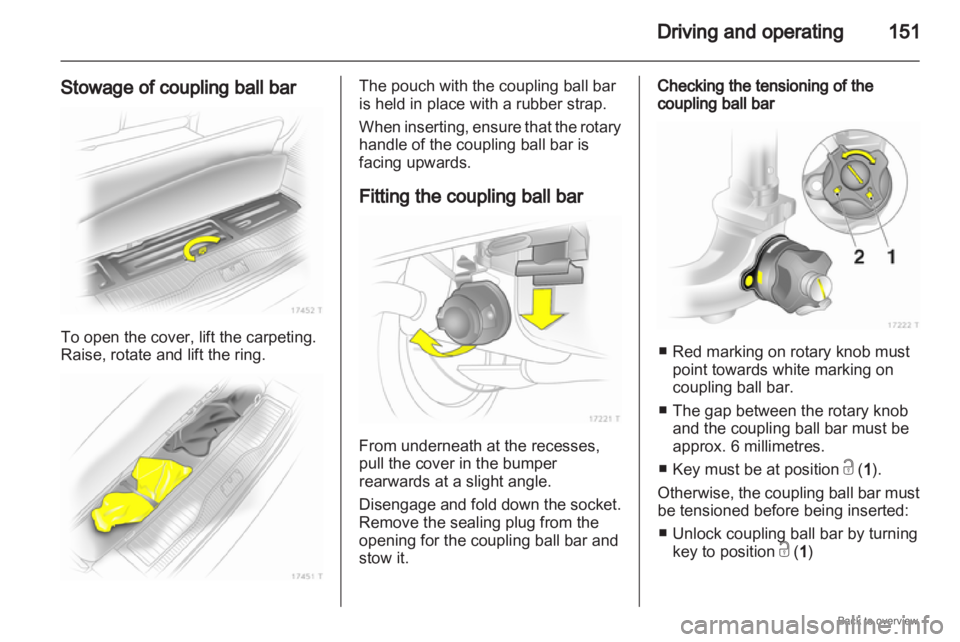
Stowage of coupling ball bar To open the cover, lift the carpeting.
Raise, rotate and lift the ring. The pouch with the coupling ball bar
is held in place with a rubber strap.
When
inserting, ensure that the rotary
handle of the coupling ball bar is
facing upwards.
Fitting the coupling ball bar From underneath at the recesses,
pull the cover in the bumper
rearwards at a slight angle.
Disengage
and fold down the socket.
Remove the sealing plug from the
opening for the coupling ball bar and
stow it. Checking the tensioning of the
coupling ball bar
■ Red marking on rotary knob must
point towards white marking on
coupling ball bar.
■
The gap between the rotary knoband the coupling ball bar must be
approx. 6 millimetres.
■ Key must be at position c (1 ).
Otherwise, the coupling ball bar must
be tensioned before being inserted: ■ Unlock coupling ball bar by turning key to position c (1 )
Page 153 of 228
Driving and operating
153
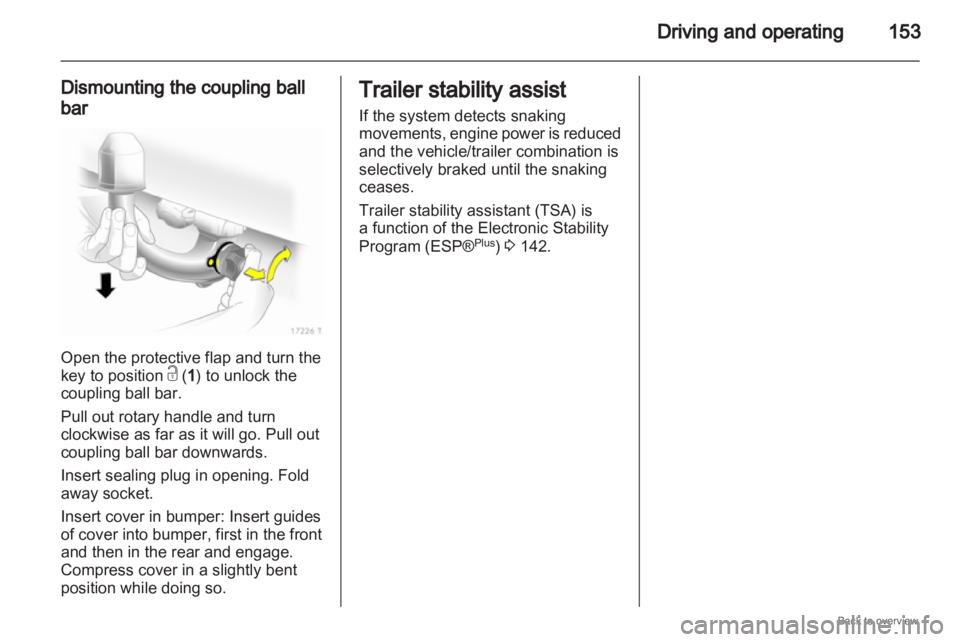
Dismounting the coupling ball
bar Open the protective flap and turn the
key to position c (1
) to unlock the
coupling ball bar.
Pull out rotary handle and turn
clockwise as far as it will go. Pull out
coupling ball bar downwards.
Insert sealing plug in opening. Fold
away socket.
Insert cover in bumper: Insert guides
of cover into bumper, first in the front
and then in the rear and engage.
Compress cover in a slightly bent
position while doing so. Trailer stability assist
If the system detects snaking
movements,
engine power is reduced
and the vehicle/trailer combination is
selectively braked until the snaking
ceases.
Trailer stability assistant (TSA) is
a function of the Electronic Stability
Program (ESP® Plus
) 3 142.
Page 160 of 228
160
Vehicle care
Wiper blade on the rear window Lift wiper arm. Disengage wiper blade
as shown in illustration and remove. Bulb replacement
Switch off the ignition and switch off
the
relevant switch or close the doors.
Only hold a new bulb at the base! Do
not touch the bulb glass with bare
hands.
Use only the same bulb type for
replacement. The bulbs of the front outer lamps are
replaced through openings in the
front wheel housing: turn wheels in
the way that gains access, release
catch and remove cover. To replace bulbs on the right side of
the engine compartment, detach the
air hose from the air filter. On the left
side, detach the plug to the fuse box.
Halogen headlights
Headlamps have separate systems
for
high beam 1 (inner bulbs) and low
beam 2 (outer bulbs).
Low beam 1. Replace bulbs through the opening in the wheel housing.
Page 162 of 228
162
Vehicle care
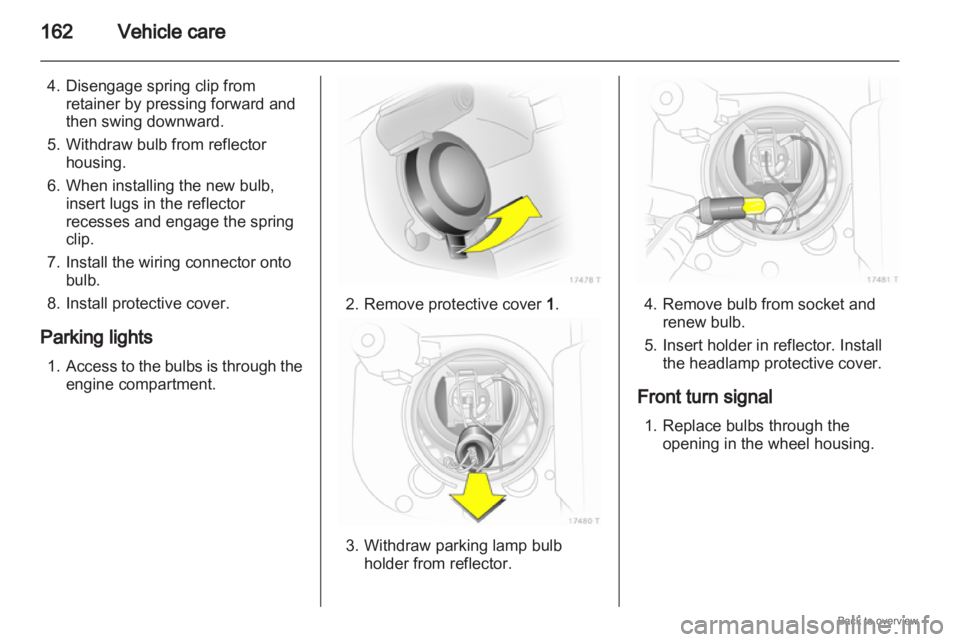
4. Disengage spring clip from retainer by pressing forward and
then swing downward.
5.
Withdraw bulb from reflectorhousing.
6. When installing the new bulb, insert lugs in the reflector
recesses and engage the spring
clip.
7. Install the wiring connector onto bulb.
8. Install protective cover.
Parking lights 1. Access to the bulbs is through the engine compartment. 2. Remove protective cover
1. 3. Withdraw parking lamp bulb
holder from reflector. 4. Remove bulb from socket and
renew bulb.
5.
Insert holder in reflector. Installthe headlamp protective cover.
Front turn signal 1. Replace bulbs through the opening in the wheel housing.
Page 163 of 228
Vehicle care
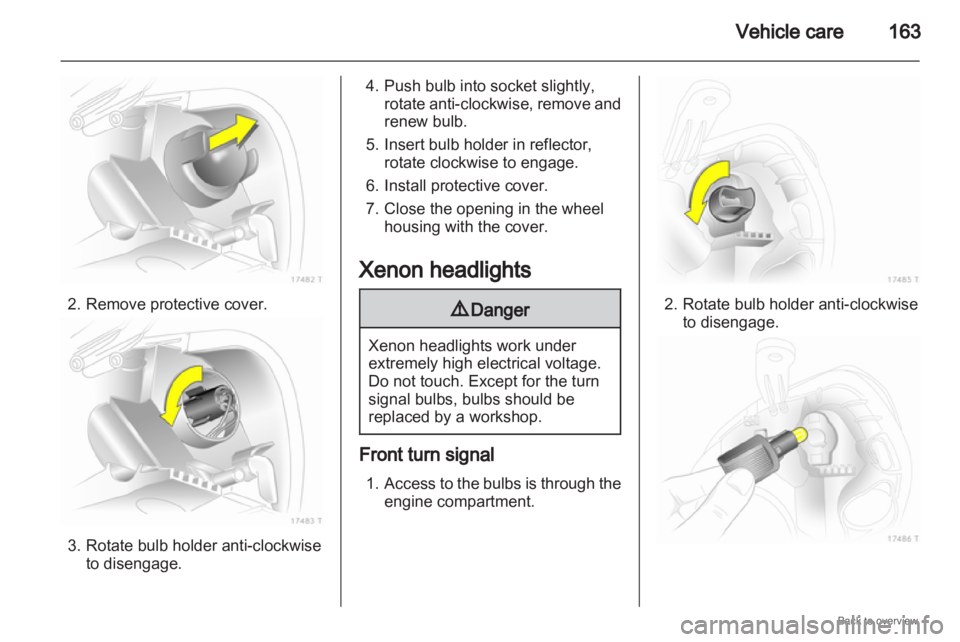
1632. Remove protective cover.
3. Rotate bulb holder anti-clockwise
to disengage. 4. Push bulb into socket slightly,
rotate anti-clockwise, remove and
renew bulb.
5. Insert bulb holder in reflector, rotate clockwise to engage.
6. Install protective cover.
7. Close the opening in the wheel housing with the cover.
Xenon headlights 9
Danger Xenon headlights work under
extremely high electrical voltage.
Do not touch. Except for the turn
signal bulbs, bulbs should be
replaced by a workshop.
Front turn signal
1. Access
to the bulbs is through the
engine compartment. 2. Rotate bulb holder anti-clockwise
to disengage.
Page 164 of 228
164
Vehicle care
3. Push bulb into socket slightly, rotate anti-clockwise, remove and
renew bulb.
4. Insert bulb holder in reflector, rotate clockwise to engage.
Fog lights
Have bulbs replaced by a workshop.
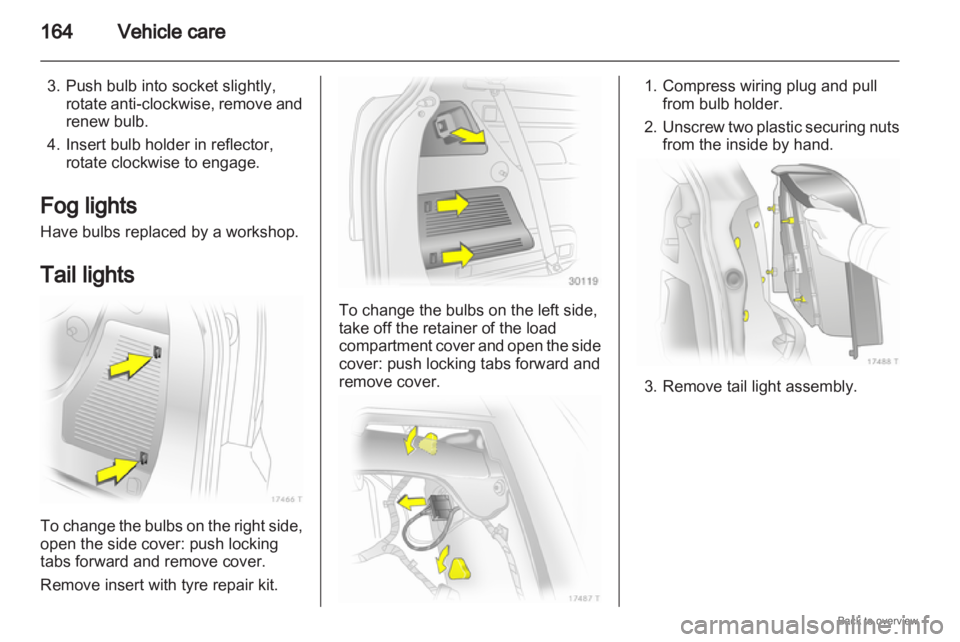
Tail lights To change the bulbs on the right side,
open the side cover: push locking
tabs forward and remove cover.
Remove insert with tyre repair kit. To change the bulbs on the left side,
take off the retainer of the load
compartment
cover and open the side
cover: push locking tabs forward and
remove cover. 1. Compress wiring plug and pull
from bulb holder.
2. Unscrew
two plastic securing nuts
from the inside by hand. 3. Remove tail light assembly.
Page 165 of 228
Vehicle care
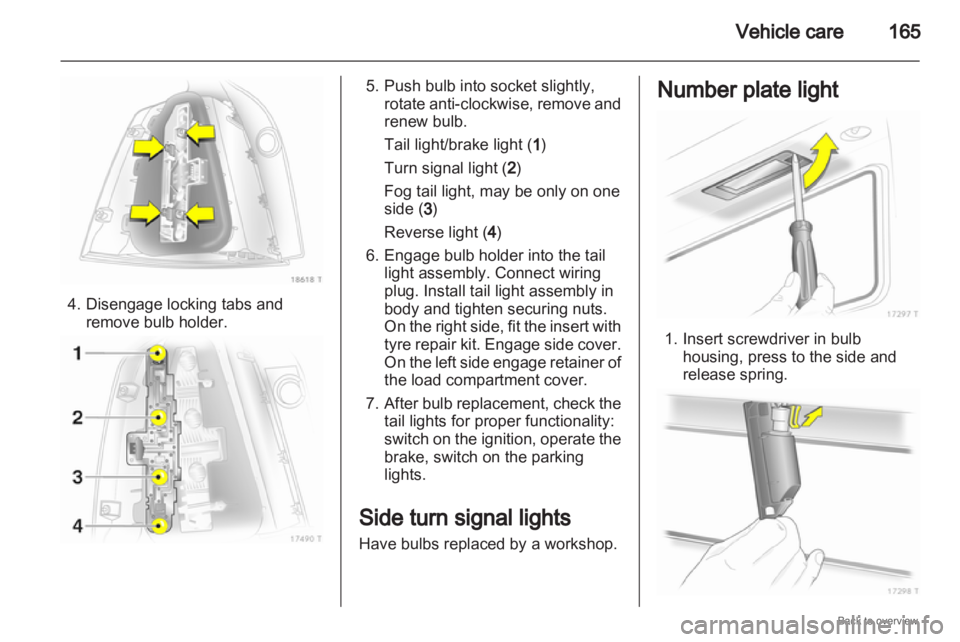
1654. Disengage locking tabs and
remove bulb holder. 5. Push bulb into socket slightly,
rotate anti-clockwise, remove and
renew bulb.
Tail light/brake light ( 1)
Turn signal light ( 2)
Fog tail light, may be only on one
side (3 )
Reverse light ( 4)
6. Engage bulb holder into the tail light assembly. Connect wiring
plug. Install tail light assembly in
body and tighten securing nuts.
On the right side, fit the insert with
tyre repair kit. Engage side cover.
On the left side engage retainer of
the load compartment cover.
7. After bulb replacement, check the tail lights for proper functionality:
switch on the ignition, operate the
brake, switch on the parking
lights.
Side turn signal lights
Have bulbs replaced by a workshop. Number plate light
1. Insert screwdriver in bulb
housing, press to the side and
release spring.