2009 NISSAN TIIDA O2 SENSOR
[x] Cancel search: O2 SENSORPage 3147 of 4331
.
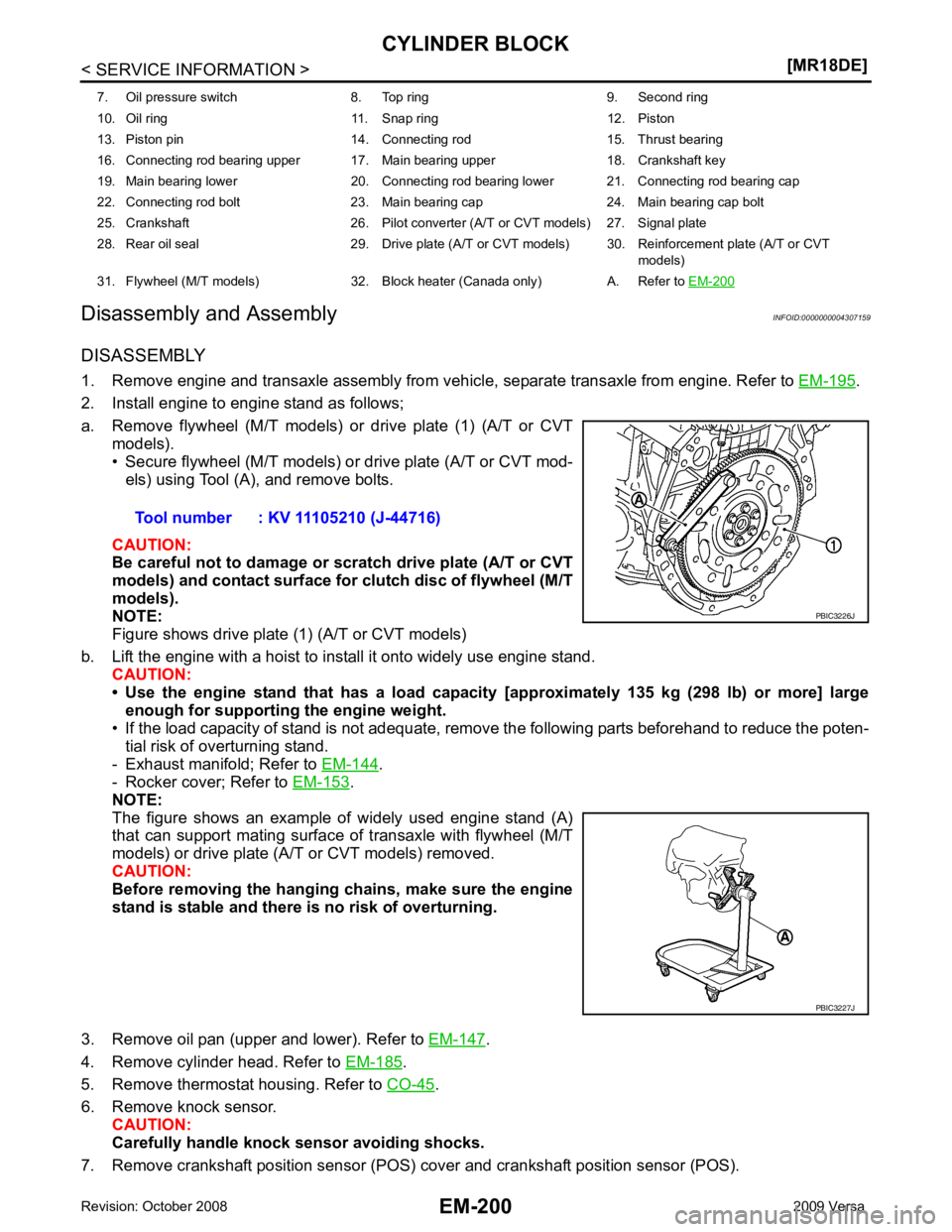
2. Install engine to engine stand as follows;
a. Remove flywheel (M/T models) or drive plate (1) (A/T or CVT models).
• Secure flywheel (M/T models) or drive plate (A/T or CVT mod-
els) using Tool (A), and remove bolts.
CAUTION:
Be careful not to damage or scratch drive plate (A/T or CVT
models) and contact surface for clutch disc of flywheel (M/T
models).
NOTE:
Figure shows drive plate (1) (A/T or CVT models)
b. Lift the engine with a hoist to install it onto widely use engine stand. CAUTION:
• Use the engine stand that has a load capacity [approximately 135 kg (298 lb) or more] large
enough for supporting the engine weight.
• If the load capacity of stand is not adequate, remo ve the following parts beforehand to reduce the poten-
tial risk of overturning stand.
- Exhaust manifold; Refer to EM-144 .
- Rocker cover; Refer to EM-153 .
NOTE:
The figure shows an example of widely used engine stand (A)
that can support mating surface of transaxle with flywheel (M/T
models) or drive plate (A/T or CVT models) removed.
CAUTION:
Before removing the hanging chains, make sure the engine
stand is stable and there is no risk of overturning.
3. Remove oil pan (upper and lower). Refer to EM-147 .
4. Remove cylinder head. Refer to EM-185 .
5. Remove thermostat housing. Refer to CO-45 .
6. Remove knock sensor. CAUTION:
Carefully handle knock sensor avoiding shocks.
7. Remove crankshaft position sensor (POS) cover and crankshaft position sensor (POS).
7. Oil pressure switch 8. Top ring 9. Second ring
10. Oil ring 11. Snap ring 12. Piston
13. Piston pin 14. Connecting rod 15. Thrust bearing
16. Connecting rod bearing upper 17. Main bearing upper 18. Crankshaft key
19. Main bearing lower 20. Connecting rod bearing lower 21. Connecting rod bearing cap
22. Connecting rod bolt 23. Main bearing cap 24. Main bearing cap bolt
25. Crankshaft 26. Pilot converter (A/T or CVT models) 27. Signal plate
28. Rear oil seal 29. Drive plate (A/T or CVT models) 30. Reinforcement plate (A/T or CVT models)
31. Flywheel (M/T models) 32. Block heater (Canada only) A. Refer to EM-200 PBIC3227J
Page 3148 of 4331
EM
NP
O
CAUTION:
• Avoid impacts such as a dropping.
• Never disassemble.
• Keep it away from metal particles.
• Never place sensor in a location wher e it is exposed to magnetism.
8. Remove oil filter (for intake valve timing control).
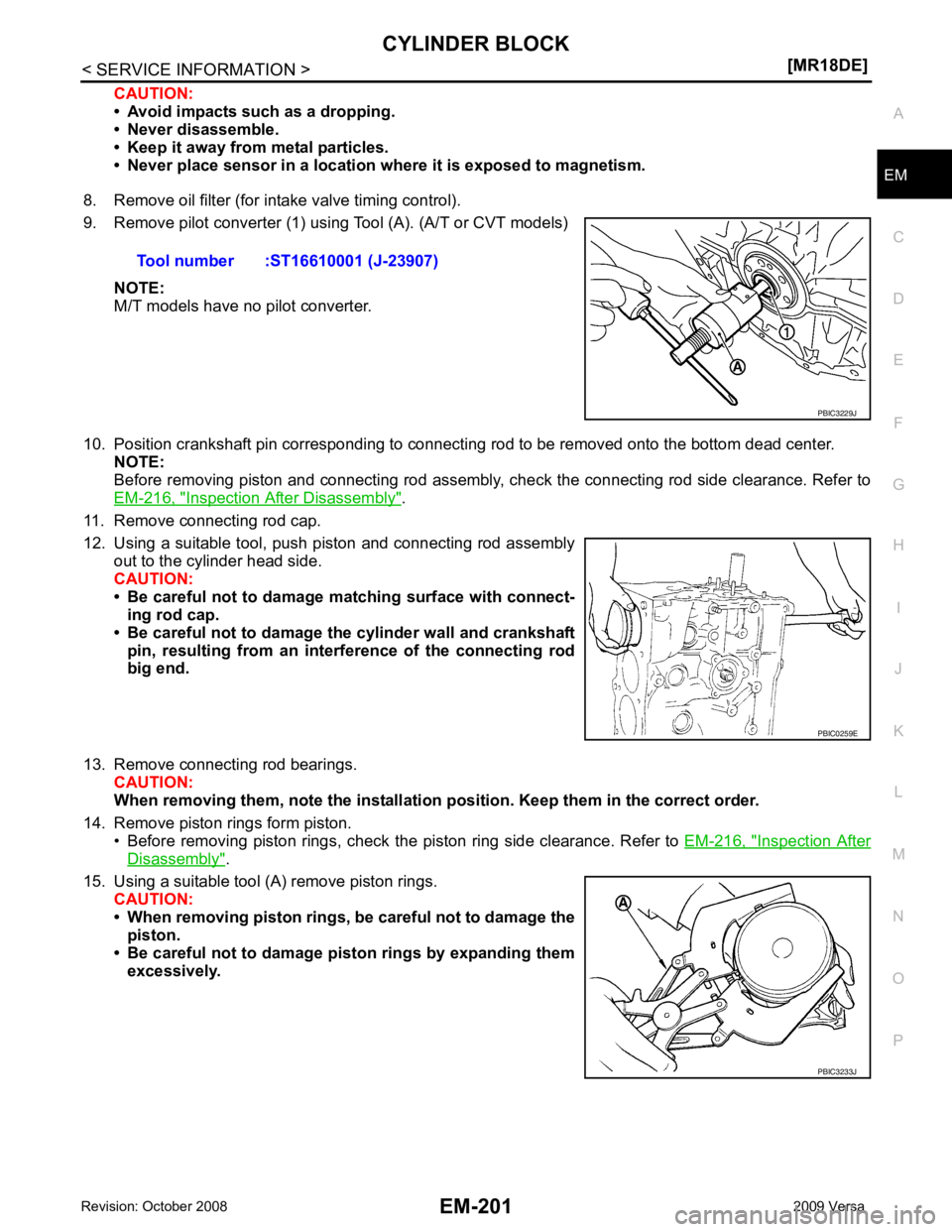
9. Remove pilot converter (1) using Tool (A). (A/T or CVT models)
NOTE:
M/T models have no pilot converter.
10. Position crankshaft pin corresponding to connecting rod to be removed onto the bottom dead center. NOTE:
Before removing piston and connecting rod assembly, check the connecting rod side clearance. Refer to
EM-216, " Inspection After Disassembly " .
11. Remove connecting rod cap.
12. Using a suitable tool, push piston and connecting rod assembly out to the cylinder head side.
CAUTION:
• Be careful not to damage matching surface with connect- ing rod cap.
• Be careful not to damage the cylinder wall and crankshaft pin, resulting from an inte rference of the connecting rod
big end.
13. Remove connecting rod bearings. CAUTION:
When removing them, note the installation position. Keep them in the correct order.
14. Remove piston rings form piston. • Before removing piston rings, check the piston ring side clearance. Refer to EM-216, " Inspection After
Disassembly " .
15. Using a suitable tool (A) remove piston rings. CAUTION:
• When removing piston rings, be careful not to damage the
piston.
• Be careful not to damage piston rings by expanding them excessively.Tool number :ST16610001 (J-23907)
PBIC0259E
PBIC3233J
Page 3187 of 4331
![NISSAN TIIDA 2009 Service Repair Manual PREPARATION
EX-3
< PREPARATION >
[HR16DE] C
D E
F
G H
I
J
K L
M A EX
NP
O
PREPARATION
PREPARATION
Special Service Tool INFOID:0000000004784375
Commercial Service Tool INFOID:0000000004784394
Tool numb](/manual-img/5/57398/w960_57398-3186.png "NISSAN TIIDA 2009 Service Repair Manual PREPARATION
EX-3
< PREPARATION >
[HR16DE] C
D E
F
G H
I
J
K L
M A EX
NP
O
PREPARATION
PREPARATION
Special Service Tool INFOID:0000000004784375
Commercial Service Tool INFOID:0000000004784394
Tool numb")
PREPARATION
EX-3
< PREPARATION >
[HR16DE] C
D E
F
G H
I
J
K L
M A EX
NP
O
PREPARATION
PREPARATION
Special Service Tool INFOID:0000000004784375
Commercial Service Tool INFOID:0000000004784394
Tool number
Tool name Description
KV10114400
(J-38365)
Heated oxygen sensor wrench Loosening or tightening heated oxygen sen-
sor
a: 22 mm (0.87 in) NT636
(Kent-Moore No.)
Tool name Description
(J-43897-18)
(J-43897-12)
Heated oxygen sensor thread cleaner Reconditioning the exhaust system threads
before installing new heated oxygen and Air
fuel ratio sensors (Use with anti-seize lubri-
cant shown below.)
a: 18 mm (0.71 in) dia. for zirconia heated
oxygen sensor
b: 12 mm (0.47 in) dia. for titania heated ox-
ygen sensor
Anti-seize lubricant (Permatex 133AR
or equivalent meeting MIL specifica-
tion MIL-A-907) Lubricating heated oxygen sensor thread
cleaner when reconditioning exhaust system
threads
Power tool Loosening bolts and nuts AEM488
AEM489
PBIC0190E
Page 3189 of 4331
EX
NP
O
ON-VEHICLE REPAIR
EXHAUST SYSTEM
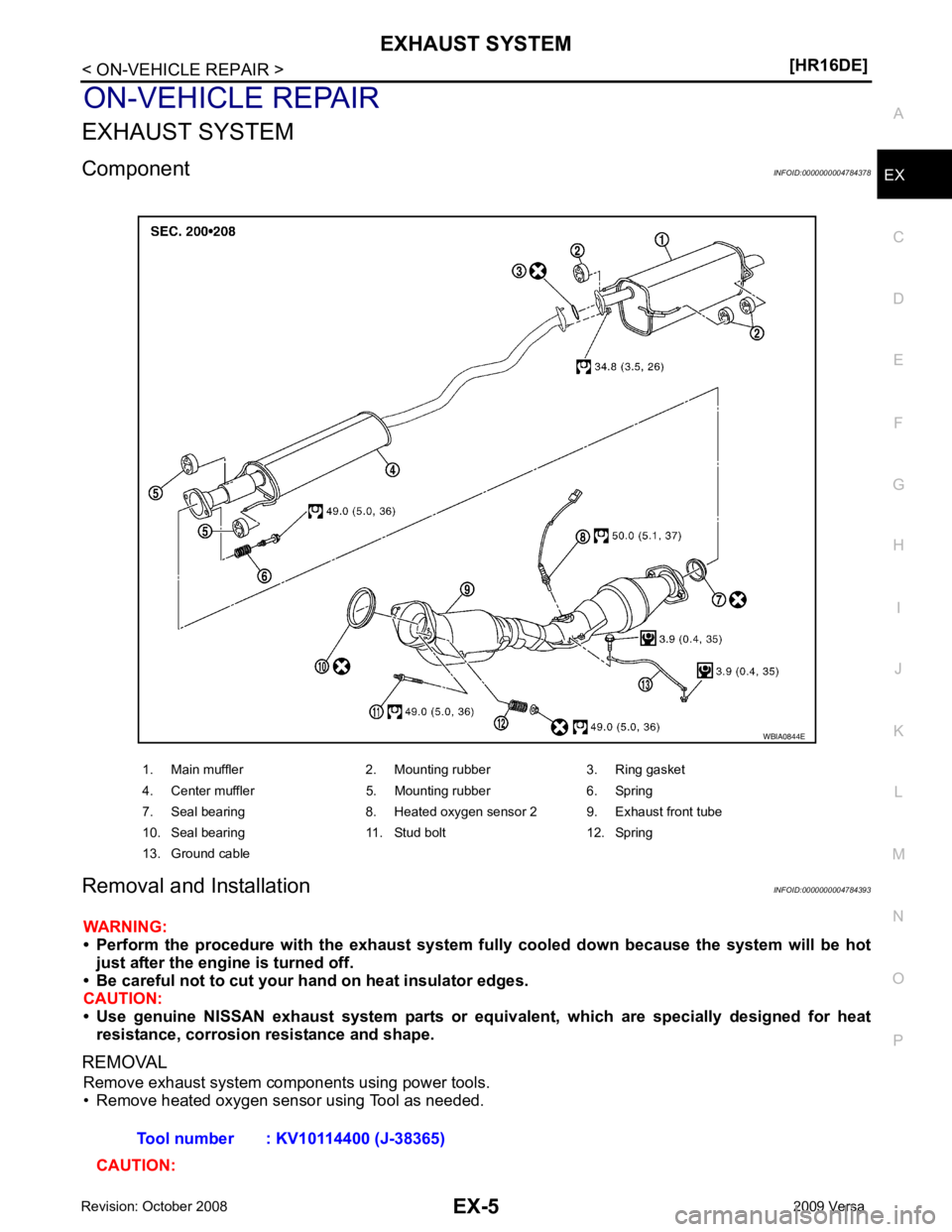
Component INFOID:0000000004784378
Removal and Installation INFOID:0000000004784393
WARNING:
• Perform the procedure with the exhaust system fu lly cooled down because the system will be hot
just after the engine is turned off.
• Be careful not to cut your hand on heat insulator edges.
CAUTION:
• Use genuine NISSAN exhaust system parts or equi valent, which are specially designed for heat
resistance, corrosion resistance and shape.
REMOVAL Remove exhaust system components using power tools.
• Remove heated oxygen sensor using Tool as needed.
CAUTION: 1. Main muffler 2. Mounting rubber 3. Ring gasket
4. Center muffler 5. Mounting rubber 6. Spring
7. Seal bearing 8. Heated oxygen sensor 2 9. Exhaust front tube
10. Seal bearing 11. Stud bolt 12. Spring
13. Ground cable
Page 3191 of 4331

EX
NP
O
SERVICE INFORMATION
PRECAUTIONS
Precaution for Supplemental Restraint System (SRS) "AIR BAG" and "SEAT BELT
PRE-TENSIONER" INFOID:0000000004784390
The Supplemental Restraint System such as “A IR BAG” and “SEAT BELT PRE-TENSIONER”, used along
with a front seat belt, helps to reduce the risk or severi ty of injury to the driver and front passenger for certain
types of collision. This system includes seat belt switch inputs and dual stage front air bag modules. The SRS
system uses the seat belt switches to determine the front air bag deployment, and may only deploy one front
air bag, depending on the severity of a collision and w hether the front occupants are belted or unbelted.
Information necessary to service the system safely is included in the SRS and SB section of this Service Man-
ual.
WARNING:
• To avoid rendering the SRS inoper ative, which could increase the risk of personal injury or death in
the event of a collision which would result in air bag inflation, all maintenance must be performed by
an authorized NISSAN/INFINITI dealer.
• Improper maintenance, including in correct removal and installation of the SRS can lead to personal
injury caused by unintentional act ivation of the system. For removal of Spiral Cable and Air Bag
Module, see the SRS section.
• Do not use electrical test equipm ent on any circuit related to the SRS unless instructed to in this
Service Manual. SRS wiring harnesses can be identi fied by yellow and/or orange harnesses or har-
ness connectors.
• When working near the Airbag Diagnosis Sensor Un it or other Airbag System sensors with the Igni-
tion ON or engine running, DO NOT use air or el ectric power tools or strike near the sensor(s) with a
hammer. Heavy vibration could activate the sensor( s) and deploy the air bag(s), possibly causing
serious injury.
• When using air or electric power tools or hammers , always switch the Ignition OFF, disconnect the
battery, and wait at least 3 minutes before performing any service.
Precaution Necessary for Steering Wh eel Rotation After Battery Disconnect
INFOID:0000000004675325
NOTE:
• This Procedure is applied only to models with Inte lligent Key system and NATS (NISSAN ANTI-THEFT SYS-
TEM).
• Remove and install all control units after disconnecti ng both battery cables with the ignition knob in the
″ LOCK ″ position.
• Always use CONSULT-III to perform self-diagnosis as a part of each function inspection after finishing work.
If DTC is detected, perform trouble diagnosis according to self-diagnostic results.
For models equipped with the Intelligent Key system and NATS , an electrically controlled steering lock mech-
anism is adopted on the key cylinder.
For this reason, if the battery is disconnected or if the battery is discharged, the steering wheel will lock and
steering wheel rotation will become impossible.
If steering wheel rotation is required when battery pow er is interrupted, follow the procedure below before
starting the repair operation.
OPERATION PROCEDURE 1. Connect both battery cables. NOTE:
Supply power using jumper cables if battery is discharged.
2. Use the Intelligent Key or mechanical key to turn the ignition switch to the ″ACC ″ position. At this time, the
steering lock will be released.
3. Disconnect both battery cables. The steering lock will remain released and the steering wheel can be
rotated.
4. Perform the necessary repair operation.
5. When the repair work is completed, return the ignition switch to the ″LOCK ″ position before connecting
the battery cables. (At this time, the steering lock mechanism will engage.)
6. Perform a self-diagnosis check of al l control units using CONSULT-III.
Page 3192 of 4331
![NISSAN TIIDA 2009 Service Repair Manual EX-8< SERVICE INFORMATION >
[MR18DE]
PREPARATION
PREPARATION
Special Service Tool INFOID:0000000004306676
Commercial Service Tool INFOID:0000000004675326
Tool number
Tool name Description
KV10114400
(](/manual-img/5/57398/w960_57398-3191.png "NISSAN TIIDA 2009 Service Repair Manual EX-8< SERVICE INFORMATION >
[MR18DE]
PREPARATION
PREPARATION
Special Service Tool INFOID:0000000004306676
Commercial Service Tool INFOID:0000000004675326
Tool number
Tool name Description
KV10114400
(")
EX-8< SERVICE INFORMATION >
[MR18DE]
PREPARATION
PREPARATION
Special Service Tool INFOID:0000000004306676
Commercial Service Tool INFOID:0000000004675326
Tool number
Tool name Description
KV10114400
(J-38365)
Heated oxygen sensor wrench Loosening or tightening heated oxygen sen-
sor
a: 22 mm (0.87 in) NT636
(Kent-Moore No.)
Tool name Description
(J-43897-18)
(J-43897-12)
Heated oxygen sensor thread cleaner Reconditioning the exhaust system threads
before installing new heated oxygen and Air
fuel ratio sensors (Use with anti-seize lubri-
cant shown below.)
a: 18 mm (0.71 in) dia. for zirconia heated
oxygen sensor
b: 12 mm (0.47 in) dia. for titania heated ox-
ygen sensor
Anti-seize lubricant (Permatex 133AR
or equivalent meeting MIL specifica-
tion MIL-A-907) Lubricating heated oxygen sensor thread
cleaner when reconditioning exhaust system
threads
Power tool Loosening bolts and nuts AEM488
AEM489
PBIC0190E
Page 3193 of 4331
![NISSAN TIIDA 2009 Service Repair Manual EXHAUST SYSTEM
EX-9
< SERVICE INFORMATION >
[MR18DE] C
D E
F
G H
I
J
K L
M A EX
NP
O
EXHAUST SYSTEM
Checking Exhaust System INFOID:0000000004306678
Check exhaust pipes, muffler and mounting for improp](/manual-img/5/57398/w960_57398-3192.png "NISSAN TIIDA 2009 Service Repair Manual EXHAUST SYSTEM
EX-9
< SERVICE INFORMATION >
[MR18DE] C
D E
F
G H
I
J
K L
M A EX
NP
O
EXHAUST SYSTEM
Checking Exhaust System INFOID:0000000004306678
Check exhaust pipes, muffler and mounting for improp")
EXHAUST SYSTEM
EX-9
< SERVICE INFORMATION >
[MR18DE] C
D E
F
G H
I
J
K L
M A EX
NP
O
EXHAUST SYSTEM
Checking Exhaust System INFOID:0000000004306678
Check exhaust pipes, muffler and mounting for improper attachment,
leaks, cracks, damage or deterioration.
• If necessary, repair or replace damaged parts.
Component INFOID:0000000004675327
Removal and Installation INFOID:0000000004675328
WARNING:
• Perform the procedure with the exhaust system fu lly cooled down because the system will be hot
just after the engine is turned off. SMA211A
1. Main muffler 2. Mounting rubber 3. Ring gasket
4. Center muffler 5. Mounting rubber 6. Spring
7. Seal bearing 8. Heated oxygen sensor 2 9. Exhaust front tube
10. Seal bearing 11. Stud bolt 12. Spring
13. Ground cable AWBIA0746GB
Page 3194 of 4331
![NISSAN TIIDA 2009 Service Repair Manual EX-10< SERVICE INFORMATION >
[MR18DE]
EXHAUST SYSTEM
• Be careful not to cut your ha nd on heat insulator edges.
CAUTION:
• Use genuine NISSAN exhaust system parts or equi valent, which a](/manual-img/5/57398/w960_57398-3193.png "NISSAN TIIDA 2009 Service Repair Manual EX-10< SERVICE INFORMATION >
[MR18DE]
EXHAUST SYSTEM
• Be careful not to cut your ha nd on heat insulator edges.
CAUTION:
• Use genuine NISSAN exhaust system parts or equi valent, which a")
EX-10< SERVICE INFORMATION >
[MR18DE]
EXHAUST SYSTEM
• Be careful not to cut your ha nd on heat insulator edges.
CAUTION:
• Use genuine NISSAN exhaust system parts or equi valent, which are specially designed for heat
resistance, corrosion resistance and shape.
REMOVAL
Remove exhaust system components using power tools.
• Remove heated oxygen sensor using Tool as needed.
CAUTION:
Be careful not to damage heated oxygen sensor.
INSTALLATION
Installation is in the reverse order of removal.
CAUTION:
• Always replace exhaust gaskets and seal bear ings with new ones when installing.
• Before installing a new heated oxygen sensor, clean and apply an ti-seize lubricant to exhaust sys-
tem threads using suitable tool.
• Discard any heated oxygen sensor which has been dropped from a height of more than 0.5 m (19.7
in) onto a hard surface such as a co ncrete floor; install a new one.
• Do not over-tighten the heated oxygen sensor. Doing so may damage the heated oxygen sensor,
resulting in the MIL coming on.
• Remove deposits from the sealing surface of each connection. Connect them securely to avoid
exhaust leakage.
• Temporarily tighten nuts on the exhaust manifold side and bolts on the vehicle side. Check each part
for unusual interference, and then ti ghten them to the specified torque.
• When installing each mounting rubb er, avoid twisting or unusual extension in up/down and right/left
directions.
Exhaust Manifold to Exhaust Front Tube
1. Securely insert seal bearing (2) into exhaust manifold (1) side in the direction shown.
• Exhaust front tube (5)
CAUTION:
Be careful not to damage seal bearing surface when install-
ing.
2. Install spring (3), tighten nut (4). • Be careful that the stud bolt nut does not interfere with the
flanged area ( ).
• Make sure the spring (3) sits properly on the flange surface by aligning it to the locator dimples.
Exhaust Front Tube to Center Muffler
1. Securely insert seal bearing (2) into exhaust front tube (1) side in the direction shown.
• Center muffler (5)
CAUTION:
Be careful not to damage seal bearing surface when install-
ing.
2. Install spring (3), tighten bolt (4). • Be careful that the stud bolt does not interfere with the flanged
area ( ).
• Make sure the spring (3) sits properly on the flange surface by
aligning it to the locator dimples.
INSPECTION AFTER INSTALLATION Tool number : KV10114400 (J-38365)
Oxygen sensor thread cleaner : — (J-43897-18)
Oxygen sensor thread cleaner : — (J-43897-12) PBIC3797E
PBIC3798E