Page 285 of 521
NOTE:
•Use of Climatized ULSD Diesel Fuel or Number 1
ULSD Diesel Fuel results in a noticeable decrease in
fuel economy.
•Climatized ULSD Diesel Fuel is a blend of Number 2
ULSD and Number 1 ULSD Diesel Fuels, which re-
duces the temperature at which wax crystals form in
fuel.
NOTE:This engine requires the use of“Ultra Low
Sulfur Diesel Fuel.”Use of incorrect fuel could result in
exhaust system damage. Refer to “Fuel Requirements” in
this section for further details on fuel recommendations.
Battery Blanket Usage
A battery loses 60% of its cranking power as the battery
temperature decreases to 0°F (-18°C). For the same de-
crease in temperature, the engine requires twice as much
power to crank at the same RPM. The use of batteryblankets will greatly increase starting capability at low
temperatures. Suitable battery blankets are available
from your authorized MOPAR�dealer.
Engine Starting Procedure
WARNING!
NEVER pour fuel or other flammable liquid into the
air inlet opening in an attempt to start the vehicle.
This could result in a flash fire causing serious
personal injury.
1. The shift lever must be in the NEUTRAL or PARK
position before you can start the engine.
2. Turn the ignition key to the ON position.
3. Watch for the “Wait To Start Light” in the instrument
cluster. Refer to “Instrument Cluster” in Section 4 of this
manual. It will glow for two to ten seconds or more,
STARTING AND OPERATING 283
5
Page 286 of 521

depending on engine temperature. When the “Wait To
Start” goes out, the engine is ready to start.
4. Tip Start Feature
Do notpress the accelerator. Use the Fob with Integrated
Key (FOBIK) to briefly turn the ignition switch to the
START position and then release it. The starter motor will
continue to run, and it will automatically disengage
when the engine is running. If the engine fails to start, the
starter will disengage automatically in 20 seconds. The
starter can be disengaged by turning the ignition key to
the OFF position, if required.
5. After the engine starts, allow it to idle for approxi-
mately 30 seconds before driving. This allows oil to
circulate and lubricate the turbocharger.
Avoid prolonged idling in ambient temperatures below
0°F (-18°C). Long periods of idling may be harmful to
your engine because combustion chamber temperatures
can drop so low that the fuel may not burn completely.Incomplete combustion allows carbon and varnish to
form on piston rings and injector nozzles. Also, the
unburned fuel can enter the crankcase, diluting the oil
and causing rapid wear to the engine.
Engine Warm-Up
Avoid full throttle operation when the engine is cold.
When starting a cold engine, bring the engine up to
operating speed slowly to allow the oil pressure to
stabilize as the engine warms up.
NOTE:High-speed, no-load running of a cold engine
can result in excessive white smoke and poor engine
performance. No-load engine speeds should be kept
under 1,200 RPM during the warm-up period, especially
in cold ambient temperature conditions.
If temperatures are below 32°F (0°C), operate the engine
at moderate speeds for five minutes before full loads are
applied.
284 STARTING AND OPERATING
Page 287 of 521
Engine Idling - In Cold Weather
Avoid prolonged idling in ambient temperatures below
0°F (-18°C). Long periods of idling may be harmful to
your engine because combustion chamber temperatures
can drop so low that the fuel may not burn completely.
Incomplete combustion allows carbon and varnish to
form on piston rings and injector nozzles. Also, the
unburned fuel can enter the crankcase, diluting the oil
and causing rapid wear to the engine.
Stopping The Engine
Before turning off your turbo diesel engine, always allow
the engine to return to normal idle speed and run for
several seconds. This assures proper lubrication of the
turbocharger. This is particularly necessary after any
period of hard driving.
Idle the engine a few minutes before routine shutdown.
After full load operation, idle the engine three to five
minutes before shutting it down. This idle period willallow the lubricating oil and coolant to carry excess heat
away from the combustion chamber, bearings, internal
components, and turbocharger. This is especially impor-
tant for turbocharged, charge air cooled engines.
ENGINE BLOCK HEATER — IF EQUIPPED
The engine block heater warms the engine, and permits
quicker starts in cold weather. Connect the heater cord to
a ground-fault interrupter protected 110-115 Volt AC
electrical outlet with a grounded, three-wire extension
cord.
Use the heater when temperatures below 0°F (-18°C) are
expected to last for several days.
The block heater must be plugged in at least one hour to
have an adequate warming effect on the coolant.
The engine block heater cord is located:
•3.7L/4.7L Engine — coiled and strapped to the engine
oil dipstick tube.
STARTING AND OPERATING 285
5
Page 288 of 521
•5.7L Engine — bundled and fastened to the injector
harness.
•3.0L Diesel Engine — on the passenger side of the
vehicle, mounted on a stud between the fresh airbox
and coolant reservoir.
WARNING!
Remember to disconnect the cord before driving.
Damage to the 110-115 Volt AC electrical cord could
cause electrocution.
AUTOMATIC TRANSMISSION
CAUTION!
Damage to the transmission may occur if the follow-
ing precautions are not observed:
•Shift into PARK only after the vehicle has come to
a complete stop.
•Shift into or out of REVERSE only after the
vehicle has come to a complete stop and the engine
is at idle speed.
•Do not shift from REVERSE, PARK, or NEUTRAL
into any forward gear when the engine is above
idle speed.
•Before shifting into any gear, make sure your foot
is firmly on the brake pedal.
286 STARTING AND OPERATING
Page 289 of 521
WARNING!
It is dangerous to move the shift lever out of PARK or
NEUTRAL if the engine speed is higher than idle
speed. If your foot is not firmly on the brake pedal,
the vehicle could accelerate quickly forward or in
reverse. You could lose control of the vehicle and hit
someone or something. Only shift into gear when the
engine is idling normally and when your foot is
firmly on the brake pedal.
Brake/Transmission Shift Interlock System
This system prevents you from moving the shift lever out
of PARK and into any gear unless the brake pedal is
pressed. This system is active only while the ignition
switch is in the ON position. Always depress thebrake
pedal first,before moving the shift lever out of PARK.
Brake/Transmission Interlock Manual Override
Your vehicle may be equipped with a shift lock manual
override. The manual override may be used in the event
that the shift lever should fail to move from PARK with
the key in the ON position and the brake pedal de-
pressed. To operate the shift lock manual override, per-
form the following steps:
1. Turn the key to the ON position without starting the
engine.
2. Firmly set the parking brake.
3. Using a flat blade screwdriver, carefully remove the
shift lock manual override cover, which is located on the
PRNDL bezel.
4. Depress and maintain firm pressure on the brake
pedal.
STARTING AND OPERATING 287
5
Page 290 of 521
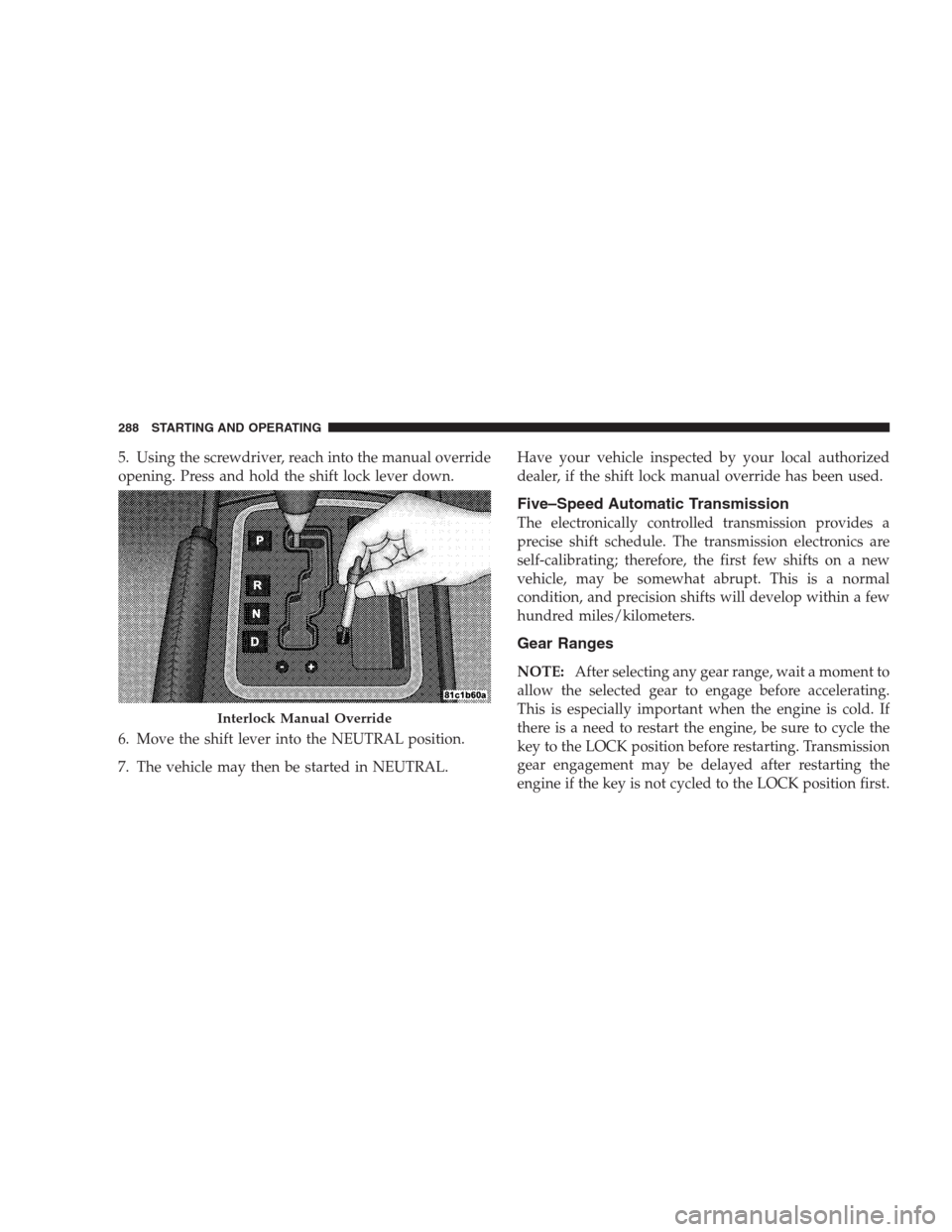
5. Using the screwdriver, reach into the manual override
opening. Press and hold the shift lock lever down.
6. Move the shift lever into the NEUTRAL position.
7. The vehicle may then be started in NEUTRAL.Have your vehicle inspected by your local authorized
dealer, if the shift lock manual override has been used.
Five–Speed Automatic Transmission
The electronically controlled transmission provides a
precise shift schedule. The transmission electronics are
self-calibrating; therefore, the first few shifts on a new
vehicle, may be somewhat abrupt. This is a normal
condition, and precision shifts will develop within a few
hundred miles/kilometers.
Gear Ranges
NOTE:After selecting any gear range, wait a moment to
allow the selected gear to engage before accelerating.
This is especially important when the engine is cold. If
there is a need to restart the engine, be sure to cycle the
key to the LOCK position before restarting. Transmission
gear engagement may be delayed after restarting the
engine if the key is not cycled to the LOCK position first.
Interlock Manual Override
288 STARTING AND OPERATING
Page 291 of 521
PARK
This gear position supplements the parking brake by
locking the transmission. The engine can be started in
this range. Never use PARK while the vehicle is in
motion. Apply the parking brake when leaving the
vehicle in this range. Always apply the parking brake
first, then place the shift lever into the PARK position.
WARNING!
•Never use the PARK position as a substitute for
the parking brake. Always apply parking brake
fully when parked to guard against vehicle move-
ment and possible injury or damage.
(Continued)
WARNING! (Continued)
•It is dangerous to move the shift lever out of PARK
or NEUTRAL if the engine speed is higher than
idle speed. If your foot is not firmly on the brake
pedal, the vehicle could accelerate quickly forward
or in reverse. You could lose control of the vehicle
and hit someone or something. Only shift into
gear when the engine is idling normally and when
your right foot is firmly on the brake pedal.
REVERSE
Use this range only after the vehicle has come to a
complete stop.
NEUTRAL
Shift into NEUTRAL when the vehicle is standing for
prolonged periods with the engine running. The engine
may be started in this range. Set the parking brake if you
must leave the vehicle.
STARTING AND OPERATING 289
5
Page 292 of 521
NOTE:Towing the vehicle, coasting, or driving for any
other reason with the shift lever in NEUTRAL can result
in severe transmission damage. Refer to “Recreational
Towing” in Section 5 and “Towing a Disabled Vehicle” in
Section 6 of this manual.
DRIVE
Shift into DRIVE only when the vehicle is at a complete
stop and the brakes are firmly applied. The transmission
automatically upshifts through fifth gear. The DRIVE
position provides optimum driving characteristics under
all normal operating conditions.
Electronic Range Select (ERS)Operation
The Electronic Range Select (ERS) shift control allows
you to move the shift lever left (-) or right (+) when the
shift lever is in the DRIVE position, allowing you to limit
the highest available gear. For example, if the drivershifts the transmission into ERS 3 (third gear), the trans-
mission will never shift above third gear, but can shift
down to 2 (second) or 1 (first), when needed.
NOTE:
•If you pull and hold (not tap) the shift lever to the left
(-), the transmission will downshift to the lowest gear
that can be attained without overrevving the engine.
The display will show the gear the vehicle is in and
will limit the top gear to the one displayed.
•If you pull and hold (not tap) the shift lever to the right
(+), the transmission will exit the gear limiting mode
and shift to the appropriate gear. The display will read
�D�.
3.7L and 3.0L Diesel Engine
When in the DRIVE position, the first tap to the left (-),
will shift down one gear and will display that gear. For
example, if you are in DRIVE and are in 5th gear, when
you tap the shift lever one time to the left (-), the
290 STARTING AND OPERATING