Page 266 of 521
Recirculation
The recirculation feature can be selected with
the mode control knob. You may choose be-
tween Bi-Level Recirculation and Panel Recir-
culation air outlets while in this mode. Nor-
mally, air enters from outside the vehicle. However, when
in “Recirculation” mode air inside the vehicle is re-used.
Use this mode to rapidly cool the inside of the vehicle.
The “Recirculation” mode can also be used to tempo-
rarily block out outside odors, smoke, and dust.
Air Conditioning
To turn on the Air Conditioning, set the fan control
at any speed and press the snowflake button
located on the control panel. Conditioned air will
be directed through the outlets selected by the mode
control. A light in the snowflake button shows that the air
conditioning is on.Slight changes in engine speed or power may be noticed
when the air conditioning compressor is on. This is a
normal occurrence as the compressor will cycle on and
off to maintain comfort and increase fuel economy.
Automatic Temperature Control — If Equipped
The Automatic Temperature Control System automati-
cally maintains the interior comfort level desired by the
driver and passenger.
264 UNDERSTANDING YOUR INSTRUMENT PANEL
Page 268 of 521
respectively. With the temperature setting in these posi-
tions, the system does not attempt automatic comfort
control.
Air Conditioning
The air conditioning in this system is automatic.
Pressing this button while in AUTO mode will
cause the LED to flash three times and remain off.
This indicates that the system is in AUTO and requesting
the air conditioning is not necessary.
Recirculation
The system will automatically control recircu-
lation. However, pressing this button will tem-
porarily put the system in “Recirculation”
mode. This can be used when outside condi-
tions such as smoke, odors, dust, or high humidity are
present. This will cause the LED to illuminate.NOTE:
•The surface of the climate control panel, and the top
center of the instrument panel should be kept free of
debris due to the climate control sensor’s location.
Mud on the windshield may also cause poor operation
of this system.
•To provide you with maximum comfort in the auto-
matic mode, during cold start-ups the blower fan will
remain off until the engine warms up. However, the
fan will engage immediately if the defrost mode is
selected or if you manually select a blower speed.
•Under certain conditions (after the vehicle is turned
off) the climate control system may recalibrate and a
noise may be heard for 20 seconds. This is part of
normal operation.
266 UNDERSTANDING YOUR INSTRUMENT PANEL
Page 274 of 521
When using the air conditioner in extremely heavy
traffic, in hot weather, especially when towing a trailer,
additional engine cooling may be required. If this situa-
tion is encountered, operate the transmission in a lower
gear to increase engine RPM, coolant flow and fan speed.
When stopped in heavy traffic, it may be necessary to
shift into NEUTRAL and depress the accelerator slightly
for fast idle operation to increase coolant flow and fan
speed.
Your air conditioning system is also equipped with an
automatic recirculation system. When the system senses
a heavy load or high heat conditions, it may use partial
Recirculation A/C mode to provide additional comfort.Winter Operation
When operating the system during the winter months,
make sure the air intake, located directly in front of the
windshield, is free of ice, slush, snow, or other
obstructions.
Vacation Storage
Anytime you store your vehicle, or keep it out of service
(i.e. vacation) for two weeks or more, run the air condi-
tioning system at idle for about five minutes in the fresh
air and high blower setting. This will ensure adequate
system lubrication to minimize the possibility of com-
pressor damage when the system is started again.
272 UNDERSTANDING YOUR INSTRUMENT PANEL
Page 277 of 521
STARTING AND OPERATING
CONTENTS
�Starting Procedure..................... 280
▫Normal Starting..................... 280
▫Extremely Cold Weather (Below�20°F Or
�29°C)............................ 281
▫If Engine Fails To Start................ 281
▫After Starting....................... 282
▫Normal Starting — Diesel Engines........ 282
�Engine Block Heater — If Equipped........ 285
�Automatic Transmission................. 286▫Brake/Transmission Shift Interlock System . . 287
▫Brake/Transmission Interlock Manual
Override.......................... 287
▫Five–Speed Automatic Transmission....... 288
▫Gear Ranges........................ 288
▫Rocking The Vehicle.................. 295
�Four-Wheel Drive Operation............. 296
▫Quadra-Trac I�Operating
Instructions/Precautions — If Equipped.... 296
5
Page 280 of 521
�Fuel Requirements..................... 355
▫3.7 And 4.7L Engine.................. 355
▫5.7L Engine........................ 355
▫Reformulated Gasoline................ 356
▫Gasoline/Oxygenate Blends............. 356
▫E-85 Usage In Non-Flex Fuel Vehicles...... 357
▫MMT In Gasoline.................... 357
▫Materials Added To Fuel............... 358
▫Fuel System Cautions................. 358
▫Carbon Monoxide Warnings............ 359
�Fuel Requirements (Diesel Engines)......... 360
�Flexible Fuel (4.7L Engine Only) —
If Equipped.......................... 361▫E-85 General Information............... 361
▫Ethanol Fuel (E-85)................... 362
▫Fuel Requirements................... 362
▫Selection Of Engine Oil For Flexible Fuel
Vehicles (E-85) And Gasoline Vehicles...... 363
▫Starting........................... 363
▫Cruising Range...................... 363
▫Replacement Parts................... 364
�Adding Fuel......................... 364
▫Fuel Filler Cap (Gas Cap).............. 364
�Vehicle Loading...................... 367
▫Certification Label................... 367
278 STARTING AND OPERATING
Page 282 of 521

STARTING PROCEDURE
Before starting your vehicle, adjust your seat, adjust the
inside and outside mirrors, fasten your seat belt, and if
present, instruct all other occupants to buckle their seat
belts.
WARNING!
•Never leave children alone in a vehicle. Leaving
unattended children in a vehicle is dangerous for a
number of reasons. A child or others could be
seriously or fatally injured. Do not leave the key in
the ignition. A child could operate power win-
dows, other controls, or move the vehicle.
•Do not leave animals or children inside parked
vehicles in hot weather; interior heat buildup may
cause serious injury or death.
Normal Starting
Tip Start
NOTE:Normal starting of either a cold or a warm
engine is obtained without pumping or depressing the
accelerator pedal.
Do notpress the accelerator. Use the Fob with Integrated
Key to briefly turn the ignition switch to the START
position and release it as soon as the starter engages. The
starter motor will continue to run, and it will disengage
automatically when the engine is running. If the engine
fails to start, the starter will disengage automatically in
10 seconds. If this occurs, turn the ignition switch to the
LOCK position, wait 10 to 15 seconds, then repeat the
normal starting procedure.
280 STARTING AND OPERATING
Page 283 of 521
Extremely Cold Weather (Below�20°F or�29°C)
To ensure reliable starting at these temperatures, use of
an externally powered electric engine block heater (avail-
able from your authorized dealer) is recommended.
If Engine Fails To Start
WARNING!
•Never pour fuel or other flammable liquids into
the throttle body air inlet opening in an attempt to
start the vehicle. This could result in a flash fire
causing serious personal injury.
(Continued)
WARNING! (Continued)
•Do not attempt to push or tow your vehicle to get
it started. Vehicles equipped with an automatic
transmission cannot be started this way. Unburned
fuel could enter the catalytic converter and once
the engine has started, ignite and damage the
converter and vehicle. If the vehicle has a dis-
charged battery, booster cables may be used to
obtain a start from a booster battery or the battery
in another vehicle. This type of start can be dan-
gerous if done improperly. Refer to Section 6 for
proper jump-starting procedures and follow them
carefully.
If the engine fails to start after you have followed the
“Normal Starting” or “Extreme Cold Weather” proce-
dures, it may be flooded. To clear any excess fuel, push
the accelerator pedal all the way to the floor and hold it.
Then, turn the ignition switch to the START position and
STARTING AND OPERATING 281
5
Page 284 of 521
release it as soon as the starter engages. The starter motor
will disengage automatically in 10 seconds. Once this
occurs, release the accelerator pedal, turn the ignition
switch to the LOCK position, wait 10 to 15 seconds, then
repeat the normal starting procedure.
CAUTION!
To prevent damage to the starter, wait 10 to 15 sec-
onds before trying again.
After Starting
The idle speed is controlled automatically and it will
decrease as the engine warms up.
Normal Starting — Diesel Engines
Observe the following when the engine is operating.
•All message center lights are off.
•Malfunction Indicator Light (MIL) is off.
•Low Oil Pressure Light is off.
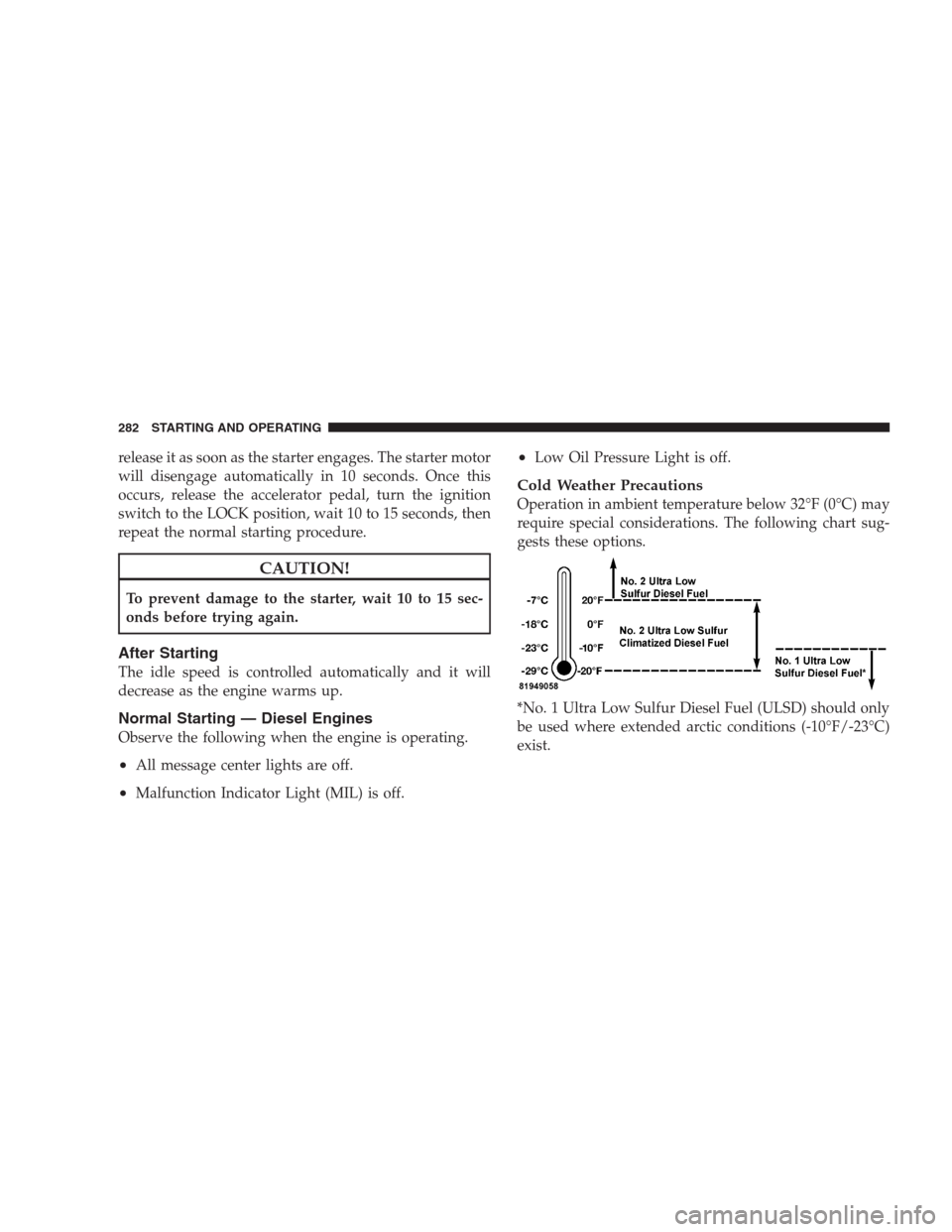
Cold Weather Precautions
Operation in ambient temperature below 32°F (0°C) may
require special considerations. The following chart sug-
gests these options.
*No. 1 Ultra Low Sulfur Diesel Fuel (ULSD) should only
be used where extended arctic conditions (-10°F/-23°C)
exist.
282 STARTING AND OPERATING