Page 188 of 521

the ON position before engine start. If the bulb does not
come on when turning the key from OFF to ON, have the
condition checked promptly.
Certain conditions such as a loose or missing gas cap,
poor fuel quality, etc. may illuminate the light after
engine start. The vehicle should be serviced if the light
stays on through several of your typical driving cycles. In
most situations the vehicle will drive normally and will
not require towing.
The MIL flashes to alert you to serious conditions that
could lead to immediate loss of power or severe catalytic
converter damage. The vehicle should be serviced as
soon as possible if this occurs.
6. Airbag Warning Light
This light turns on and remains on for six to
eight seconds as a bulb check when the ignition
switch is first turned ON. If the light is not onduring starting, stays on, or turns on while driving, have
the system inspected by an authorized dealer as soon as
possible.
7. Anti-Lock Brake (ABS) Light
This light monitors the Anti-Lock Brake System
(ABS). The light will turn on when the ignition
switch is turned to the ON position and may
stay on for as long as four seconds.
If the ABS light remains on or turns on while driving, it
indicates that the Anti-Lock portion of the brake system
is not functioning and that service is required. However,
the conventional brake system will continue to operate
normally if the BRAKE warning light is not on.
If the ABS light is on, the brake system should be serviced
as soon as possible to restore the benefits of Anti-Lock
brakes. If the ABS light does not turn on when the
Ignition switch is turned to the ON position, have the
light inspected by an authorized dealer.
186 UNDERSTANDING YOUR INSTRUMENT PANEL
Page 280 of 521
�Fuel Requirements..................... 355
▫3.7 And 4.7L Engine.................. 355
▫5.7L Engine........................ 355
▫Reformulated Gasoline................ 356
▫Gasoline/Oxygenate Blends............. 356
▫E-85 Usage In Non-Flex Fuel Vehicles...... 357
▫MMT In Gasoline.................... 357
▫Materials Added To Fuel............... 358
▫Fuel System Cautions................. 358
▫Carbon Monoxide Warnings............ 359
�Fuel Requirements (Diesel Engines)......... 360
�Flexible Fuel (4.7L Engine Only) —
If Equipped.......................... 361▫E-85 General Information............... 361
▫Ethanol Fuel (E-85)................... 362
▫Fuel Requirements................... 362
▫Selection Of Engine Oil For Flexible Fuel
Vehicles (E-85) And Gasoline Vehicles...... 363
▫Starting........................... 363
▫Cruising Range...................... 363
▫Replacement Parts................... 364
�Adding Fuel......................... 364
▫Fuel Filler Cap (Gas Cap).............. 364
�Vehicle Loading...................... 367
▫Certification Label................... 367
278 STARTING AND OPERATING
Page 285 of 521
NOTE:
•Use of Climatized ULSD Diesel Fuel or Number 1
ULSD Diesel Fuel results in a noticeable decrease in
fuel economy.
•Climatized ULSD Diesel Fuel is a blend of Number 2
ULSD and Number 1 ULSD Diesel Fuels, which re-
duces the temperature at which wax crystals form in
fuel.
NOTE:This engine requires the use of“Ultra Low
Sulfur Diesel Fuel.”Use of incorrect fuel could result in
exhaust system damage. Refer to “Fuel Requirements” in
this section for further details on fuel recommendations.
Battery Blanket Usage
A battery loses 60% of its cranking power as the battery
temperature decreases to 0°F (-18°C). For the same de-
crease in temperature, the engine requires twice as much
power to crank at the same RPM. The use of batteryblankets will greatly increase starting capability at low
temperatures. Suitable battery blankets are available
from your authorized MOPAR�dealer.
Engine Starting Procedure
WARNING!
NEVER pour fuel or other flammable liquid into the
air inlet opening in an attempt to start the vehicle.
This could result in a flash fire causing serious
personal injury.
1. The shift lever must be in the NEUTRAL or PARK
position before you can start the engine.
2. Turn the ignition key to the ON position.
3. Watch for the “Wait To Start Light” in the instrument
cluster. Refer to “Instrument Cluster” in Section 4 of this
manual. It will glow for two to ten seconds or more,
STARTING AND OPERATING 283
5
Page 363 of 521
Diesel fuel is seldom completely free of water. To prevent
fuel system trouble, drain the accumulated water from
the fuel/water separator using the provided fuel/water
separator drain. If you buy good quality fuel and follow
the cold weather advice above, fuel conditioners should
not be required in your vehicle. If available in your area,
a high cetane “premium” diesel fuel may offer improved
cold-starting and warm-up performance.
FLEXIBLE FUEL (4.7L ENGINE ONLY) — IF
EQUIPPED
E-85 General Information
The information in this section is for Flexible Fuel ve-
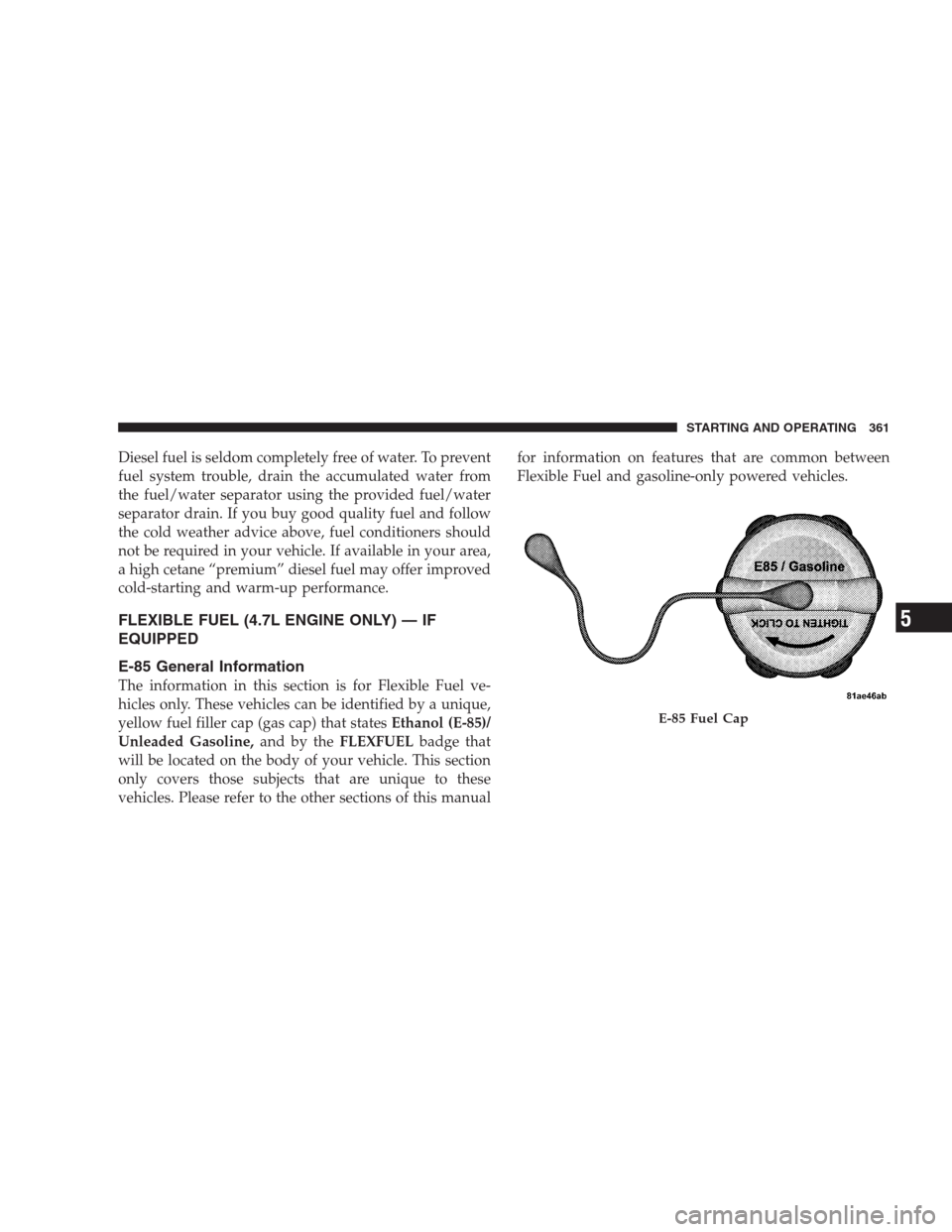
hicles only. These vehicles can be identified by a unique,
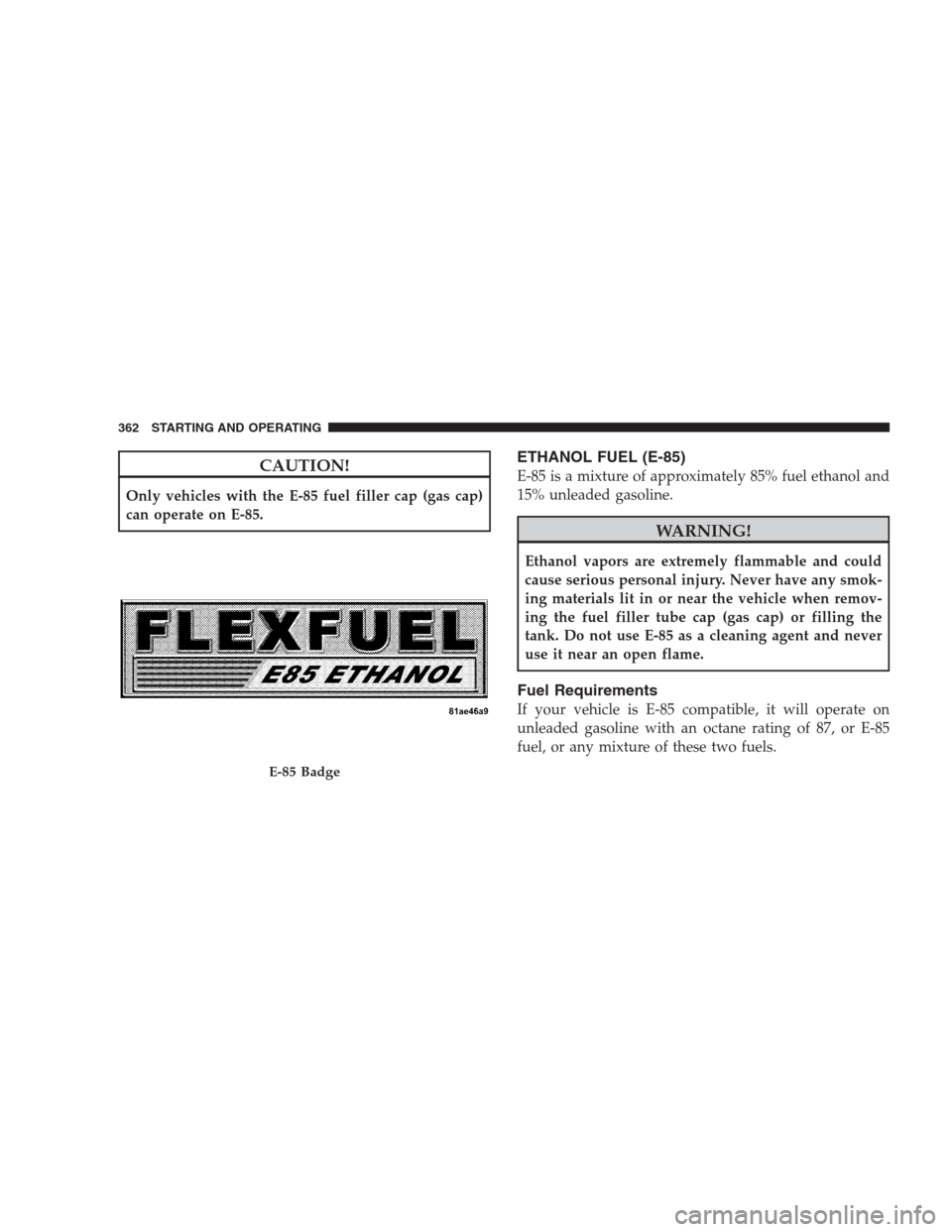
yellow fuel filler cap (gas cap) that statesEthanol (E-85)/
Unleaded Gasoline,and by theFLEXFUELbadge that
will be located on the body of your vehicle. This section
only covers those subjects that are unique to these
vehicles. Please refer to the other sections of this manualfor information on features that are common between
Flexible Fuel and gasoline-only powered vehicles.
E-85 Fuel Cap
STARTING AND OPERATING 361
5
Page 364 of 521
CAUTION!
Only vehicles with the E-85 fuel filler cap (gas cap)
can operate on E-85.
ETHANOL FUEL (E-85)
E-85 is a mixture of approximately 85% fuel ethanol and
15% unleaded gasoline.
WARNING!
Ethanol vapors are extremely flammable and could
cause serious personal injury. Never have any smok-
ing materials lit in or near the vehicle when remov-
ing the fuel filler tube cap (gas cap) or filling the
tank. Do not use E-85 as a cleaning agent and never
use it near an open flame.
Fuel Requirements
If your vehicle is E-85 compatible, it will operate on
unleaded gasoline with an octane rating of 87, or E-85
fuel, or any mixture of these two fuels.
E-85 Badge
362 STARTING AND OPERATING
Page 366 of 521
consumption. You can expect your MPG and your driv-
ing range to decrease by about 30% compared to gasoline
operation.
Replacement Parts
All components in your Flexible Fuel Vehicle (FFV) are
designed to be compatible with ethanol. Always be sure
that your vehicle is serviced with correct ethanol com-
patible parts.
CAUTION!
•Replacing fuel system components with non-
ethanol compatible components can damage your
vehicle.
•Do not use ethanol mixture greater than 85% in
your vehicle. It will cause difficulty in cold start-
ing and may affect drivability.
ADDING FUEL
CAUTION!
DO NOT put gasoline in your diesel vehicle (if
equipped). If you accidentally put gasoline in your
vehicle, DO NOT start the engine. This will cause
damage to the fuel system. Have the fuel system
flushed.
Fuel Filler Cap (Gas Cap)
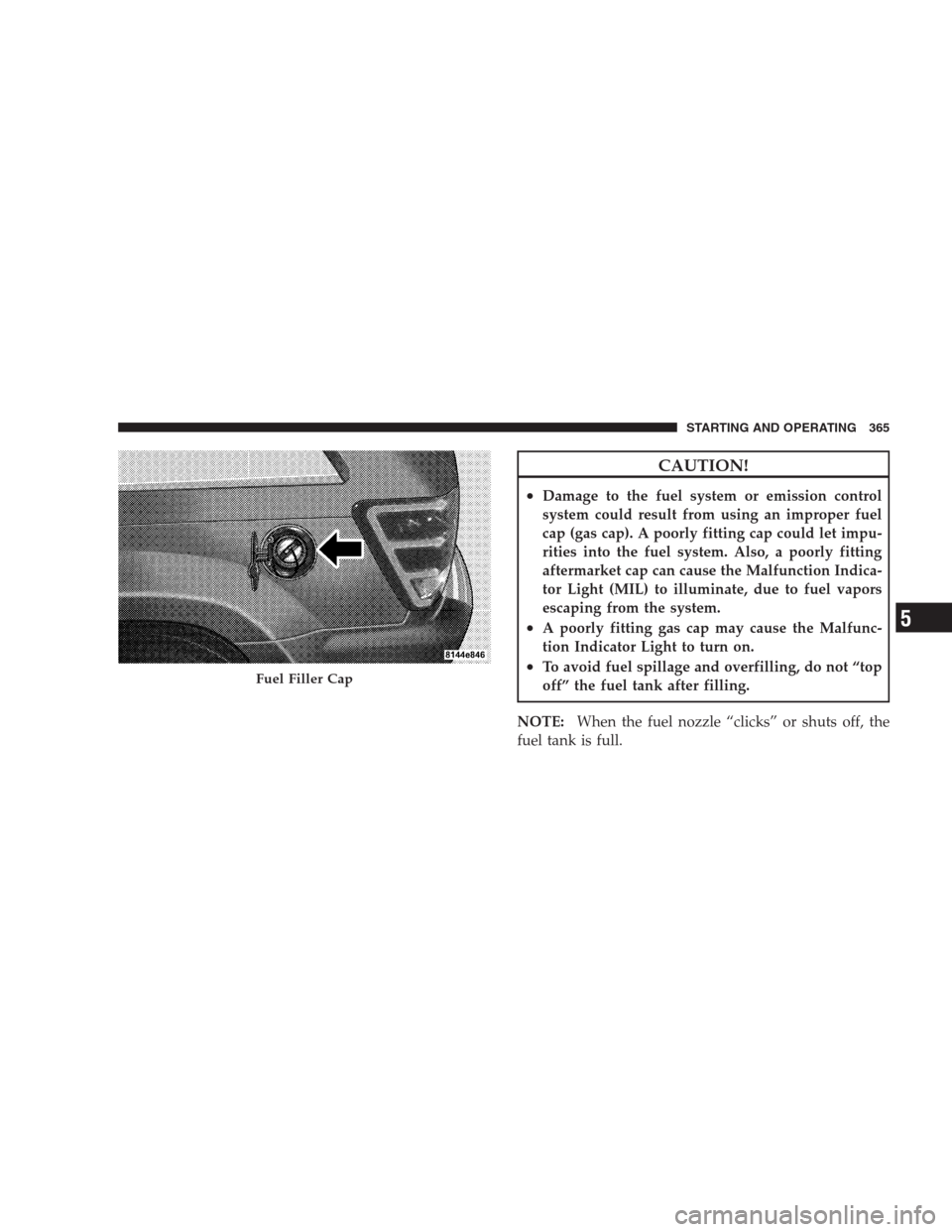
The gas cap is located behind the fuel filler door, on the
driver’s side of the vehicle. If the gas cap is lost or
damaged, be sure the replacement cap is for use with this
vehicle.
364 STARTING AND OPERATING
Page 367 of 521
CAUTION!
•Damage to the fuel system or emission control
system could result from using an improper fuel
cap (gas cap). A poorly fitting cap could let impu-
rities into the fuel system. Also, a poorly fitting
aftermarket cap can cause the Malfunction Indica-
tor Light (MIL) to illuminate, due to fuel vapors
escaping from the system.
•A poorly fitting gas cap may cause the Malfunc-
tion Indicator Light to turn on.
•To avoid fuel spillage and overfilling, do not “top
off” the fuel tank after filling.
NOTE:When the fuel nozzle “clicks” or shuts off, the
fuel tank is full.Fuel Filler Cap
STARTING AND OPERATING 365
5
Page 368 of 521

WARNING!
•Never have any smoking materials lit in or near
the vehicle when the gas cap is removed or the
tank filled.
•Never add fuel when the engine is running. This is
in violation of most state and federal fire regula-
tions and will cause the malfunction indicator
light to turn on.
NOTE:Tighten the gas cap about one-quarter turn until
you hear one click. This is an indication that the cap is
properly tightened.
If the gas cap is not tighten properly, the Malfunction
Indicator Light will come on. Be sure the gas cap is
tightened every time the vehicle is refueled.
WARNING!
A fire may result if gasoline is pumped into a
portable container that is inside of a vehicle. You
could be burned. Always place gas containers on the
ground while filling.
Loose Fuel Filler Cap Message
If the vehicle diagnostic system determines that the fuel
filler cap is loose, improperly installed, or damaged, a
“CHECK GASCAP” message will be displayed in the
EVIC (Electronic Vehicle Information Center). Refer to
“Electronic Vehicle Information Center” in Section 4 of
this manual. Tighten the fuel filler cap until a “clicking”
sound is heard. This is an indication that the fuel filler
cap is properly tightened. Refer to “Onboard Diagnostic
System — OBDII” in Section 7 of this manual for more
information.
366 STARTING AND OPERATING