Page 417 of 521
3.0L Diesel Engine Only
Anytime the oil is drained and filled it is very important
to wait 15 minutes before starting the engine.
Engine Oil Selection — Gasoline Engines
For best performance and maximum protection for all
engines under all types of operating conditions, the
manufacturer recommends engine oils that are API Cer-
tified and meet the requirements of Chrysler Material
Standard MS-6395.
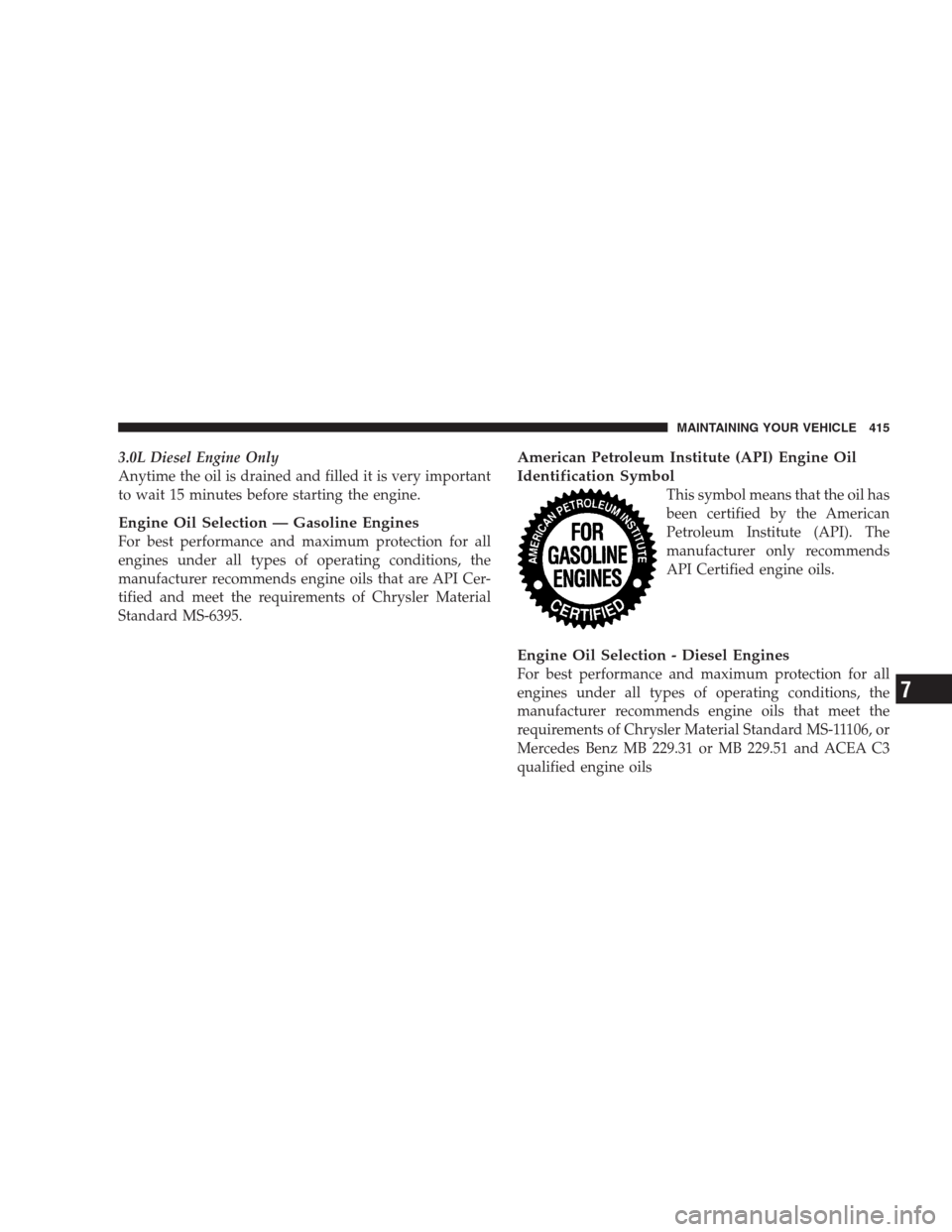
American Petroleum Institute (API) Engine Oil
Identification Symbol
This symbol means that the oil has
been certified by the American
Petroleum Institute (API). The
manufacturer only recommends
API Certified engine oils.
Engine Oil Selection - Diesel Engines
For best performance and maximum protection for all
engines under all types of operating conditions, the
manufacturer recommends engine oils that meet the
requirements of Chrysler Material Standard MS-11106, or
Mercedes Benz MB 229.31 or MB 229.51 and ACEA C3
qualified engine oils
MAINTAINING YOUR VEHICLE 415
7
Page 418 of 521
Engine Oil Viscosity (3.7L/4.7L/5.7L Engines)
SAE 5W-20 engine oil is recommended for all operating
temperatures. This engine oil improves low temperature
starting and vehicle fuel economy.
The engine oil filler cap also shows the recommended
engine oil viscosity for your vehicle. For information on
engine oil filler cap location, refer to “Engine Compart-
ment” in this section.
Lubricants, which do not have both the engine oil certi-
fication mark and the correct SAE viscosity grade num-
ber, should not be used.
Engine Oil Viscosity (3.0L Diesel Engine)
CAUTION!
Your vehicle is equipped with an advanced technol-
ogy Diesel Engine and an emission device designed
to limit Diesel Particulate Emissions from being
released into the atmosphere. The durability of your
engine and life expectancy of this diesel particulate
filter emission device is highly dependent on the use
of the correct engine oil.
SAE 5W-30 Synthetic Low Ash engine oil is recom-
mended for all operating temperatures. This engine oil
improves low temperature starting and vehicle fuel
economy.
416 MAINTAINING YOUR VEHICLE
Page 419 of 521
The engine oil filler cap also shows the recommended
engine oil viscosity for your vehicle. For information on
engine oil filler cap location, refer to “Engine Compart-
ment” in this section.
Synthetic Engine Oils
You may use synthetic engine oils if the recommended oil
quality requirements are met, and the recommended
maintenance intervals for oil and filter changes are
followed.
Materials Added to Engine Oils
The manufacturerstrongly recommendsagainst the ad-
dition of any additives (other than leak detection dyes) to
the engine oil. Engine oil is an engineered product and its
performance may be impaired by supplemental
additives.
Disposing of Used Engine Oil and Oil Filters
Care should be taken in disposing of used engine oil and
oil filters from your vehicle. Used oil and oil filters,indiscriminately discarded, can present a problem to the
environment. Contact your local authorized dealer, ser-
vice station, or governmental agency for advice on how
and where used oil and oil filters can be safely discarded
in your area.
Engine Oil Filter
The engine oil filter should be replaced with a new filter
at every oil change.
Engine Oil Filter Selection
The manufacturer’s engines have a full-flow type dispos-
able oil filter. Use a filter of this type for replacement. The
quality of replacement filters varies considerably. Only
high-quality filters should be used to assure most effi-
cient service. MOPAR�engine oil filters are high-quality
oil filters and are recommended.
Engine Air Cleaner Filter
Refer to the “Maintenance Schedule” in Section 8 for the
proper maintenance interval.
MAINTAINING YOUR VEHICLE 417
7
Page 420 of 521
WARNING!
The air induction system (air cleaner, hoses, etc) can
provide a measure of protection in the case of engine
backfire. Do not remove the air induction system (air
cleaner, hoses, etc.) unless such removal is necessary
for repair or maintenance. Make sure that no one is
near the engine compartment before starting the
vehicle with the air induction system (air cleaner,
hoses, etc.) removed. Failure to do so can result in
serious personal injury.
Engine Air Cleaner Filter Selection
The quality of replacement engine air cleaner filters
varies considerably. Only high quality filters should be
used to assure most efficient service. MOPAR�engine air
cleaner filters are a high quality filter and are
recommended.
Maintenance-Free Battery
Your vehicle is equipped with a maintenance-free battery.
You will never have to add water, nor is periodic main-
tenance required.
WARNING!
•Battery fluid is a corrosive acid solution and can
burn or even blind you. Do not allow battery fluid
to contact your eyes, skin or clothing. Do not lean
over a battery when attaching clamps. If acid
splashes in eyes or on skin, flush the area imme-
diately with large amounts of water.
•Battery gas is flammable and explosive. Keep
flame or sparks away from the battery. Do not use
a booster battery or any other booster source with
an output greater than 12 Volts. Do not allow cable
clamps to touch each other.
(Continued)
418 MAINTAINING YOUR VEHICLE
Page 423 of 521

Windshield Wiper Blades
Clean the rubber edges of the wiper blades and the
windshield periodically with a sponge or soft cloth and a
mild nonabrasive cleaner to remove accumulations of salt
or road film.
Operation of the wipers on dry glass for long periods
may cause deterioration of the wiper blades. Always use
washer fluid when using the wipers to remove salt or dirt
from a dry windshield.
Avoid using the wiper blades to wipe frost or ice from the
windshield. Keep the blade rubber out of contact with
petroleum products such as engine oil, gasoline, etc.
Adding Washer Fluid
On vehicles equipped with a Electronic Vehicle Informa-
tion Center (EVIC), the low washer fluid level will be
indicated. When the sensor detects a low fluid level, the
windshield will light on the vehicle graphic outline and
the “WASHER FLUID LOW” message will be displayed.The fluid reservoir for the windshield washers and the
rear window washer is shared. The fluid reservoir is
located in the engine compartment, be sure to check the
fluid level at regular intervals. Fill the reservoir with
windshield washer solvent only (not radiator antifreeze).
When refilling the washer fluid reservoir, take some
washer fluid and apply it to a cloth or towel and wipe
clean the wiper blades, this will help blade performance.
To prevent freeze-up of your windshield washer system
in cold weather, select a solution or mixture that meets or
exceeds the temperature range of your climate. This
rating information can be found on most washer fluid
containers.
MAINTAINING YOUR VEHICLE 421
7
Page 424 of 521
WARNING!
Commercially available windshield washer solvents
are flammable. They could ignite and burn you. Care
must be exercised when filling or working around
the washer solution.
Exhaust System
The best protection against carbon monoxide entry into
the vehicle body is a properly maintained engine exhaust
system.
If you notice a change in the sound of the exhaust system;
or if the exhaust fumes can be detected inside the vehicle;
or when the underside or rear of the vehicle is damaged;
have an authorized technician inspect the complete ex-
haust system and adjacent body areas for broken, dam-
aged, deteriorated, or mispositioned parts. Open seams
or loose connections could permit exhaust fumes to seepinto the passenger compartment. In addition, inspect the
exhaust system each time the vehicle is raised for lubri-
cation or oil change. Replace as required.
WARNING!
Exhaust gases can injure or kill. They contain carbon
monoxide (CO), which is colorless and odorless.
Breathing it can make you unconscious and can
eventually poison you. To avoid breathing CO, refer
to Exhaust Gas in the Safety Tips section of this
manual.
The catalytic converter requires the use of unleaded fuel
only. Leaded gasoline will destroy the effectiveness of the
converter as an emission control device.
422 MAINTAINING YOUR VEHICLE
Page 425 of 521
Under normal operating conditions, the catalytic con-
verter will not require maintenance. However, it is im-
portant to keep the engine properly tuned to assure
proper catalyst operation and prevent possible catalyst
damage.
CAUTION!
Damage to the catalytic converter can result if your
vehicle is not kept in proper operating condition. In
the event of engine malfunction, particularly involv-
ing engine misfire or other apparent loss of perfor-
mance, have your vehicle serviced promptly. Contin-
ued operation of your vehicle with a severe
malfunction could cause the converter to overheat,
resulting in possible damage to the converter and
vehicle.NOTE:Intentional tampering with emissions control
systems can result in civil penalties being assessed
against you.
WARNING!
A hot exhaust system can start a fire if you park over
materials that can burn. Such materials might be
grass or leaves coming into contact with your exhaust
system. Do not park or operate your vehicle in areas
where your exhaust system can contact anything that
can burn.
In unusual situations involving grossly malfunctioning
engine operation, a scorching odor may suggest severe
and abnormal catalyst overheating. If this occurs, stop
the vehicle, turn off the engine and allow it to cool.
Service, including a tuneup to manufacturer’s specifica-
tions, should be obtained immediately.
MAINTAINING YOUR VEHICLE 423
7
Page 426 of 521
To minimize the possibility of catalytic converter dam-
age:
•Do not shut off the engine or interrupt the ignition,
when the transmission is in gear and the vehicle is in
motion.
•Do not try to start the engine by pushing or towing the
vehicle.
•Do not idle the engine with any spark plug wires
disconnected or removed, such as when diagnostic
testing, or for prolonged periods during very rough
idle or malfunctioning operating conditions.
Cooling System
WARNING!
You or others can be badly burned by hot engine
coolant (antifreeze) or steam from your radiator. If
you see or hear steam coming from under the hood,
do not open the hood until the radiator has had time
to cool. Never try to open a cooling system pressure
cap when the radiator or coolant bottle is hot.
Engine Coolant Checks
Check the engine coolant (antifreeze) protection every
12 months (before the onset of freezing weather, where
applicable). If the engine coolant (antifreeze) is dirty or
rusty in appearance, the system should be drained,
flushed and refilled with fresh engine coolant (anti-
freeze). Check the front of the A/C condenser for any
424 MAINTAINING YOUR VEHICLE