Page 391 of 521
WHAT TO DO IN EMERGENCIES
CONTENTS
�Hazard Warning Flashers................ 390
�If Your Engine Overheats................ 390
�Jacking And Tire Changing............... 391
▫Jack Location....................... 392
▫Spare Tire Stowage................... 392
▫Spare Tire Removal................... 393
▫Preparations For Jacking............... 393▫Jacking Instructions................... 394
�Jump-Starting........................ 398
�Emergency Tow Hooks — If Equipped...... 400
�Towing A Disabled Vehicle............... 401
▫2–Wheel Drive Models Only............ 401
▫4–Wheel Drive Models Only............ 401
6
Page 392 of 521
HAZARD WARNING FLASHERS
The Hazard Warning flasher switch is located on the
switch bank just above the climate controls.
Press the switch to turn on the Hazard Warning
flashers. When the Hazard Warning flasher switch
is activated, all directional turn signals will flash
on and off to warn oncoming traffic of an emergency.
Press the switch a second time to turn off flashers.
This is an emergency warning system and should not be
used when the vehicle is in motion. Use it when your
vehicle is disabled and is creating a safety hazard for
other motorists.
If it is necessary to leave the vehicle to go for service, the
Hazard Warning flasher will continue to operate with the
ignition key removed and the vehicle locked.
NOTE:With extended use, the Hazard Warning flasher
may run down your battery.
IF YOUR ENGINE OVERHEATS
In any of the following situations, you can reduce the
potential for overheating by taking the appropriate ac-
tion.
•On the highways — Slow down.
•In city traffic — While stopped, put the transmission in
NEUTRAL, but do not increase the engine idle speed.
NOTE:There are steps that you can take to slow down
an impending overheat condition. If your air conditioner
is on, turn it off. The air conditioning system adds heat to
the engine cooling system and turning off the A/C
removes this heat. You can also turn the temperature
control to maximum heat, the mode control to floor, and
the fan control to high. This allows the heater core to act
as a supplement to the radiator and aids in removing heat
from the engine cooling system.
390 WHAT TO DO IN EMERGENCIES
Page 393 of 521
CAUTION!
Driving with a hot cooling system could damage
your vehicle. If the temperature gauge reads HOT
(H), pull over and stop the vehicle. Idle the vehicle
with the air conditioner turned off until the pointer
drops back into the normal range. If the pointer
remains on HOT (H), and you hear continuous
chimes, turn the engine off immediately, and call for
service.
JACKING AND TIRE CHANGING
WARNING!
•Getting under a jacked-up vehicle is dangerous.
The vehicle could slip off the jack and fall on you.
You could be crushed. Never get any part of your
body under a vehicle that is on a jack. If you need
to get under a raised vehicle, take it to a service
center where it can be raised on a lift.
•The jack is designed to be used as a tool for
changing tires only. The jack should not be used to
lift the vehicle for service purposes. The vehicle
should be jacked on a firm, level surface only.
Avoid ice or slippery areas.
WHAT TO DO IN EMERGENCIES 391
6
Page 397 of 521
WARNING! (Continued)
•Never start or run the engine with the vehicle on a
jack.
•Do not let anyone sit in the vehicle when it is on a
jack.
•Do not get under the vehicle when it is on a jack.
•Only use the jack in the positions indicated and
for lifting this vehicle during a tire change.
•If working on or near a roadway, be extremely
careful of motor traffic.
•To assure that spare tires, flat or inflated are
securely stowed, spares must be stowed with the
valve stem facing the ground.
•Turn on the Hazard Warning flasher.1. Remove the spare tire, jack, and tools from storage.
2. Loosen (but do not remove) the wheel lug nuts by
turning them to the left, one turn, while the wheel is still
on the ground.
Jack Warning Label
WHAT TO DO IN EMERGENCIES 395
6
Page 402 of 521
5. Connect the other cable, first to the negative terminal
of the booster battery and then to the engine of the
vehicle with the discharged battery. Make sure you have
a good contact on the engine.
6. Start the engine in the vehicle that has the booster
battery, let the engine idle a few minutes, then start the
engine in the vehicle with the discharged battery.
7. When removing the jumper cables, reverse the above
sequence exactly. Be careful of the moving belts and fan.
WARNING!
Any procedure other than above could result in:
•Personal injury caused by electrolyte squirting out
the battery vent.
•Personal injury or property damage due to battery
explosion.
(Continued)
WARNING! (Continued)
•Damage to charging system of booster vehicle or
of immobilized vehicle.
•You should not try to start your vehicle by pushing
or towing.
•Do not connect the cable to the negative post of the
discharge battery. The resulting electrical spark
could cause the battery to explode.
•During cold weather when temperatures are be-
low freezing point, electrolyte in a discharged
battery may freeze. Do not attempt jump-starting
because the battery could rupture or explode. The
battery temperature must be brought up above
freezing point before attempting jump-start.
EMERGENCY TOW HOOKS — IF EQUIPPED
If your vehicle is equipped with tow hooks, there will be
one in the rear and two mounted on the front of the
400 WHAT TO DO IN EMERGENCIES
Page 405 of 521
MAINTAINING YOUR VEHICLE
CONTENTS
�Engine Compartment – 3.7L.............. 406
�Engine Compartment – 4.7L.............. 407
�Engine Compartment – 5.7L.............. 408
�Engine Compartment – 3.0L Diesel......... 409
�Onboard Diagnostic System — OBD II...... 410
▫Loose Fuel Filler Cap Message........... 410
�Emissions Inspection And Maintenance
Programs............................ 411
�Replacement Parts..................... 413�Dealer Service........................ 413
�Maintenance Procedures................. 413
▫Engine Oil......................... 414
▫Engine Air Cleaner Filter............... 417
▫Maintenance-Free Battery.............. 418
▫Air Conditioner Maintenance............ 419
▫Body Lubrication.................... 420
▫Windshield Wiper Blades............... 421
▫Adding Washer Fluid................. 421
7
Page 407 of 521
�Fluids And Capacities.................. 456
�Fluids, Lubricants, And Genuine Parts....... 458▫Engine............................ 458
▫Chassis........................... 460
MAINTAINING YOUR VEHICLE 405
7
Page 408 of 521
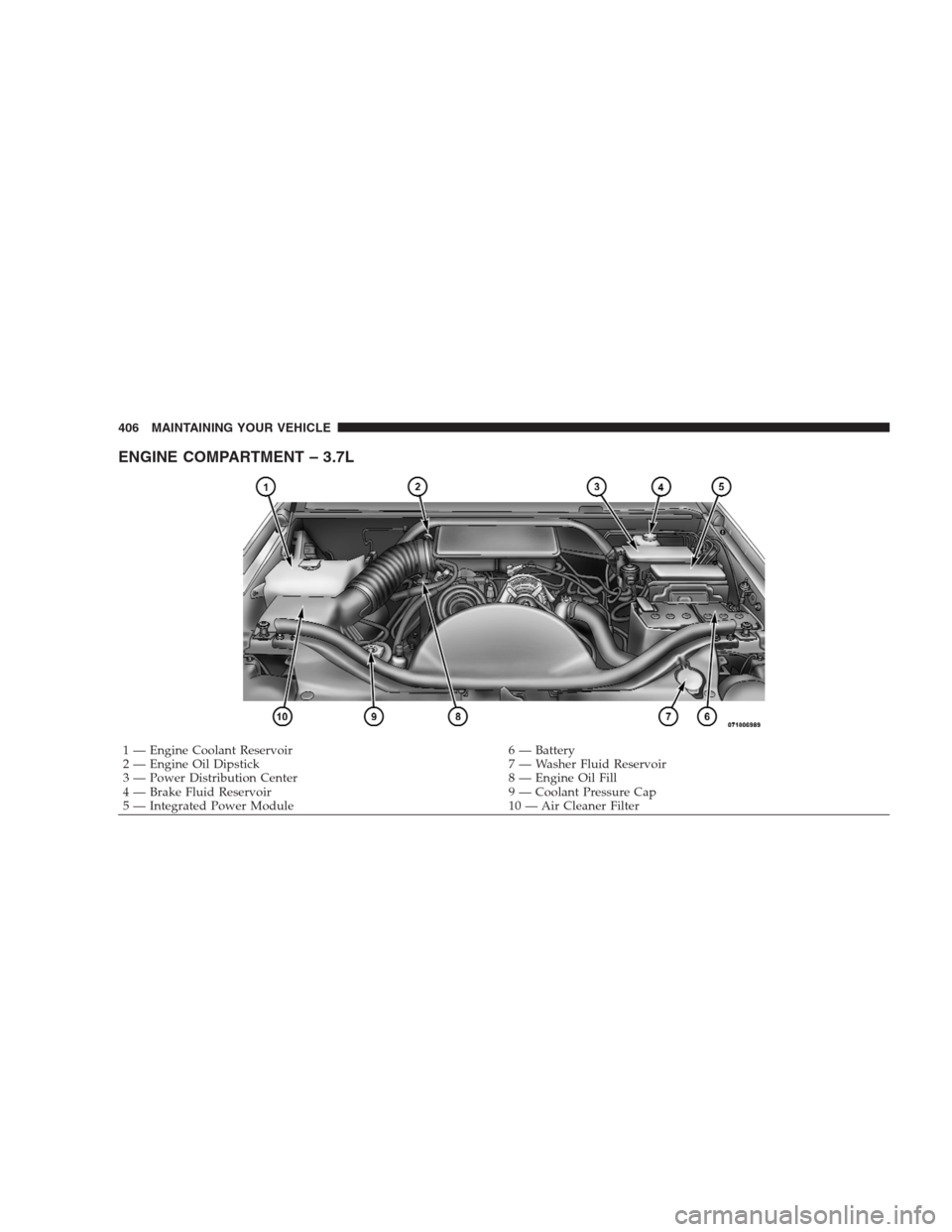
ENGINE COMPARTMENT – 3.7L
1 — Engine Coolant Reservoir 6 — Battery
2 — Engine Oil Dipstick 7 — Washer Fluid Reservoir
3 — Power Distribution Center 8 — Engine Oil Fill
4 — Brake Fluid Reservoir 9 — Coolant Pressure Cap
5 — Integrated Power Module 10 — Air Cleaner Filter 406 MAINTAINING YOUR VEHICLE