2009 JAGUAR XF Start
[x] Cancel search: StartPage 199 of 391

199
Maintenance
ENGINE OIL CHECK - V8 Petrol
engines
Engine oil consumption
A certain amount of oil consumption is normal.
The rate of consumpt ion will depend on the
following:
• The quality and viscosity of the oil.
• Climatic conditions.
• The speed at which th e engine is being
operated.
• Road conditions.
Drivers should expe ct above normal
consumption when th e engine is new.
Checking the oil level
For an accurate oil level reading to be taken, the
following conditions must be met:
•The vehicle needs to be parked on level
ground. •
The oil level should be checked when the
oil is hot. It is therefore recommended that
a reading is taken after a journey.
• The vehicle needs to stand for
approximately 10 minutes after the engine
is switched off, to allow the oil to drain
back into the sump.
Note: The system will not gi ve a reading until
the oil level has stabilised.
Once the above conditions are met, check the
oil level as follows:
1. Switch on the ignition - do not start the
engine.
2. Set the transmission to Park ( P).
3. Press the TRIP butt on on the end of the
left-hand column stalk repeatedly, until the
oil can icon is displa yed at the bottom of
the message centre.
4. The oil level and topping- up advice will be
shown in the message centre. Top-up as
instructed.
CAUTIONS
It is recommended that the oil level is
checked weekly. If any significant or
sudden drop in oil level is noted you should
seek qualified assistance immediately.
Your vehicle’s warranty may be
invalidated if damage is caused by the
use of improper engine oil. Low quality or
obsolete oils do not provide the protection
required by modern, high performance
engines. Failure to use an oil that meets the
required specification could cause excessive
engine wear, a build up of sludge and deposits
and increased pollution. It could also lead to
engine failure.
Do not use oil additi ves of any type as
engine damage could occur. Use only
specified lubricants.
Page 201 of 391

201
Maintenance
1.Unscrew the oil filler cap (arrowed).
2. Add the appropriate quantity of oil (as
indicated by the message centre oil level
display). Wait 5 minutes to let the oil level
stabilise and re-check the level.
Clean up any oil spilled during topping up.
3. Once the correct level is achieved, refit the
filler cap and hand tighten securely.
Note: The approximate quantity of oil required
to raise the level from the minimum level of
safe operation to the ma ximum, is 1.5 litres
(2.6 pints).
ENGINE OIL CHECK - V6 Diesel
engines
Engine oil consumption
A certain amount of oil consumption is normal.
The rate of consumption will depend on the
following:
• The quality and visc osity of the oil.
• Climatic conditions.
• The speed at which the engine is being
operated.
• Road conditions.
Drivers should expe ct above normal
consumption when the engine is new.
JAG1383
CAUTIONS
If the warning ENGINE OIL CRITICALLY
LOW is displayed in the message centre,
stop the engine as soon as it is safe to do so
and seek qualified assistance. Do not start the
engine until the cause ha s been identified and
rectified.
Your vehicle’s warranty may be
invalidated if damage is caused by the
use of improper engine oil. Low quality or
obsolete oils do not pr ovide the protection
required by modern, high performance
engines. Failure to use an oil that meets the
required specification could cause excessive
engine wear, a build up of sludge and deposits
and increased pollution. It could also lead to
engine failure.
Do not use oil additives of any type as
engine damage could occur. Use only
specified lubricants.
Page 202 of 391

Maintenance
202
Oil level warnings
Warnings will be displayed in the message
centre if the oil level is not maintained within
the safe operating le vels (minimum and
maximum). A warning will also be displayed if
there is a fault with the oil level monitoring
system.
• ENGINE OIL LOW (amber): The oil is at the
minimum level for sa fe operation. Top-up
with 1 litre (1.8 pints) of oil.
• ENGINE OIL HIGH (amber): This warning
is displayed when the e ngine is started, if
the oil is above the maximum level for safe
operation. Seek qualified assistance to
have the engine oil drained, before driving
the vehicle.
• ENGINE OIL CRITICALLY LOW (red): The
oil is below the minimum level for safe
operation. Stop the vehicle as soon as
safety permits and top-up with 1.5 litres
(2.6 pints) of oil. Wait for 5 minutes,
recheck the oil level reading and top-up
again if necessary.
• ENGINE OIL LEVEL MONITOR SYSTEM
FAULT (amber): A fault with the oil level
monitoring system is indicated. Seek
qualified assistance as soon as possible.
Checking the oil level
The engine oil level is automatically monitored
and is displayed in the trip computer area of the
message centre.
The current oil level can be viewed with the
ignition on, with the engine stopped and the
transmission in Park (P ).
To view the current oil level, allow 5 minutes
after stopping the engine (to allow the oil level
to stabilise), then press the TRIP button on the
end of the left column stalk repeatedly, until the
oil can icon is displayed at the bottom of the
message centre. A.
Oil at recommended level. No top-up
required.
B. Add 0.5 litres (0.9 pint) of oil.
C. Add 1 litre (1.8 pints) of oil.
D. Oil level above maximum for safe
operation. Do not driv e the vehicle. Seek
qualified assistance.
E. Oil level below minimum for safe
operation. Add 1.5 litre (2.6 pints) of oil,
then recheck level.
F1. Oil level stabilising, oil level not available.
Wait ten minutes and then recheck the oil
level display.
F2. If this display is accompanied by the
warning message ENGINE OIL LEVEL
MONITOR SYSTEM FAULT , a fault with
the oil level monitor is indicated. Seek
qualified assistance.
ADD 0.5L
ADD 1.0L
LEVEL OK
JAG1412
SEE HANDBOOK
NOT AVAILABLE
SEE HANDBOOK
SEE HANDBOOK
C
B
A
F
E
D
Page 208 of 391

Maintenance
208
POWER STEERING FLUID CHECK
Checking the fluid level
Check and top-up the fluid with the vehicle on
level ground, with the e ngine switched off and
the system cold. Ensure that the steering wheel
is not turned after stopping the engine.
The level of fluid can be seen through the
translucent body of the reservoir. The fluid level shoul
d be between the MIN and
the MAX marks.
Topping up the fluid
1.Clean the filler cap before removing to
prevent dirt from entering the reservoir.
2. Remove filler cap.
3. Using Mobil ATF320, top-up the reservoir
until the fluid level is between the MIN and
MAX marks.
4. Replace filler cap.
WARNINGS
Power steering fluid is highly toxic.
Keep containers sealed and out of
reach of children. If accidental
consumption of fluid is suspected, seek
medical attenti on immediately.
If the fluid comes into contact with
the skin or eyes, rinse immediately
with plenty of water.
Power steering fluid is highly
inflammable. Do not allow power
steering fluid to come into contact
with naked flames or other sources of ignition
(e.g. a hot engine) - a fire may result.
CAUTIONS
The engine must not be started if the
fluid level has dropped below the MIN
mark. Severe damage to the steering pump
could result.
Seek qualified assistance immediately if
there is a noticeable drop in the fluid
level. Severe damage to the steering pump
could result.
If fluid loss is slow, the reservoir may be
topped-up to the upper level mark to
enable the vehicle to be driven to a repair
facility for examination. However, it is
recommended that you seek qualified
assistance before driving the vehicle.CAUTIONS
It is imperative that the power steering
system does not beco me contaminated
in any way. Always use new fluid and clean the
area around the filler neck both before
removing the filler ca p and after topping up.
Never return drained fluid to the system.
Power steering fluid will damage
painted surfaces. So ak up any spillage
with an absorbent cloth immediately and wash
the area with a mixture of car shampoo and
water.
Do not fill the reservoir above the MAX
mark.
E95166
Page 212 of 391
Vehicle battery
212
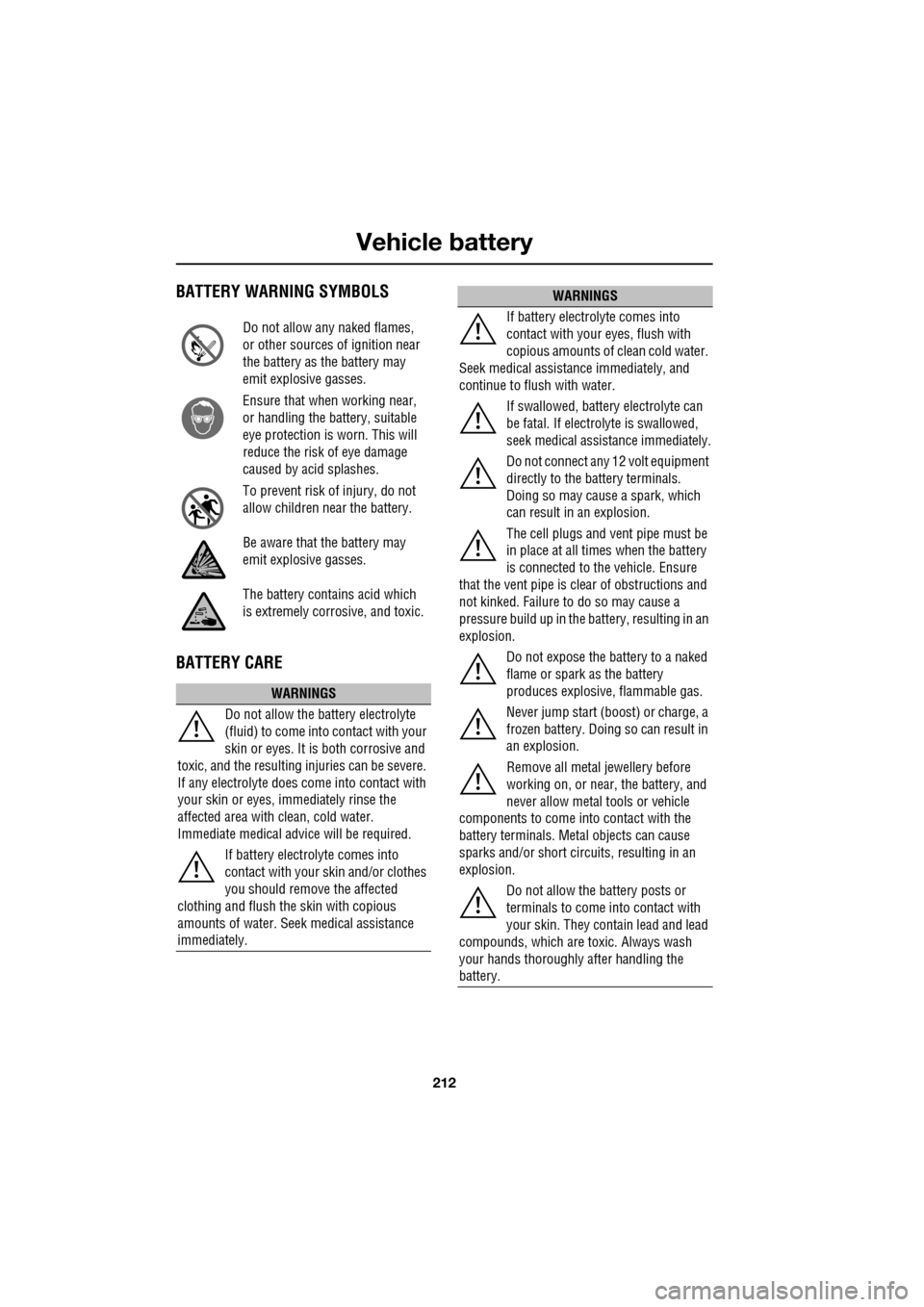
BATTERY WARNING SYMBOLS
BATTERY CARE
Do not allow any naked flames,
or other sources of ignition near
the battery as the battery may
emit explosive gasses.
Ensure that when working near,
or handling the battery, suitable
eye protection is worn. This will
reduce the risk of eye damage
caused by acid splashes.
To prevent risk of injury, do not
allow children near the battery.
Be aware that the battery may
emit explosive gasses.
The battery contains acid which
is extremely corrosive, and toxic.
WARNINGS
Do not allow the battery electrolyte
(fluid) to come into contact with your
skin or eyes. It is both corrosive and
toxic, and the resulting injuries can be severe.
If any electrolyte does come into contact with
your skin or eyes, immediately rinse the
affected area with clean, cold water.
Immediate medical advice will be required.
If battery electrolyte comes into
contact with your skin and/or clothes
you should remove the affected
clothing and flush the skin with copious
amounts of water. Seek medical assistance
immediately.
If battery electrolyte comes into
contact with your eyes, flush with
copious amounts of clean cold water.
Seek medical assistance immediately, and
continue to flush with water.
If swallowed, battery electrolyte can
be fatal. If electrolyte is swallowed,
seek medical assistance immediately.
Do not connect any 12 volt equipment
directly to the battery terminals.
Doing so may cause a spark, which
can result in an explosion.
The cell plugs and vent pipe must be
in place at all times when the battery
is connected to the vehicle. Ensure
that the vent pipe is clear of obstructions and
not kinked. Failure to do so may cause a
pressure build up in the battery, resulting in an
explosion.
Do not expose the battery to a naked
flame or spark as the battery
produces explosive , flammable gas.
Never jump start (boost) or charge, a
frozen battery. Doing so can result in
an explosion.
Remove all metal jewellery before
working on, or near , the battery, and
never allow metal tools or vehicle
components to come into contact with the
battery terminals. Metal objects can cause
sparks and/or short circuits, resulting in an
explosion.
Do not allow the battery posts or
terminals to come into contact with
your skin. They cont ain lead and lead
compounds, which are toxic. Always wash
your hands thoroughly after handling the
battery.
WARNINGS
Page 214 of 391

Vehicle battery
214
USING BOOSTER CABLES
Note: Before connecti ng booster cables,
ensure that the battery connections on the
disabled vehicle are correct and that all
electrical equipment has been switched off.
1. Connect one end of the positive booster
cable to the positive terminal on the donor
vehicle's battery.
2. Connect the other end of the positive
booster cable to the positive terminal on
the disabled vehicle's battery. 3.
Connect one end of th e negative booster
cable to the earth point of the donor vehicle
that is recommended for jump starting by
the manufacturer.
4. Connect the other end of the negative
booster cable to a suitable earth point on
the disabled vehicle. The earth point
should be at least 0.5 metres (20 inches)
away from the battery and as far as
possible from any fu el or brake pipes.
• Check that all cables are clear of any
moving components and that all four
connections are secure.
5. Start the engine of the donor vehicle, and
allow it to idle for a few minutes.
6. Start the engine of the disabled vehicle.
7. Allow both vehicles to idle for two minutes.
8. Switch off the donor vehicle.
Disconnecting the cables
Note: Do not switch on any electrical
equipment until after th e cables have been
disconnected.
The engine should be running on the
previously disabled ve hicle and the engine
switched off on the donor vehicle. Disconnect
the booster cables in the exact reverse order of
that used for connection.
WARNINGS
Always wear appropriate eye
protection when working with
batteries.
During normal use, batteries emit
explosive hydrogen gas - ensure
sparks and naked lights are kept away
from the luggage compartment.
Do not attempt to start the vehicle if
the electrolyte in the battery is
suspected of being frozen.
Make sure both batt eries are of the 12
volt type and that the booster cables
have insulated clamps and are
approved for use with 12 volt batteries.
Do not disconnect the discharged
battery.
Do not connect posit ive (+) terminals
to negative (-) terminals and ensure
booster cables are kept away from
any moving parts in the engine compartment.
Do not connect a booster cable to the
negative (-) terminal of the battery.
Always connect to the recommended
earthing point.
WARNING
To avoid serious in jury use extreme
caution when removing the booster
cables as the engine will be running
on the previously disabl ed vehicle. This means
that you may be workin g close to components
which are moving at high speed, carry high
voltage, or may be hot.
Page 219 of 391
219
Wheels and tyres
The following procedure should be used to
check and adjust the tyres pressures.
1.Remove the valve cap.
2. Firmly attach a tyre pressure gauge/inflator
to the valve.
3. Read the tyre pressure from the gauge,
and add air if required.
4. If air is added to the tyre, remove the gauge
and re-attach it be fore reading the
pressure. Failure to do so may result in an
inaccurate reading.
5. If the tyre pressure is too high, remove the
gauge and allow air out of the tyre by
pressing the centre of the valve. Refit the
gauge to the valve and check the pressure.
6. Repeat the process a dding or removing air
as required until the correct tyre pressure
is reached.
7. Refit the valve cap.
Note: It is an offence in certain countries to
drive a vehicle with incorrect tyre pressures.
Note: It is the driver's responsibility to ensure
that the tyre pressures are correct.
Tyre valves
Keep the valve caps screwed down firmly to
prevent water or dirt entering the valve. Check
the valves for leaks when checking the tyre
pressures.
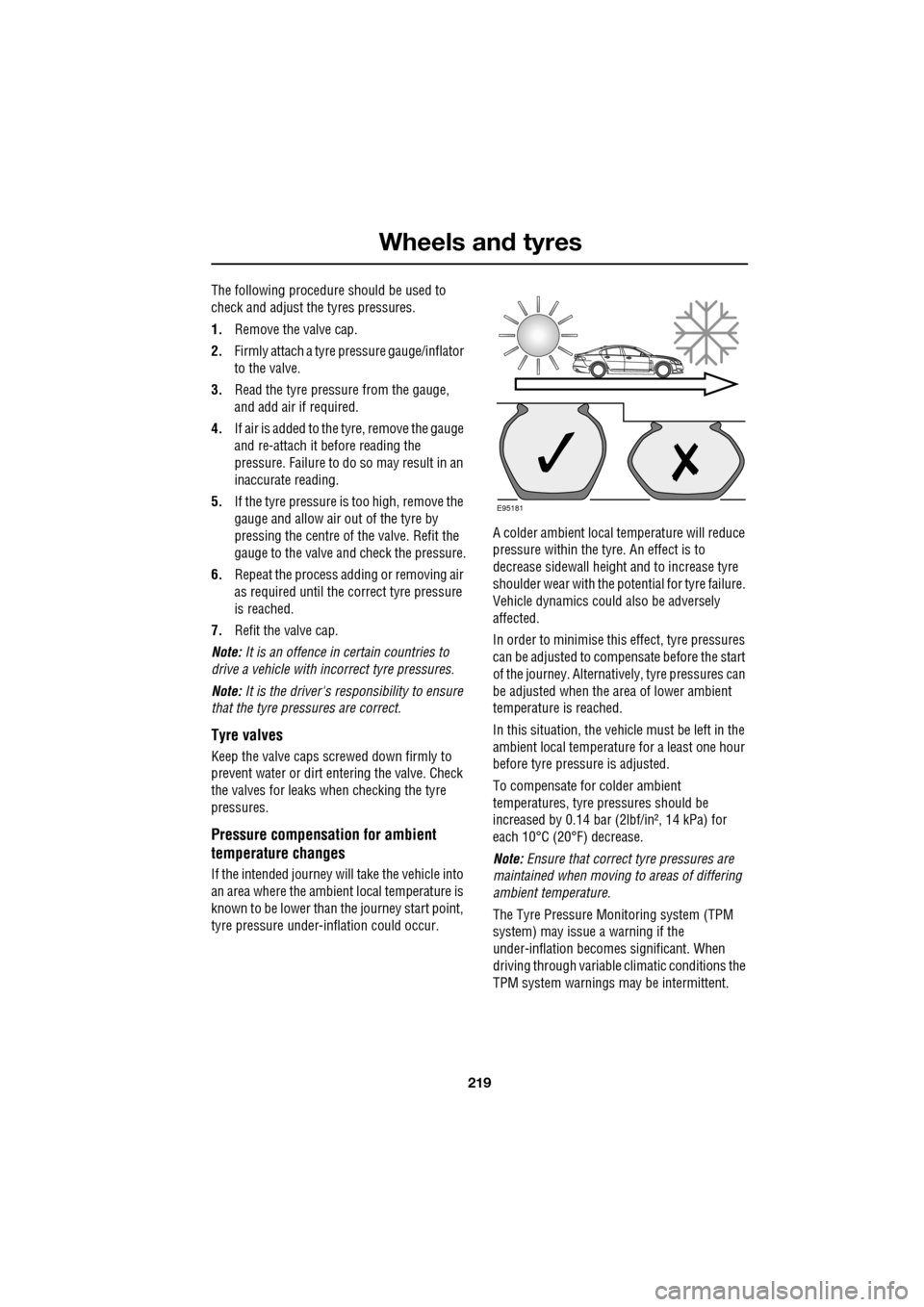
Pressure compensation for ambient
temperature changes
If the intended journey will take the vehicle into
an area where the ambien t local temperature is
known to be lower than the journey start point,
tyre pressure under-i nflation could occur. A colder ambient local temperature will reduce
pressure within the tyre. An effect is to
decrease sidewall height
and to increase tyre
shoulder wear with the potential for tyre failure.
Vehicle dynamics could also be adversely
affected.
In order to minimise this effect, tyre pressures
can be adjusted to compensate before the start
of the journey. Alternatively, tyre pressures can
be adjusted when the area of lower ambient
temperature is reached.
In this situation, the vehicle must be left in the
ambient local temperature for a least one hour
before tyre pressu re is adjusted.
To compensate for colder ambient
temperatures, tyre pressures should be
increased by 0.14 bar (2lbf/in², 14 kPa) for
each 10°C (20°F) decrease.
Note: Ensure that correct tyre pressures are
maintained when moving to areas of differing
ambient temperature.
The Tyre Pressure M onitoring system (TPM
system) may issue a warning if the
under-inflation becomes significant. When
driving through variable climatic conditions the
TPM system warnings may be intermittent.
E95181
Page 221 of 391

221
Wheels and tyres
Wear indicators
When the tread has worn down to
approximately 2 mm, wear indicators start to
appear at the surface of the tread pattern. This
produces a continuous band of rubber across
the tread as a visual indicator.
To maintain performance and grip the tyre
must be replaced as soon as the wear indicator
becomes visible. Sooner, if legislation requires
replacement at a greater tread depth.
Note: Tread depth should be checked
regularly, in some case more frequently than
the service intervals. For advice on checking
tyres contact your Dealer/Authorised repairer
or a tyre dealer.
Age degradation
Tyres degrade over time due to the effects of
ultraviolet light, extreme temperatures, high
loads, and environmen tal conditions. It is
recommended that tyres are replaced at least
every six years, but they may require
replacement more frequently.
Jaguar recommends that even if unused, the
spare tyre be replaced at the same time as the
four road tyres.
Punctured tyres
Tyre checks
Not all punctures result in the tyre deflating
immediately. Therefore, it is important to check
the tyres for damage and foreign objects,
regularly.
When driving, if a sudden vibration, or change
to the vehicle's hand ling is noticed, reduce
speed immediately. Do not brake hard, or make
any sudden manoeuvres or direction changes.
Drive slowly to an area off the main highway
and stop the vehicle.
Note: Driving the vehicle to a safe area may
cause damage to th e punctured tyre, but
occupant safety is far more important.
Inspect the tyres for signs of punctures,
damage or under inflati on. If any damage or
deformity is detected, the tyre should be
replaced. If a spare tyre is not available, then
the vehicle should be reco vered to a tyre repair
centre, or Dealer/Approved repairer.
WARNING
Wear indicators show the minimum
tread depth recommended by the
manufacturers. Tyres which have
worn to this point will have reduced grip and
poor water displacement characteristics.
CAUTION
If tread wear is uneve n across a tyre, or
the tyre wears excessively, the vehicle
should be checked by your Dealer/Authorised
Repairer as soon as possible.
E91698
WARNING
Do not drive the vehicle with a
punctured tyre. Even if the punctured
tyre has not deflated, it is unsafe to
use, as the tyre may deflate suddenly at any
time. See TYRE REPAIR KIT (page 229).