2009 HYUNDAI TUCSON ECU
[x] Cancel search: ECUPage 146 of 273

2
DRIVING YOUR HYUNDAI
11
!
o To maintain the required levels of ve-
hicle performance and safety, the sys-
tem may not execute certain gear-
shifts when the selector lever is oper-
ated.
o Before driving away from a stop on a
slippery road, push the selector lever
forward into the +(UP) position. This
causes the transaxle to shift into 2nd
gear which is better for smooth driv-
ing away on a slippery road. Push the
selector lever to the -(DOWN) side to
shift back to 1st gear.
CAUTION:
o In sports mode, The driver must ex-
ecute shifts in accordance with pre-
vailing road conditions, taking care to
keep the engine speed below the red
zone. For engine protection, upward
shifts are made automatically when
the engine rpm reaches the red zone.
o By rapidly moving the selector lever
backwards (-) twice, it is possible to
skip one gear, i.e., 3rd to 1st, 4th to
2nd. Since sudden engine braking
and/or rapid acceleration can cause a
loss of traction, however, downshifts
must be made carefully in accordance
with the vehicle's speed.NOTE:o In sports mode, only the four forward
gears can be selected. To select re-
verse or park, move the selector le-
ver to the "R" or "P" position as re-
quired.
o In sports mode, downward shifts are
made automatically when the vehicle
slows down. When the vehicle stops,
1st gear is automatically selected.
C090H01L-GATNOTE:o For smooth and safe operation, de-
press the brake pedal when shifting
from "Neutral" position or "Park"
position to a forward or reverse gear.
o The ignition key must be in the "ON"
position and the brake pedal fully de-
pressed in order to move the shift
lever from the "P" (Park) position to
any of the other positions.
o It is always possible to shift from "R",
"N", "D" position to "P" position. The
vehicle must be fully stopped to avoid
transaxle damage.
!
C090I04L-GAT
CAUTION:
o Shift into "R", "D" and "P" position
only when the vehicle has completely
stopped.
o Do not accelerate the engine in re-
verse or any of the forward positions
with the brakes applied.
o Always apply the footbrake when
shifting from "P" or "N", to "R" or
"D"position.
o Do not use the "P" (Park) position in
place of the parking brake. Always
set the parking brake, shift the
transaxle into "P" (Park) position and
turn off the ignition when you leave the
vehicle, even momentarily. Never
leave the vehicle unattended while
the engine is running.
o When accelerating from a stop on a
steep hill, the vehicle may have a
tendency to roll backwards. Shifting
the shift lever into 2nd gear while in
Sport mode will help prevent the ve-
hicle from rolling backwards.
o Check the automatic transaxle fluid
level regularly, and add fluid as nec-
essary.
o See the maintenance schedule for
the proper fluid recommendation.
Page 161 of 273
2
DRIVING YOUR HYUNDAI
26
C190B01S-AATTrailer HitchesSelect the proper hitch and ball combina-
tion, making sure that its location is com-
patible with that of the trailer or vehicle
being towed.
Use a quality non-equalizing hitch which
distributes the tongue load uniformly
throughout the chassis.
The hitch should be bolted securely to the
car and installed by a qualified technician.
DO NOT USE A HITCH DESIGNED FOR
TEMPORARY INSTALLATION AND
NEVER USE ONE THAT ATTACHES
ONLY TO THE BUMPER.C190C01Y-AATTrailer BrakesIf your trailer is equipped with a braking
system, make sure it conforms to federal
and/or local regulations and that it is prop-
erly installed and operating correctly.NOTE:If you tow a trailer or vehicle, your car will
require more frequent maintenance due
to the additional load. See Maintenance
Under Severe Usage Conditions" on
page 5-6.
C190D01S-AATSafety ChainsShould the hitch connection between your
vehicle and the trailer or vehicle you are
towing fail, the trailer or vehicle could
wander dangerously across other lanes of
traffic and ultimately leave the roadway. To
eliminate this potentially dangerous situa-
tion, safety chains, attached between your
car and the trailer or towed vehicle, are
required in most states.
CAUTION:
o Never connect a trailer brake system
directly to the vehicle brake system.
o When towing a trailer on steep grades
(in excess of 6%) pay close attention
to the engine coolant temperature
gauge to ensure the engine does not
overheat. If the needle of the coolant
temperature gauge moves across the
dial towards "H" (HOT), pull over and
stop as soon as it is safe to do so, and
allow the engine to idle until it cools
down. You may proceed once the
engine has cooled sufficiently.
!
TRAILER OR VEHICLE TOWING!
C190A01S-AATIf you are considering towing with your car,
you should first check with your State's
Department of Motor Vehicles to deter-
mine their legal requirements.
Since laws vary from State to State the
requirements for towing trailers, cars, or
other types of vehicles or apparatus may
differ. Ask your Hyundai dealer for further
details before towing.
CAUTION:
Do not do any towing with your car during
its first 1,200 miles (2,000 km) in order to
allow the engine to properly break in.
Failure to heed this caution may result in
serious engine or transaxle damage.
Page 163 of 273
2
DRIVING YOUR HYUNDAI
28
C190F01O-AATTrailer or Vehicle Towing Tips1. Before towing, check hitch and safety
chain connections as well as proper
operation of the trailer running lights,
brake lights, and turn signals.
2. Trailer towing requires more fuel than
normal conditions.
3. To maintain engine braking efficiency,
do not tow a trailer with the transaxle in
fifth gear (manual transaxle) or over-
drive (automatic transaxle).
4. Always secure items in the trailer to
prevent load shift while driving.
5. Check the condition and air pressure of
all tires on the trailer and your car. Low
tire pressure can seriously affect the
handling. Also check the spare tire.
6. The vehicle/trailer combination is more
affected by crosswind and buffeting.
When being passed by a large vehicle,
keep a constant speed and steer straight
ahead. If there is too much wind buffet-
ing, slow down to get out of the other
vehicle's air turbulence.
7. When parking your car and trailer, es-
pecially on a hill, be sure to follow all the
normal precautions. Turn your front
wheel into the curb, set the parking
brake firmly, and put the transaxle in 1st
or Reverse (manual) or Park (automatic).
In addition, place wheel chocks at each
of the trailer's tires.8. If the trailer has electric brakes, start
your vehicle and trailer moving, and
then apply the trailer brake controller by
hand to be sure the brakes are working.
This lets you check your electrical con-
nection at the same time.
9. During your trip, check occasionally to
be sure that the load is secure, and that
the lights and any trailer brakes are still
working.
10. Avoid jerky starts, sudden accelera-
tion or sudden stops.
11. Avoid sharp turns and rapid lane
changes.
12. Avoid holding the brake pedal down
too long or too frequently. This could
cause the brakes to overheat, resulting
in reduced braking efficiency.
13. When going down a hill, shift into a
lower gear and use the engine braking
effect.
When ascending a long grade, down-
shift the transaxle to a lower gear and
reduce speed to reduce chances of
engine overloading and/or overheat-
ing.
14. If you have to stop while going uphill,
do not hold the vehicle in place by
pressing on the accelerator. This can
cause the automatic transaxle to over-
heat. Use the parking brake or
footbrake.
15.If the transaxle shifts frequently while
going up a hill, shift down one gear.
!
WARNING:
o Improperly loading your vehicle and
trailer can seriously affect its steer-
ing and braking performance causing
a crash which could cause serious
injury or death.
o Towing a trailer affected vehicle han-
dling and braking.
o Drive more slowly when towing a trailer
and allow more distance when brak-
ing.
o Be careful when driving in slippery
and windy conditions.
o Be careful when turning and while
driving up and down hills.
o Do not exceed 45 mph or the posted
towing speed limit, whichever is lower.
Page 169 of 273

2
DRIVING YOUR HYUNDAI
34
!
WARNING:
Items you carry inside your vehicle
can strike and injure people in a
sudden stop or turn, or in a crash.
o Put things in the cargo area of
your vehicle. Try to spread the
weight evenly.
o Never stack items, like suitcases,
inside the vehicle above the tops
of the seats.
o Do not leave an unsecured child
restraint in your vehicle.
o When you carry something inside
the vehicle, secure it.
o Do not drive with a seat folded
down unless necessary.
Page 171 of 273
32WHAT TO DO IN AN EMERGENCY
IF THE ENGINE WILL NOT START!
D010A01A-AAT D010B02A-AAT
If Engine Doesn't Turn Over or Turns
Over Slowly
D010C02Y-AATIf Engine Turns Over Normally but
Does Not Start1. Check fuel level.
2. With the key in the "OFF" position, check
all connectors at ignition, coil and spark
plugs. Reconnect any that may be dis-
connected or loose.
3. Check the fuel line in the engine com-
partment.
4. If the engine still does not start, call a
Hyundai dealer or seek other qualified
assistance.D010D01A-AATIf Engine Stalls While Driving1. Reduce your speed gradually, keeping
a straight line. Move cautiously off the
road to a safe place.
2. Turn on your emergency flashers.
3. Try to start the engine again. If your ve-
hicle will not start, contact a Hyundai
dealer or seek other qualified assistance.
WARNING:
If the engine will not start, do not push or
pull the car to start it. This could result in
a collision or cause other damage. In
addition, push or pull starting may cause
the catalytic converter to be overloaded
and create a fire hazard.
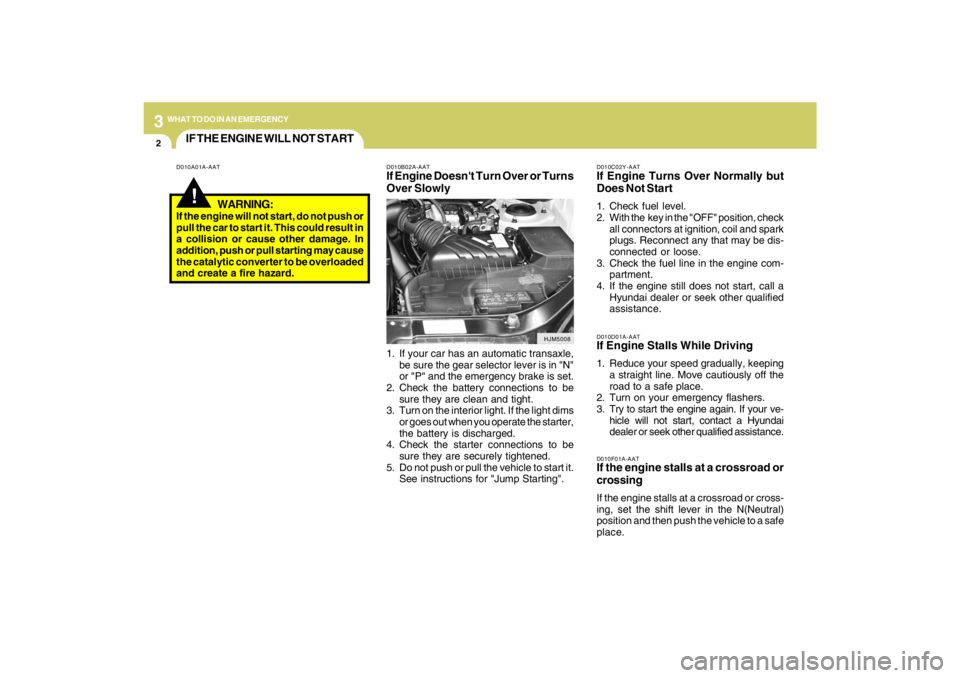
1. If your car has an automatic transaxle,
be sure the gear selector lever is in "N"
or "P" and the emergency brake is set.
2. Check the battery connections to be
sure they are clean and tight.
3. Turn on the interior light. If the light dims
or goes out when you operate the starter,
the battery is discharged.
4. Check the starter connections to be
sure they are securely tightened.
5. Do not push or pull the vehicle to start it.
See instructions for "Jump Starting".
HJM5008
D010F01A-AAT
If the engine stalls at a crossroad or
crossingIf the engine stalls at a crossroad or cross-
ing, set the shift lever in the N(Neutral)
position and then push the vehicle to a safe
place.
Page 185 of 273
316
WHAT TO DO IN AN EMERGENCY
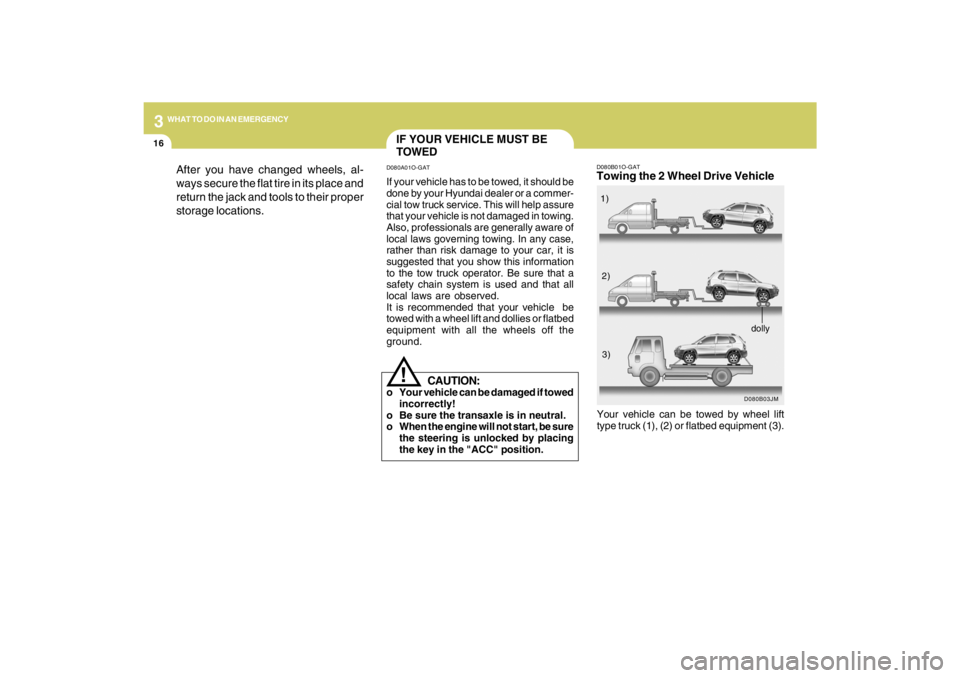
D080B01O-GATTowing the 2 Wheel Drive Vehicle
D080B03JM
Your vehicle can be towed by wheel lift
type truck (1), (2) or flatbed equipment (3).1)
2)
3)
dolly
After you have changed wheels, al-
ways secure the flat tire in its place and
return the jack and tools to their proper
storage locations.
IF YOUR VEHICLE MUST BE
TOWEDD080A01O-GATIf your vehicle has to be towed, it should be
done by your Hyundai dealer or a commer-
cial tow truck service. This will help assure
that your vehicle is not damaged in towing.
Also, professionals are generally aware of
local laws governing towing. In any case,
rather than risk damage to your car, it is
suggested that you show this information
to the tow truck operator. Be sure that a
safety chain system is used and that all
local laws are observed.
It is recommended that your vehicle be
towed with a wheel lift and dollies or flatbed
equipment with all the wheels off the
ground.
!
CAUTION:
o Your vehicle can be damaged if towed
incorrectly!
o Be sure the transaxle is in neutral.
o When the engine will not start, be sure
the steering is unlocked by placing
the key in the "ACC" position.
Page 201 of 273
5
VEHICLE MAINTENANCE REQUIREMENTS
7
F060D01A-AATo Fuel Lines, Fuel Hoses and Con-
nectionsCheck the fuel lines, fuel hoses and con-
nections for leakage and damage. Have a
trained technician replace any damaged
or leaking parts immediately.F060B01A-AATo Drive BeltsInspect all drive belts for evidence of cuts,
cracks, excessive wear or oil saturation
and replace if necessary. Drive belts should
be checked periodically for proper tension
and adjusted as necessary.
F060M01A-AATo Engine Oil and FilterThe engine oil and filter should be changed
at the intervals specified in the mainte-
nance schedule. If the car is being driven
in severe conditions, more frequent oil and
filter changes are required.F060C01A-AATo Fuel FilterA clogged filter can limit the speed at which
the vehicle may be driven, damage the
emission system and cause hard starting.
If an excessive amount of foreign matter
accumulates in the fuel tank, the filter may
require replacement more frequently.
After installing a new filter, run the engine
for several minutes, and check for leaks at
the connections. Fuel filters should be
installed by trained technicians.
F060F01O-AATo Vacuum HosesInspect the surface of hoses for evidence
of heat and/or mechanical damage. Hard
and brittle rubber, cracking, tears, cuts,
abrasions, and excessive swelling indi-
cate deterioration. Particular attention
should be paid to examine those hose
surfaces nearest to high heat sources,
such as the exhaust manifold.
Inspect the hose routing to assure that the
hoses do not come in contact with any heat
source, sharp edges or moving compo-
nent which might cause heat damage or
mechanical wear. Inspect all hose con-
nections, such as clamps and couplings,
to make sure they are secure, and that no
leaks are present. Hoses should be re-
placed immediately if there is any evi-
dence of deterioration or damage.
EXPLANATION OF SCHEDULED MAINTENANCE
ITEMS
Page 202 of 273

5
VEHICLE MAINTENANCE REQUIREMENTS8
F070D01A-AATo Manual Transaxle OilInspect the manual transaxle oil according
to the maintenance schedule.NOTE:If the oil level is low, check for possible
leaks before adding oil. Do not overfill.
F070C01A-AATo CoolantThe coolant should be changed at the
intervals specified in the maintenance
schedule.F060E01A-AATo Timing BeltInspect all parts related to the timing belt for
damage and deformation. Replace any
damaged parts immediately.F060J01A-AATo Spark PlugsMake sure to install new spark plugs of the
correct heat range.F060H01A-AATo Air Cleaner FilterA Genuine Hyundai air cleaner filter is
recommended when the filter is replaced.
F060G01A-AATo Vapor Hose and Fuel Filler CapThe vapor hose and fuel filler cap should
be inspected at those intervals specified in
the maintenance schedule. Make sure that
a new vapor hose or fuel filler cap is cor-
rectly replaced.F065F01O-AATo Crankcase Ventilation HoseInspect the surface of hose for evidence of
heat and/or mechanical damage. Hard
and brittle rubber, cracking, tears, cuts,
abrasions, and excessive swelling indi-
cate deterioration. Particular attention
should be paid to examine that hose sur-
face nearest to high heat sources, such as
the exhaust manifold.
Inspect the hose routing to assure that the
hose does not come in contact with any
heat source, sharp edges or moving com-
ponent which might cause heat damage or
mechanical wear. Inspect all hose con-
nections, such as clamps and couplings,
to make sure they are secure, and that no
leaks are present. Hose should be re-
placed immediately if there is any evi-
dence of deterioration or damage.
F070E06A-AATo Automatic Transaxle FluidThe fluid level should be in the “HOT”
range of the dipstick, after the engine and
transaxle are at normal operating tem-
perature. Check the automatic transaxle
fluid level with the engine running and the
transaxle in neutral, with the parking brake
properly applied. Use HYUNDAI GENU-
INE ATF SP III, DIAMOND ATF SP III, SK
ATF SP III or other brands meeting the SP
III specification approved by Hyundai Motor
Co. when adding or changing fluid. Using
the wrong ATF may result in damage to the
ATM.