2009 HYUNDAI TUCSON ECU
[x] Cancel search: ECUPage 40 of 273
1
FEATURES OF YOUR HYUNDAI
29
!
WARNING:
!Only place a LATCH or LATCH-com-
patible child seat in the left or right out-
board rear seating positions (as
shown) to the appropriate LATCH
anchors provided.
o Never mount more than one child re-
straint to a single tether or to a single
lower anchorage point. The increased
load caused by multiple seats may
cause the tethers or anchorage points
to break, causing serious injury or
death.
o When using the vehicle’s “LATCH”
system to install a child restraint sys-
tem in the rear seat, all unused ve-
hicle rear seat belt metal latch plates
or tabs must be latched securely in
their seat belt buckles and the seat
belt webbing must be retracted be-
hind the child restraint to prevent the
child from reaching and taking hold of
unretracted seat belts. Unlatched
metal latch plates or tabs may allow
the child to reach the unretracted seat
belts which may result in strangula-
tion and a serious injury or death to
the child in the child restraint.
!
WARNING:
o A child can be seriously injured or
killed in a collision if the child restraint
is not properly anchored. Always
follow the child seat manufacturer’s
instructions for installation and use.
o Never install a child restraint using
the LATCH anchors at the center po-
sition of the rear seat. In a crash, the
LATCH anchors may break if a car
seat is improperly placed in the cen-
ter position resulting in serious or
fatal injuries.
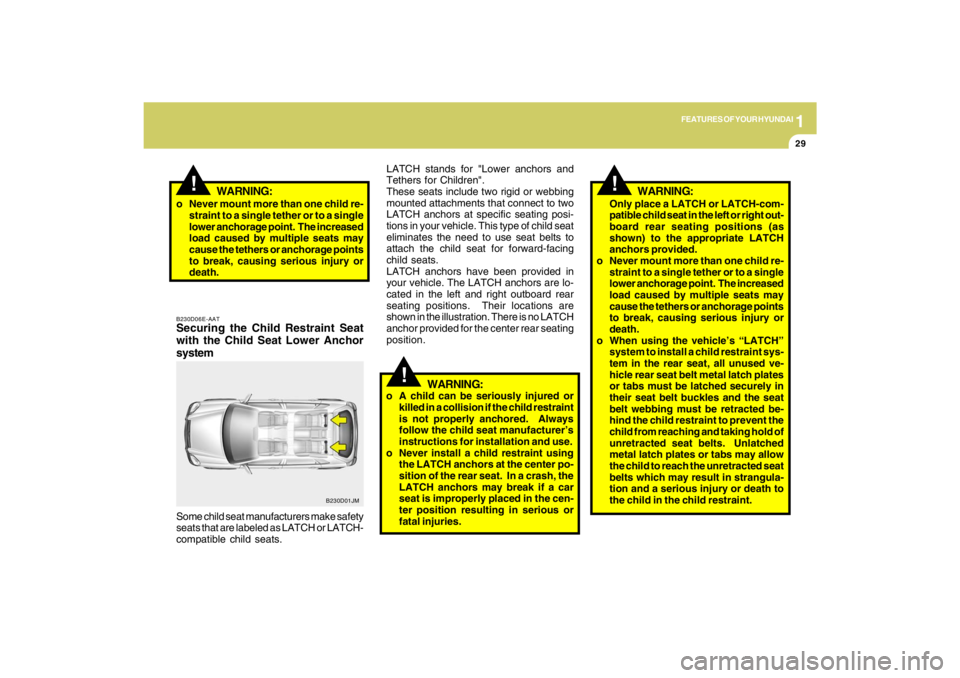
B230D06E-AATSecuring the Child Restraint Seat
with the Child Seat Lower Anchor
systemSome child seat manufacturers make safety
seats that are labeled as LATCH or LATCH-
compatible child seats.
B230D01JM
WARNING:
o Never mount more than one child re-
straint to a single tether or to a single
lower anchorage point. The increased
load caused by multiple seats may
cause the tethers or anchorage points
to break, causing serious injury or
death.LATCH stands for "Lower anchors and
Tethers for Children".
These seats include two rigid or webbing
mounted attachments that connect to two
LATCH anchors at specific seating posi-
tions in your vehicle. This type of child seat
eliminates the need to use seat belts to
attach the child seat for forward-facing
child seats.
LATCH anchors have been provided in
your vehicle. The LATCH anchors are lo-
cated in the left and right outboard rear
seating positions. Their locations are
shown in the illustration. There is no LATCH
anchor provided for the center rear seating
position.
Page 55 of 273

1FEATURES OF YOUR HYUNDAI44
B990B02JM-AATSide Impact AirbagYour Hyundai is equipped with a side
impact airbag in each front seat. The pur-
pose of the airbag is to provide the vehicle's
driver and/or the front passenger with ad-
ditional protection than that offered by the
seat belt alone. The side impact airbags
are designed to deploy only during certain
side-impact collisions, depending on the
crash severity, angle, speed and point of
impact. The side impact airbags are not
designed to deploy in all side impact situ-
ations.
B990B02JM
!
WARNING:
o Do not sit on sharp objects such as
tools when occupying the front pas-
senger seat. This can adversely af-
fect the occupant classification sys-
tem.
o Do not use accessory seat covers on
the front seats.
o Accident statistics show that children
are safer if they are restrained in the
rear, as opposed to the front seat. It is
recommended that child restraints
be secured in a rear seat, including an
infant riding in a rear-facing infant
seat, a child riding in a forward-facing
child seat and an older child riding in
a booster seat.
o Airbags can only be used once – have
an authorized Hyundai dealer replace
the airbag immediately after deploy-
ment.
!
WARNING:
o A smaller-stature adult who is not
seated correctly (for example: seat
excessively reclined, leaning on the
center console, or hips shifted for-
ward in the seat) can cause a condi-
tion where the advanced frontal airbag
system senses less weight than if the
occupant were seated properly (sit-
ting upright with the seatback in an
upright position, centered on the seat
cushion with their seat belt on, legs
comfortably extended and their feet
on the floor). This condition can result
in an adult potentially being
misclassified and illumination of the
PASSENGER AIR BAG "OFF" indica-
tor.
Page 89 of 273

1FEATURES OF YOUR HYUNDAI78
!TAIL GATEB540A01JM-AATo Pull and raise the "DOOR" release lever
to open the tail gate.
o To close, lower the door, then press
down on it until it locks. To be sure the
door is securely fastened, try to pull it up
again.
OJM019023
WARNING:
The tail gate should always be kept com-
pletely closed while the vehicle is in
motion. If it is left open or ajar, poisonous
exhaust gases may enter the car result-
ing in serious illness or death to the
occupants. See additional warnings con-
cerning exhaust gases on page 2-2.
PARKING BRAKEB530A02A-AATApplying the parking brakeTo engage the parking brake, first apply
the foot brake and then without pressing
the release button in, pull the parking brake
lever up as far as possible. In addition it is
recommended that when parking the ve-
hicle on a gradient, the shift lever should
be positioned in the appropriate low gear
on manual transaxle vehicles or in the P
(Park) position on automatic transaxle ve-
hicles.
HJM3026
Releasing the parking brakeTo release the parking brake, first apply
the foot brake and pull the parking brake
lever slightly. Secondly, depress the re-
lease button and lower the parking brake
lever while holding the button.
CAUTION:
Driving with the parking brake applied
will cause excessive brake pad (or lin-
ing) and brake rotor wear.
!
Page 91 of 273
1FEATURES OF YOUR HYUNDAI80
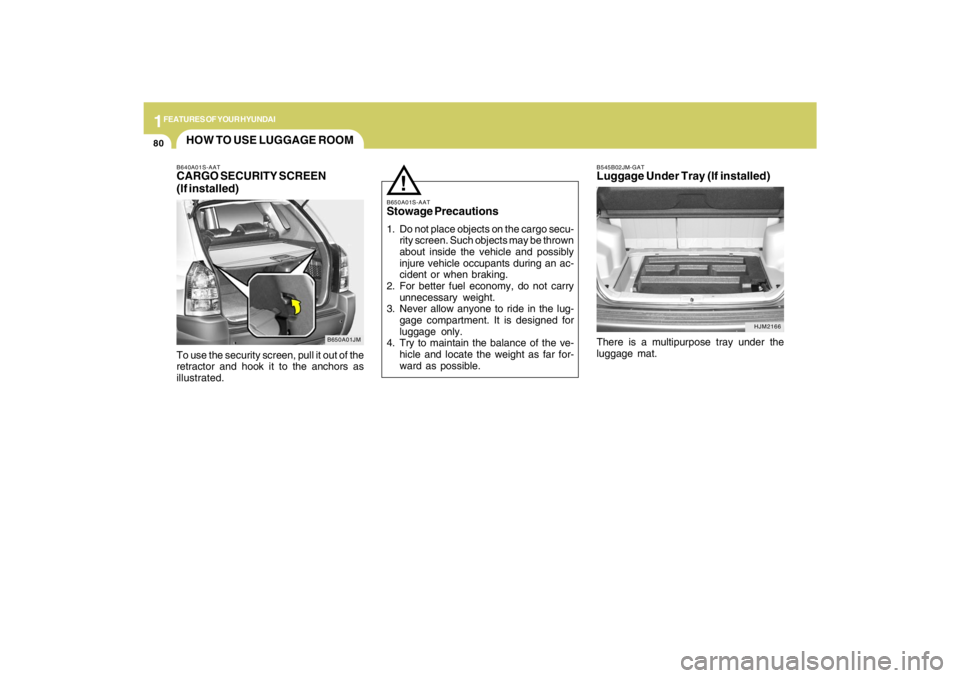
HJM2166 B545B02JM-GAT
Luggage Under Tray (If installed)There is a multipurpose tray under the
luggage mat.
HOW TO USE LUGGAGE ROOM
B650A01JM B640A01S-AAT
CARGO SECURITY SCREEN
(If installed)To use the security screen, pull it out of the
retractor and hook it to the anchors as
illustrated.
B650A01S-AATStowage Precautions1. Do not place objects on the cargo secu-
rity screen. Such objects may be thrown
about inside the vehicle and possibly
injure vehicle occupants during an ac-
cident or when braking.
2. For better fuel economy, do not carry
unnecessary weight.
3. Never allow anyone to ride in the lug-
gage compartment. It is designed for
luggage only.
4. Try to maintain the balance of the ve-
hicle and locate the weight as far for-
ward as possible.
!
Page 94 of 273
1
FEATURES OF YOUR HYUNDAI
83
!
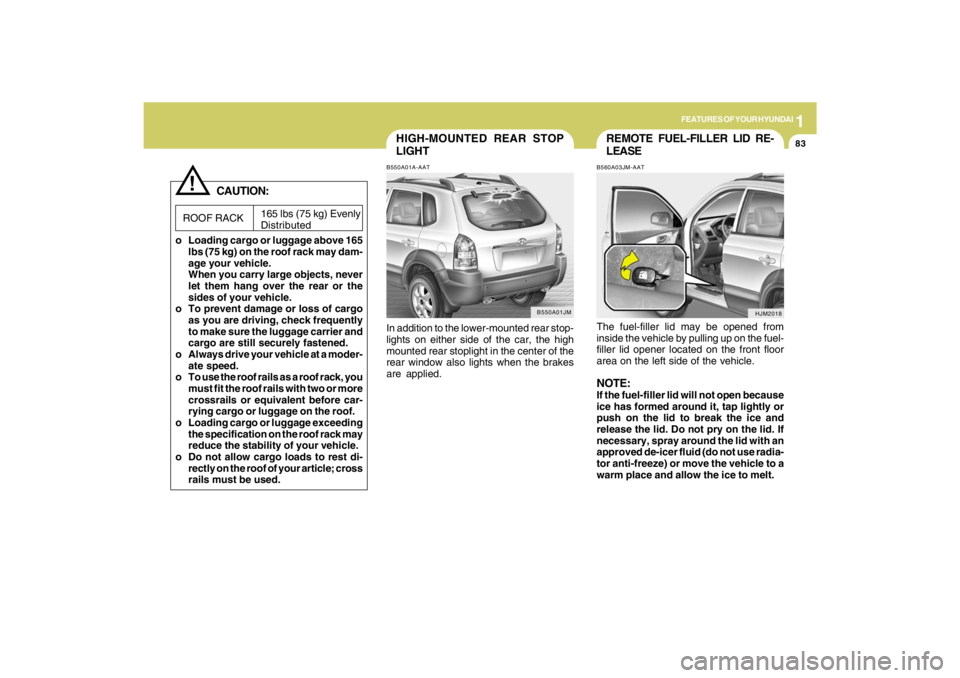
HIGH-MOUNTED REAR STOP
LIGHTB550A01A-AATIn addition to the lower-mounted rear stop-
lights on either side of the car, the high
mounted rear stoplight in the center of the
rear window also lights when the brakes
are applied.
B550A01JM
165 lbs (75 kg) Evenly
Distributed
ROOF RACK
CAUTION:
o Loading cargo or luggage above 165
lbs (75 kg) on the roof rack may dam-
age your vehicle.
When you carry large objects, never
let them hang over the rear or the
sides of your vehicle.
o To prevent damage or loss of cargo
as you are driving, check frequently
to make sure the luggage carrier and
cargo are still securely fastened.
o Always drive your vehicle at a moder-
ate speed.
o To use the roof rails as a roof rack, you
must fit the roof rails with two or more
crossrails or equivalent before car-
rying cargo or luggage on the roof.
o Loading cargo or luggage exceeding
the specification on the roof rack may
reduce the stability of your vehicle.
o Do not allow cargo loads to rest di-
rectly on the roof of your article; cross
rails must be used.
HJM2018
REMOTE FUEL-FILLER LID RE-
LEASEB560A03JM-AATThe fuel-filler lid may be opened from
inside the vehicle by pulling up on the fuel-
filler lid opener located on the front floor
area on the left side of the vehicle.NOTE:If the fuel-filler lid will not open because
ice has formed around it, tap lightly or
push on the lid to break the ice and
release the lid. Do not pry on the lid. If
necessary, spray around the lid with an
approved de-icer fluid (do not use radia-
tor anti-freeze) or move the vehicle to a
warm place and allow the ice to melt.
Page 95 of 273
1FEATURES OF YOUR HYUNDAI84
B560A01JM
!
o Tighten the cap until it clicks, other-
wise the "
" light will illuminate.
o If you open the fuel filler cap during
high ambient temperatures, a slight
"pressure sound" may be heard. This
is normal and not a cause for concern.
Whenever you open the fuel filler cap,
turn it slowly.
o Do not "top-off" after the nozzle auto-
matically shuts off when refueling.
o Automotive fuels are flammable/ex-
plosive materials. When refueling,
please note the following guidelines
carefully.
- Before touching the fuel nozzle or
fuel filler cap, have one's hands in
contact with metal parts away from
the filler neck to discharge static
electricity.
- Do not get back in the vehicle while
refueling. Do not operate anything
that can produce static electricity.
Static electricity discharge can ig-
nite fuel vapors resulting in explo-
sion.
!
WARNING:
o Gasoline vapors are dangerous. Be-
fore refueling, always stop the engine
and never smoke or allow sparks and
open flames near the filler area.
o Never operate your vehicle without a
filler cap properly installed, flammable
vapors and gasoline could leak out in
dangerous situations such as a colli-
sion or rollover. If the filler cap must
be replaced, only use genuine Hyundai
replacement parts.
o After refueling, make sure the fuel
cap is installed securely to prevent
fuel spillage in the event of an acci-
dent.
- When using a portable fuel con-
tainer be sure to place the con-
tainer on the ground while refueling.
Static electricity discharge from the
container can ignite fuel vapors
causing a fire. While starting refuel-
ing contact should be maintained
until the filling is complete.
- Do not use cellular phones around
a gas station. The electric current
or electronic interference from cel-
lular phones can ignite fuel vapors
causing a fire.
- When refueling always shut the en-
gine off. Sparks by electrical equip-
ment of the engine can ignite fuel
vapors causing a fire. After refuel-
ing, check to make sure the fuel
filler cap is securely closed, and
then start the engine.
- Do not smoke or try to light ciga-
rettes around a gas station. Auto-
motive fuels are flammable.
WARNING:
Page 98 of 273
1
FEATURES OF YOUR HYUNDAI
87
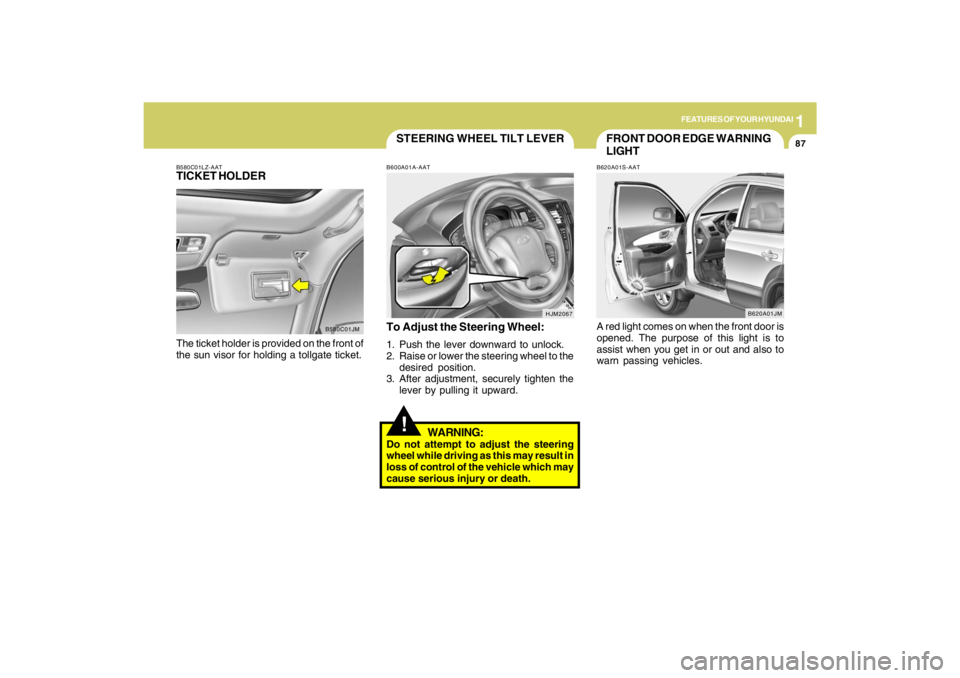
HJM2067
STEERING WHEEL TILT LEVER!
To Adjust the Steering Wheel:1. Push the lever downward to unlock.
2. Raise or lower the steering wheel to the
desired position.
3. After adjustment, securely tighten the
lever by pulling it upward.
WARNING:
Do not attempt to adjust the steering
wheel while driving as this may result in
loss of control of the vehicle which may
cause serious injury or death.B600A01A-AAT
B580C01LZ-AATTICKET HOLDERThe ticket holder is provided on the front of
the sun visor for holding a tollgate ticket.
B580C01JM
FRONT DOOR EDGE WARNING
LIGHTB620A01S-AATA red light comes on when the front door is
opened. The purpose of this light is to
assist when you get in or out and also to
warn passing vehicles.
B620A01JM
Page 139 of 273
2
DRIVING YOUR HYUNDAI
4
TO START THE ENGINEC030A01E-AATCOMBINATION IGNITION SWITCHo If your Hyundai is equipped with a
manual transaxle, place the shift lever
in neutral and depress the clutch pedal
fully.
o If your Hyundai has an automatic
transaxle, place the shift lever in "P"
(park).
o To start the engine, insert the ignition
key and turn it to the "START" position.
Release it as soon as the engine starts.
Do not hold the key in the "START"
position for more that 15 seconds.NOTE:o For safety, the engine will not start if
the clutch pedal is not depressed fully
(Manual Transaxle) or the shift lever
is not in "P" or "N" Position (Auto-
matic Transaxle).
o The ignition key cannot be turned from
"ACC" position to "LOCK" position
unless the shift lever is in the "P"
(Park) position or the negative bat-
tery terminal is disconnected from
the battery. To remove the key, al-
ways confirm that the shift lever is
securely positioned in "P" (Park) (For
Automatic Transaxle).
o For additional information about start-
ing, see page 2-6.
BEFORE STARTING THE EN-
GINEC020A04A-AATBefore you start the engine, you should
always:
1. Look around the vehicle to be sure
there are no flat tires, puddles of oil,
water or other indications of possible
trouble.
2. After entering the car, check to be sure
the parking brake is engaged.
3. Check that all windows, and lights are
clean.
4. Check that the interior and exterior mir-
rors are clean and in position.
5. Check your seat, seatback and head-
rest to be sure they are in their proper
positions.
6. Lock all the doors.
7. Fasten your seat belt and be sure that all
other occupants have fastened theirs.
8. Turn off all lights and accessories that
are not needed.
9. When you turn the ignition switch to
"ON", check that all appropriate warn-
ing lights are operating and that you
have sufficient fuel.
10. Check the operation of warning lights
and all bulbs when key is in the "ON"
position.
!
WARNING:
o All passengers must be properly
belted whenever the vehicle is mov-
ing. Refer to pages: 1-19 through 1-
25 for more information on their proper
use.
o Always check the surrounding areas
near your vehicle for people, espe-
cially children, before putting a car
into 'drive.'
!
WARNING:
Always wear appropriate shoes when
operating your vehicle.
Unsuitable shoes (high heels, ski boots,
etc.) may interfere with your ability to
use the brake and accelerator pedal,
and the clutch (if installed).
!
WARNING:
When you intend to park or stop the
vehicle with the engine on, be careful not
to depress the accelerator pedal for a
long period of time. It may overheat the
engine or exhaust system and cause
fire.