Page 169 of 469

the key is in the ON position before engine start. If the
MIL does not come on when turning the key from LOCK
to ON, have the condition checked promptly.
Certain conditions such as a loose or missing gas cap,
poor fuel quality, etc., may illuminate the MIL after
engine start. The vehicle should be serviced if the MIL
stays on through several of your typical driving cycles. In
most situations, the vehicle will drive normally and will
not require towing.
The MIL flashes to alert you to serious conditions that
could lead to immediate loss of power or severe catalytic
converter damage. The vehicle should be serviced as
soon as possible if this occurs.26. Door Ajar Indicator
This light will turn on to indicate that one or more door
may be ajar.
27. Decklid Ajar Indicator
This light will turn on to indicate that the decklid may be
ajar.
28. Windshield Washer Fluid Low Indicator
This light will turn on to indicate the windshield washer
fluid is low.
4
UNDERSTANDING YOUR INSTRUMENT PANEL 167
Page 172 of 469
Electronic Vehicle Information Center (EVIC)
Displays
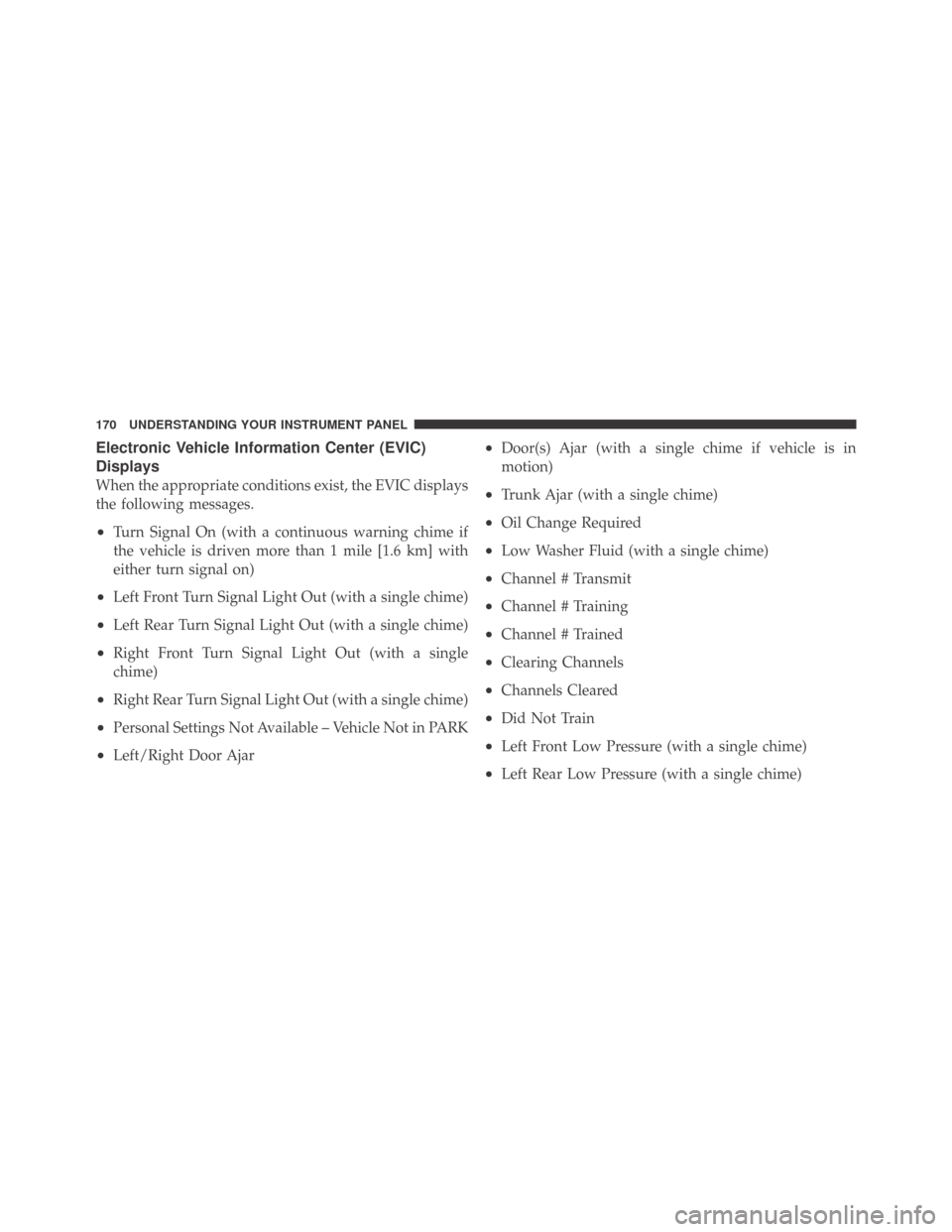
When the appropriate conditions exist, the EVIC displays
the following messages.
•Turn Signal On (with a continuous warning chime if
the vehicle is driven more than 1 mile [1.6 km] with
either turn signal on)
•Left Front Turn Signal Light Out (with a single chime)
•Left Rear Turn Signal Light Out (with a single chime)
•Right Front Turn Signal Light Out (with a single
chime)
•Right Rear Turn Signal Light Out (with a single chime)
•Personal Settings Not Available – Vehicle Not in PARK
•Left/Right Door Ajar
•Door(s) Ajar (with a single chime if vehicle is in
motion)
•Trunk Ajar (with a single chime)
•Oil Change Required
•Low Washer Fluid (with a single chime)
•Channel # Transmit
•Channel # Training
•Channel # Trained
•Clearing Channels
•Channels Cleared
•Did Not Train
•Left Front Low Pressure (with a single chime)
•Left Rear Low Pressure (with a single chime)
170 UNDERSTANDING YOUR INSTRUMENT PANEL
Page 365 of 469
MAINTAINING YOUR VEHICLE
CONTENTS
�Engine Compartment — 3.5L............. 366
�Engine Compartment — 5.7L............. 367
�Onboard Diagnostic System — OBD II...... 368
▫Loose Fuel Filler Cap................. 368
�Emissions Inspection And Maintenance
Programs............................ 369
�Replacement Parts..................... 370
�Dealer Service........................ 371�Maintenance Procedures................. 371
▫Engine Oil......................... 372
▫Engine Oil Filter..................... 375
▫Engine Air Cleaner Filter............... 376
▫Maintenance-Free Battery.............. 376
▫Air Conditioner Maintenance............ 378
▫Body Lubrication.................... 379
▫Windshield Wiper Blades............... 380
▫Adding Washer Fluid................. 380
7
363
Page 368 of 469
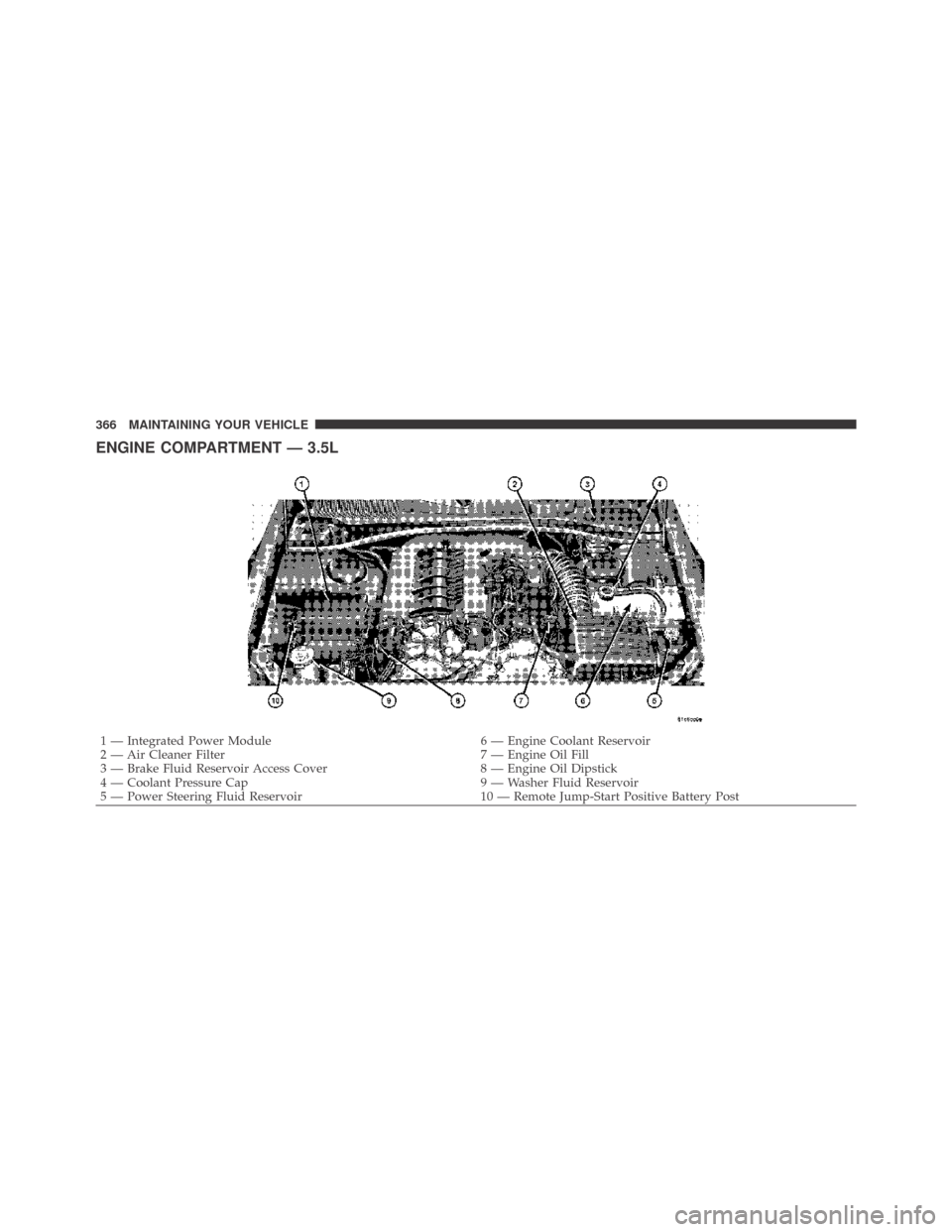
ENGINE COMPARTMENT — 3.5L
1 — Integrated Power Module 6 — Engine Coolant Reservoir
2 — Air Cleaner Filter 7 — Engine Oil Fill
3 — Brake Fluid Reservoir Access Cover 8 — Engine Oil Dipstick
4 — Coolant Pressure Cap 9 — Washer Fluid Reservoir
5 — Power Steering Fluid Reservoir 10 — Remote Jump-Start Positive Battery Post 366 MAINTAINING YOUR VEHICLE
Page 369 of 469
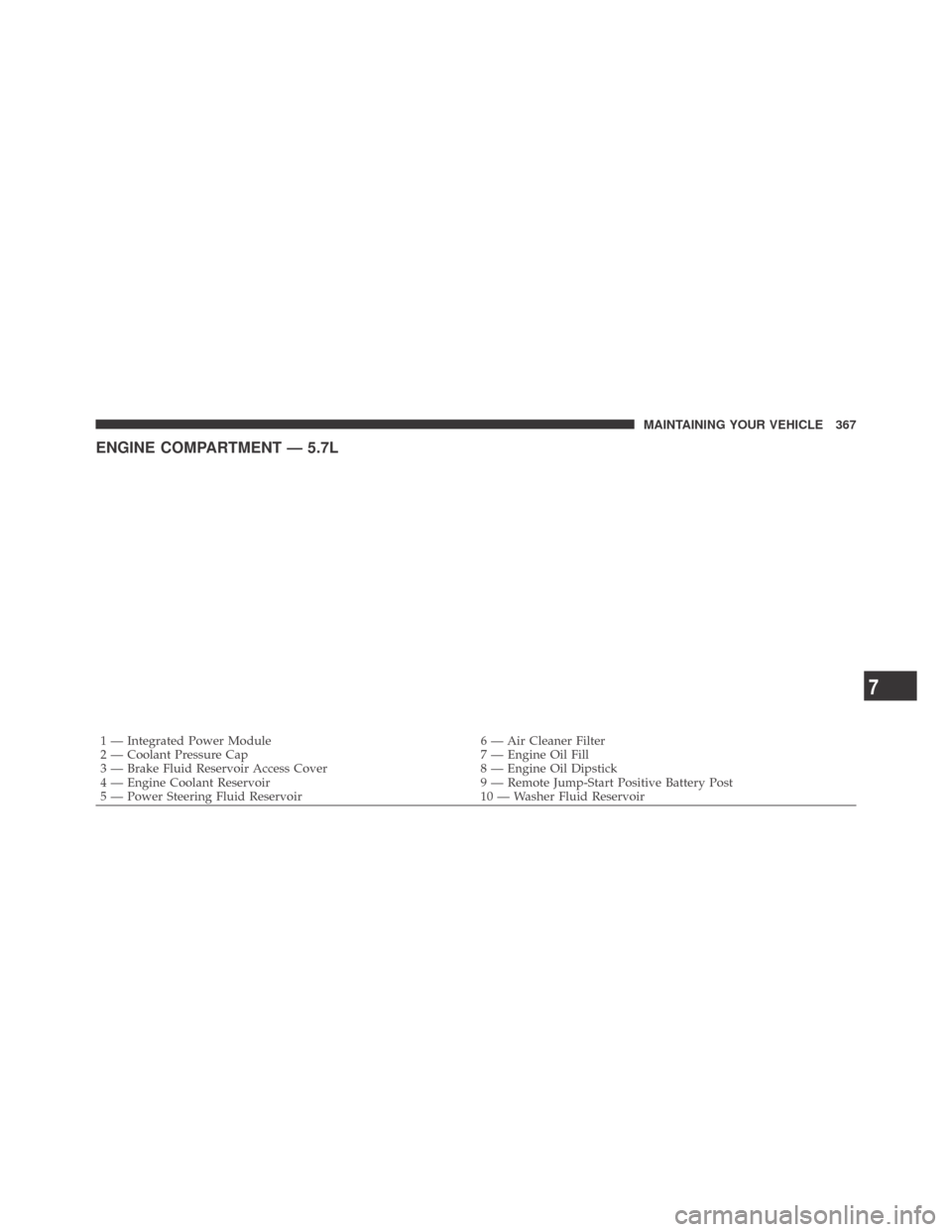
ENGINE COMPARTMENT — 5.7L
1 — Integrated Power Module 6 — Air Cleaner Filter
2 — Coolant Pressure Cap 7 — Engine Oil Fill
3 — Brake Fluid Reservoir Access Cover 8 — Engine Oil Dipstick
4 — Engine Coolant Reservoir 9 — Remote Jump-Start Positive Battery Post
5 — Power Steering Fluid Reservoir 10 — Washer Fluid Reservoir
7
MAINTAINING YOUR VEHICLE 367
Page 382 of 469

attention should also be given to hood latching compo-
nents to ensure proper function. When performing other
underhood services, the hood latch, release mechanism
and safety catch should be cleaned and lubricated.
The external lock cylinders should be lubricated twice a
year, preferably in the Fall and Spring. Apply a small
amount of a high quality lubricant such as MOPAR�
Lock Cylinder Lubricant directly into the lock cylinder.
Windshield Wiper Blades
Clean the rubber edges of the wiper blades and the
windshield periodically with a sponge or soft cloth and a
mild nonabrasive cleaner. This will remove accumula-
tions of salt or road film.
Operation of the wipers on dry glass for long periods
may cause deterioration of the wiper blades. Always use
washer fluid when using the wipers to remove salt or dirt
from a dry windshield.Avoid using the wiper blades to remove frost or ice from
the windshield. Keep the blade rubber out of contact with
petroleum products such as engine oil, gasoline, etc.
NOTE:Life expectancy of wiper blades varies depend-
ing on geographical area and frequency of use. Poor
performance of blades may be present with chattering,
marks, water lines or wet spots. If any condition is
present please proceed to clean wiper blades with humid
cloth removing any debris that may be affecting its
function.
Adding Washer Fluid
The windshield washer fluid reservoir is located in the
front of the engine compartment. Be sure to check the
fluid level at regular intervals. Fill the reservoir with
windshield washer solvent (not radiator antifreeze) and
operate the system for a few seconds to flush out the
residual water.
380 MAINTAINING YOUR VEHICLE
Page 383 of 469
When refilling the washer fluid reservoir, apply some
washer fluid to a cloth or towel and wipe the wiper
blades clean. This will help blade performance.
To prevent freeze-up of your windshield washer system in
cold weather, select a solution or mixture that meets or
exceeds the temperature range of your climate. This rating
information can be found on most washer fluid containers.
The fluid reservoir will hold nearly 1 gal (4 L) of washer
fluid when the message “Low Washer Fluid” appears in
the Electronic Vehicle Information Center (EVIC) (if
equipped).
WARNING!
Commercially available windshield washer solvents
are flammable. They could ignite and burn you. Care
must be exercised when filling or working around
the washer solution.
Exhaust System
The best protection against carbon monoxide entry into
the vehicle body is a properly maintained engine exhaust
system.
Whenever a change is noticed in the sound of the exhaust
system, when exhaust fumes can be detected inside the
vehicle, or when the underside or rear of the vehicle is
damaged, have a competent mechanic inspect the com-
plete exhaust system and adjacent body areas for broken,
damaged, deteriorated, or mispositioned parts. Open
seams or loose connections could permit exhaust fumes
to seep into the passenger compartment. In addition,
inspect the exhaust system each time the vehicle is raised
for lubrication or oil change. Replace as required.
7
MAINTAINING YOUR VEHICLE 381
Page 421 of 469

NOTE:
•The oil change indicator message will not monitor the
time since the last oil change. Change your vehicle’s
oil if it has been six months since your last oil change,
even if the oil change indicator message is NOT
illuminated.
•Change your engine oil more often if you drive your
vehicle off-road for an extended period of time.
•Under no circumstances should oil change intervals
exceed 6,000 miles (10,000 km) or six months, which-
ever comes first.
Your authorized dealer will reset the oil change indicator
message after completing the scheduled oil change. If a
scheduled oil change is performed by someone other
than your authorized dealer, the message can be reset by
referring to the steps described under “Oil Change
Required” under “Electronic Vehicle Information Center(EVIC)” in Section 4 or under “Odometer/Trip Odom-
eter” under “Instrument Cluster Descriptions” in Sec-
tion 4.
At Each Stop for Fuel
•Check the engine oil level. Refer to “Engine Oil” under
“Maintenance Procedures” in Section 7.
•Check the windshield washer solvent and add if
required.
Once a Month
•Check tire pressure and look for unusual wear or
damage.
•Inspect the battery, and clean and tighten the terminals
as required.
•Check the fluid levels of the coolant reservoir, brake
master cylinder, and power steering, and add as
needed.
8
M
A
I
N
T
E
N
A
N
C
E
S
C
H
E
D
U
L
E
SMAINTENANCE SCHEDULES 419