Page 232 of 469
NOTE:If you experience difficulty in playing a particu-
lar disc, it may be damaged (i.e., scratched, reflective
coating removed, a hair, moisture or dew on the disc)
oversized, or have copyright encoding. Try a known
good disc before considering disc player service.
RADIO OPERATION AND CELLULAR PHONES
Under certain conditions, the cellular phone being on in
your vehicle can cause erratic or noisy performance from
your radio. This condition may be lessened or eliminated
by relocating the cellular phone antenna. This condition
is not harmful to the radio. If your radio performance
does not satisfactorily “clear” by the repositioning of the
antenna, it is recommended that the radio volume be
turned down or off during cellular phone operation.
CLIMATE CONTROLS
Manual Air Conditioning and Heating System
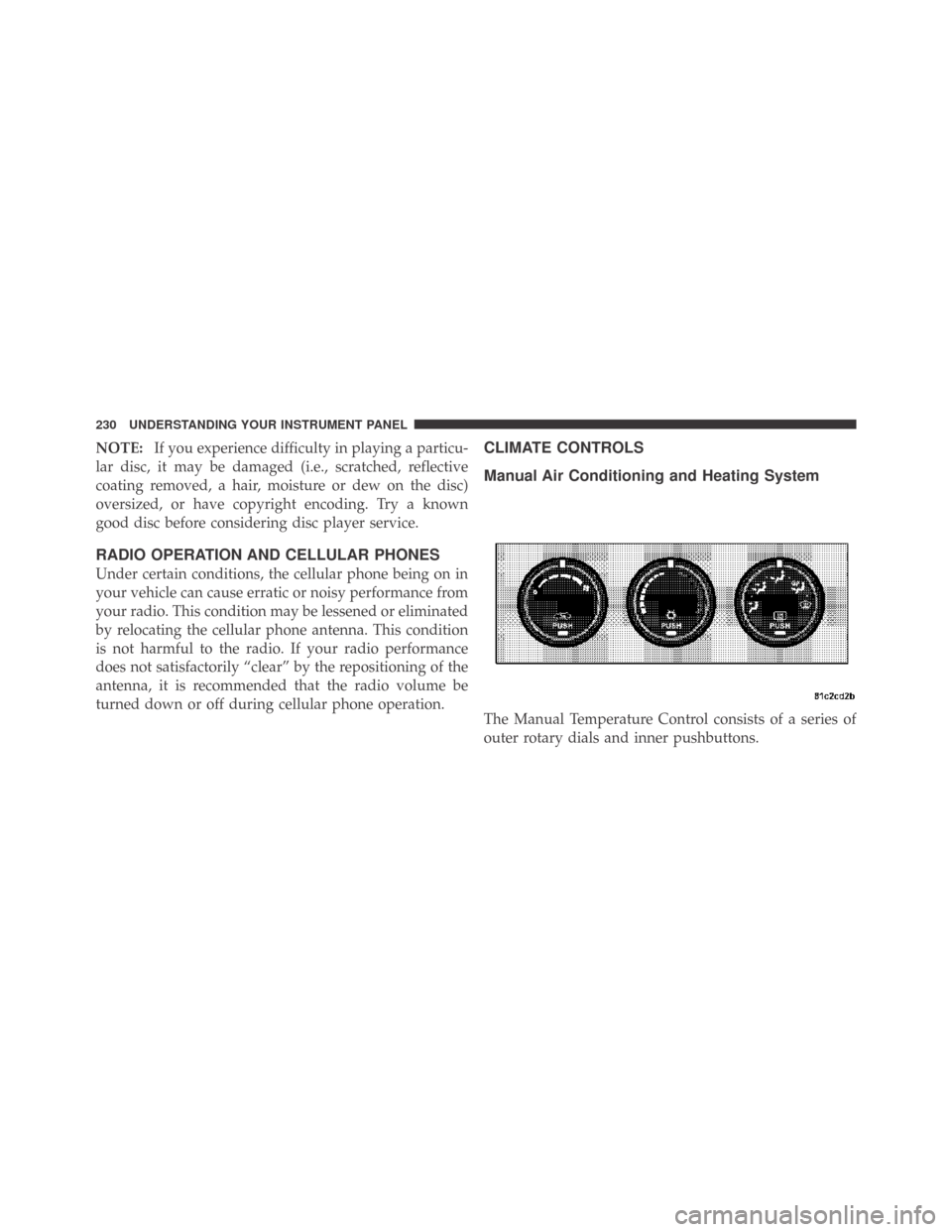
The Manual Temperature Control consists of a series of
outer rotary dials and inner pushbuttons.
230 UNDERSTANDING YOUR INSTRUMENT PANEL
Page 280 of 469

When the vehicle is driven over 7 mph (11 km/h), you
may also hear a slight clicking sound as well as some
related motor noises. These noises are the system per-
forming its self check cycle to ensure that the ABS system
is working properly. This self check occurs each time the
vehicle is started and accelerated past 7 mph (11 km/h).
ABS is activated during braking under certain road or
stopping conditions. ABS-inducing conditions can in-
clude ice, snow, gravel, bumps, railroad tracks, loose
debris, or panic stops.
You also may experience the following when the brake
system goes into anti-lock:
•The ABS motor running (it may continue to run for a
short time after the stop),
•The clicking sound of solenoid valves,
•Brake pedal pulsations, and
•A slight drop or fall away of the brake pedal at the end
of the stop.
These are all normal characteristics of ABS.
WARNING!
•The Anti-Lock Brake System (ABS) contains so-
phisticated electronic equipment that may be sus-
ceptible to interference caused by improperly in-
stalled or high output radio transmitting
equipment. This interference can cause possible
loss of anti-lock braking capability. Installation of
such equipment should be performed by qualified
professionals.
(Continued)
278 STARTING AND OPERATING
Page 313 of 469

turn off when the fault condition no longer exists. A
system fault can occur due to any of the following:
1. Signal interference due to electronic devices or driving
next to facilities emitting the same radio frequencies as
the TPM sensors.
2. Installing aftermarket window tinting that contains
materials that may block radio wave signals.
3. Accumulation of snow or ice around the wheels or
wheel housings.
4. Using tire chains on the vehicle.
5. Using wheels/tires not equipped with TPM sensors.
Vehicles with Compact Spare
1. The compact spare tire does not have a TPM sensor.
Therefore, the TPMS will not monitor the pressure in the
compact spare tire.2. If you install the compact spare tire in place of a road
tire that has a pressure below the low-pressure warning
limit, upon the next ignition key cycle, a chime will
sound and the “TPM Telltale Light” will turn ON.
3. After driving the vehicle for up to 20 minutes above
15 mph (25 km/h), the “TPM Telltale Light” will flash on
and off for 75 seconds and then remain on solid.
4. For each subsequent ignition key cycle, a chime will
sound and the “TPM Telltale Light” will flash on and off
for 75 seconds and then remain on solid.
5. Once you repair or replace the original road tire, and
reinstall it on the vehicle in place of the compact spare,
the TPMS will update automatically and the “TPM
Telltale Light” will turn OFF, as long as no tire pressure is
below the low-pressure warning limit in any of the four
active road tires. The vehicle may need to be driven for
up to 20 minutes above 15 mph (25 km/h) in order for the
TPMS to receive this information.
5
STARTING AND OPERATING 311
Page 316 of 469

Check TPMS Warning
If a system fault is detected, the “TPM Telltale Light” will
flash on and off for 75 seconds and then remain on solid. The
system fault will also sound a chime. In addition, the EVIC
will display a�CHECK TPM SYSTEM�message for three
seconds and then display dashes (- -) in place of the pressure
value to indicate which sensor is not being received.
If the ignition key is cycled, this sequence will repeat,
providing the system fault still exists. If the system fault
no longer exists, the “TPM Telltale Light” will no longer
flash, and the�CHECK TPM SYSTEM�message will no
longer display, and a pressure value will display in place
of the dashes. A system fault can occur due to any of the
following:
1. Signal interference due to electronic devices or driving
next to facilities emitting the same radio frequencies as
the TPM sensors.
2. Installing aftermarket window tinting that contains
materials that may block radio wave signals.
3. Accumulation of snow or ice around the wheels or
wheel housings.
4. Using tire chains on the vehicle.
5. Using wheels/tires not equipped with TPM sensors.
314 STARTING AND OPERATING
Page 359 of 469
NOTE:The battery is stored under an access cover in
the trunk. Remote battery terminals are located in the
engine compartment for jump-starting.
1. Wear eye protection and remove any metal jewelry
such as watchbands or bracelets that might make an
inadvertent electrical contact.
2. When boost is provided by a battery in another
vehicle, park that vehicle within booster cable reach, but
do not allow the vehicles to touch one another.
WARNING!
Do not permit vehicles to touch each other as this
could establish a ground connection and personal
injury could result.3. Set the parking brake, place the automatic transmis-
sion in PARK (manual transmission in NEUTRAL), and
turn the ignition switch to the LOCK position on both
vehicles.
4. Turn off the heater, radio, and all unnecessary electri-
cal loads.
5. Connect one end of the jumper cable to the remote
jump-start positive battery post(+)in the engine com-
partment. Connect the other end of the same cable to the
positive terminal of the booster battery. Refer to the
following illustration for jump-starting connections.
6
WHAT TO DO IN EMERGENCIES 357
Page 401 of 469
Do not use abrasive cleaning components, solvents, steel
wool or other aggressive material to clean the lenses.
Glass Surfaces
All glass surfaces should be cleaned on a regular basis
with MOPAR�Glass Cleaner or any commercial
household-type glass cleaner. Never use an abrasive type
cleaner. Use caution when cleaning the inside rear win-
dow equipped with electric defrosters or the right rear
quarter window equipped with the radio antenna. Do
not use scrapers or other sharp instrument that may
scratch the elements.
When cleaning the rear view mirror, spray cleaner on the
towel or rag that you are using. Do not spray cleaner
directly on the mirror.
Cleaning Plastic Instrument Cluster Lenses
The lenses in front of the instruments in this vehicle are
molded in clear plastic. When cleaning the lenses, care
must be taken to avoid scratching the plastic.1. Clean with a wet soft rag or micro-fiber towel. A mild
soap solution may be used, but do not use high alcohol
content or abrasive cleaners. If soap is used, wipe clean
with a clean damp rag.
2. Dry with a soft tissue.
Seat Belt Maintenance
Do not bleach, dye, or clean the belts with chemical
solvents or abrasive cleaners. This will weaken the fabric.
Sun damage can also weaken the fabric.
If the belts need cleaning, use MOPAR�Total Clean, a
mild soap solution, or lukewarm water. Do not remove
the belts from the vehicle to wash them.
Replace the belts if they appear frayed or worn or if the
buckles do not work properly.
Cleaning the Center Console Cupholders
Clean with a damp cloth or towel using a mild detergent
with the cupholder in the center console.
7
MAINTAINING YOUR VEHICLE 399
Page 408 of 469
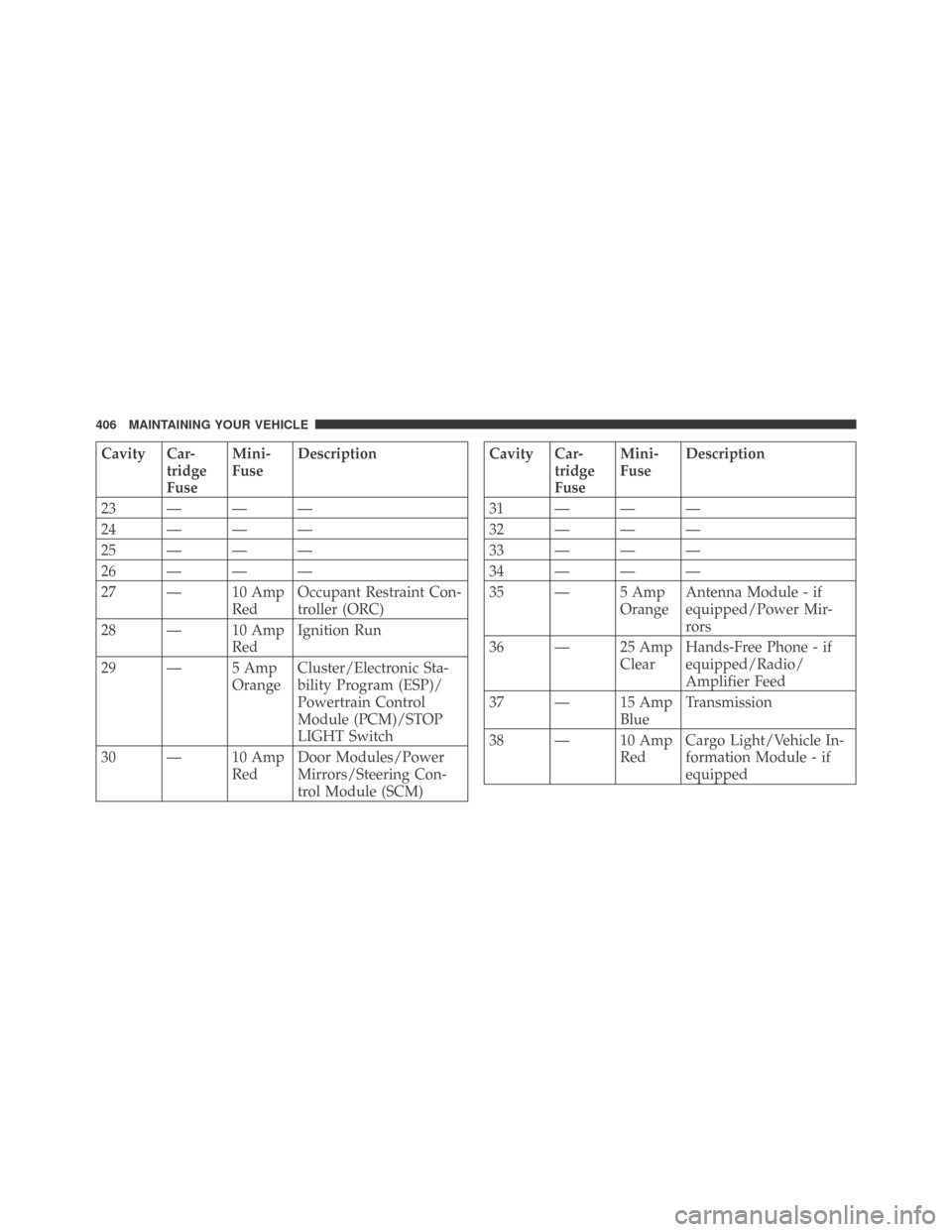
Cavity Car-
tridge
FuseMini-
FuseDescription
23———
24———
25———
26———
27 — 10 Amp
RedOccupant Restraint Con-
troller (ORC)
28 — 10 Amp
RedIgnition Run
29 — 5 Amp
OrangeCluster/Electronic Sta-
bility Program (ESP)/
Powertrain Control
Module (PCM)/STOP
LIGHT Switch
30 — 10 Amp
RedDoor Modules/Power
Mirrors/Steering Con-
trol Module (SCM)Cavity Car-
tridge
FuseMini-
FuseDescription
31———
32———
33———
34———
35 — 5 Amp
OrangeAntenna Module - if
equipped/Power Mir-
rors
36 — 25 Amp
ClearHands-Free Phone - if
equipped/Radio/
Amplifier Feed
37 — 15 Amp
BlueTransmission
38 — 10 Amp
RedCargo Light/Vehicle In-
formation Module - if
equipped
406 MAINTAINING YOUR VEHICLE
Page 446 of 469
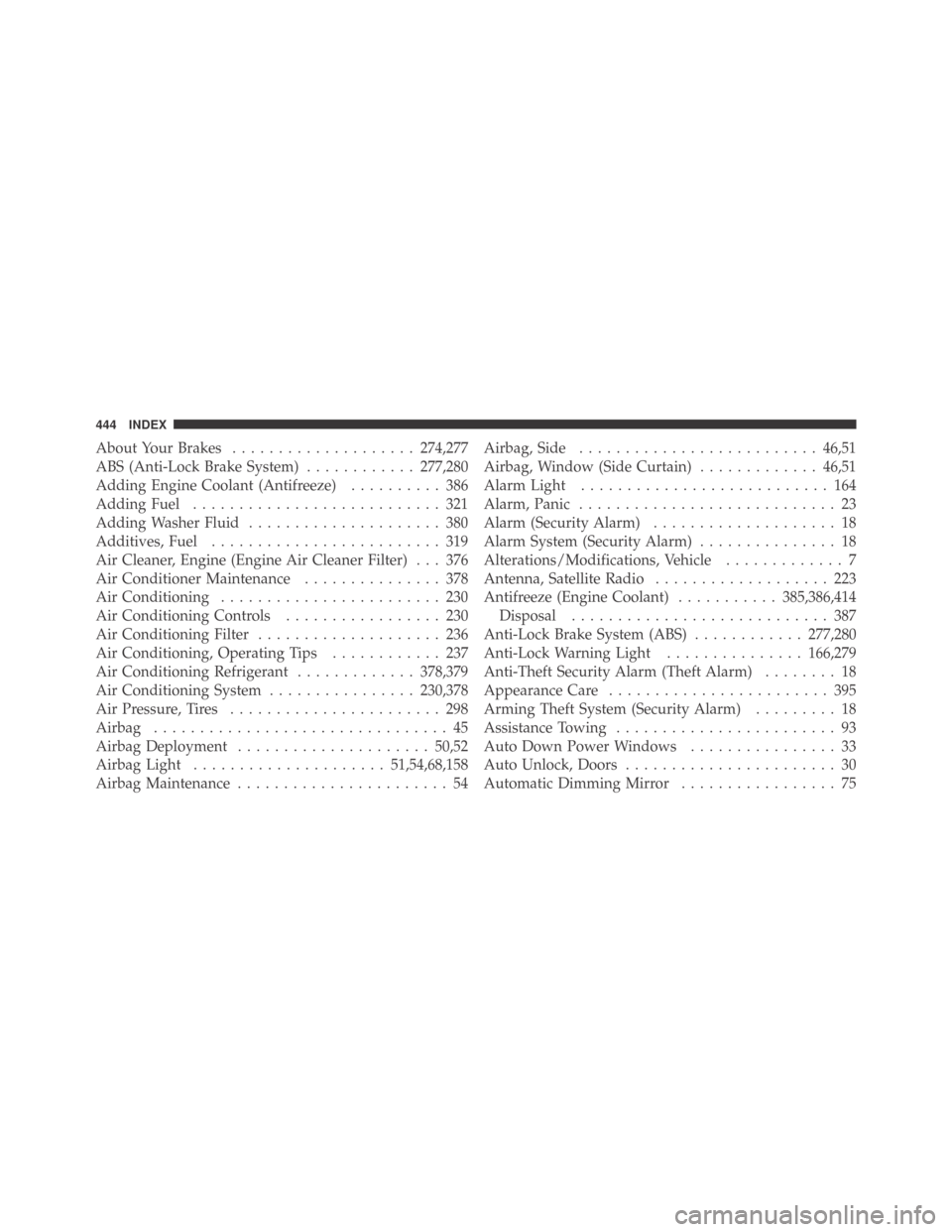
About Your Brakes....................274,277
ABS (Anti-Lock Brake System)............277,280
Adding Engine Coolant (Antifreeze).......... 386
Adding Fuel........................... 321
Adding Washer Fluid..................... 380
Additives, Fuel......................... 319
Air Cleaner, Engine (Engine Air Cleaner Filter) . . . 376
Air Conditioner Maintenance............... 378
Air Conditioning........................ 230
Air Conditioning Controls................. 230
Air Conditioning Filter.................... 236
Air Conditioning, Operating Tips............ 237
Air Conditioning Refrigerant.............378,379
Air Conditioning System................230,378
Air Pressure, Tires....................... 298
Airbag................................ 45
Airbag Deployment..................... 50,52
Airbag Light..................... 51,54,68,158
Airbag Maintenance....................... 54Airbag, Side.......................... 46,51
Airbag, Window (Side Curtain)............. 46,51
AlarmLight ........................... 164
Alarm, Panic............................ 23
Alarm (Security Alarm).................... 18
Alarm System (Security Alarm)............... 18
Alterations/Modifications, Vehicle............. 7
Antenna, Satellite Radio................... 223
Antifreeze (Engine Coolant)...........385,386,414
Disposal............................ 387
Anti-Lock Brake System (ABS)............277,280
Anti-Lock Warning Light...............166,279
Anti-Theft Security Alarm (Theft Alarm)........ 18
Appearance Care........................ 395
Arming Theft System (Security Alarm)......... 18
Assistance Towing........................ 93
Auto Down Power Windows................ 33
Auto Unlock, Doors....................... 30
Automatic Dimming Mirror................. 75
444 INDEX