Page 71 of 469

Defroster
Check operation by selecting the defrost mode and place
the blower control on high speed. You should be able to
feel the air directed against the windshield. See your
authorized dealer for service if your defroster is
inoperable.
Periodic Safety Checks You Should Make Outside
the Vehicle
Tires
Examine tires for excessive tread wear and uneven wear
patterns. Check for stones, nails, glass, or other objects
lodged in the tread. Inspect the tread and sidewall for
cuts and cracks. Check the wheel nuts for tightness.
Check the tires (including spare) for proper pressure.
Lights
Have someone observe the operation of exterior lights
while you work the controls. Check turn signal and high
beam indicator lights on the instrument panel.
Door Latches
Check for positive closing, latching, and locking.
Fluid Leaks
Check area under vehicle after overnight parking for fuel,
engine coolant, oil, or other fluid leaks. Also, if gasoline
fumes are detected or if fuel, power steering fluid, or
brake fluid leaks are suspected, the cause should be
located and corrected immediately.
2
THINGS TO KNOW BEFORE STARTING YOUR VEHICLE 69
Page 242 of 469

▫Five-Speed Automatic Transmission (5.7L
Engine)........................... 264
▫Gear Ranges........................ 264
�AutoStick�— If Equipped............... 268
▫AutoStick�Operation................. 268
�Driving On Slippery Surfaces............. 269
▫Acceleration........................ 269
▫Traction........................... 270
�Driving Through Water................. 270
▫Flowing/Rising Water................. 271
�Power Steering....................... 273
▫Power Steering Fluid Check............. 273
�Parking Brake........................ 274▫Manual Transmission — If Equipped...... 275
▫Automatic Transmission — If Equipped.... 276
�Brake System........................ 277
▫Anti-Lock Brake System (ABS) — If
Equipped.......................... 277
�Multi-Displacement System (MDS) (If
Equipped) – 5.7L Engine Only............. 280
�Electronic Brake Control System........... 280
▫ABS (Anti-Lock Brake System) — If
Equipped.......................... 280
▫TCS (Traction Control System) — If
Equipped.......................... 281
▫BAS (Brake Assist System) — If Equipped . . . 281
▫HSA (Hill Start Assist) — Manual
Transmission Only................... 283
240 STARTING AND OPERATING
Page 275 of 469
POWER STEERING
The standard power steering system will give you good
vehicle response and increased ease of maneuverability
in tight spaces. The system will provide mechanical
steering capability if power assist is lost.
If for some reason the power assist is interrupted, it will
still be possible to steer your vehicle. Under these condi-
tions, you will observe a substantial increase in steering
effort, especially at very low vehicle speeds and during
parking maneuvers.
NOTE:Increased noise levels at the end of the steering
wheel travel are considered normal and do not indicate
that there is a problem with the power steering system.
Upon initial start-up in cold weather, the power steering
pump may make noise for a short amount of time. This is
due to the cold, thick fluid in the steering system. This
noise should be considered normal, and it does not in any
way damage the steering system.WARNING!
Continued operation with reduced power steering
assist could pose a safety risk to yourself and others.
Service should be obtained as soon as possible.
CAUTION!
Prolonged operation of the steering system at the end
of the steering wheel travel will increase the steering
fluid temperature and it should be avoided when
possible. Damage to the power steering pump may
occur.
Power Steering Fluid Check
Checking the power steering fluid level at a defined
service interval is not required. The fluid should only be
checked if a leak is suspected, abnormal noises are
5
STARTING AND OPERATING 273
Page 276 of 469

apparent, and/or the system is not functioning as antici-
pated. Coordinate inspection efforts through an autho-
rized dealer.
CAUTION!
Do not use chemical flushes in your power steering
system as the chemicals can damage your power
steering components. Such damage is not covered by
the New Vehicle Limited Warranty.
WARNING!
Fluid level should be checked on a level surface and
with the engine off to prevent injury from moving
parts and to ensure accurate fluid level reading. Do
not overfill. Use only manufacturer’s recommended
power steering fluid.If necessary, add fluid to restore to the proper indicated
level. With a clean cloth, wipe any spilled fluid from all
surfaces. Refer to “Fluids, Lubricants, and Genuine
Parts” in Section 7 for the correct fluid type.
PARKING BRAKE
The parking brake should always be applied when the
driver is not in the vehicle.
The “Brake Warning Light” in the instrument cluster will
turn on when the parking brake is applied and the
ignition switch is ON.
NOTE:This light only shows that the parking brake is
applied. It does not show the degree of brake application.
When parking on a flat surface, place the shift lever in the
PARK position (automatic transmission), R (Reverse) or
first gear (manual transmission) first and then apply the
parking brake.
274 STARTING AND OPERATING
Page 368 of 469
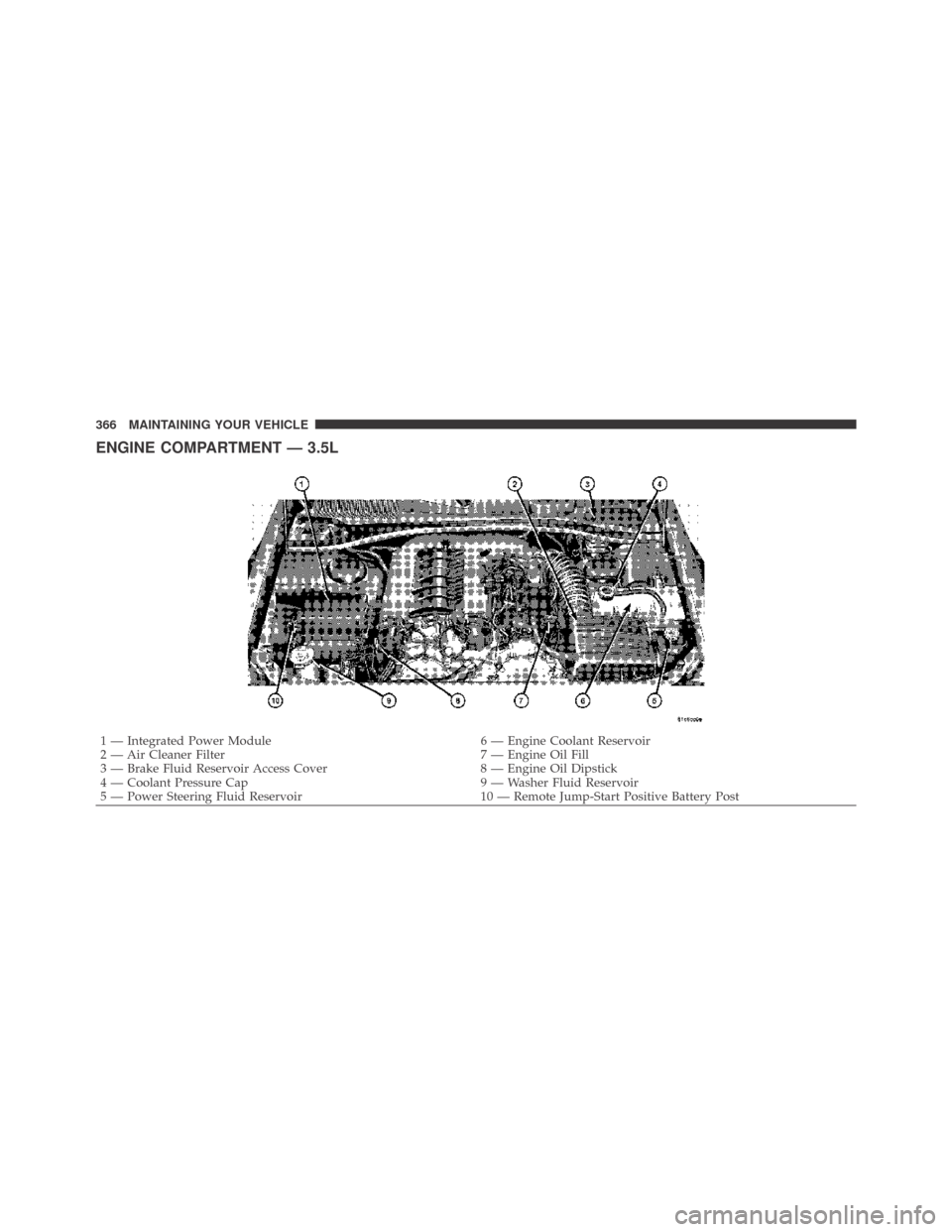
ENGINE COMPARTMENT — 3.5L
1 — Integrated Power Module 6 — Engine Coolant Reservoir
2 — Air Cleaner Filter 7 — Engine Oil Fill
3 — Brake Fluid Reservoir Access Cover 8 — Engine Oil Dipstick
4 — Coolant Pressure Cap 9 — Washer Fluid Reservoir
5 — Power Steering Fluid Reservoir 10 — Remote Jump-Start Positive Battery Post 366 MAINTAINING YOUR VEHICLE
Page 369 of 469
ENGINE COMPARTMENT — 5.7L
1 — Integrated Power Module 6 — Air Cleaner Filter
2 — Coolant Pressure Cap 7 — Engine Oil Fill
3 — Brake Fluid Reservoir Access Cover 8 — Engine Oil Dipstick
4 — Engine Coolant Reservoir 9 — Remote Jump-Start Positive Battery Post
5 — Power Steering Fluid Reservoir 10 — Washer Fluid Reservoir
7
MAINTAINING YOUR VEHICLE 367
Page 374 of 469

CAUTION! (Continued)
•Your vehicle has been built with improved fluids
that protect the performance and durability of
your vehicle and also allow extended maintenance
intervals. Do not use chemical flushes in these
components as the chemicals can damage your
engine, transmission, power steering or air condi-
tioning. Such damage is not covered by the New
Vehicle Limited Warranty. If a flush is needed
because of component malfunction, use only the
specified fluid for the flushing procedure.
Engine Oil
Checking Oil Level — 3.5L Engine
To assure proper engine lubrication, the engine oil must
be maintained at the correct level. Check the oil level atregular intervals, such as every fuel stop. The best time to
check the engine oil level is about five minutes after a
fully warmed engine is shut off.
Checking the oil while the vehicle is on level ground will
improve the accuracy of the oil level readings. Maintain
the oil level between the MIN and MAX markings on the
dipstick. Adding 1.0 qt (1.0 L) of oil when the reading is
at the MIN mark will result in a MAX reading on these
engines.
CAUTION!
Overfilling or underfilling will cause oil aeration or
loss of oil pressure. This could damage your engine.
Checking Oil Level — 5.7L Engine
To assure proper engine lubrication, the engine oil must
be maintained at the correct level. Check the oil level at
372 MAINTAINING YOUR VEHICLE
Page 418 of 469
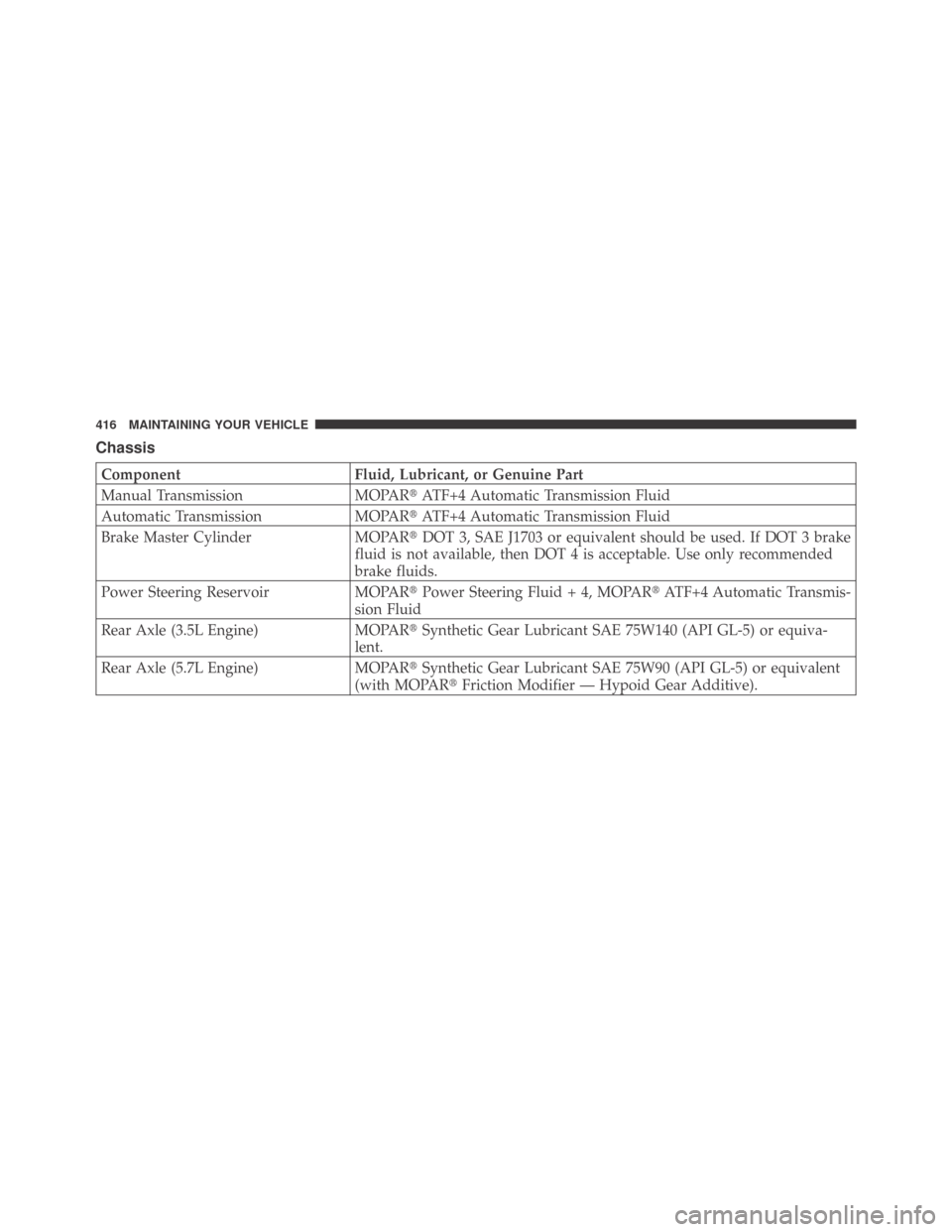
Chassis
Component Fluid, Lubricant, or Genuine Part
Manual Transmission MOPAR�ATF+4 Automatic Transmission Fluid
Automatic Transmission MOPAR�ATF+4 Automatic Transmission Fluid
Brake Master Cylinder MOPAR�DOT 3, SAE J1703 or equivalent should be used. If DOT 3 brake
fluid is not available, then DOT 4 is acceptable. Use only recommended
brake fluids.
Power Steering Reservoir MOPAR�Power Steering Fluid + 4, MOPAR�ATF+4 Automatic Transmis-
sion Fluid
Rear Axle (3.5L Engine) MOPAR�Synthetic Gear Lubricant SAE 75W140 (API GL-5) or equiva-
lent.
Rear Axle (5.7L Engine) MOPAR�Synthetic Gear Lubricant SAE 75W90 (API GL-5) or equivalent
(with MOPAR�Friction Modifier — Hypoid Gear Additive).
416 MAINTAINING YOUR VEHICLE