Page 83 of 534
To obtain Integrated Child Seat replacement instruc-
tions:Refer to the Publication order forms at the back of
this manual and specify publication number
81–226–0919.
Child Restraints
Everyone in your vehicle needs to be buckled up all the
time, including babies and children. Every state in the
United States and all Canadian provinces require that
small children ride in proper restraint systems. This is the
law, and you can be prosecuted for ignoring it.
Children 12 years and younger should ride properly
buckled up in a rear seat. According to crash statistics,
children are safer when properly restrained in the rear
seats rather than in the front.
WARNING!
In a collision, an unrestrained child, even a tiny baby,
can become a missile inside the vehicle. The force
required to hold even an infant on your lap could
become so great that you could not hold the child, no
matter how strong you are. The child and others
could be badly injured. Any child riding in your
vehicle should be in a proper restraint for the child’s
size.
Infants and Small Children
There are different sizes and types of restraints for
children from newborn size to the child almost large
enough for an adult safety belt. Always check the child
seat Owner’s Manual to ensure you have the right seat
for your child. Use the restraint that is correct for your
child.
THINGS TO KNOW BEFORE STARTING YOUR VEHICLE 81
2
ProCarManuals.com
Page 87 of 534

•Carefully follow the instructions that come with the
restraint. If you install the restraint improperly, it may
not work when you need it.
•The passenger seat belts are equipped with cinching
latch plates, which are designed to keep the lap
portion tight around the child restraint so that it is not
necessary to use a locking clip. Pulling up on the
shoulder portion of the lap/shoulder belt will tighten
the belt. The cinching latch plate will keep the belt
tight, however, any seat belt system will loosen with
time, so check the belt occasionally and pull it tight if
necessary.
•In the rear seat, you may have trouble tightening the
lap/shoulder belt on the child restraint because the
buckle or latch plate is too close to the belt path
opening on the restraint. Disconnect the latch plate
from the buckle and twist the short buckle end of thebelt several times to shorten it. Insert the latch plate
into the buckle with the release button facing out.
•If the belt still can’t be tightened, or if pulling and
pushing on the restraint loosens the belt, disconnect
the latch plate from the buckle, turn the buckle
around, and insert the latch plate into the buckle
again. If you still can’t make the child restraint secure,
try a different seating position.
•Buckle the child into the seat according to the child
restraint manufacturer’s directions.
•When your child restraint is not in use, secure it in the
vehicle with the seat belt or remove it from the vehicle.
Don’t leave it loose in the vehicle. In a sudden stop or
collision, it could strike the occupants or seatbacks and
cause serious personal injury.
THINGS TO KNOW BEFORE STARTING YOUR VEHICLE 85
2
ProCarManuals.com
Page 89 of 534
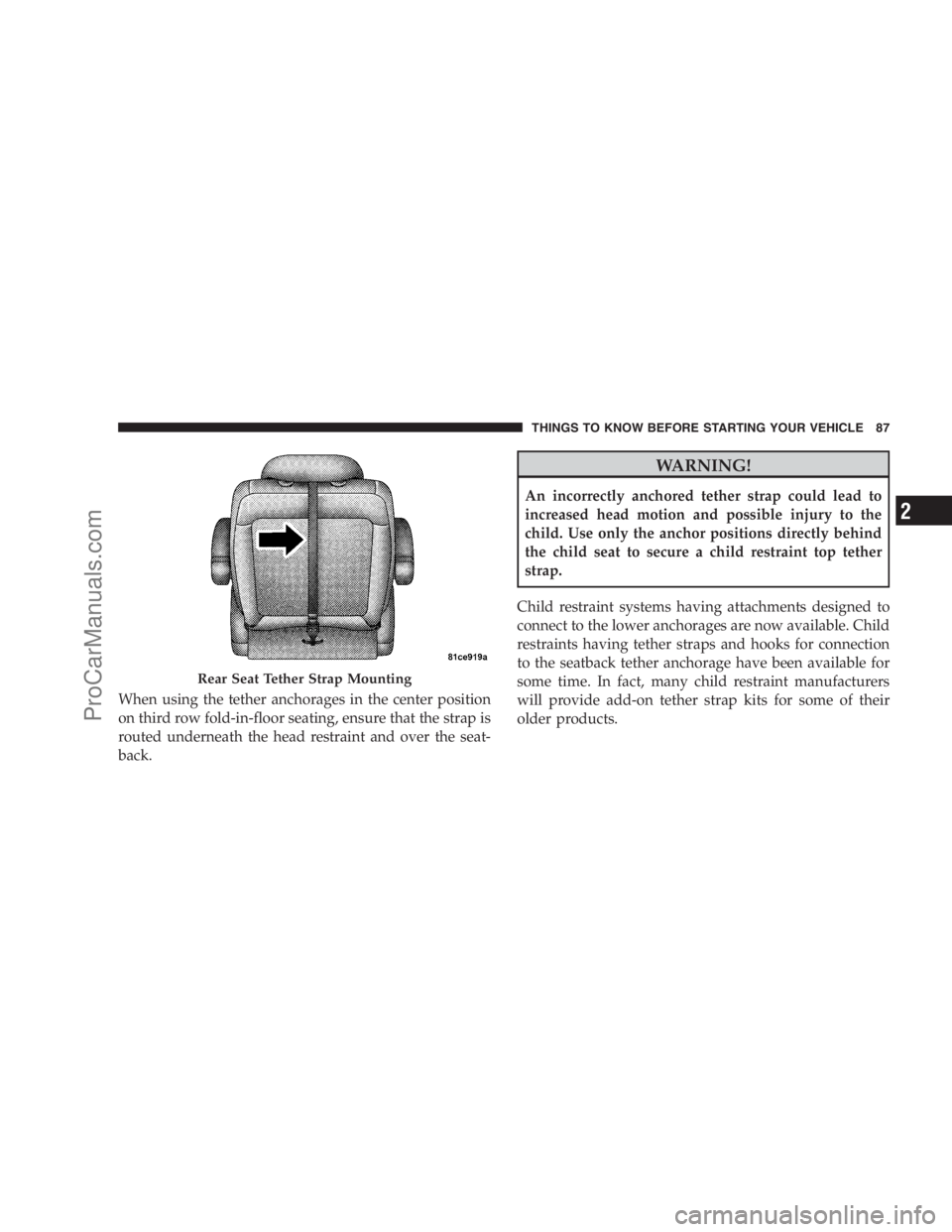
When using the tether anchorages in the center position
on third row fold-in-floor seating, ensure that the strap is
routed underneath the head restraint and over the seat-
back.
WARNING!
An incorrectly anchored tether strap could lead to
increased head motion and possible injury to the
child. Use only the anchor positions directly behind
the child seat to secure a child restraint top tether
strap.
Child restraint systems having attachments designed to
connect to the lower anchorages are now available. Child
restraints having tether straps and hooks for connection
to the seatback tether anchorage have been available for
some time. In fact, many child restraint manufacturers
will provide add-on tether strap kits for some of their
older products.
Rear Seat Tether Strap Mounting
THINGS TO KNOW BEFORE STARTING YOUR VEHICLE 87
2
ProCarManuals.com
Page 92 of 534
Transporting Pets
Airbags deploying in the front seat could harm your pet.
An unrestrained pet could be thrown about and possibly
injured, or injure a passenger during panic braking or in
a collision.
Pets should be restrained in the rear seat in pet harnesses
or pet carriers that are secured by seat belts.
REAR SEAT DELETE FEATURE (COMMERCIAL
VEHICLES ONLY) — IF EQUIPPED
Commercial cargo vehicles are not designed for use as a
family vehicle and are not intended for carrying children
in the front passenger seat. However, if you must carry a
child in a vehicle without a rear seat, the passenger seat
should be moved to the full rearward position and the
child must be in a proper restraint system based on its
age, size and weight.
WARNING!
NEVER carry a child in a rear facing infant carrier in
a vehicle without rear seats. In an accident, serious
injury or death may occur from the deploying pas-
senger airbag.
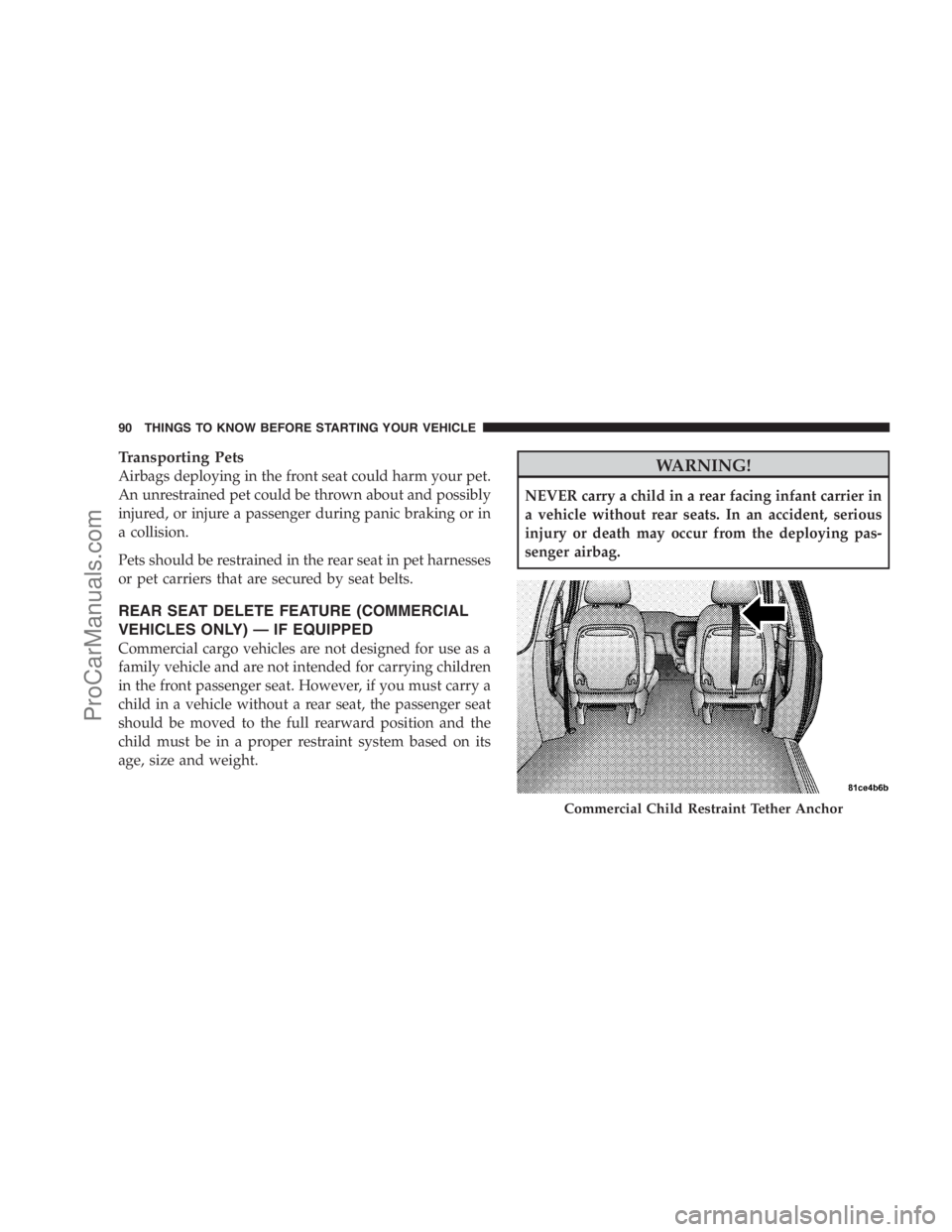
Commercial Child Restraint Tether Anchor
90 THINGS TO KNOW BEFORE STARTING YOUR VEHICLE
ProCarManuals.com
Page 93 of 534
This vehicle is equipped with a child restraint tether
anchor located on the lower rear of the front passenger
seat.Use this tether anchor to secure only forward-
facing child restraints equipped with an upper tether
strap.
WARNING!
Rearward-facing infant restraints must never be se-
cured in the passenger seat of a vehicle with a
passenger airbag. In an accident, a passenger airbag
may deploy causing severe injury or death to infants
riding in rearward-facing infant restraints.
Restraining Infants and Small Children with Seat
Delete Feature (Commercial Vehicles Only)
There are different sizes and types of restraints for
children from newborn size to the child almost large
enough for an adult safety belt. Use the restraint that is
correct for your child:
•The rearward-facing infant carrier is for babies weigh-
ing up to about 20 lbs (9 kg), and less than one year
old. THIS TYPE OF SEAT CANNOT BE USED IN A
VEHICLE EQUIPPED WITH THE REAR SEAT DE-
LETE FEATURE (Commercial Vehicles Only).
•The forward-facing child seat is for children from
about 20 to 40 lbs (9 to 18 kg), and more than one year
old.
•A convertible child seat, one that is designed to be
used for children who are too heavy for a rearward-
facing infant seat, may be used IN THE FORWARD
FACING POSITION ONLY, IT MUST NEVER BE
INSTALLED FACING TO THE REAR IN A VEHICLE
EQUIPPED WITH THE REAR SEAT DELETE FEA-
TURE (Commercial Vehicles Only). When a convert-
ible seat is properly installed facing forward, the
vehicle seat should be adjusted to therear most
position.
THINGS TO KNOW BEFORE STARTING YOUR VEHICLE 91
2
ProCarManuals.com
Page 94 of 534

•Children more than 40 lbs (18 kg) should be secured in
the passenger seat in a child restraint or belt-
positioning booster seat with the seat adjusted to the
rear most position. Older children who do not use
child restraints or belt-positioning booster seats
should ride properly buckled in the passenger seat
with the seat adjusted to the rearmost position. Never
allow children to slide the shoulder belt behind them
or under their arm.
Tether Installation for Commercial Vehicles with
Rear Seat Delete
To secure the child restraint upper tether strap to the
vehicle, follow the instructions shown:
1. Locate the child restraint tether anchor on the lower
rear of the front passenger seat.
2. Follow the child restraint manufacturer’s directions
for proper use of connecting the child restraint to the
extended tether strap.3. Route the tether strap under the head rest.
NOTE:Ensure that the child restraint tether strap is
centered between the headrest supports underneath the
head rest.
4. Using the hook attached to the child restraint tether
strap, attach the child restraint tether strap to the metal
anchor on the lower rear of the front passenger seat.
5. Following the child seat manufacturer’s instructions,
tighten the child restraint tether strap.
6. Inspect the tether anchor strap for nicks, abrasions,
discoloration, and loose threads. If these, or any other
condition that might affect the performance of the strap is
observed, DO NOT USE. Contact your authorized deal-
ership for a replacement part.
92 THINGS TO KNOW BEFORE STARTING YOUR VEHICLE
ProCarManuals.com
Page 102 of 534
�Overhead Consoles..................... 194
▫Front Overhead Console................ 194
�Garage Door Opener — If Equipped........ 197
▫Programming HomeLink�.............. 199
▫Gate Operator/Canadian Programming..... 202
▫Security........................... 202
▫Troubleshooting Tips.................. 203
▫General Information................... 203
�Power Sunroof — If Equipped............. 204
▫Power Sunroof Operation............... 204
�Electrical Power Outlets — If Equipped...... 206
�Power Inverter — If Equipped............ 208
�Cupholders.......................... 209▫Instrument Panel Cupholders............ 209
▫Interior Bottle Holders................. 210
▫Smoker’s Package Kit — If Equipped...... 210
�Storage............................. 211
▫Glove Compartments.................. 211
▫Door Trim Panel Storage............... 212
▫Driver Seatback Storage — If Equipped..... 213
▫Second Row Seat Storage Bins —
If Equipped......................... 214
▫Rear Compartment Storage Bins.......... 215
▫Coat Hooks......................... 216
▫Cargo Area Storage................... 216
100 UNDERSTANDING THE FEATURES OF YOUR VEHICLE
ProCarManuals.com
Page 159 of 534
5. Lower the release handle located at the bottom front
edge of the seat.
Each seat weighs about 90 lbs (81 kg).
NOTE:Electrical contacts for the available heated seats
automatically disengage or engage as the seat is removed
or installed. The contacts slide past each other as the seat
is rolled to and from the strikers.
When reinstalling the seat, make certain to lower the
release handle to ensure the seat is latched securely.
WARNING!
In a collision, you or others in your vehicle could be
injured if seats are not properly latched to their floor
attachments. Always be sure the seats are fully
latched.
Swivel ’n Go Premium Seating Table — If
Equipped
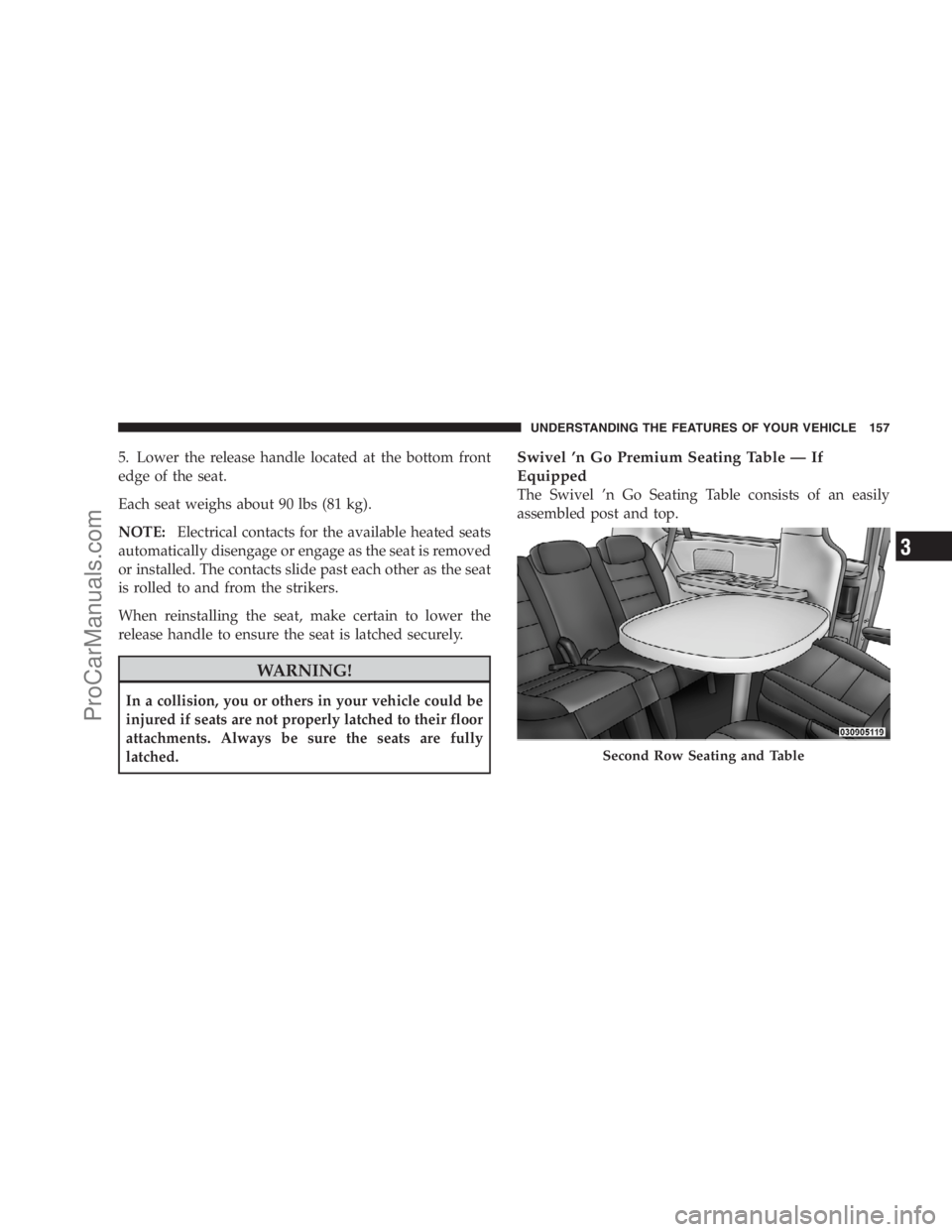
The Swivel ’n Go Seating Table consists of an easily
assembled post and top.
Second Row Seating and Table
UNDERSTANDING THE FEATURES OF YOUR VEHICLE 157
3
ProCarManuals.com