Page 31 of 534
NOTE:
•If your power door locks were unlocked, Remote Start
will automatically lock the doors.
•The park lights will turn on and remain on during
Remote Start mode.
•For security, power window and power sunroof op-
eration (if equipped) are disabled when the vehicle is
in the Remote Start mode.
•The engine can be started two consecutive 15-minute
cycles with the RKE transmitter. However, the ignition
switch must be turned to the ON position before you
can repeat the start sequence.
To Enter the Vehicle After Remote Start
To enter the vehicle while the engine is running during a
Remote Start, you must first unlock the vehicle using the
UNLOCK button on the transmitter. After the vehicle is
unlocked, you can enter the vehicle, insert the key into
the ignition switch and move it to the ON position,
otherwise the engine will shut off at the end of 15- minute
cycle.
Remote Starting Button
THINGS TO KNOW BEFORE STARTING YOUR VEHICLE 29
2
ProCarManuals.com
Page 32 of 534
To Exit Remote Start Mode and Drive the Vehicle
Before the end of the 15-minute cycle, press and release
the UNLOCK button on the RKE transmitter to unlock
the doors and disarm the Vehicle Security Alarm (if
equipped). Then, prior to the end of the 15-minute cycle,
insert the key into the ignition switch and turn the switch
to the ON position.
NOTE:
•The ignition switch must be in the ON position in
order to drive the vehicle.
•For vehicles equipped with the Electronic Vehicle
Information Center (EVIC), the message “Insert Key/
Turn to ON” will flash in the EVIC until you insert the
key. Once inserted, the message “Turn to ON” will
flash in the EVIC until you turn the key to ON.
Cancel Remote Start
Remote Starting will also cancel if any of the following
occur:
•The engine stalls or engine speed exceeds 2500 rpm
•Any engine warning lights come on
•The hood is opened
•The hazard switch is pressed
•The shift lever is moved out of PARK
•The brake pedal is pressed
•The engine is allowed to run for the entire 15-minute
cycle
To Turn Off the Engine While in Remote Start
Mode
Press and release the REMOTE START button one time.
NOTE:To avoid inadvertent shutdowns while in the
Remote Start Mode, the system will not allow the Remote
Start button to shutdown the engine for two seconds after
receiving a valid Remote Start request.
30 THINGS TO KNOW BEFORE STARTING YOUR VEHICLE
ProCarManuals.com
Page 33 of 534
When to Reset Remote Start
The vehicle can be started remotely up to a maximum of
two times. The vehicle is also allowed a maximum of one
failed start, where the Remote Starting sequence was
initiated but the engine stopped cranking without start-
ing. After either of these conditions, or if the Vehicle
Security Alarm system is alarming, or if the PANIC
button was pressed, the vehicle must be reset by inserting
a valid key into the ignition switch and rotating the key
to the ON position, and then rotating the key back to the
LOCK/OFF position.
DOOR LOCKS
Manual Door Locks
Lock the doors by pushing down on the lock plungers on
each door trim panel.If the lock plunger is down when you shut the door, the
door will lock. Therefore, make sure the keys are not
inside the vehicle before closing the door.
Manual Door Lock
THINGS TO KNOW BEFORE STARTING YOUR VEHICLE 31
2
ProCarManuals.com
Page 34 of 534
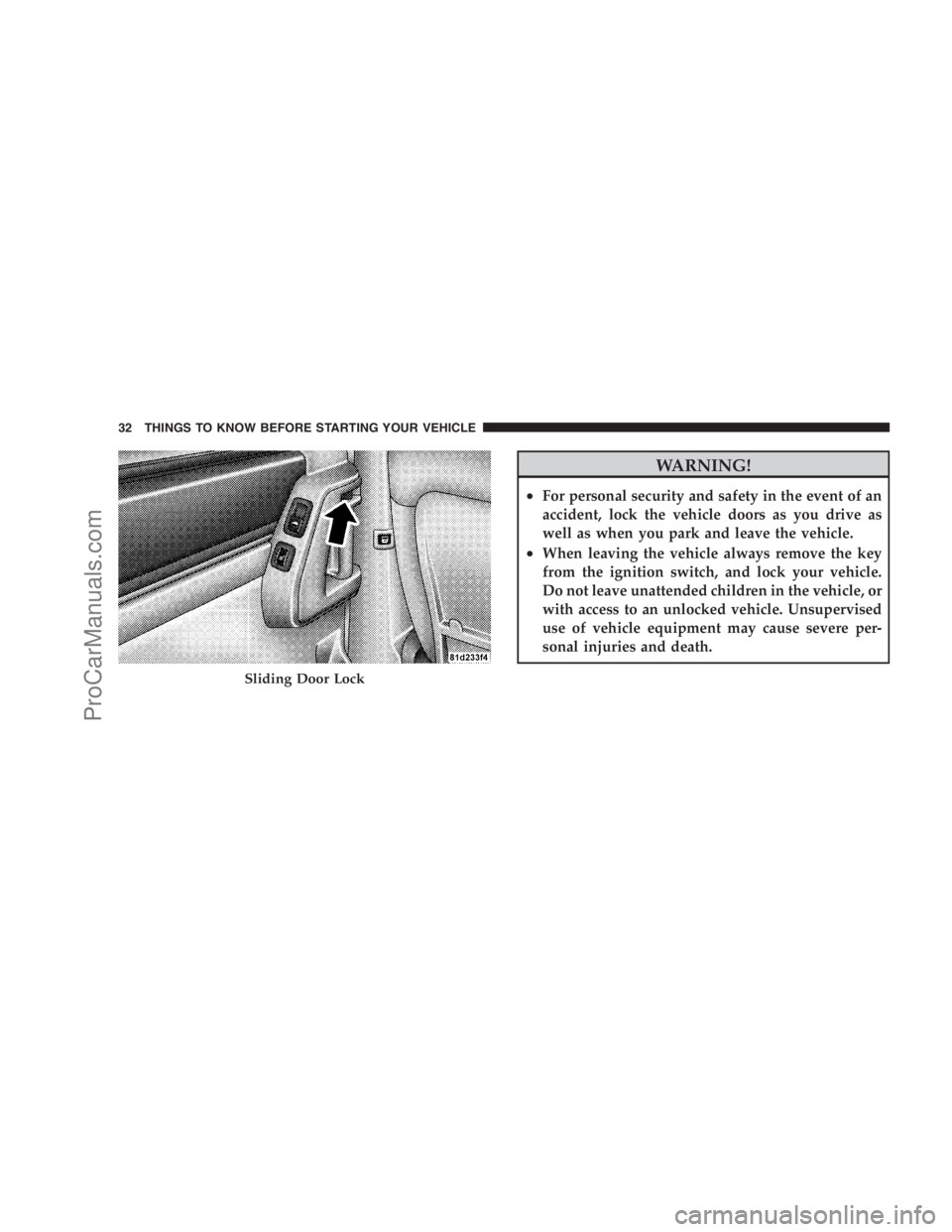
WARNING!
•For personal security and safety in the event of an
accident, lock the vehicle doors as you drive as
well as when you park and leave the vehicle.
•When leaving the vehicle always remove the key
from the ignition switch, and lock your vehicle.
Do not leave unattended children in the vehicle, or
with access to an unlocked vehicle. Unsupervised
use of vehicle equipment may cause severe per-
sonal injuries and death.
Sliding Door Lock
32 THINGS TO KNOW BEFORE STARTING YOUR VEHICLE
ProCarManuals.com
Page 56 of 534
WARNING! (Continued)
•Do not operate the storage bin covers while the
vehicle is in motion.
•Do not use a storage bin latch as a tie down.
CAUTION!
The storage bin cover must be flat and locked to
avoid damage from contact with the front seat tracks,
which have minimal clearance to the cover.
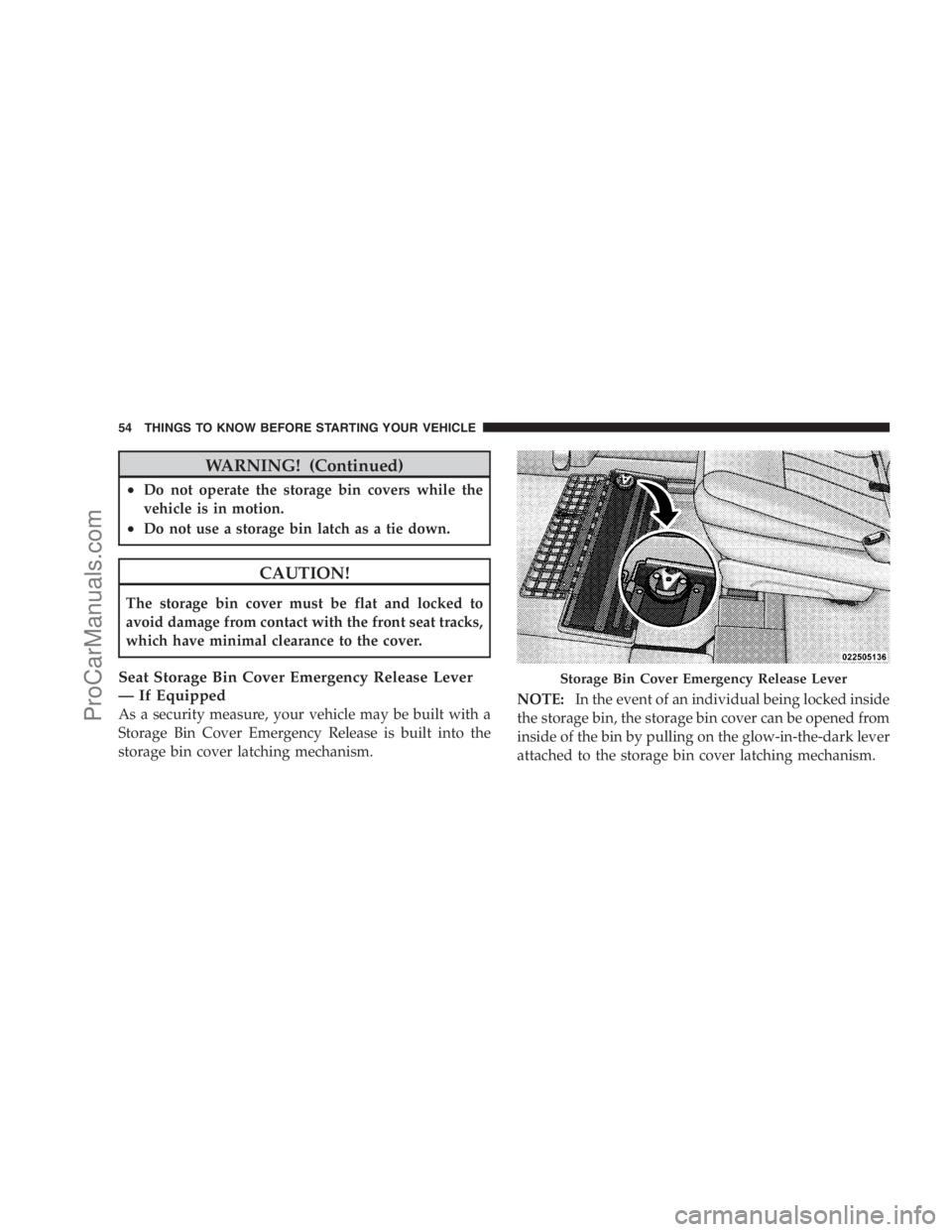
Seat Storage Bin Cover Emergency Release Lever
— If Equipped
As a security measure, your vehicle may be built with a
Storage Bin Cover Emergency Release is built into the
storage bin cover latching mechanism.NOTE:In the event of an individual being locked inside
the storage bin, the storage bin cover can be opened from
inside of the bin by pulling on the glow-in-the-dark lever
attached to the storage bin cover latching mechanism.
Storage Bin Cover Emergency Release Lever
54 THINGS TO KNOW BEFORE STARTING YOUR VEHICLE
ProCarManuals.com
Page 57 of 534
OCCUPANT RESTRAINTS
Some of the most important safety features in your
vehicle are the restraint systems:
•Three-point lap and shoulder belts for all seating
positions
•Pretensioning and load-limiting retractors for the front
seat belts
•Advanced multistage driver and new active-vent front
passenger airbags
•Supplemental side airbags that span the front, second,
and third row seating for the driver and passengers
seated next to a window.
•An energy-absorbing steering column and steering
wheel
•Knee bolsters/blockers for front seat occupants
•Front seat belt retractors incorporate pretensioners to
enhance occupant protection by managing occupant
energy during an impact event.
•All seat belt systems (except the driver’s, Swivel n’ Go,
and third row center position) include Automatic
Locking Retractors (ALRs), which lock the seat belt
webbing into position by extending the belt all the
way out and then adjusting the belt to the desired
length to restrain a child seat or secure a large item in
a seat.
If you will be carrying children too small for adult-size
seat belts, your seat belts or the Lower Anchors and
Tether for CHildren (LATCH) feature also can be used to
hold infant and child restraint systems.
NOTE:The front airbags have a multistage inflator
design. This allows the airbag to have different rates of
inflation that are based on collision severity.
THINGS TO KNOW BEFORE STARTING YOUR VEHICLE 55
2
ProCarManuals.com
Page 63 of 534
WARNING!
A frayed or torn belt could rip apart in a collision and
leave you with no protection. Inspect the belt system
periodically, checking for cuts, frays, or loose parts.
Damaged parts must be replaced immediately. Do
not disassemble or modify the system. Seat belt
assemblies must be replaced after a collision if they
have been damaged (bent retractor, torn webbing,
etc.).
Third Row Center Shoulder Belt Instructions
The shoulder belt for the third row center seat is located
in the headliner slightly behind the third row seat.
Pull the strap down and secure the small latch plate of
the lap belt into the small buckle until you hear a “click”.
Position the shoulder belt on your chest so that it is
comfortable and not resting on your neck. When the beltis long enough to fit, insert the large latch plate into the
buckle until you hear a “click.” The retractor should
withdraw any slack in the belt.
To release the small latch plate, position the end of the
large latch plate against the red button on the small latch
plate and push upward. Reinstall the latch plates into the
headliner.
Adjustable Upper Shoulder Belt Anchorage
In the front seats and the second row outboard seats, the
shoulder belt anchorage can be adjusted upward or
downward to help position the belt away from your
neck. The upper anchorage can be adjusted upward by
pushing anywhere on the anchorage. To move the an-
chorage downward, squeeze the actuation buttons while
simultaneously pushing down on the anchorage assem-
bly.
THINGS TO KNOW BEFORE STARTING YOUR VEHICLE 61
2
ProCarManuals.com
Page 71 of 534
collisions, both the front and side airbags may be trig-
gered. However, even in collisions where the airbags
work, you need the seat belts to keep you in the right
position for the airbags to protect you properly.
Here are some simple steps you can take to minimize the
risk of harm from a deploying airbag.
Children 12 years old and younger should always ride
buckled up in a rear seat. Infants in rear-facing child
restraints shouldNEVERride in the front seat of a
vehicle with a passenger front airbag. An airbag deploy-
ment can cause severe injury or death to infants in that
position.
Children that are not big enough to wear the vehicle seat
belt properly (see Section on Child Restraints should be
secured in the rear seat in child restraints or belt-
positioning booster seats. Older children who do not use
child restraints or belt-positioning booster seats shouldride properly buckled up in the rear seat. Never allow
children to slide the shoulder belt behind them or under
their arm.
If a child from 1 to 12 years old must ride in the front
passenger seat because the vehicle is crowded, move the
seat as far back as possible, and use the proper child
restraint. Refer to the section on Child Restraints.
You should read the instructions provided with your
child restraint to make sure that you are using it properly.
All occupants should wear their lap and shoulder belts
properly.
The driver and front passenger seats should be moved
back as far as practical to allow the front airbags room to
inflate.
If your vehicle has side airbags, do not lean against the
door, airbags will inflate forcefully into the space be-
tween you and the door.
THINGS TO KNOW BEFORE STARTING YOUR VEHICLE 69
2
ProCarManuals.com