Page 169 of 526
The ACC SET screen will display once again if any ACC
activity occurs, which may include any of the following:
•Set speed change
•Distance setting change
•System cancel
•Acquisition/loss of Target
•Driver override
•System off
•Proximity warning
•ACC warning
The EVIC will return to the last display selected
after five seconds of no ACC activity.
UNDERSTANDING THE FEATURES OF YOUR VEHICLE 167
3
Page 170 of 526
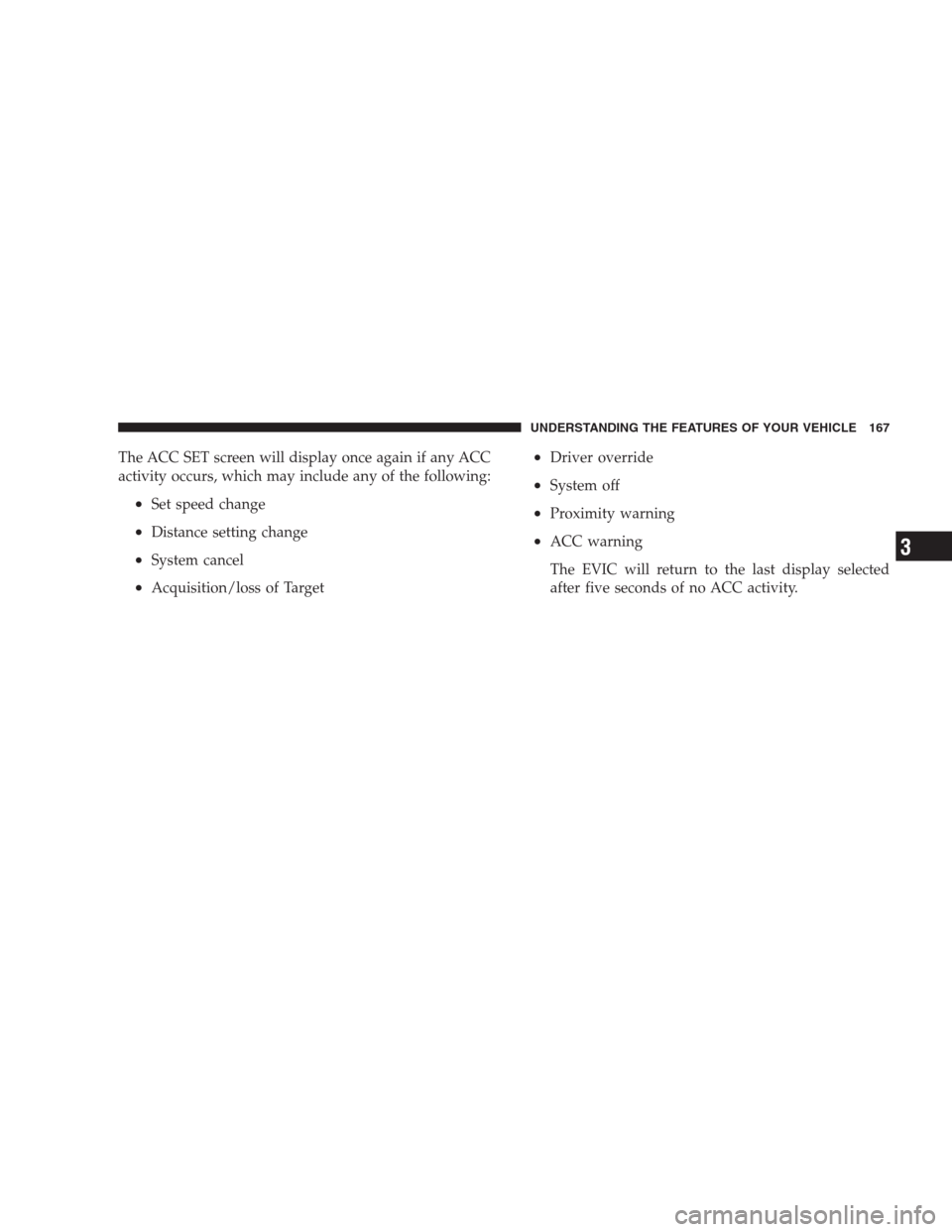
Display Warnings and Maintenance
ACC Blinded Warning
The ACC Blinded Warning will display when conditions
temporarily limit system performance. This most often
occurs at times of poor visibility, such as in snow, fog,
heavy rain, or when driving into direct sunlight (sunrise
or sunset). The ACC system may also become tempo-
rarily blinded due to obstructions, such as dirt or ice. In
these cases, the EVIC will display “ACC Blinded” and
the system will deactivate.
NOTE:If the ACC Blinded Warning is active Normal
(Fixed Speed) Cruise Control is still available. For addi-
tional information refer to “Normal (Fixed Speed) Cruise
Control Mode” in this section.
168 UNDERSTANDING THE FEATURES OF YOUR VEHICLE
Page 172 of 526
NOTE:Installing a vehicle front-end protector or an
aftermarket grille or modifying the grille is not recom-
mended. Doing so may block the sensor and inhibit ACC
operation.
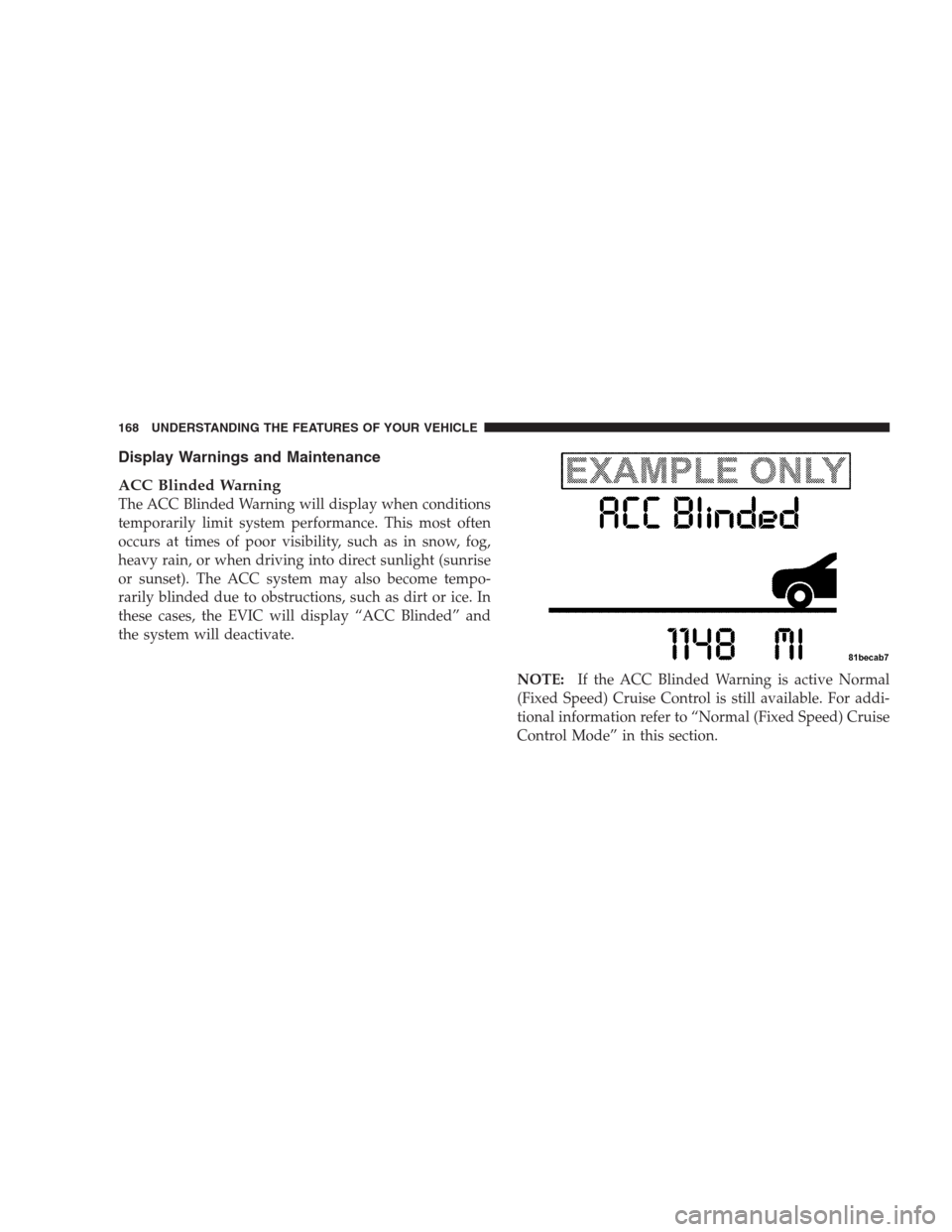
ACC Unavailable Warning
If the system turns off, and the EVIC displays�ACC
UNAVAILABLE,�there may be a temporary malfunction
that limits ACC functionality. Although the vehicle is still
drivable under normal conditions, ACC will be tempo-
rarily unavailable. If this occurs, try activating ACC again
later, following a key cycle. If the problem persists, see
your authorized dealer.
Service ACC Warning
If the system turns off, and the EVIC displays “SERVICE
ACC,” it indicates there is an internal system fault.
Although the vehicle is still drivable under normal
conditions, have the system checked by an authorized
dealer.
170 UNDERSTANDING THE FEATURES OF YOUR VEHICLE
Page 177 of 526
Normal (Fixed Speed) Cruise Control Mode
In addition to adaptive cruise control mode, a normal
(fixed speed) cruise control mode is available for cruising
at fixed speeds. The Normal cruise control mode is
designed to maintain a set cruising speed without requir-
ing the driver to operate the accelerator. Cruise control
can only be operated if the vehicle speed is above 25 mph
(40 km/h).
To change modes, press and hold the�ON/OFF/MODE�
button for at least one second in either the OFF state or
the READY state.�Normal Cruise Ready�will be dis-
played once the mode becomes available. To switch back
to ACC, press and hold the “ON/OFF/MODE” button
again for at least one second.WARNING!
In the normal cruise control mode, the system will
not react to vehicles ahead. In addition, the proximity
warning does not activate and no alarm will sound
even if you are too close to the vehicle ahead since
the presence of the vehicle ahead nor the vehicle-to-
vehicle distance is detected. Be sure to maintain a
safe distance between your vehicle and the vehicle
ahead. Always be aware which mode is selected.
To set a Desired Speed
When the vehicle reaches the speed desired, tap the lever
down and release (“SET/DECEL”). The EVIC will dis-
play the set speed.
NOTE:You must observe the display when setting or
changing speed, not the speedometer.
UNDERSTANDING THE FEATURES OF YOUR VEHICLE 175
3
Page 179 of 526

REAR PARK ASSIST
The Rear Park Assist is a driver aid that senses for
obstacles behind the vehicle. Refer to the Warnings,
Cautions, and Notes in this section for system limitations
and usage recommendations.
The Rear Park Assist is active when the driver shifts the
transmission into the REVERSE position, and the parking
brake is not applied, and the vehicle speed is less than
10 mph (16 km/h).
The system can be turned on or off through the Electronic
Vehicle Information Center (EVIC) when the vehicle is in
PARK. Refer to “Personal Settings (Customer-
Programmable Features)” under “Electronic Vehicle In-
formation Center (EVIC)” in Section 4.The system uses four sensors located in the rear bumper
to scan for obstacles up to 79 in (200 cm) away from the
rear bumper fascia. The warning display located above
the rear window provides both visible and audible
warnings to indicate the range of the object.
Rear Park Assist LED Display
UNDERSTANDING THE FEATURES OF YOUR VEHICLE 177
3
Page 180 of 526
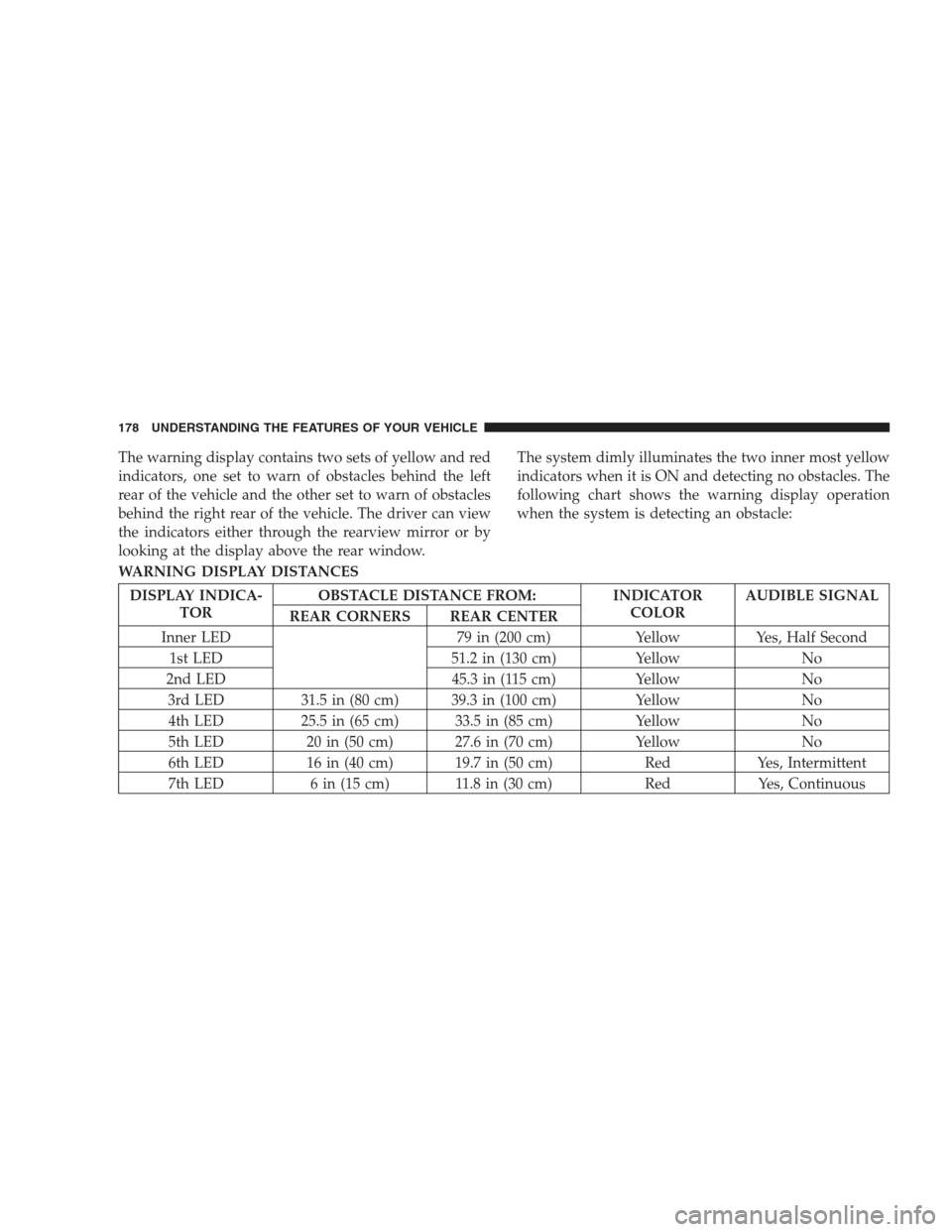
The warning display contains two sets of yellow and red
indicators, one set to warn of obstacles behind the left
rear of the vehicle and the other set to warn of obstacles
behind the right rear of the vehicle. The driver can view
the indicators either through the rearview mirror or by
looking at the display above the rear window.The system dimly illuminates the two inner most yellow
indicators when it is ON and detecting no obstacles. The
following chart shows the warning display operation
when the system is detecting an obstacle:
WARNING DISPLAY DISTANCES
DISPLAY INDICA-
TOROBSTACLE DISTANCE FROM: INDICATOR
COLORAUDIBLE SIGNAL
REAR CORNERS REAR CENTER
Inner LED 79 in (200 cm) Yellow Yes, Half Second
1st LED 51.2 in (130 cm) Yellow No
2nd LED 45.3 in (115 cm) Yellow No
3rd LED 31.5 in (80 cm) 39.3 in (100 cm) Yellow No
4th LED 25.5 in (65 cm) 33.5 in (85 cm) Yellow No
5th LED 20 in (50 cm) 27.6 in (70 cm) Yellow No
6th LED 16 in (40 cm) 19.7 in (50 cm) Red Yes, Intermittent
7th LED 6 in (15 cm) 11.8 in (30 cm) Red Yes, Continuous
178 UNDERSTANDING THE FEATURES OF YOUR VEHICLE
Page 181 of 526
NOTE:The Rear Park Assist will MUTE the radio, if on,
when the system is sounding an audio tone.
WARNING!
•Drivers must be careful when backing up even
when using the Rear Park Assist. Always check
carefully behind your vehicle, look behind you,
and be sure to check for pedestrians, animals,
other vehicles, obstructions, and blind spots be-
fore backing up. You are responsible for safety and
must continue to pay attention to your surround-
ings. Failure to do so can result in serious injury or
death.
(Continued)
WARNING! (Continued)
•Before using the Rear Park Assist, it is strongly
recommended that the ball mount and hitch ball
assembly is disconnected from the vehicle when
the vehicle is not used for towing. Failure to do so
can result in injury or damage to vehicles or
obstacles because the hitch ball will be much
closer to the obstacle than the rear fascia when the
warning display turns the red indicators ON. Also,
the sensors could detect the ball mount and hitch
ball assembly, depending on its size and shape,
giving a false indication that an obstacle is behind
the vehicle.
UNDERSTANDING THE FEATURES OF YOUR VEHICLE 179
3
Page 184 of 526
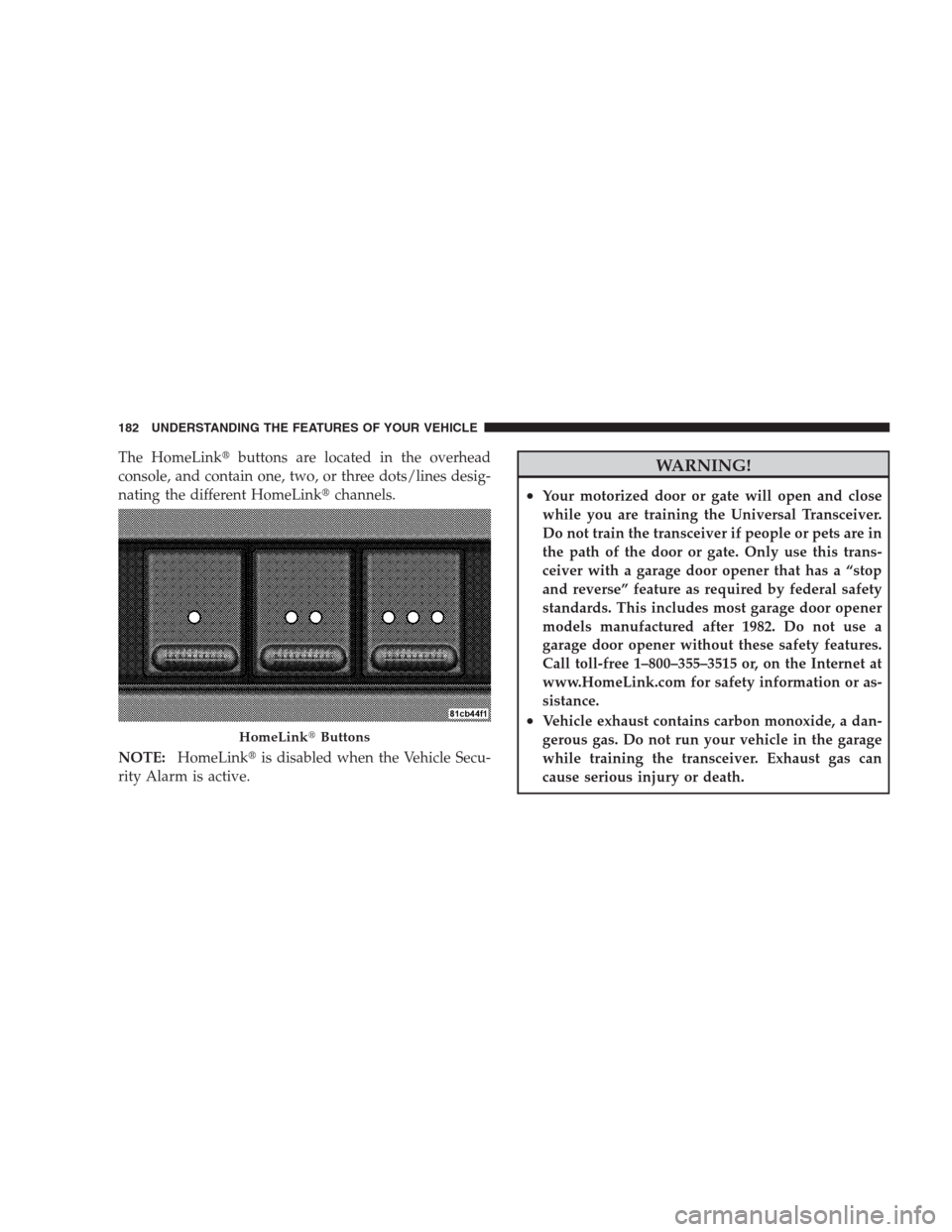
The HomeLink�buttons are located in the overhead
console, and contain one, two, or three dots/lines desig-
nating the different HomeLink�channels.
NOTE:HomeLink�is disabled when the Vehicle Secu-
rity Alarm is active.WARNING!
•Your motorized door or gate will open and close
while you are training the Universal Transceiver.
Do not train the transceiver if people or pets are in
the path of the door or gate. Only use this trans-
ceiver with a garage door opener that has a “stop
and reverse” feature as required by federal safety
standards. This includes most garage door opener
models manufactured after 1982. Do not use a
garage door opener without these safety features.
Call toll-free 1–800–355–3515 or, on the Internet at
www.HomeLink.com for safety information or as-
sistance.
•Vehicle exhaust contains carbon monoxide, a dan-
gerous gas. Do not run your vehicle in the garage
while training the transceiver. Exhaust gas can
cause serious injury or death.
HomeLink�Buttons
182 UNDERSTANDING THE FEATURES OF YOUR VEHICLE