Page 414 of 526
CAUTION! (Continued)
•Racing the engine or spinning the wheels too fast
may lead to transmission overheating and failure.
It can also damage the tires. Do not spin the
wheels above 35 mph (55 km/h).
WARNING!
Fast spinning tires can be dangerous. Forces gener-
ated by excessive wheel speeds may cause tire dam-
age or failure. A tire could explode and injure some-
one. Do not spin your vehicle’s wheels faster than
35 mph (55 km/h) when you are stuck, and don’t let
anyone near a spinning wheel, no matter what the
speed.
TOWING A DISABLED VEHICLE
Without The Ignition Key
Special care must be taken when the vehicle is towed
with the ignition in the LOCK position. The only ap-
proved method of towing without the ignition key is
with a flatbed truck. Proper towing equipment is neces-
sary to prevent damage to the vehicle.
Towing This Vehicle Behind Another Vehicle
Flatbed towing is recommended. DO NOT tow an AWD
vehicle with the rear wheels on the ground unless the
rear driveshaft is removed and the transmission is in
NEUTRAL.
Vehicles WITHOUT AWD may be towed (with rear
wheels on the ground) with the transmission in NEU-
TRAL under the following conditions:
•The distance to be traveled must not exceed 15 miles
(24 km).
412 WHAT TO DO IN EMERGENCIES
Page 432 of 526
WARNING! (Continued)
•The air conditioning system contains refrigerant
under high pressure. To avoid risk of personal
injury or damage to the system, adding refrigerant
or any repair requiring lines to be disconnected
should be done by an experienced technician.
Refrigerant Recovery and Recycling
R-134a Air Conditioning Refrigerant is a hydrofluoro-
carbon (HFC) that is endorsed by the Environmental
Protection Agency and is an ozone-saving product. How-
ever, the manufacturer recommends that air conditioning
service be performed by authorized dealers or other
service facilities using recovery and recycling equipment.
NOTE:Use only manufacturer approved A/C system
sealers, stop leak products, seal conditioners, compressor
oil, and refrigerants.
A/C Air Filter
The filter is located in the fresh air inlet under the hood,
behind a removable panel in the cowl on the passenger
side of the vehicle, next to the windshield wipers. When
installing a new filter, ensure its proper orientation. To
replace the filter, remove the access door in the cowl
screen by pressing the retaining clips. Slide the lid on the
filter adapter forward and down and remove the used
filter. Install the new filter with arrows pointing in the
direction of airflow, which is toward the rear of the
vehicle (text and arrows on the filter indicate this).
Refer to the “Maintenance Schedule” in Section 8 for
proper maintenance intervals.
Body Lubrication
Locks and all body pivot points, including such items as
seat tracks, door hinge pivot points and rollers, liftgate,
tailgate, sliding doors and hood hinges, should be lubri-
cated periodically with a lithium based grease such as
430 MAINTAINING YOUR VEHICLE
Page 433 of 526
MOPAR�Spray White Lube to assure quiet, easy opera-
tion and to protect against rust and wear. Prior to the
application of any lubricant, the parts concerned should
be wiped clean to remove dust and grit; after lubricating
excess oil and grease should be removed. Particular
attention should also be given to hood latching compo-
nents to insure proper function. When performing other
underhood services, the hood latch, release mechanism
and safety catch should be cleaned and lubricated.
The external lock cylinders should be lubricated twice a
year, preferably in the Fall and Spring. Apply a small
amount of a high quality lubricant such as MOPAR�
Lock Cylinder Lubricant directly into the lock cylinder.
Windshield Wiper Blades
Clean the rubber edges of the wiper blades and the
windshield periodically with a sponge or soft cloth and a
mild nonabrasive cleaner. This will remove accumula-
tions of salt or road film.Operation of the wipers on dry glass for long periods
may cause deterioration of the wiper blades. Always use
washer fluid when using the wipers to remove salt or dirt
from a dry windshield.
Avoid using the wiper blades to remove frost or ice from
the windshield. Keep the blade rubber out of contact with
petroleum products such as engine oil, gasoline, etc.
Windshield Washers/Headlight Washers — If
Equipped
The windshield washer and the headlight washer (if
equipped) share the same fluid reservoir. The fluid
reservoir is located in the front of the engine compart-
ment. Be sure to check the fluid level in the reservoir at
regular intervals. Fill the reservoir with windshield
washer solvent (not radiator antifreeze) and operate the
system for a few seconds to flush out the residual water.
MAINTAINING YOUR VEHICLE 431
7
Page 437 of 526
Cooling System
WARNING!
•When working near the radiator cooling fan, dis-
connect the fan motor lead or turn the ignition
switch to the LOCK position. The fan is tempera-
ture controlled and can start at any time the
ignition switch is in the ON position.
•You or others can be badly burned by hot engine
coolant (antifreeze) or steam from your radiator. If
you see or hear steam coming from under the
hood, do not open the hood until the radiator has
had time to cool. Never try to open a cooling
system pressure cap when the radiator is hot.
Coolant Checks
Check engine coolant (antifreeze) protection every
12 months (before the onset of freezing weather, where
applicable). If the engine coolant (antifreeze) is dirty orrusty in appearance, the system should be drained,
flushed, and refilled with fresh coolant. Check the front
of the A/C condenser for any accumulation of bugs,
leaves, etc. If dirty, clean by gently spraying water from a
garden hose vertically down the face of the condenser.
Check the coolant recovery bottle tubing for brittle rub-
ber, cracking, tears, cuts, and tightness of the connection
at the bottle and radiator. Inspect the entire system for
leaks.
With the engine at normal operating temperature (but
not running), check the cooling system pressure cap for
proper vacuum sealing by draining a small amount of
engine coolant (antifreeze) from the radiator drain cock.
If the cap is sealing properly, the engine coolant (anti-
freeze) will begin to drain from the coolant recovery
bottle. DO NOT REMOVE THE COOLANT PRESSURE
CAP WHEN THE COOLING SYSTEM IS HOT.
MAINTAINING YOUR VEHICLE 435
7
Page 452 of 526
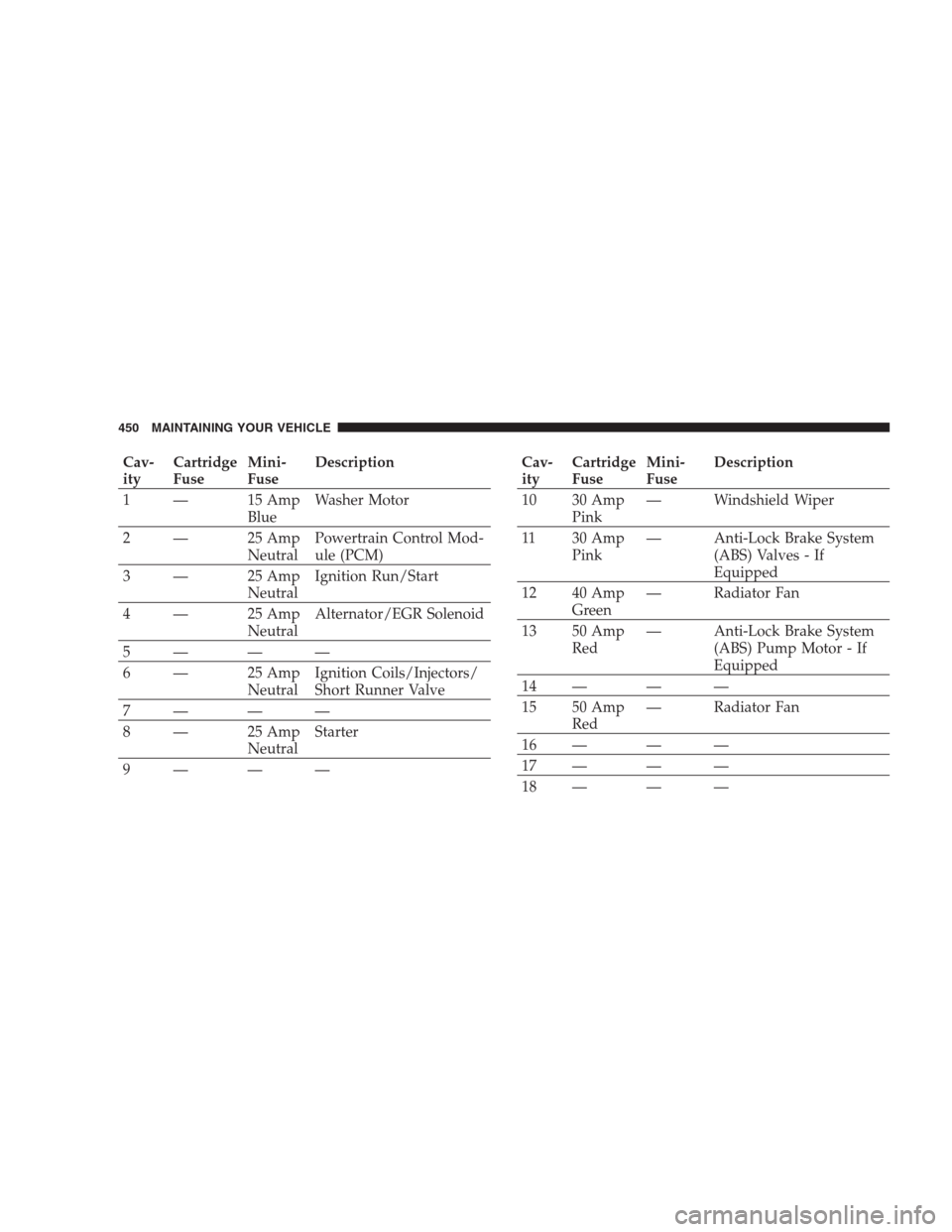
Cav-
ityCartridge
FuseMini-
FuseDescription
1 — 15 Amp
BlueWasher Motor
2 — 25 Amp
NeutralPowertrain Control Mod-
ule (PCM)
3 — 25 Amp
NeutralIgnition Run/Start
4 — 25 Amp
NeutralAlternator/EGR Solenoid
5— — —
6 — 25 Amp
NeutralIgnition Coils/Injectors/
Short Runner Valve
7— — —
8 — 25 Amp
NeutralStarter
9— — —Cav-
ityCartridge
FuseMini-
FuseDescription
10 30 Amp
Pink— Windshield Wiper
11 30 Amp
Pink— Anti-Lock Brake System
(ABS) Valves - If
Equipped
12 40 Amp
Green— Radiator Fan
13 50 Amp
Red— Anti-Lock Brake System
(ABS) Pump Motor - If
Equipped
14 — — —
15 50 Amp
Red— Radiator Fan
16 — — —
17 — — —
18 — — —
450 MAINTAINING YOUR VEHICLE
Page 457 of 526
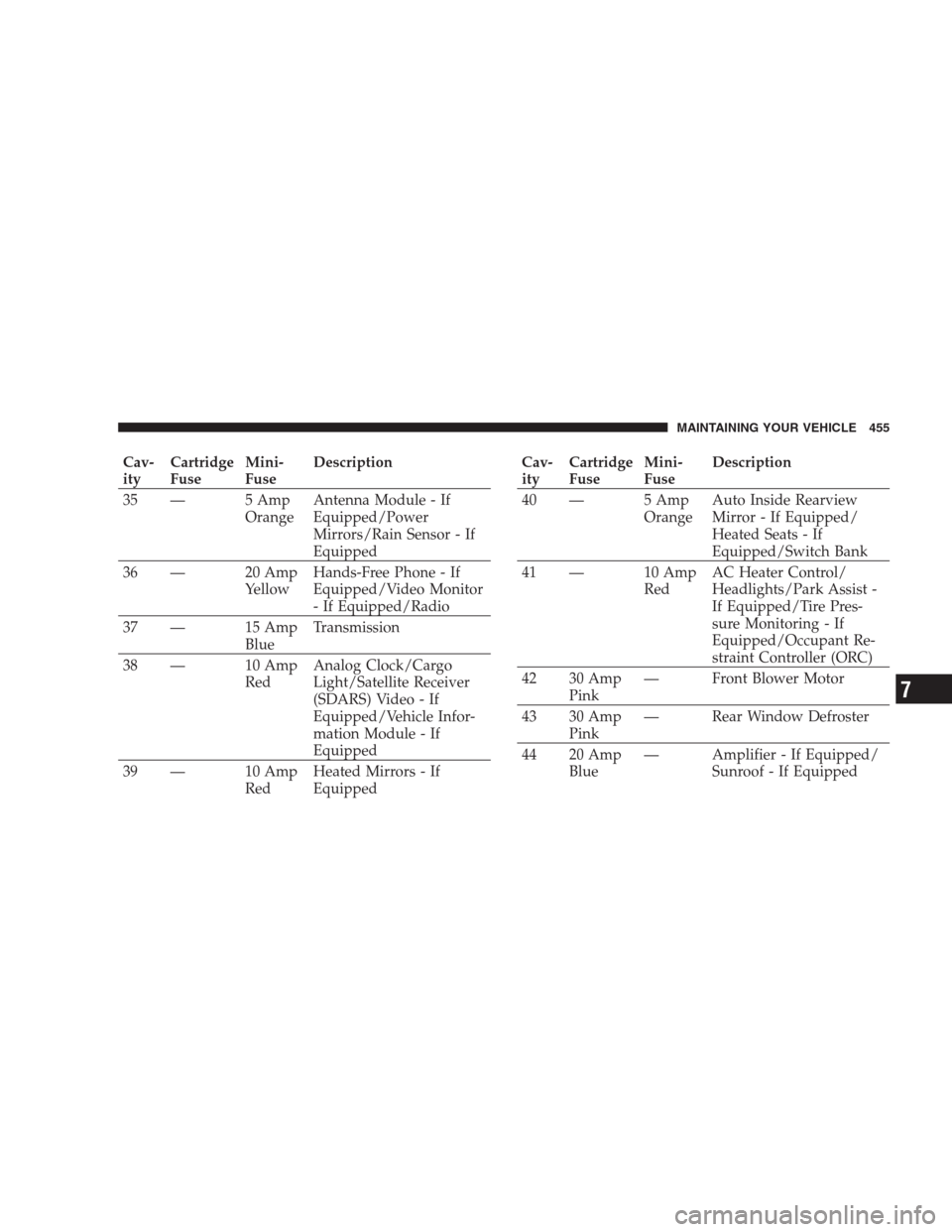
Cav-
ityCartridge
FuseMini-
FuseDescription
35 — 5 Amp
OrangeAntenna Module - If
Equipped/Power
Mirrors/Rain Sensor - If
Equipped
36 — 20 Amp
YellowHands-Free Phone - If
Equipped/Video Monitor
- If Equipped/Radio
37 — 15 Amp
BlueTransmission
38 — 10 Amp
RedAnalog Clock/Cargo
Light/Satellite Receiver
(SDARS) Video - If
Equipped/Vehicle Infor-
mation Module - If
Equipped
39 — 10 Amp
RedHeated Mirrors - If
EquippedCav-
ityCartridge
FuseMini-
FuseDescription
40 — 5 Amp
OrangeAuto Inside Rearview
Mirror - If Equipped/
Heated Seats - If
Equipped/Switch Bank
41 — 10 Amp
RedAC Heater Control/
Headlights/Park Assist -
If Equipped/Tire Pres-
sure Monitoring - If
Equipped/Occupant Re-
straint Controller (ORC)
42 30 Amp
Pink— Front Blower Motor
43 30 Amp
Pink— Rear Window Defroster
44 20 Amp
Blue— Amplifier - If Equipped/
Sunroof - If Equipped
MAINTAINING YOUR VEHICLE 455
7
Page 460 of 526
Center High Mount Stop Light
(CHMSL)....... LED(Serviced at Authorized Dealer)
Outside Mirror Turn Signal & Approach
Lights.......... LED(Serviced at Authorized Dealer)
License.............................. W5W
BULB REPLACEMENT
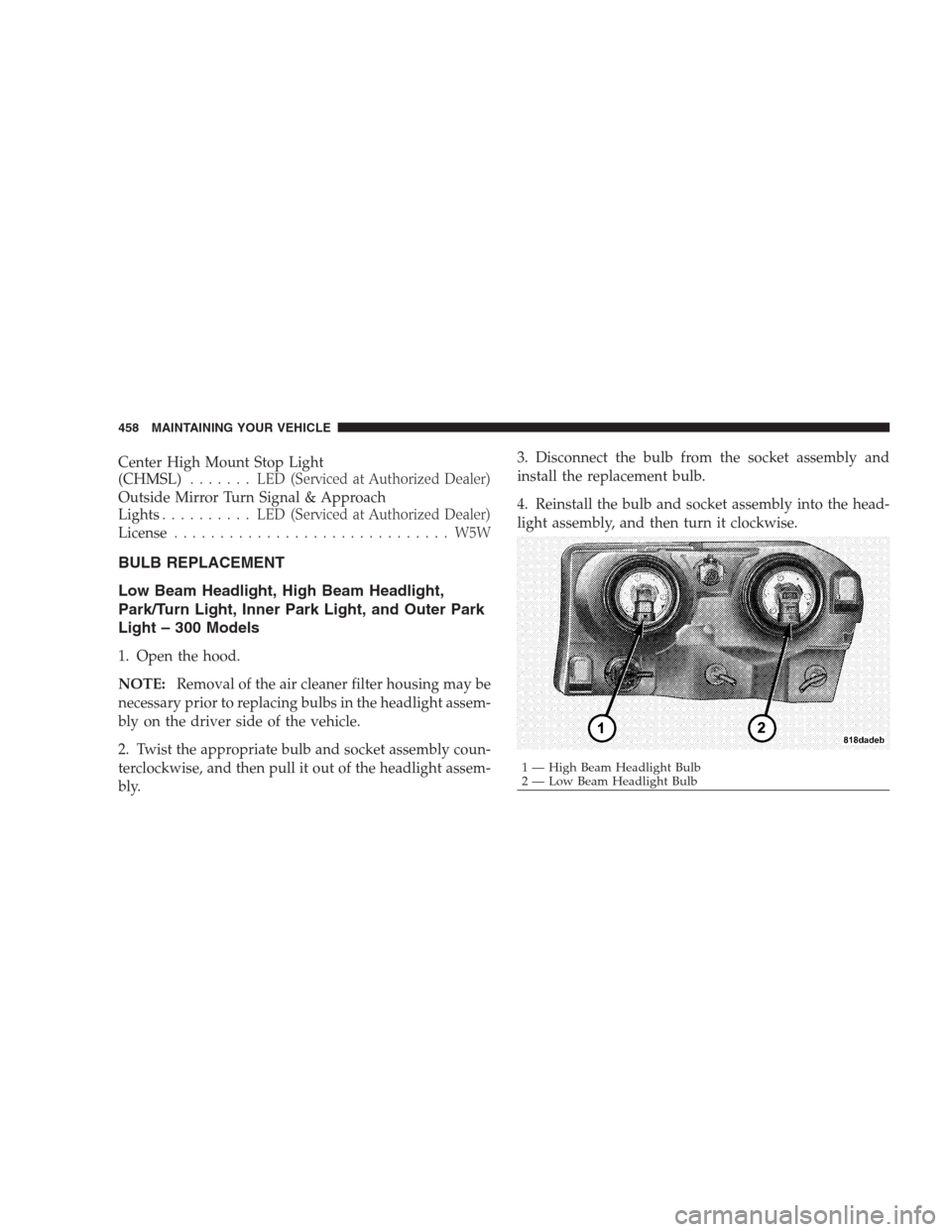
Low Beam Headlight, High Beam Headlight,
Park/Turn Light, Inner Park Light, and Outer Park
Light – 300 Models
1. Open the hood.
NOTE:Removal of the air cleaner filter housing may be
necessary prior to replacing bulbs in the headlight assem-
bly on the driver side of the vehicle.
2. Twist the appropriate bulb and socket assembly coun-
terclockwise, and then pull it out of the headlight assem-
bly.3. Disconnect the bulb from the socket assembly and
install the replacement bulb.
4. Reinstall the bulb and socket assembly into the head-
light assembly, and then turn it clockwise.
1 — High Beam Headlight Bulb
2 — Low Beam Headlight Bulb 458 MAINTAINING YOUR VEHICLE
Page 463 of 526
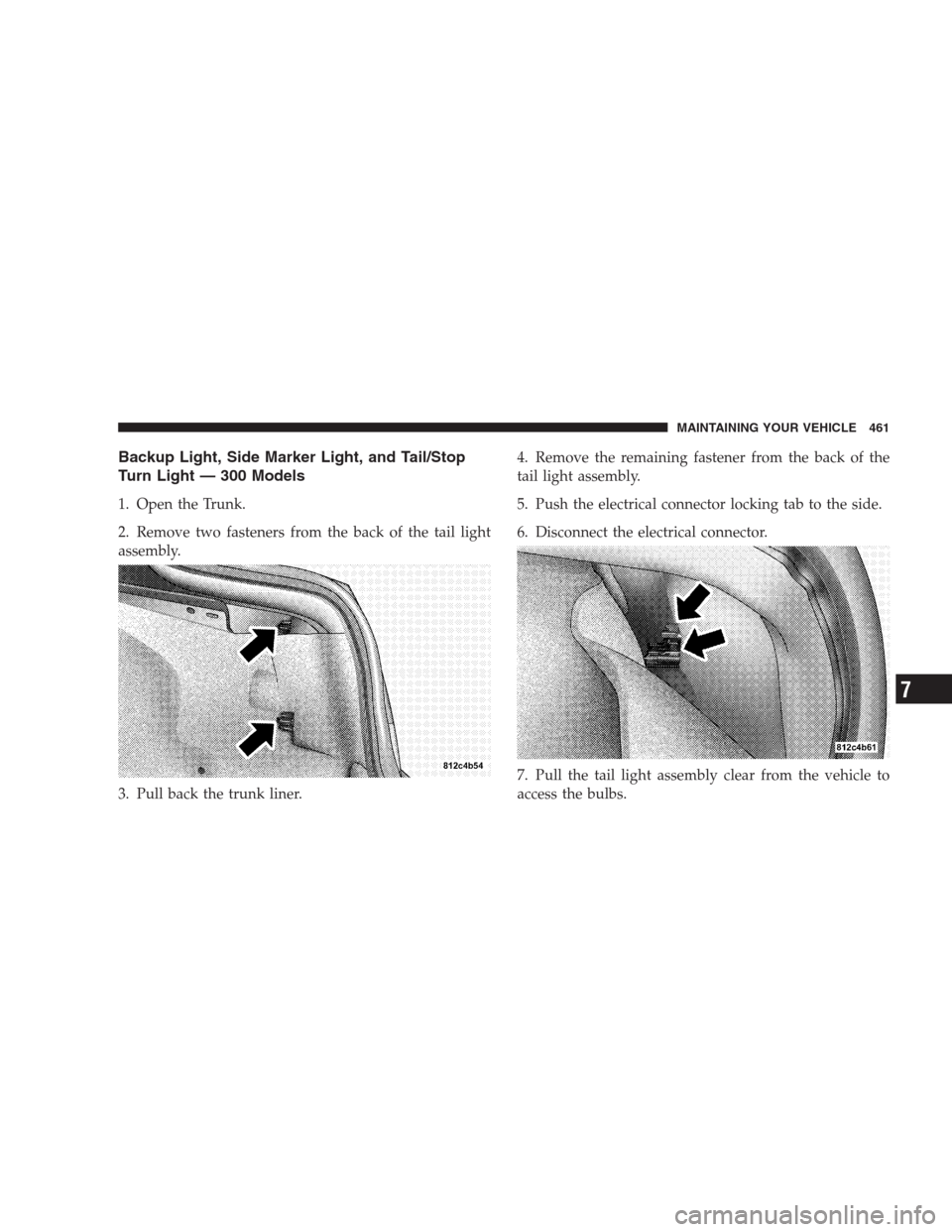
Backup Light, Side Marker Light, and Tail/Stop
Turn Light — 300 Models
1. Open the Trunk.
2. Remove two fasteners from the back of the tail light
assembly.
3. Pull back the trunk liner.4. Remove the remaining fastener from the back of the
tail light assembly.
5. Push the electrical connector locking tab to the side.
6. Disconnect the electrical connector.
7. Pull the tail light assembly clear from the vehicle to
access the bulbs.
MAINTAINING YOUR VEHICLE 461
7