Page 288 of 526
•Display Sirius ID number — Press the AUDIO/
SELECT button to display the Sirius ID number. This
number is used to activate, deactivate, or change the
Sirius subscription.
SET Button – To Set the Pushbutton Memory
When you are receiving a channel that you wish to
commit to pushbutton memory, press the SET button.
The symbol SET 1 will now show in the display window.
Select the button (1-6) you wish to lock onto this channel
and press and release that button. If a button is not
selected within five seconds after pressing the SET but-
ton, the channel will continue to play but will not be
stored into pushbutton memory.
You may add a second channel to each pushbutton by
repeating the above procedure with this exception: Press
the SET button twice and SET 2 will show in the display
window. Each button can be set for SET 1 and SET 2. This
allows a total of 12 Satellite channels to be stored intopushbutton memory. The channels stored in SET 2
memory can be selected by pressing the pushbutton
twice.
Every time a preset button is used, a corresponding
button number will display.Buttons1-6
These buttons tune the radio to the channels that you
commit to pushbutton memory (12 Satellite stations).
Operating Instructions — uconnect�phone (If
Equipped)
Refer to “uconnect�phone” in Section 3.
Operating Instructions — Video Entertainment
System (VES)™ (If Equipped)
Refer to separate “Video Entertainment System (VES)™
Guide.”
286 UNDERSTANDING YOUR INSTRUMENT PANEL
Page 293 of 526
REMOTE SOUND SYSTEM CONTROLS — IF
EQUIPPED
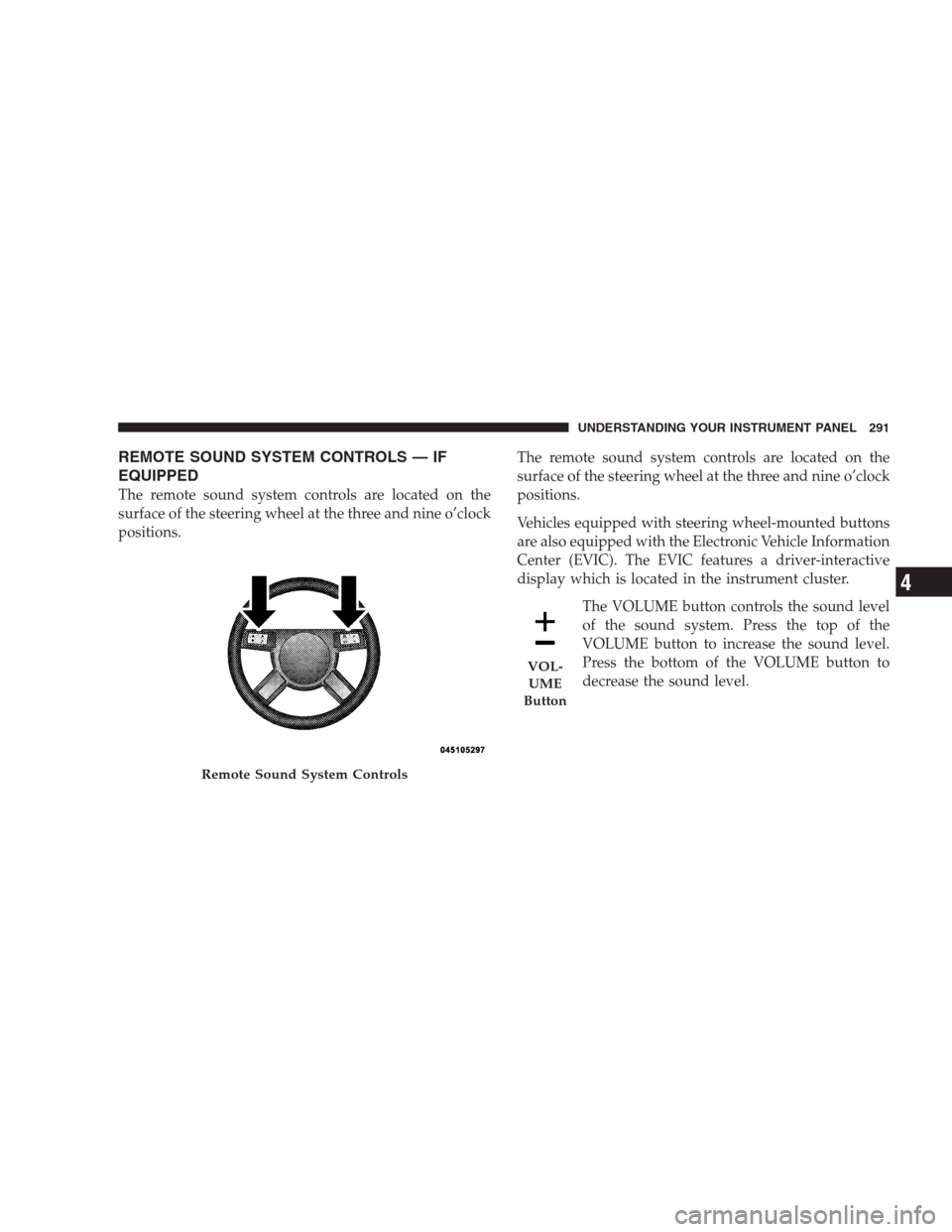
The remote sound system controls are located on the
surface of the steering wheel at the three and nine o’clock
positions.The remote sound system controls are located on the
surface of the steering wheel at the three and nine o’clock
positions.
Vehicles equipped with steering wheel-mounted buttons
are also equipped with the Electronic Vehicle Information
Center (EVIC). The EVIC features a driver-interactive
display which is located in the instrument cluster.
The VOLUME button controls the sound level
of the sound system. Press the top of the
VOLUME button to increase the sound level.
Press the bottom of the VOLUME button to
decrease the sound level.
Remote Sound System Controls
VOL-
UME
Button
UNDERSTANDING YOUR INSTRUMENT PANEL 291
4
Page 298 of 526
•Bi-Level
Air flows through the outlets located in the instru-
ment panel and through the outlets located on the
floor. Air flows through the registers in the back of the
center console to the rear seat passengers. These registers
can be closed to partially block airflow.
•Panel
Air flows through the outlets located in the instru-
ment panel. Air flows through the registers in the
back of the center console to the rear seat passengers.
These registers can be closed to block airflow.
•Recirculation Control
The mode control knob also controls the recir-
culation feature. You can choose Bi-Level Re-
circulation air outlets, Panel Recirculation air
outlets, or a mix or both while in this mode.
Normally, air enters from outside the vehicle. However,
when in Recirculation mode air inside the vehicle isre-used. Use this mode to cool the inside of the vehicle
rapidly. The Recirculation mode can also be used to
temporarily block out outside odors, smoke, and dust.
Air Conditioning Control
Press this button to turn on and turn off the air
conditioning. When the air conditioning is turned
on, cool dehumidified air will flow through the
outlets selected with the mode control. Press this button
a second time to turn off the air conditioning. An
indicator in the button will illuminate when compressor
operation is selected.
296 UNDERSTANDING YOUR INSTRUMENT PANEL
Page 303 of 526
The operator can override the AUTO mode setting to
change airflow distribution by rotating the mode control
knob (on the right) to one of the following positions.
•Defrost
Air is directed to the windshield through the
outlets at the base of the windshield. Air is also
directed to the front door windows through the side
window demister grilles.
•Defrost/Floor
Air flows through the front and rear floor outlets
and the outlets at the base of the windshield. Air is
also directed to the front door windows through the
side window demister grilles.
•Floor
Air flows through the floor outlets located under
the instrument panel and into the rear seating area
through vents under the front seats.
•Bi-Level
Air flows through the outlets located in the instru-
ment panel and through the outlets located on the
floor. Air flows through the registers in the back of the
center console to the rear seat passengers. These registers
can be closed to block airflow.
•Panel
Air flows through the outlets located in the instru-
ment panel. Air flows through the registers in the
back of the center console to the rear seat passengers.
These registers can be closed to block airflow.
•Air Conditioning Control
Press this button to turn on the air conditioning
during manual operation only. When the air con-
ditioning is turned on, cool dehumidified air will
flow through the outlets selected with the mode control
dial. Press this button a second time to turn off the air
conditioning. An indicator in the button illuminates
when manual compressor operation is selected.
UNDERSTANDING YOUR INSTRUMENT PANEL 301
4
Page 304 of 526
NOTE:To control the air conditioning manually, the
mode selector must be moved out of the AUTO position.
•Recirculation Control
This button can be used to block out smoke,
odors, dust, high humidity, or if rapid cooling
is desired. The Recirculation mode should only
be used temporarily. An indicator in the button
illuminates when the Recirculation mode is active. You
may use this feature separately.
NOTE:Extended use of recirculation may cause the
windows to fog. If the interior of the windows begins to
fog, press the recirculation button to return to outside air.
Some temp/humidity conditions will cause captured
interior air to condense on windows and hamper visibil-
ity. For this reason, the system will not allow recirculation
to be selected while in Defrost or Defrost/Floor mode.Attempting to use the recirculation while in these modes
will cause the indicator in the control button to blink and
then turn off.
Operating Tips
NOTE:Refer to the chart at the end of this section for
suggested control settings for various weather condi-
tions.
Summer Operation
The engine cooling system in air-conditioned vehicles
must be protected with a high-quality antifreeze coolant
to provide proper corrosion protection and to protect
against engine overheating. A 50% solution of ethylene
glycol antifreeze coolant in water is recommended. Refer
to “Maintenance Procedures” in Section 7 for proper
coolant selection.
302 UNDERSTANDING YOUR INSTRUMENT PANEL
Page 307 of 526
STARTING AND OPERATING
CONTENTS
�Starting Procedures.................... 309
▫Automatic Transmission............... 309
▫Normal Starting..................... 310
▫Extremely Cold Weather (Below -20°F Or
-29°C)............................ 311
▫If Engine Fails To Start................ 311
▫After Starting....................... 312
�Engine Block Heater — If Equipped........ 312
�Automatic Transmission................. 312▫General Information.................. 313
▫Brake/Transmission Shift Interlock System . . 315
▫Brake/Transmission Interlock Manual
Override.......................... 315
▫4-Speed Automatic Transmission......... 316
▫5-Speed Automatic Transmission......... 321
�AutoStick�— If Equipped............... 326
▫AutoStick�Operation................. 326
�All-Wheel Drive (AWD) — If Equipped...... 326
5
Page 308 of 526
�Driving On Slippery Surfaces............. 327
▫Acceleration........................ 327
▫Traction........................... 328
�Driving Through Water................. 328
▫Flowing/Rising Water................. 329
▫Shallow Standing Water............... 329
�Power Steering....................... 331
▫Power Steering Fluid Check............. 332
�Parking Brake........................ 332
�Anti-Lock Brake System................. 334
�Electronic Brake Control System........... 336
▫Anti-Lock Brake System (ABS)........... 336
▫Traction Control System (TCS)........... 337▫Brake Assist System (BAS).............. 337
▫Electronic Stability Program (ESP)........ 338
▫Synchronizing ESP................... 340
▫ESP/BAS Malfunction Indicator Light And
ESP/TCS Indicator Light............... 341
�Tire Safety Information................. 342
▫Tire Markings....................... 342
▫Tire Identification Number (TIN)......... 345
▫Tire Loading And Tire Pressure.......... 346
�Tires — General Information............. 350
▫Tire Pressure....................... 350
▫Tire Inflation Pressures................ 351
▫Tire Pressures For High Speed Operation . . . 353
306 STARTING AND OPERATING
Page 312 of 526
CAUTION!
Damage to the transmission may occur if the follow-
ing precautions are not observed:
•Shift into PARK only after the vehicle has come to
a complete stop.
•Shift into or out of REVERSE only after the
vehicle has come to a complete stop and the engine
is at idle speed.
•Do not shift from REVERSE, PARK, or NEUTRAL
into any forward gear when the engine is above
idle speed.
•Before shifting into any gear, make sure your foot
is firmly on the brake pedal.
Normal Starting
Tip Start
NOTE:Normal starting of either a cold or a warm
engine is obtained without pumping or depressing the
accelerator pedal.
Do notpress the accelerator. Use the Fob with Integrated
Key to briefly turn the ignition switch to the START
position and release it as soon as the starter engages. The
starter motor will continue to run, and it will disengage
automatically when the engine is running. If the engine
fails to start, the starter will disengage automatically in
10 seconds. If this occurs, turn the ignition switch to the
LOCK position, wait 10 to 15 seconds, then repeat the
normal starting procedure.
310 STARTING AND OPERATING