2009 CHEVROLET CORVETTE tow
[x] Cancel search: towPage 218 of 434
Audio Settings
Press and holdOewhen no tone or speaker control
is displayed to adjust all tone and speaker controls
to the middle position. AUDIO SETTINGS CENTERED
displays.
Adjusting the Tone (Bass/Treble)
Oe(Bass/Treble):To adjust the Bass or Treble:
Press and release
Oeuntil BASS or TREBLE
displays.
Turn theOeknob to increase or to decrease
the level.
Press and hold theOeknob until the level
changes to the middle position.
Adjusting the Speakers (Balance/Fade)
Oe(Balance/Fade):To adjust the Balance:
Press and release
Oeuntil BALANCE displays.
Turn theOeknob to move the sound toward the
right or the left speakers.
Press and hold theOeknob until the level
changes to the middle position.To adjust the Fade:
Press and release
Oeuntil FADE displays
Turn theOeknob to move the sound toward the
front or the rear speakers.
Press and hold theOeknob until the level
changes to the middle position.
AUTO EQ (Automatic Equalization):The radio saves
separate AUTO EQ settings for each preset and source.
For vehicles without the Bose
®sound system:
Press AUTO EQ to select equalization settings
designed for CLASSICAL, POP, ROCK, JAZZ,
TALK, and COUNTRY.
Selecting CUSTOM or changing bass or treble,
returns the EQ to the manual bass and treble
settings.
For vehicles with the Bose
®sound system:
Press AUTO EQ to select equalization settings from
EQ1 through EQ6.
Selecting CUSTOM or changing bass or treble,
returns the EQ to the manual bass and treble
settings.
3-82
Page 245 of 434
Your Driving, the Road, and the Vehicle............4-2
Driving for Better Fuel Economy.......................4-2
Defensive Driving...........................................4-2
Drunk Driving.................................................4-3
Control of a Vehicle........................................4-3
Braking.........................................................4-4
Antilock Brake System (ABS)...........................4-5
Braking in Emergencies...................................4-6
Traction Control System (TCS).........................4-6
Active Handling System...................................4-8
Limited-Slip Rear Axle...................................4-10
Selective Ride Control...................................4-10
Steering......................................................4-11
Off-Road Recovery.......................................4-13
Passing.......................................................4-13
Loss of Control.............................................4-13Racing or Other Competitive Driving................4-15
Driving at Night............................................4-16
Driving in Rain and on Wet Roads..................4-16
Before Leaving on a Long Trip.......................4-17
Highway Hypnosis........................................4-18
Hill and Mountain Roads................................4-18
Winter Driving..............................................4-19
If Your Vehicle is Stuck in Sand, Mud,
Ice, or Snow.............................................4-21
Rocking Your Vehicle to Get It Out.................4-22
Loading the Vehicle......................................4-22
Towing..........................................................4-28
Towing Your Vehicle.....................................4-28
Recreational Vehicle Towing...........................4-28
Towing a Trailer...........................................4-28
Section 4 Driving Your Vehicle
4-1
Page 266 of 434
Rocking Your Vehicle to Get It Out
Turn the steering wheel left and right to clear the area
around the front wheels. Turn the traction control system
off. Shift back and forth between R (Reverse) and a
forward gear, spinning the wheels as little as possible.
For a manual transmission, shift slowly between either
1 (First) or 2 (Second) and R (Reverse), allowing the
wheels to stop before shifting into gear. To prevent
transmission wear, wait until the wheels stop spinning
before shifting gears. Release the accelerator pedal while
shifting, and press lightly on the accelerator pedal when
the transmission is in gear. Slowly spinning the wheels in
the forward and reverse directions causes a rocking
motion that could free the vehicle. If that does not get the
vehicle out after a few tries, it might need to be towed out.
If the vehicle does need to be towed out, seeTowing
Your Vehicle on page 4-28.
Loading the Vehicle
It is very important to know how much weight your
vehicle can carry. This weight is called the vehicle
capacity weight and includes the weight of all
occupants, cargo and all nonfactory-installed
options. Two labels on your vehicle show how much
weight it may properly carry, the Tire and Loading
Information label and the Certication label.
{CAUTION:
Do not load the vehicle any heavier than the
Gross Vehicle Weight Rating (GVWR), or
either the maximum front or rear Gross Axle
Weight Rating (GAWR). If you do, parts on the
vehicle can break, and it can change the way
your vehicle handles. These could cause you
to lose control and crash. Also, overloading
can shorten the life of the vehicle.
4-22
Page 268 of 434
Steps for Determining Correct Load Limit
1.Locate the statement “The combined weight
of occupants and cargo should never exceed
XXX kg or XXX lbs” on your vehicle’s placard.
2.Determine the combined weight of the driver
and passengers that will be riding in your
vehicle.
3.Subtract the combined weight of the driver
and passengers from XXX kg or XXX lbs.
4.The resulting gure equals the available
amount of cargo and luggage load capacity.
For example, if the “XXX” amount equals
1400 lbs and there will be ve 150 lb
passengers in your vehicle, the amount of
available cargo and luggage load capacity is
650 lbs (1400−750 (5 x 150) = 650 lbs).
5.Determine the combined weight of luggage
and cargo being loaded on the vehicle. That
weight may not safely exceed the available
cargo and luggage load capacity calculated in
Step 4.
6.If your vehicle will be towing a trailer, the load
from your trailer will be transferred to your
vehicle. Consult this manual to determine how
this reduces the available cargo and luggage
load capacity of your vehicle.
Your vehicle is neither designed nor intended
to tow a trailer.
4-24
Page 272 of 434
Towing
Towing Your Vehicle
The vehicle was neither designed nor intended to be
towed with any of its wheels on the ground.
Consult your dealer/retailer or a professional towing
service if the disabled vehicle needs to be towed.
SeeRoadside Assistance Program on page 7-7.
Notice:Dolly towing or dinghy towing the vehicle
may cause damage because of reduced ground
clearance. Always put the vehicle on a atbed truck.
Recreational Vehicle Towing
Notice:Dolly towing or dinghy towing the vehicle
may cause damage because of reduced ground
clearance. Always put the vehicle on a atbed truck.
The vehicle was neither designed nor intended to be
towed with any of its wheels on the ground. If the vehicle
must be towed, see “Towing Your Vehicle” earlier in
this section.
Towing a Trailer
The vehicle is neither designed nor intended to tow a
trailer.
4-28
Page 292 of 434
Engine Oil
Checking Engine Oil
(Except ZO6 and ZR1)
If the CHECK OIL LEVEL message displays on the
Driver Information Center (DIC), check the engine oil
level right away. For more information, seeDriver
Information Center (DIC) on page 3-49. You should
check the engine oil level regularly; this is an added
reminder.
It is a good idea to check the engine oil level every time
you get fuel. In order to get an accurate reading, the oil
must be warm and the vehicle must be on level ground.
The engine oil dipstick handle is a yellow loop.
SeeEngine Compartment Overview on page 5-14
for the location of the engine oil dipstick.
1. Turn off the engine and give the oil a few minutes
to drain back into the oil pan. If you do not do this,
the oil dipstick might not show the actual level.
2. Pull out the dipstick and clean it with a lint-free
paper towel or a cloth, then push it back in all
the way.
3. Remove the dipstick again, keeping the tip down
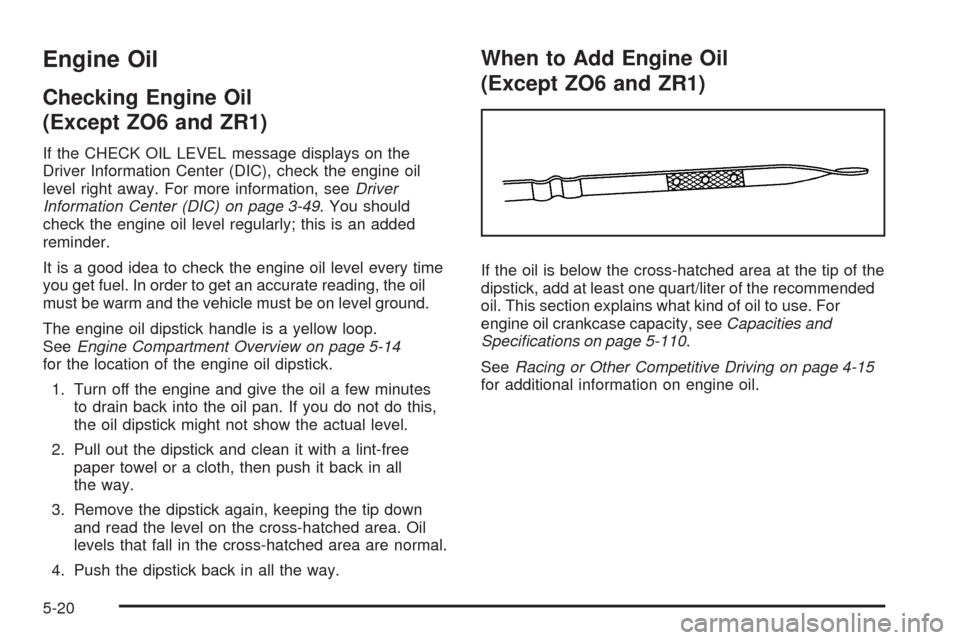
and read the level on the cross-hatched area. Oil
levels that fall in the cross-hatched area are normal.
4. Push the dipstick back in all the way.
When to Add Engine Oil
(Except ZO6 and ZR1)
If the oil is below the cross-hatched area at the tip of the
dipstick, add at least one quart/liter of the recommended
oil. This section explains what kind of oil to use. For
engine oil crankcase capacity, seeCapacities and
Specifications on page 5-110.
SeeRacing or Other Competitive Driving on page 4-15
for additional information on engine oil.
5-20
Page 294 of 434
The engine oil dipstick handle is a yellow loop.
The dipstick is located on the dry sump engine oil tank.
SeeEngine Compartment Overview on page 5-14
for the location of the dry sump engine oil tank.
These vehicles have a racetrack-ready dry sump
engine lubrication system. This high-performance system
operates differently than a standard engine lubrication
system and requires a special procedure when checking
the engine oil level. Follow this procedure closely when
checking the engine oil level.
The engine oil level must be checked when the engine
is warm. Cold oil level in the dry sump tank may not
indicate the actual amount of oil in the system. With
this system, engine oil is contained in an external tank,
separate from the engine. Under normal operating
conditions, the oil pan under the engine does not store
any oil. If the vehicle has been parked for an extended
period without the engine being started, some oil will
seep back into the oil pan, reducing the amount of oil
held in the dry sump tank and there could be no engine
oil at all showing on the dipstick.This is normal since the dipstick is designed to read
engine oil level only after the engine has run long enough
to reach normal operating temperature. Do not add
engine oil based on cold engine dipstick readings.
The engine oil level on the dipstick will also be inaccurate
if checked while the engine is running.
1. To obtain an accurate engine oil level reading,
warm up the engine to at least 175°F (80°C).
Cold oil will not give a correct oil level reading.
2. Once the engine is warm, turn off the engine.
Checking the oil while the engine is running
will result in an incorrect oil level reading.
3. Wait at least ve minutes (but not more than
20 minutes) to allow oil to drain and settle in
the engine.
4. Remove the dipstick from the external engine oil
tank and clean it with a lint-free paper towel or a
cloth. Re-insert the dipstick into the external oil tank,
pushing it all the way in until it stops.
5. Remove the dipstick from the oil tank and read the
level on the cross-hatched area. Oil levels that fall
in the cross-hatched area are normal.
5-22
Page 308 of 434
Checking Coolant
The vehicle must be on a level surface when checking
the coolant level.
Check to see if coolant is visible in the coolant surge
tank. If the coolant inside the coolant surge tank is boiling,
do not do anything else until it cools down. If coolant
is visible but the coolant level is not at or above the
FULL COLD mark, add a 50/50 mixture of clean,
drinkable water and DEX-COOL coolant at the coolant
recovery tank, but be sure the cooling system is cool
before this is done. SeeEngine Coolant on page 5-34
for more information.
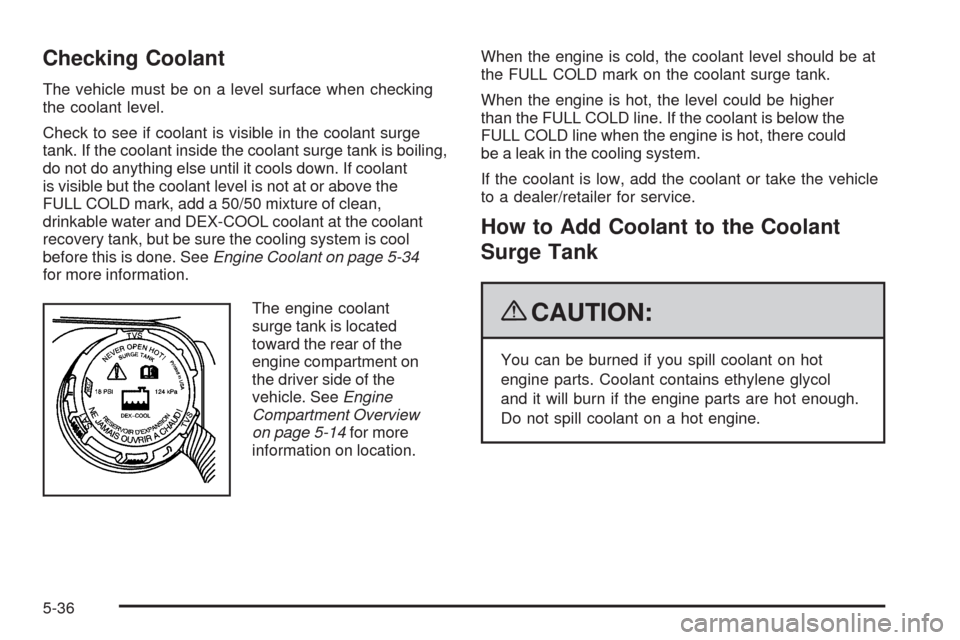
The engine coolant
surge tank is located
toward the rear of the
engine compartment on
the driver side of the
vehicle. SeeEngine
Compartment Overview
on page 5-14for more
information on location.When the engine is cold, the coolant level should be at
the FULL COLD mark on the coolant surge tank.
When the engine is hot, the level could be higher
than the FULL COLD line. If the coolant is below the
FULL COLD line when the engine is hot, there could
be a leak in the cooling system.
If the coolant is low, add the coolant or take the vehicle
to a dealer/retailer for service.
How to Add Coolant to the Coolant
Surge Tank
{CAUTION:
You can be burned if you spill coolant on hot
engine parts. Coolant contains ethylene glycol
and it will burn if the engine parts are hot enough.
Do not spill coolant on a hot engine.
5-36