2009 CHEVROLET CORVETTE tow
[x] Cancel search: towPage 331 of 434
Taillamps, Turn Signal, and
Stoplamps
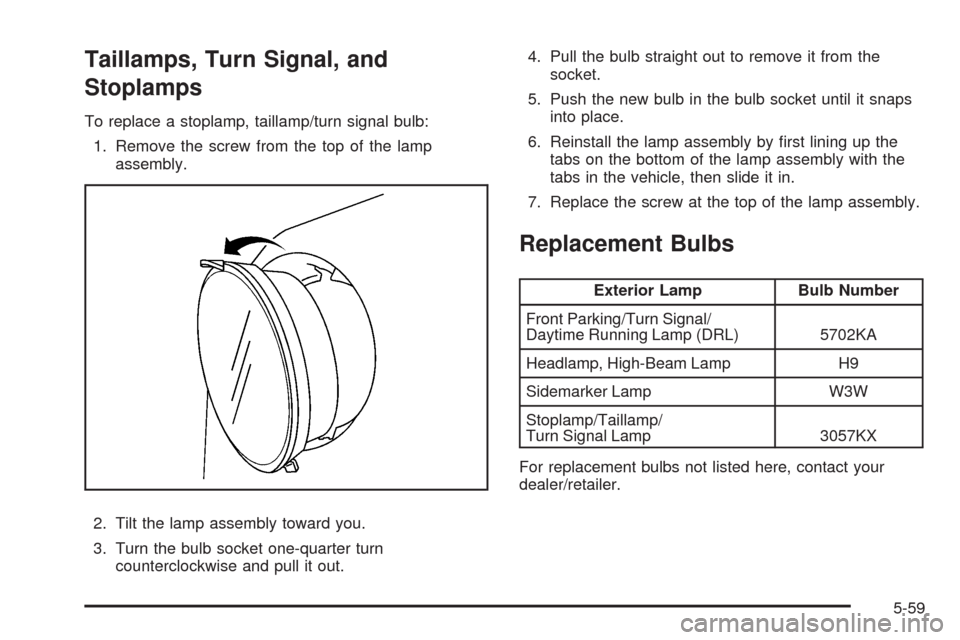
To replace a stoplamp, taillamp/turn signal bulb:
1. Remove the screw from the top of the lamp
assembly.
2. Tilt the lamp assembly toward you.
3. Turn the bulb socket one-quarter turn
counterclockwise and pull it out.4. Pull the bulb straight out to remove it from the
socket.
5. Push the new bulb in the bulb socket until it snaps
into place.
6. Reinstall the lamp assembly by rst lining up the
tabs on the bottom of the lamp assembly with the
tabs in the vehicle, then slide it in.
7. Replace the screw at the top of the lamp assembly.
Replacement Bulbs
Exterior Lamp Bulb Number
Front Parking/Turn Signal/
Daytime Running Lamp (DRL) 5702KA
Headlamp, High-Beam Lamp H9
Sidemarker Lamp W3W
Stoplamp/Taillamp/
Turn Signal Lamp 3057KX
For replacement bulbs not listed here, contact your
dealer/retailer.
5-59
Page 355 of 434
{CAUTION:
Putting a used wheel on the vehicle is dangerous.
You cannot know how it has been used or how
far it has been driven. It could fail suddenly and
cause a crash. If you have to replace a wheel,
use a new GM original equipment wheel.
Notice:The wrong wheel can also cause problems
with bearing life, brake cooling, speedometer or
odometer calibration, headlamp aim, bumper height,
vehicle ground clearance, and tire clearance to
the body and chassis.
{CAUTION:
Rust or dirt on a wheel, or on the parts to
which it is fastened, can make wheel nuts
become loose after a time. The wheel could
come off and cause a crash. When you
change a wheel, remove any rust or dirt from
places where the wheel attaches to the
vehicle. In an emergency, you can use a cloth
or a paper towel to do this; but be sure to use a
scraper or wire brush later, if you need to, to
get all the rust or dirt off.
5-83
Page 362 of 434
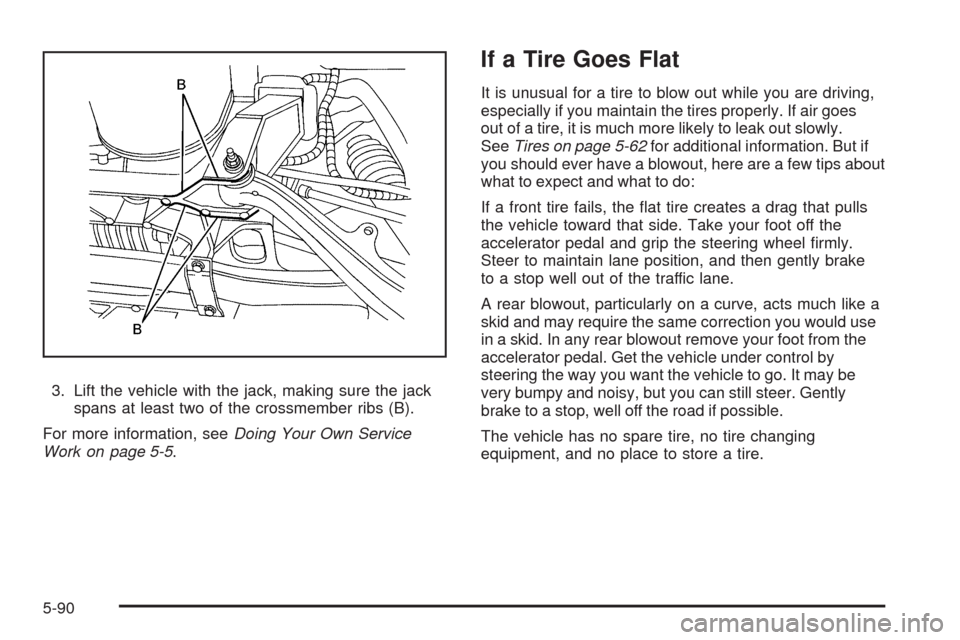
3. Lift the vehicle with the jack, making sure the jack
spans at least two of the crossmember ribs (B).
For more information, seeDoing Your Own Service
Work on page 5-5.
If a Tire Goes Flat
It is unusual for a tire to blow out while you are driving,
especially if you maintain the tires properly. If air goes
out of a tire, it is much more likely to leak out slowly.
SeeTires on page 5-62for additional information. But if
you should ever have a blowout, here are a few tips about
what to expect and what to do:
If a front tire fails, the at tire creates a drag that pulls
the vehicle toward that side. Take your foot off the
accelerator pedal and grip the steering wheel rmly.
Steer to maintain lane position, and then gently brake
to a stop well out of the traffic lane.
A rear blowout, particularly on a curve, acts much like a
skid and may require the same correction you would use
in a skid. In any rear blowout remove your foot from the
accelerator pedal. Get the vehicle under control by
steering the way you want the vehicle to go. It may be
very bumpy and noisy, but you can still steer. Gently
brake to a stop, well off the road if possible.
The vehicle has no spare tire, no tire changing
equipment, and no place to store a tire.
5-90
Page 365 of 434
Fabric/Carpet
Use a vacuum cleaner with a soft brush attachment
frequently to remove dust and loose dirt. A canister
vacuum with a beater bar in the nozzle may only be
used on oor carpet and carpeted oor mats. For any
soil, always try to remove it rst with plain water or club
soda. Before cleaning, gently remove as much of the soil
as possible using one of the following techniques:
For liquids: gently blot the remaining soil with a paper
towel. Allow the soil to absorb into the paper towel
until no more can be removed.
For solid dry soils: remove as much as possible and
then vacuum.
To clean:
1. Saturate a lint-free, clean white cloth with water or
club soda.
2. Wring the cloth to remove excess moisture.
3. Start on the outside edge of the soil and gently rub
toward the center. Continue cleaning, using a clean
area of the cloth each time it becomes soiled.4. Continue to gently rub the soiled area until the
cleaning cloth remains clean.
5. If the soil is not completely removed, use a mild
soap solution and repeat the cleaning process
that was used with plain water.
If any of the soil remains, a commercial fabric cleaner
or spot lifter may be necessary. When a commercial
upholstery cleaner or spot lifter is to be used, test a small
hidden area for colorfastness rst. If the locally cleaned
area gives any impression that a ring formation may
result, clean the entire surface.
After the cleaning process has been completed, a paper
towel can be used to blot excess moisture from the
fabric or carpet.
Coated Moldings
These moldings are around the hatch opening in the
rear area.
When lightly soiled, wipe with a sponge or soft
lint-free cloth dampened with water.
When heavily soiled, use warm soapy water.
5-93
Page 368 of 434
Dry the nish with a soft, clean chamois or an all-cotton
towel to avoid surface scratches and water spotting.
Notice:If you drive the vehicle through an
automatic car wash that does not have enough
clearance for the wide rear tires and wheels, you
could damage the vehicle. Verify with the manager
of the car wash that the vehicle will t before
entering the car wash or use a touchless car wash.
High pressure car washes may cause water to enter the
vehicle. Avoid using high pressure washes closer than
12 inches (30 cm) to the surface of the vehicle. Use of
power washers exceeding 1,200 psi (8 274 kPa) can
result in damage or removal of paint and decals.
Cleaning Exterior Lamps/Lenses
Use only lukewarm or cold water, a soft cloth and a
car washing soap to clean exterior lamps and lenses.
Follow instructions underWashing Your Vehicle on
page 5-95.
Finish Care
Occasional waxing or mild polishing of the vehicle by
hand may be necessary to remove residue from the paint
nish. Approved cleaning products can be obtained from
your dealer/retailer.
If the vehicle has a basecoat/clearcoat paint nish,
the clearcoat gives more depth and gloss to the colored
basecoat. Always use waxes and polishes that are
non-abrasive and made for a basecoat/clearcoat
paint nish.
Notice:Machine compounding or aggressive
polishing on a basecoat/clearcoat paint nish
may damage it. Use only non-abrasive waxes and
polishes that are made for a basecoat/clearcoat
paint nish on the vehicle.
Foreign materials such as calcium chloride and other
salts, ice melting agents, road oil and tar, tree sap, bird
droppings, chemicals from industrial chimneys, etc., can
damage the vehicle’s nish if they remain on painted
surfaces. Wash the vehicle as soon as possible. If
necessary, use non-abrasive cleaners that are marked
safe for painted surfaces to remove foreign matter.
Exterior painted surfaces are subject to aging, weather
and chemical fallout that can take their toll over a period
of years. To help keep the paint nish looking new, keep
the vehicle garaged or covered whenever possible.
5-96
Page 369 of 434
Protecting Exterior Bright Metal Parts
Bright metal parts should be cleaned regularly to keep
their luster. Washing with water is all that is usually
needed. However, chrome polish may be used on
chrome or stainless steel trim, if necessary.
Use special care with aluminum trim. To avoid
damaging protective trim, never use auto or chrome
polish, steam or caustic soap to clean aluminum.
A coating of wax, rubbed to high polish, is recommended
for all bright metal parts.
ZR1 Carbon Fiber Panels
Carbon ber panels can be washed and waxed like any
other panels.
Use a clear or black pigmented wax on the inner hood
carbon ber panel.
ZR1 Hood Window
The hood window on the ZR1 can be cleaned in the
same manner as the headlamp lenses. SeeCleaning
Exterior Lamps/Lenses on page 5-96for more
information.
Windshield and Wiper Blades
Clean the outside of the windshield with glass cleaner.
Clean the rubber blades using a lint free cloth or paper
towel soaked with windshield washer uid or a mild
detergent. Wash the windshield thoroughly when
cleaning the blades. Bugs, road grime, sap, and a
buildup of vehicle wash/wax treatments may cause
wiper streaking. Replace the wiper blades if they are
worn or damaged.
Wipers can be damaged by:
Extreme dusty conditions
Sand and salt
Heat and sun
Snow and ice, without proper removal
5-97
Page 371 of 434
Aluminum or Chrome-Plated Wheels
and Trim
The vehicle may have either aluminum or chrome-plated
wheels.
Keep the wheels clean using a soft clean cloth with mild
soap and water. Rinse with clean water. After rinsing
thoroughly, dry with a soft clean towel. A wax may
then be applied.
Notice:Chrome wheels and other chrome trim may
be damaged if the vehicle is not washed after driving
on roads that have been sprayed with magnesium,
calcium or sodium chloride. These chlorides are
used on roads for conditions such as ice and dust.
Always wash the vehicle’s chrome with soap and
water after exposure.
Notice:Using strong soaps, chemicals, abrasive
polishes, cleaners, brushes, or cleaners that contain
acid on aluminum or chrome-plated wheels, could
damage the surface of the wheel(s). The repairs
would not be covered by the warranty. Use only
approved cleaners on aluminum or chrome-plated
wheels.
The surface of these wheels is similar to the painted
surface of the vehicle. Do not use strong soaps,
chemicals, abrasive polishes, abrasive cleaners,cleaners with acid, or abrasive cleaning brushes
on them because they could damage the surface.
Do not use chrome polish on aluminum wheels.
Notice:Using chrome polish on aluminum wheels
could damage the wheels. The repairs would not
be covered by the warranty. Use chrome polish on
chrome wheels only.
Use chrome polish only on chrome-plated wheels, but
avoid any painted surface of the wheel, and buff off
immediately after application.
Notice:Driving the vehicle through an automatic
car wash that has silicone carbide tire cleaning
brushes, could damage the aluminum or
chrome-plated wheels. The repairs would not be
covered by the warranty. Never drive a vehicle
equipped with aluminum or chrome-plated wheels
through an automatic car wash that uses silicone
carbide tire cleaning brushes.
Tires
To clean the tires, use a stiff brush with tire cleaner.
Notice:Using petroleum-based tire dressing
products on the vehicle may damage the paint nish
and/or tires. When applying a tire dressing, always
wipe off any overspray from all painted surfaces
on the vehicle.
5-99
Page 410 of 434
Calling for Assistance
When calling Roadside Assistance, have the following
information ready:
Your name, home address, and home telephone
number
Telephone number of your location
Location of the vehicle
Model, year, color, and license plate number of the
vehicle
Odometer reading, Vehicle Identication Number
(VIN), and delivery date of the vehicle
Description of the problem
Coverage
Services are provided up to 5 years/100,000 miles
(160 000 km), whichever comes rst.
In the U.S., anyone driving the vehicle is covered.
In Canada, a person driving the vehicle without
permission from the owner is not covered.
Roadside Assistance is not a part of the New Vehicle
Limited Warranty. Chevrolet and General Motors of
Canada Limited reserve the right to make any changes
or discontinue the Roadside Assistance program at
any time without notication.Chevrolet and General Motors of Canada Limited
reserve the right to limit services or payment to an owner
or driver if they decide the claims are made too often,
or the same type of claim is made many times.
Services Provided
Emergency Fuel Delivery:Delivery of enough fuel
for the vehicle to get to the nearest service station.
Lock-Out Service:Service is provided to unlock the
vehicle if you are locked out. A remote unlock may
be available if you have OnStar
®. For security
reasons, the driver must present identication
before this service is given.
Emergency Tow From a Public Road or Highway:
Tow to the nearest Chevrolet dealer for warranty
service, or if the vehicle was in a crash and cannot
be driven. Assistance is also given when the vehicle
is stuck in the sand, mud, or snow.
Flat Tire Change:Service is provided to change a
at tire with the spare tire. The spare tire, if equipped,
must be in good condition and properly inated.
It is the owner’s responsibility for the repair or
replacement of the tire if it is not covered by the
warranty.
7-8