Page 411 of 496
399
CY40021
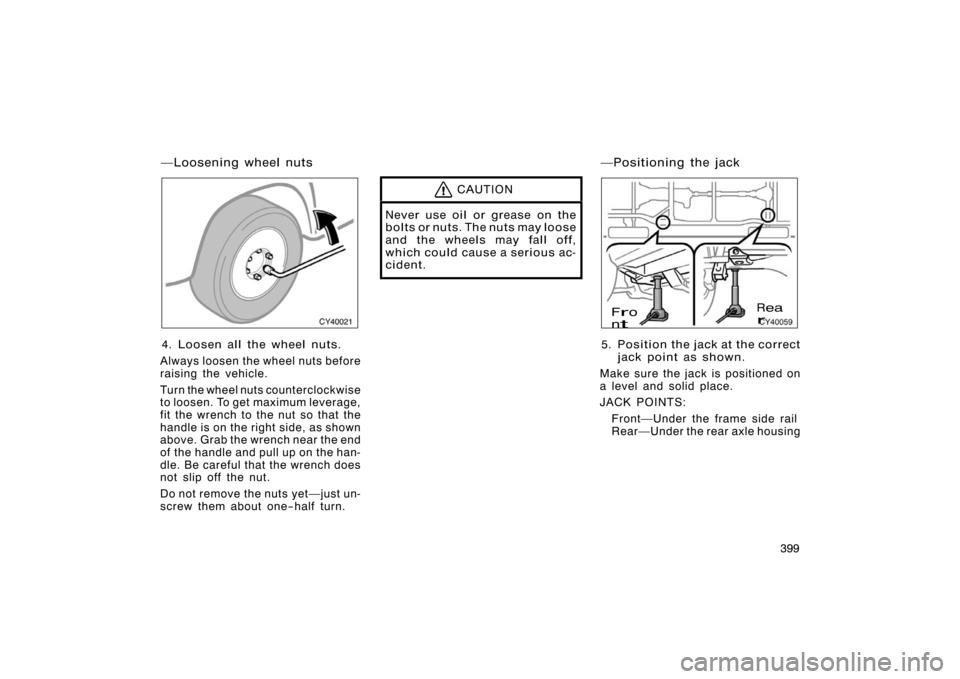
4. Loosen all the wheel nuts.
Always loosen the wheel nuts before
raising the vehicle.
Turn the wheel nuts counterclockwise
to loosen. To get maximum leverage,
fit the wrench to the nut so that the
handle is on the right side, as shown
above. Grab the wrench near the end
of the handle and pull up on the han-
dle. Be careful that the wrench does
not slip off the nut.
Do not remove the nuts yet�just un-
screw them about one−half turn.
CAUTION
Never use oil or grease on the
bolts or nuts. The nuts may loose
and the wheels may fall off,
which could cause a serious ac-
cident.
CY40059
���
�� ���
�
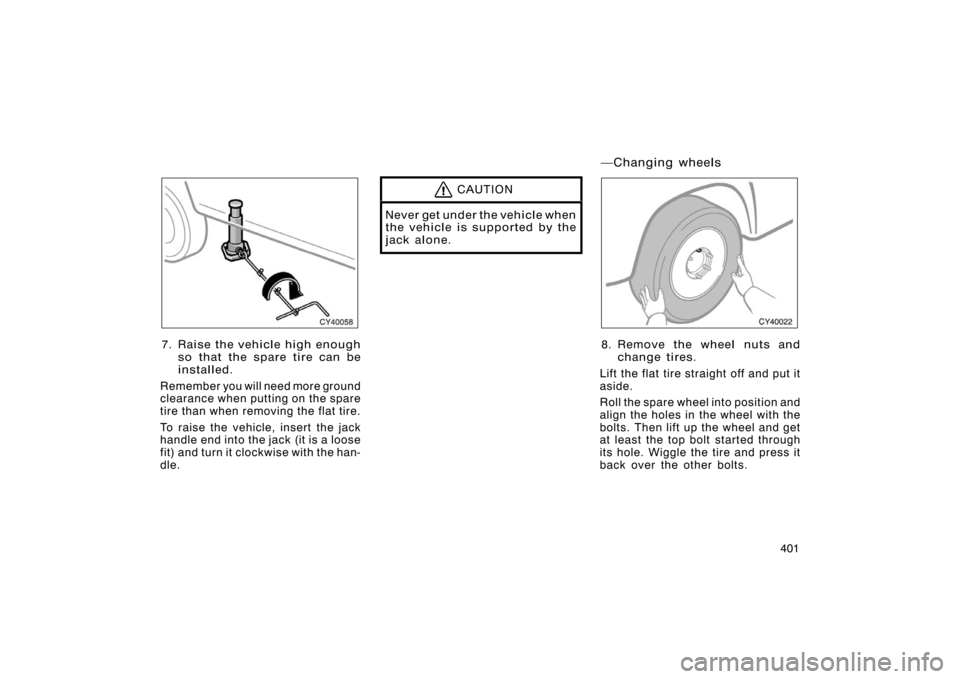
5. Position the jack at the correct
jack point as shown.
Make sure the jack is positioned on
a level and solid place.
JACK POINTS: Front�Under the frame side rail
Rear�Under the rear axle housing
�Loosening wheel nuts �Positioning the jack
Page 413 of 496
401
CY40058
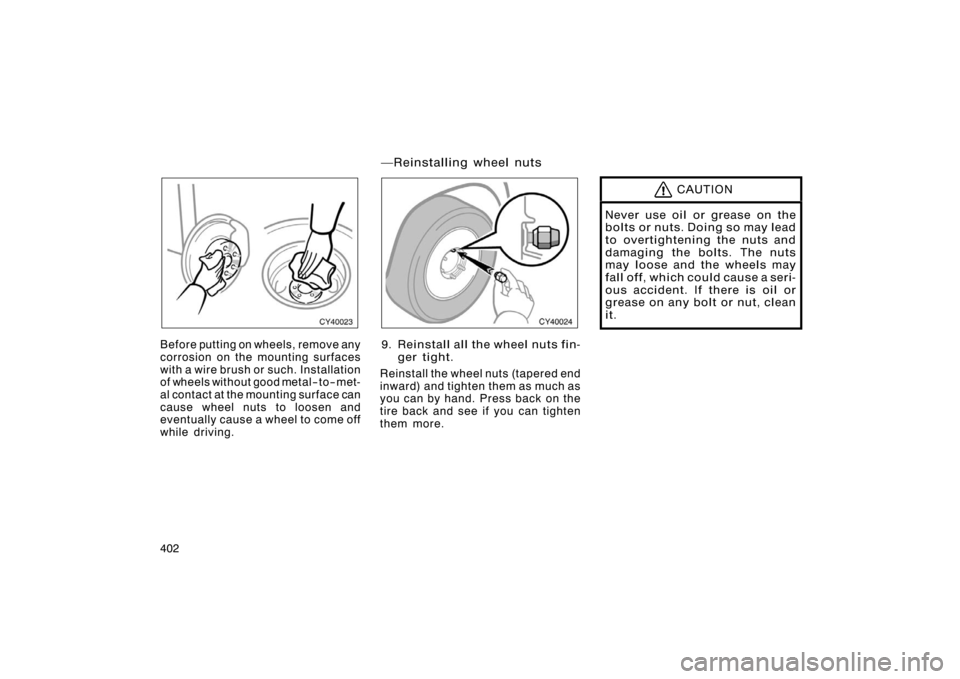
7. Raise the vehicle high enoughso that the spare tire can be
installed.
Remember you will need more ground
clearance when putting on the spare
tire than when removing the flat tire.
To raise the vehicl e, insert the jack
handle end into the jack (it is a loose
fit) and turn it clockwise with the han-
dle.
CAUTION
Never get under the vehicle when
the vehicle is supported by the
jack alone.
CY40022
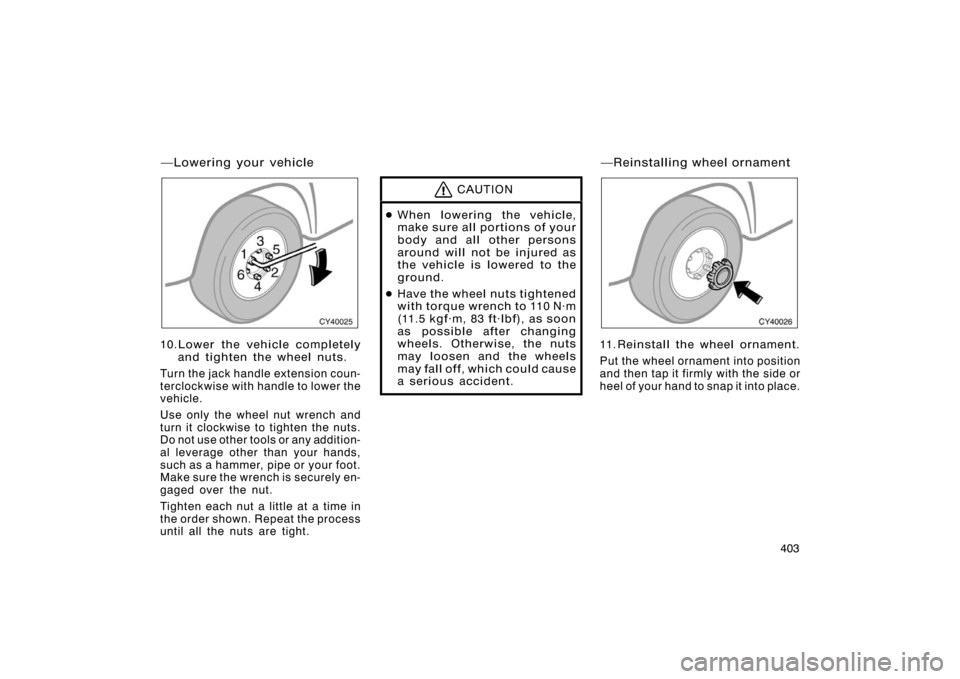
8. Remove the wheel nuts and
change tires.
Lift the flat tire straight off and put it
aside.
Roll the spare wheel into position and
align the holes in the wheel with the
bolts. Then lift up the wheel and get
at least the top bolt started through
its hole. Wiggle the tire and press it
back over the other bolts.
�Changing wheels
Page 414 of 496
402
CY40023
Before putting on wheels, remove any
corrosion on the mounting surfaces
with a wire brush or such. Installation
of wheels without good metal−to−met-
al contact at the mounting surface can
cause wheel nuts to loosen and
eventually cause a wheel to come off
while driving.
CY40024
9. Reinstall all the wheel nuts fin-ger tight.
Reinstall the wheel nuts (tapered end
inward) and tighten them as much as
you can by hand. Press back on the
tire back and see if you can tighten
them more.
CAUTION
Never use oil or grease on the
bolts or nuts. Doing so may lead
to overtightening the nuts and
damaging the bolts. The nuts
may loose and the wheels may
fall off, which could cause a seri-
ous accident. If there is oil or
grease on any bolt or nut, clean
it.
�Reinstalling wheel nuts
Page 415 of 496
403
CY40025
10.Lower the vehicle completelyand tighten the wheel nuts.
Turn the jack handle extension coun-
terclockwise with handle to lower the
vehicle.
Use only the wheel nut wrench and
turn it clockwise to tighten the nuts.
Do not use other tools or any addition-
al leverage other than your hands,
such as a hammer, pipe or your foot.
Make sure the wrench is securely en-
gaged over the nut.
Tighten each nut a little at a time in
the order shown. Repeat the process
until all the nuts are tight.
CAUTION
� When lowering the vehicle,
make sure all portions of your
body and all other persons
around will not be injured as
the vehicle is lowered to the
ground.
� Have the wheel nuts tightened
with torque wrench to 110 N·m
(11.5 kgf·m, 83 ft·lbf), as soon
as possible after changing
wheels. Otherwise, the nuts
may loosen and the wheels
may fall off, which could cause
a serious accident.
CY40026
11. Reinstall the wheel ornament.
Put the wheel ornament into position
and then tap it firmly with the side or
heel of your hand to snap it into place.
�Lowering your vehicle �Reinstalling wheel ornament
Page 416 of 496

404
CAUTION
�Take due care in handling the
ornament to avoid unexpected
personal injury.
� Do not attach a heavily dam-
aged plastic wheel ornament.
It may fly off the wheel and
cause accidents while the ve-
hicle is moving.
12.Check the air pressure of the re-
placed tire.
Adjust the air pressu re to the specifi-
cation designated on page 467 in
Section 8. If the pressure is lower,
drive slowly to the nearest service
station and fill to the correct pressure.
Do not forget to reinstall the tire infla-
tion valve cap as dirt and moisture
could get into the valve core and
possibly cause air leakage. If the cap
is missing, have a new one put on as
soon as possible.
13.Restow all the tools, jack and
flat tire securely.
As soon after changing wheels as
possible, tighten the wheel nuts to the
torque specified on page 467 in Sec-
tion 8 with a torque wrench. Have a
technician repair the flat tire.CAUTION
Before driving, make sure all the
tools, jack and flat tire are se-
curely in place in their storage
location to reduce the possibility
of personal injury during a colli-
sion or sudden braking.
�After changing wheels
Page 417 of 496
405
If your vehicle becomes stuck in snow,
mud, sand, etc., then you may attempt
to rock the vehicle free by moving it
forward and backward.
Turn off the traction control system to
become unstuck to allow the tires to
spin enough to remove the vehicle from
the obstruction. (For details, see
�Traction control system" on page 175
in Section 1−7.)
CAUTION
Do not attempt to rock the vehicle
free by moving it forward and back-
ward if people or objects are any-
where near the vehicle. During the
rocking operation the vehicle may
suddenly move forward or backward
as it becomes unstuck, causing injury
or damage to nearby people or ob-
jects.
NOTICE
If you rock your vehicle, observe the
following precautions to prevent dam-
age to the transmission and other
parts.
�Do not depress the accelerator ped-
al while shifting the selector lever
or before the transmission is com-
pletely shifted to forward or reverse
gear.
� Do not race the engine and avoid
spinning the wheels.
� If your vehicle remains stuck after
rocking the vehicle several times,
consider other ways such as tow-
ing.
CY40012
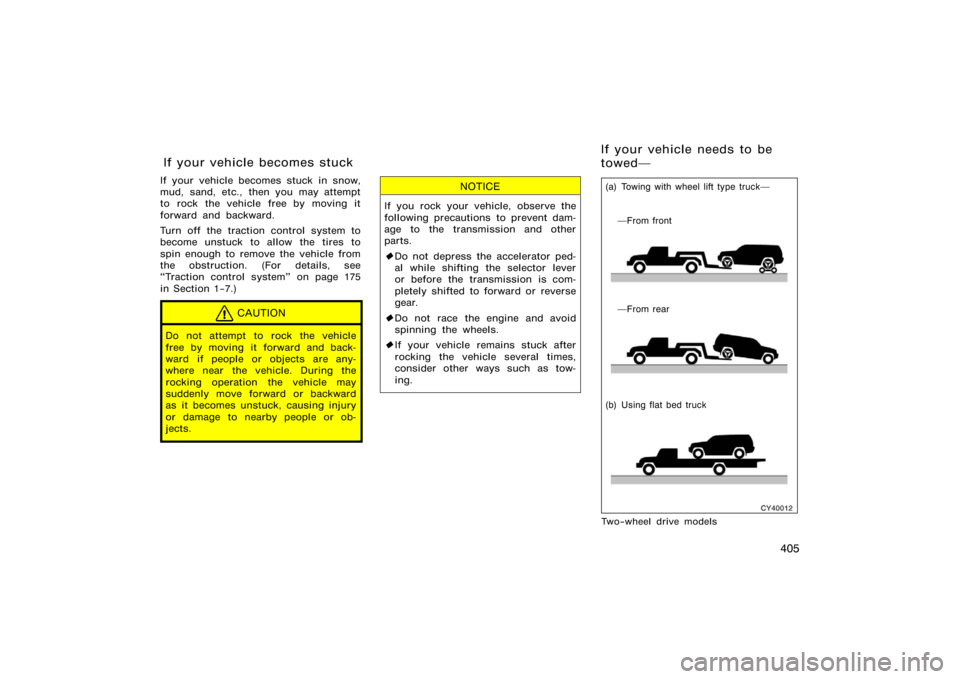
(a) Towing with wheel lift type truck�
�From front
�From rear
(b) Using flat bed truck
Two−wheel drive models
If your vehicle becomes stuck If your vehicle needs to be
towed�
Page 418 of 496
406
CY40013
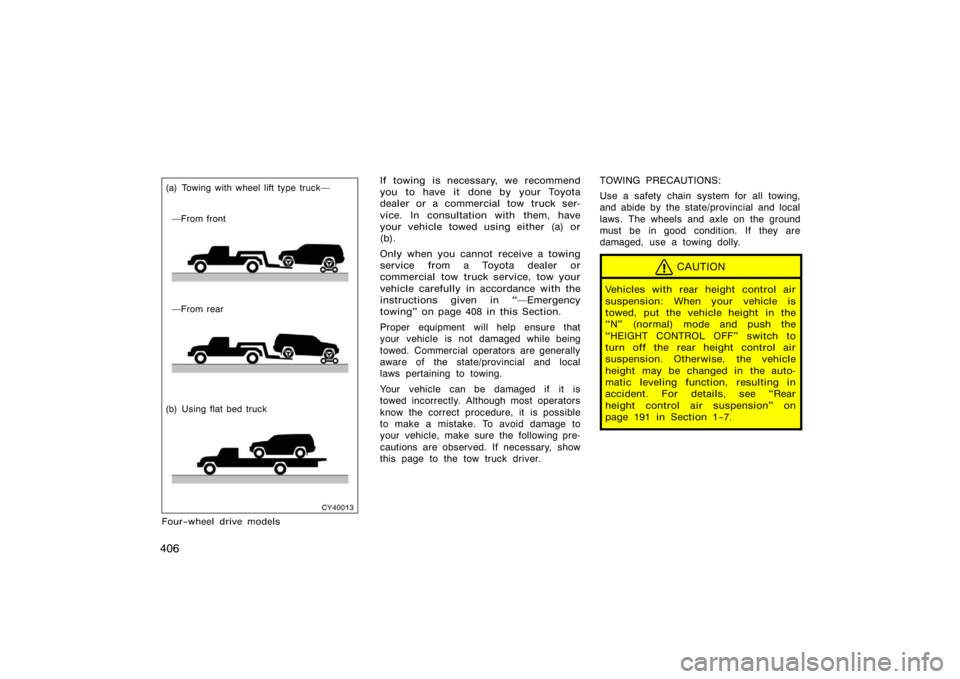
(b) Using flat bed truck�From rear �From front
(a) Towing with wheel lift type truck�
Four−wheel drive models
If towing is necessary, we recommend
you to have it done by your Toyota
dealer or a commercial tow truck ser-
vice. In consultation with them, have
your vehicle towed using either (a) or
(b).
Only when you cannot receive a towing
service from a Toyota dealer or
commercial tow truck service, tow your
vehicle carefully in accordance with the
instructions given in ��Emergency
towing" on page 408 in this Section.
Proper equipment will help ensure that
your vehicle is not damaged while being
towed. Commercial operators are generally
aware of the state/provincial and local
laws pertaining to towing.
Your vehicle can be damaged if it is
towed incorrectly. Although most operators
know the correct procedure, it is possible
to make a mistake. To avoid damage to
your vehicle, make sure the following pre-
cautions are observed. If necessary, show
this page to the tow truck driver. TOWING PRECAUTIONS:
Use a safety chain system for all towing,
and abide by the state/provincial and local
laws. The wheels and axle on the ground
must be in good condition. If they are
damaged, use a towing dolly.
CAUTION
Vehicles with rear height control air
suspension: When your vehicle is
towed, put the vehicle height in the
�N" (normal) mode and push the
�HEIGHT CONTROL OFF" switch to
turn off the rear height control air
suspension. Otherwise, the vehicle
height may be changed in the auto-
matic leveling function, resulting in
accident. For details, see �Rear
height control air suspension" on
page 191 in Section 1−7.
Page 419 of 496

407
Two−wheel drive models�
(a) Towing with wheel lift type truck
From front�Use a towing dolly under the
rear wheels.
NOTICE
Never tow a vehicle from the front
with the rear wheels on the ground,
as this may cause serious damage to
the transmission.
From rear� Place the engine switch in the
�ACC" position.
NOTICE
� When lifting wheels, take care to
ensure adequate ground clearance
for towing at the opposite end of
the raised vehicle. Otherwise, the
bumper and/or underbody of the
towed vehicle will be damaged dur-
ing towing.
� Do not tow with the key removed or
in the �LOCK" position, as the
steering lock mechanism is not
strong enough to hold the front
wheels straight while towing.
(b) Using flat bed truck Four−wheel drive models�
(a) Towing with wheel lift type truck
FULL−TIME FOUR WHEEL DRIVE
MODELS
Use a towing dolly under the wheels not
lifted by the truck.
MULTI−MODE FOUR WHEEL DRIVE
MODELS
From front�
Use a towing dolly under the
rear wheels.
NOTICE
Never tow a vehicle from the front
with the rear wheels on the ground,
as this may cause serious damage to
the transmission.
From rear� We recommend using a tow-
ing dolly under the front wheels. If you do
not use a towing dolly, place the engine
switch in the �ACC" position, put the
transmission in �N" and the multi−mode
control switch knob in �H2".
NOTICE
� When lifting wheels, take care to
ensure adequate ground clearance
for towing at the opposite end of
the raised vehicle. Otherwise, the
bumper and/or underbody of the
towed vehicle will be damaged dur-
ing towing.
� Do not tow with the key removed or
in the �LOCK" position when tow-
ing from the rear without a towing
dolly. The steering lock mechanism
is not strong enough to hold the
front wheels straight.
(b) Using flat bed truck