Page 361 of 496

349
CY20004
The brake pad wear limit indicators on
your disc brakes give a warning noise
when the brake pads are worn to where
replacement is required.
If you hear a squealing or scraping noise
while driving, have the brake pads
checked and replaced by your Toyota
dealer as soon as possible. Expensive ro-
tor damage can result if the pads are not
replaced when necessary.Your Toyota is equipped with a limited−slip
center differential (transfer). If one wheel
begins to spin, the limited−slip center dif-
ferential (transfer) is designed to aid trac-
tion by automatically transmitting driving
force to the wheels on the other drive
axle. It transmits driving force to the front
wheels if a rear wheel spins, and to the
rear wheels if a front wheel spins.
CAUTION
Do not start or run the engine while
your vehicle is supported by a jack.
The vehicle could be driven off the
jack and could pose a danger or re-
sult in serious injury.
NOTICE
Use only a spare tire of the same
brand, size, construction and load ca-
pacity as the original tires on your
Toyota because damage to the limit-
ed−slip differential could possibly oc-
cur with another tire type.
CY20013
The vehicle identification number (VIN)
is the legal identifier for your vehicle.
This number is on the left top of the
instrument panel, and can be seen
through the windshield from outside.
This is the primary identification number
for your Toyota. It is used in registering
the ownership of your vehicle.
Brake pad wear limit
indicators
Limited−slip differential
(four−wheel drive models)Your Toyota’s identification�
�Vehicle identification number
Page 366 of 496
354
CY20029
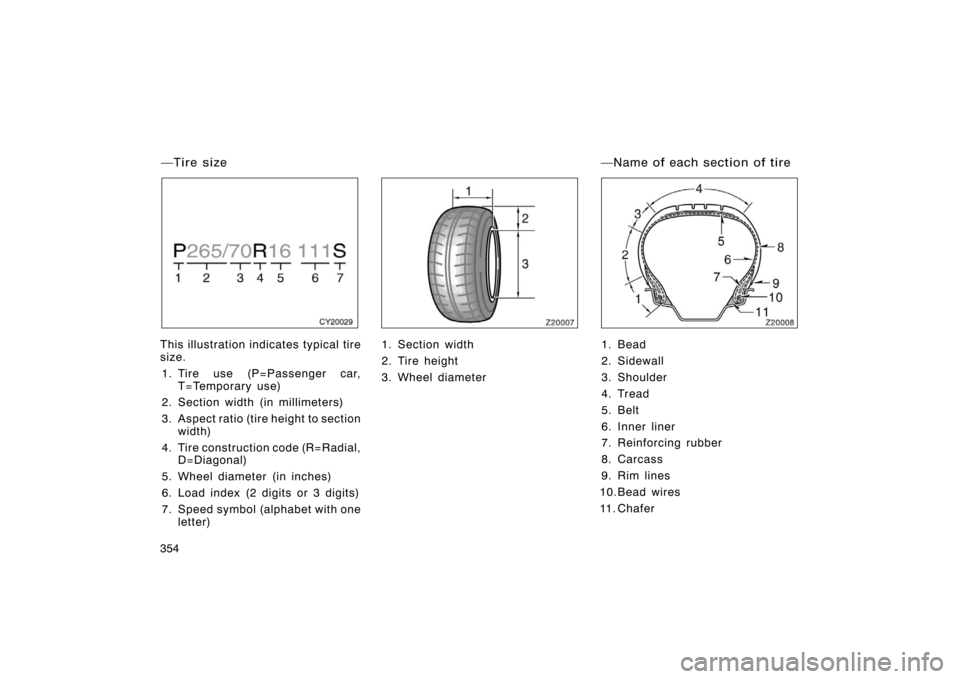
This illustration indicates typical tire
size.1. Tire use (P=Passenger car, T=Temporary use)
2. Section width (in millimeters)
3. Aspect ratio (tire height to section width)
4. Tire construction code (R=Radial, D=Diagonal)
5. Wheel diameter (in inches)
6. Load index (2 digits or 3 digits)
7. Speed symbol (alphabet with one letter)
Z20007
1. Section width
2. Tire height
3. Wheel diameter
Z20008
1. Bead
2. Sidewall
3. Shoulder
4. Tread
5. Belt
6. Inner liner
7. Reinforcing rubber
8. Carcass
9. Rim lines
10.Bead wires
11. Chafer
�Tire size �Name of each section of tire
Page 368 of 496
356 Temperature A, B, C�T he temper a-
ture grades are A (the highest), B,
and C, representing the tire’s resis-
tance to the generation of heat and
its ability to dissipate heat when
tested under controlled conditions on
a specified indoor laboratory test
wheel. Sustained high temperature
can cause the material of the tire to
degenerate and reduce tire life, and
excessive temperature can lead to
sudden tire failure. The grade C cor-
responds to a level of performance
which all passenger car tires must
meet under the Federal Motor Vehicle
Safety Standard No.109. Grades B
and A represent higher levels of per-
formance on the laboratory test wheel
than the minimum required by law.
Warning: The temperature grades for
this tire are established for a tire that
is properly inflated and not over-
loaded. Excessive speed, underinfla-
tion, or excessive loading, either sep-
arately or in combination, can cause
heat buildup and possible tire failure.
Page 370 of 496

358Ti r e relat ed ter m
Meaning
Occupant distributiondistribution of occupants in a vehicle as specified in the third column of Table
1 that follows
Production options weight
the combined weight of those installed regular production options weighing over
2.3 kg (5 lb.) in excess of those standard items which they replace, not pre-
viously considered in curb weight or accessory weight, including heavy duty
brakes, ride levelers, roof rack, heavy duty battery, and special trim
Rima metal support for a tire or a tire and
tube assembly upon which the tire beads
are seated
Rim diameter (Wheel diameter)nominal diameter of the bead seat
Rim size designationrim diameter and width
Rim type designationthe industry of manufacturer ’s designation for a rim by style or code
Rim widthnominal distance between rim flanges
Vehicle capacity weight
(Total load capacity)the rated cargo and luggage load plus 68 kg (150 lb.) times the vehicle’s desig-
nated seating capacity
Vehicle maximum load on the tirethe load on an individual tire that is determined by distributing to each axle
its share of the maximum loaded vehi cle weight and dividing by two
Vehicle normal load on the tire
the load on an individual tire that is determined by distributing to each axle
its share of the curb weight, accessory weight, and normal occupant weight
(distributed in accordance with Table 1 that follows) and dividing by two
Page 373 of 496

361
Ti r e relat ed ter m
Meaning
Outer diameterthe overall diameter of an inflated new tire
Overall widththe linear distance between the exteriors of the sidewalls of an inflated tire,
including elevations due to labeling, decorations, or protective bands or ribs
Passenger car tire
a tire intended for use on passenger cars, multipurpose passenger vehicles,
and trucks, that have a gross vehicle weight rating (GVWR) of 10,000 lb. or
less
Plya layer of rubber−coated parallel cords
Ply separationa parting of rubber compound between adjacent plies
Pneumatic tire
a mechanical device made of rubber, chemicals, fabric and steel or other mate-
rials, that, when mounted on an automotive wheel, provides the traction and
contains the gas or fluid that sustains the load
Radial ply tirea pneumatic tire in which the ply cords that extend to the beads are laid at
substantially 90 degrees to the centerline of the tread
Reinforced tirea tire designed to operate at higher l
oads and at higher inflation pressures
than the corresponding standard tire
S ec t ion widt hthe linear distance between the exteriors of the sidewalls of an inflated tire,
excluding elevations due to labeling, decoration, or protective bands
Sidewallthat portion of a tire between the tread and bead
Sidewall separationthe parting of the rubber compound from the cord material in the sidewall
Page 374 of 496
362Ti r e relat ed ter m
Meaning
Snow tire
a tire that attains a traction index equal
to or greater than 110, compared to
the ASTM E−1136 Standard Reference Test Tire, when using the snow traction
test as described in ASTM F−1805−00, Standard Test Method for Single Wheel
Driving Traction in a Straight Line on Snow−and Ice−Covered Surfaces, and
which is marked with an Alpine Symbol ( ) on at least one sidewall
Te s t r i mthe rim on which a tire is fitted for testing, and may be any rim listed as appropri-
ate for use with that tire
Treadthat portion of a tire that comes into contact with the road
Tread riba tread section running circumferentially around a tire
Tread separationpulling away of the tread from the tire carcass
Treadwear indicators(TWI)the projections within the principal grooves designed to give a visual indication
of the degrees of wear of the tread
Wheel−holding fixturethe fixture used to hold the wheel and tire assembly securely during testing
Page 376 of 496

364 Vehicle load limits include total load
capacity, seating capacity, towing ca-
pacity and cargo capacity. Follow the
load limits shown below. Total load ca-
pacity and seating capacity are also
described on the tire and loading in-
formation label. For location of the tire
and loading information label, see
�Checking tire inflat ion pr es s ur e" on
page 441.
Total load capacity:
With 5 occupants:431 kg (950 lb.)
With 7 occupants: 477 kg (1050 lb.)
Total load capacity means com-
bined weight of occupants, cargo
and luggage. Tongue load is in-
cluded when trailer towing. Seating capacity:
Without third seats:Total 5 (Front 2, Rear 3)
With third seats: Total 7 (Front 2, Rear 5)
Seating capacity means the maxi-
mum number of occupants whose
estimated average weight is 68 kg
(150 lb.) per person. Depending on
the weight of each person, the seat-
ing capacity given may exceed the
total load capacity.
NOTICE
Even if the number of occu-
pants are within the seating ca-
pacity, do not exceed the total
load capacity.
Towing capacity:For weight carrying hitch2268 kg (5000 lb.)
Also for weight distributing hitch
(4.7 L V8 [2UZ−FE] engine only) Two−wheel drive models3311 kg (7300 lb.)
Four−wheel drive models 3175 kg (7000 lb.)
Towing capacity means the maxi-
mum gross trailer weight (trailer
weight plus its cargo weight) that
your vehicle is able to tow.
Veh icle lo ad lim it s
Page 380 of 496
368
CY20024
�����
�����
��\b� ���
�� ���
������
�� �
����
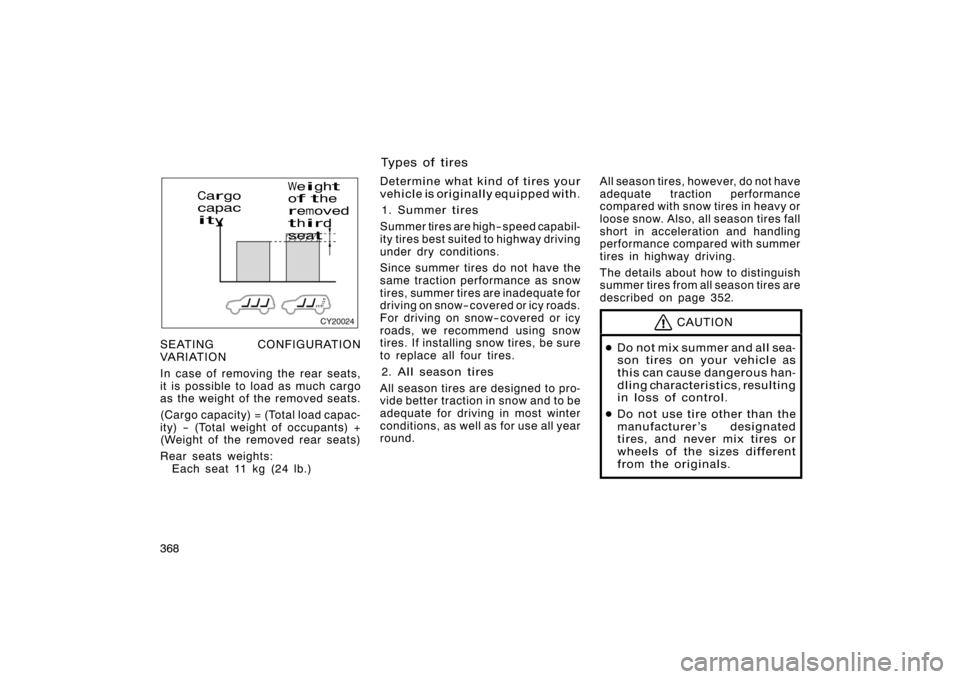
SEATING CONFIGURATION
VA R I AT I O N
In case of removing the rear seats,
it is possible to load as much cargo
as the weight of the removed seats.
(Cargo capacity) = (Total load capac-
ity) − (Total weight of occupants) +
(Weight of the removed rear seats)
Rear seats weights:
Each seat 11 kg (24 lb.) Determine what kind of tires your
vehicle is originally equipped with.
1. Summer tires
Summer tires are high−speed capabil-
ity tires best suited to highway driving
under dry conditions.
Since summer tires do not have the
same traction performance as snow
tires, summer tires are inadequate for
driving on snow−covered or icy roads.
For driving on snow−covered or icy
roads, we recommend using snow
tires. If installing snow tires, be sure
to replace all four tires.
2. All season tires
All season tires are designed to pro-
vide better traction in snow and to be
adequate for driving in most winter
conditions, as well as for use all year
round. All season tires, however, do not have
adequate traction performance
compared with snow tires in heavy or
loose snow. Also, all season tires fall
short in acceleration and handling
performance compared with summer
tires in highway driving.
The details about how to distinguish
summer tires from all season tires are
described on page 352.
CAUTION
�
Do not mix summer and all sea-
son tires on your vehicle as
this can cause dangerous han-
dling characteristics, resulting
in loss of control.
� Do not use tire other than the
manufacturer’s designated
tires, and never mix tires or
wheels of the sizes different
from the originals.
Types of tires