2008 SUBARU TRIBECA warning
[x] Cancel search: warningPage 43 of 409
the front seatbacks should be
always used in the upright posi-
tion while the vehicle is running.
If the front seatbacks are not
used in the upright position in a
collision, the risk of sliding under
the lap belt and of the lap belt
sliding up over the abdomen will
increase, and both can result in
serious internal injury or death.
. Do not put cushions or any other
materials between occupants
and seatbacks or seat cushions.
If you do so, the risk of sliding
under the lap belt and of the lap
belt sliding up over the abdomen
will increase, and both can result
in serious internal injury or
death.
WARNING
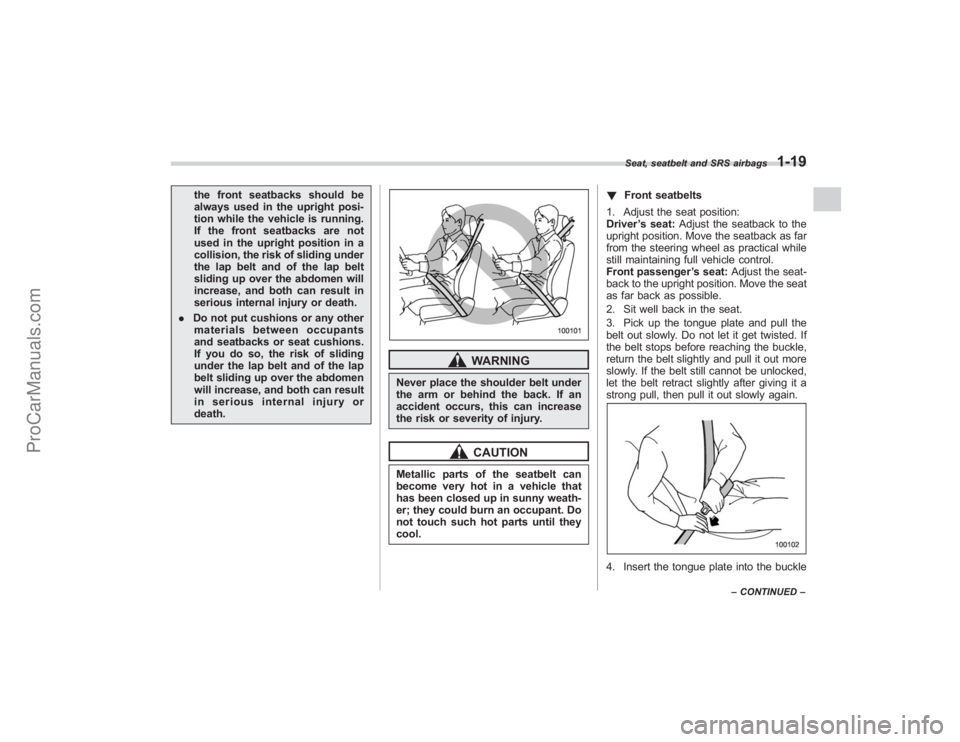
Never place the shoulder belt under
the arm or behind the back. If an
accident occurs, this can increase
the risk or severity of injury.
CAUTION
Metallic parts of the seatbelt can
become very hot in a vehicle that
has been closed up in sunny weath-
er; they could burn an occupant. Do
not touch such hot parts until they
cool. !
Front seatbelts
1. Adjust the seat position:
Driver ’s seat: Adjust the seatback to the
upright position. Move the seatback as far
from the steering wheel as practical while
still maintaining full vehicle control.
Front passenger ’s seat: Adjust the seat-
back to the upright position. Move the seat
as far back as possible.
2. Sit well back in the seat.
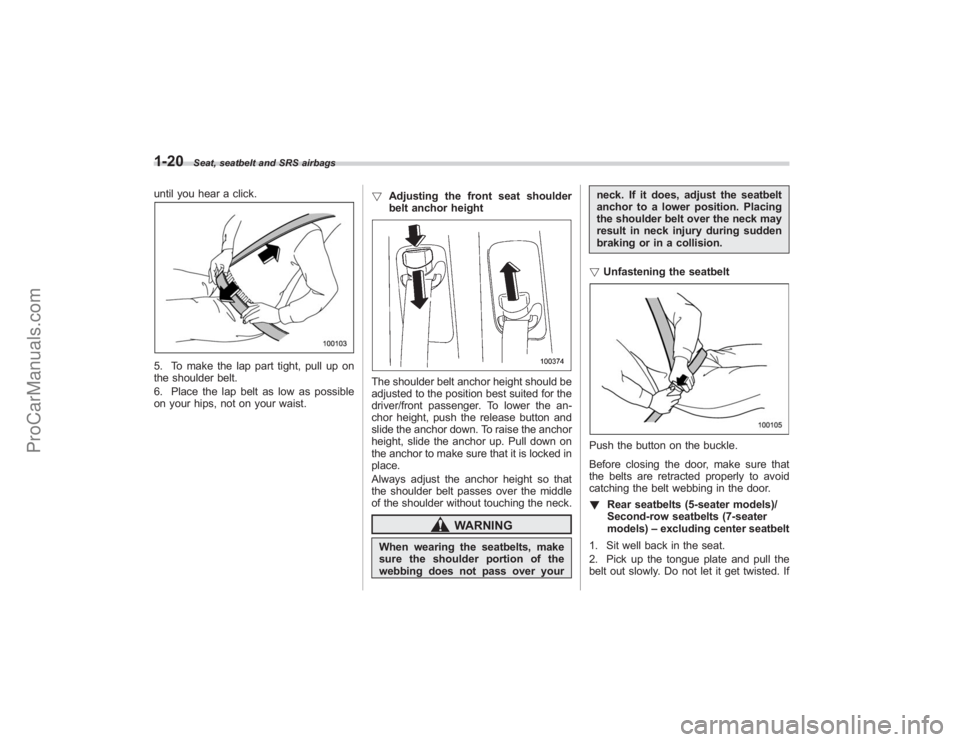
3. Pick up the tongue plate and pull the
belt out slowly. Do not let it get twisted. If
the belt stops before reaching the buckle,
return the belt slightly and pull it out more
slowly. If the belt still cannot be unlocked,
let the belt retract slightly after giving it a
strong pull, then pull it out slowly again.
4. Insert the tongue plate into the buckle
Seat, seatbelt and SRS airbags
1-19
– CONTINUED –
ProCarManuals.com
Page 44 of 409
1-20
Seat, seatbelt and SRS airbags
until you hear a click.5. To make the lap part tight, pull up on
the shoulder belt.
6. Place the lap belt as low as possible
on your hips, not on your waist.!
Adjusting the front seat shoulder
belt anchor height
The shoulder belt anchor height should be
adjusted to the position best suited for the
driver/front passenger. To lower the an-
chor height, push the release button and
slide the anchor down. To raise the anchor
height, slide the anchor up. Pull down on
the anchor to make sure that it is locked in
place.
Always adjust the anchor height so that
the shoulder belt passes over the middle
of the shoulder without touching the neck.
WARNING
When wearing the seatbelts, make
sure the shoulder portion of the
webbing does not pass over your neck. If it does, adjust the seatbelt
anchor to a lower position. Placing
the shoulder belt over the neck may
result in neck injury during sudden
braking or in a collision.
! Unfastening the seatbelt
Push the button on the buckle.
Before closing the door, make sure that
the belts are retracted properly to avoid
catching the belt webbing in the door.
! Rear seatbelts (5-seater models)/
Second-row seatbelts (7-seater
models) –excluding center seatbelt
1. Sit well back in the seat.
2. Pick up the tongue plate and pull the
belt out slowly. Do not let it get twisted. If
ProCarManuals.com
Page 45 of 409
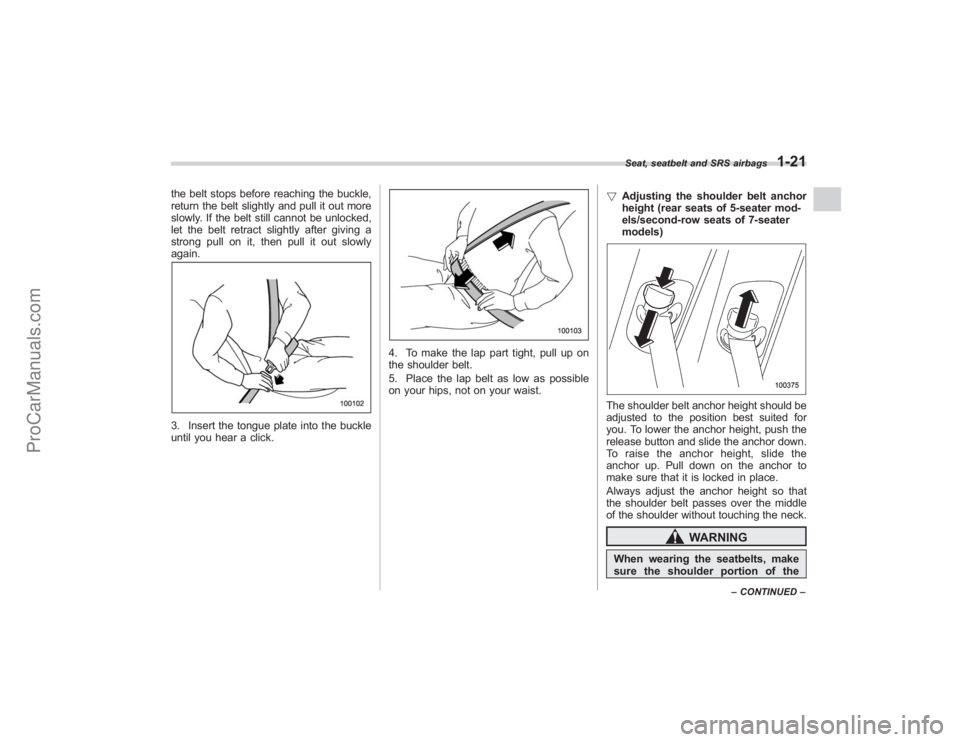
the belt stops before reaching the buckle,
return the belt slightly and pull it out more
slowly. If the belt still cannot be unlocked,
let the belt retract slightly after giving a
strong pull on it, then pull it out slowly
again.3. Insert the tongue plate into the buckle
until you hear a click.
4. To make the lap part tight, pull up on
the shoulder belt.
5. Place the lap belt as low as possible
on your hips, not on your waist.!
Adjusting the shoulder belt anchor
height (rear seats of 5-seater mod-
els/second-row seats of 7-seater
models)
The shoulder belt anchor height should be
adjusted to the position best suited for
you. To lower the anchor height, push the
release button and slide the anchor down.
To raise the anchor height, slide the
anchor up. Pull down on the anchor to
make sure that it is locked in place.
Always adjust the anchor height so that
the shoulder belt passes over the middle
of the shoulder without touching the neck.
WARNING
When wearing the seatbelts, make
sure the shoulder portion of theSeat, seatbelt and SRS airbags
1-21
–CONTINUED –
ProCarManuals.com
Page 47 of 409
WARNING
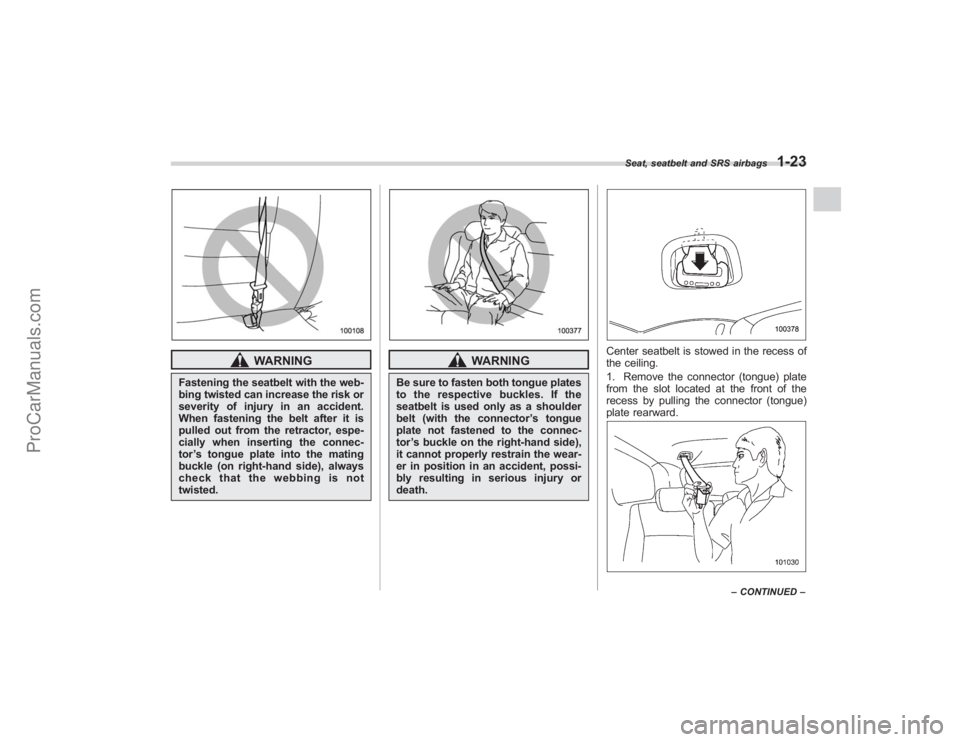
Fastening the seatbelt with the web-
bing twisted can increase the risk or
severity of injury in an accident.
When fastening the belt after it is
pulled out from the retractor, espe-
cially when inserting the connec-
tor’s tongue plate into the mating
buckle (on right-hand side), always
check that the webbing is not
twisted.
WARNING
Be sure to fasten both tongue plates
to the respective buckles. If the
seatbelt is used only as a shoulder
belt (with the connector ’s tongue
plate not fastened to the connec-
tor ’s buckle on the right-hand side),
it cannot properly restrain the wear-
er in position in an accident, possi-
bly resulting in serious injury or
death.
Center seatbelt is stowed in the recess of
the ceiling.
1. Remove the connector (tongue) plate
from the slot located at the front of the
recess by pulling the connector (tongue)
plate rearward.
Seat, seatbelt and SRS airbags
1-23
– CONTINUED –
ProCarManuals.com
Page 52 of 409

1-28
Seat, seatbelt and SRS airbags
belt retractor assemblies, use only
genuine SUBARU parts.
.If either front seatbelt does not
retract or cannot be pulled out due to
a malfunction or activation of the
pretensioner, contact your SUBARU
dealer as soon as possible.
. If the front seatbelt retractor assem-
bly or surrounding area has been
damaged, contact your SUBARU dealer
as soon as possible.
. When you sell your vehicle, we urge
you to explain to the buyer that it has
seatbelt pretensioners by alerting him
to the contents of this section.
WARNING
. To obtain maximum protection,
occupants should sit in an up-
right position with their seatbelts
properly fastened. Refer to “Seat-
belts ”section in this chapter.
. Do not modify, remove or strike
the front seatbelt retractor as-
semblies or surrounding area.
This could result in accidental
activation of the seatbelt preten-
sioners or could make the sys-
tem inoperative, possibly result-
ing in serious injury. Seatbelt
pretensioners have no user-ser- viceable parts. For required ser-
vicing of front seatbelt retractors
equipped with seatbelt preten-
sioners, see your nearest
SUBARU dealer.
. When discarding front seatbelt
retractor assemblies or scrap-
ping the entire vehicle due to
collision damage or for other
reasons, consult your SUBARU
dealer.
& System monitorsSRS airbag system warning lightA diagnostic system continually monitors
the readiness of the seatbelt pretensioner
while the vehicle is being driven. The
seatbelt pretensioners share the control module with the airbag system. Therefore,
if any malfunction occurs in a seatbelt
pretensioner, the SRS airbag system
warning light will illuminate. The SRS
airbag system warning light will show
normal system operation by lighting for
approximately 6 seconds when the igni-
tion switch is turned to the
“ON”position.
The following components are monitored
by the indicator:
. Front sub sensor (Right-hand side)
. Front sub sensor (Left-hand side)
. Airbag control module (including im-
pact and rollover sensors)
. Frontal airbag module (Driver ’s side)
. Frontal airbag module (Front passen-
ger ’s side)
. Side airbag sensor (Center pillar right-
hand side)
. Side airbag sensor (Center pillar left-
hand side)
. Side airbag module (Driver ’s side)
. Side airbag module (Front passenger ’s
side)
. Curtain airbag sensor (Rear wheel
house right-hand side)
. Curtain airbag sensor (Rear wheel
house left-hand side)
. Curtain airbag module (Right side)
. Curtain airbag module (Left side)
ProCarManuals.com
Page 53 of 409

.Seatbelt pretensioner (Driver ’s side)
. Seatbelt pretensioner (Front passen-
ger ’s side)
. Seatbelt buckle switch (Driver ’s side)
. Seatbelt buckle switch (Front passen-
ger ’s side)
. Driver ’s seat position sensor
. Front passenger ’s seatbelt tension
sensor
. Front passenger ’s occupant detection
system weight sensor
. Front passenger ’s occupant detection
control module
. Front passenger ’s frontal airbag ON
and OFF indicator
. All related wiring
WARNING
If the warning light exhibits any of
the following conditions, there may
be a malfunction in the seatbelt
pretensioners and/or SRS airbag
system. Immediately take your vehi-
cle to your nearest SUBARU dealer
to have the system checked. Unless
checked and properly repaired, the
seatbelt pretensioners and/or SRS
airbags will operate improperly (e.g.
SRS airbags may inflate in a very
minor collision or not inflate in a
severe collision), which may in- crease the risk of injury.
.
Flashing or flickering of the warn-
ing light
. No illumination of the warning
light when the ignition switch is
first turned to the “ON ”position
. Continuous illumination of the
warning light
. Illumination of the warning light
while driving
& System servicing
WARNING
. When discarding a seatbelt re-
tractor assembly or scrapping
the entire vehicle damaged by a
collision, consult your SUBARU
dealer.
. Tampering with or disconnecting
the system ’s wiring could result
in accidental activation of the
seatbelt pretensioner and/or air-
bag or could make the system
inoperative, which may result in
serious injury. The wiring har-
nesses of the seatbelt preten-
sioner and SRS airbag systems
are covered with yellow insula- tion and the connectors of the
system are yellow for easy iden-
tification. Do not use electrical
test equipment on any circuit
related to the seatbelt preten-
sioner and airbag systems. For
required servicing of the seatbelt
pretensioner, see your nearest
SUBARU dealer.
CAUTION
The front sub sensors are located
on both sides of the radiator panel,
and the airbag control module in-
cluding the impact sensors is lo-
cated under the center console. If
you need service or repair in those
areas or near the front seatbelt
retractors, we recommend that you
have an authorized SUBARU dealer
perform the work.NOTEIf the front part of the vehicle is
damaged in an accident to the extent
that the seatbelt pretensioner does not
operate, contact your SUBARU dealer
as soon as possible.
Seat, seatbelt and SRS airbags
1-29
–
CONTINUED –
ProCarManuals.com
Page 55 of 409
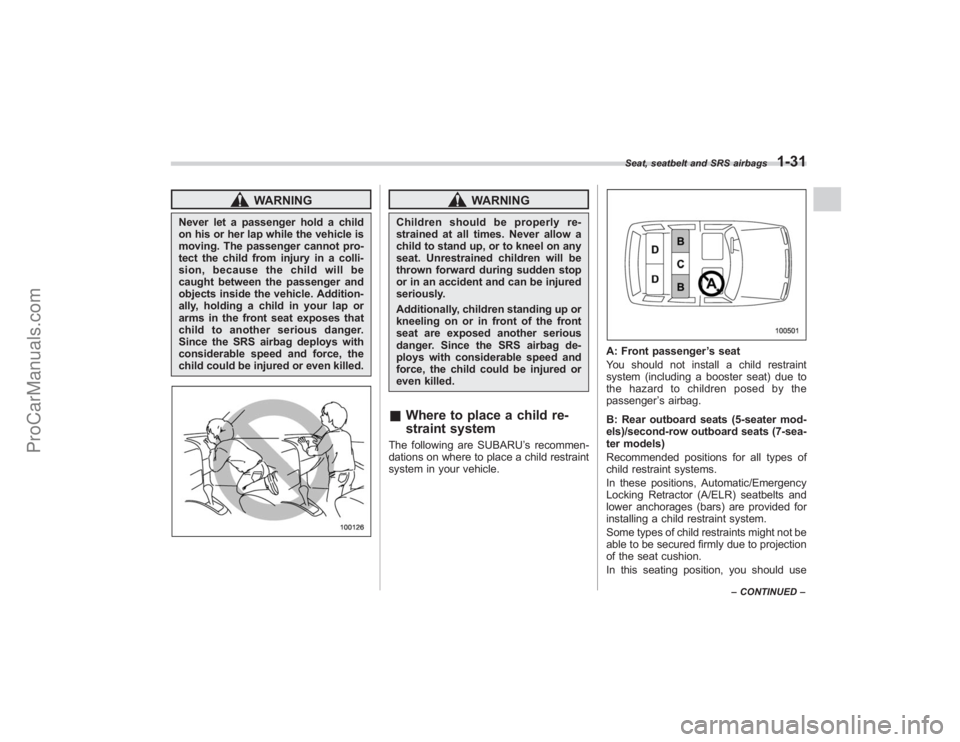
WARNING
Never let a passenger hold a child
on his or her lap while the vehicle is
moving. The passenger cannot pro-
tect the child from injury in a colli-
sion, because the child will be
caught between the passenger and
objects inside the vehicle. Addition-
ally, holding a child in your lap or
arms in the front seat exposes that
child to another serious danger.
Since the SRS airbag deploys with
considerable speed and force, the
child could be injured or even killed.
WARNING
Children should be properly re-
strained at all times. Never allow a
child to stand up, or to kneel on any
seat. Unrestrained children will be
thrown forward during sudden stop
or in an accident and can be injured
seriously.
Additionally, children standing up or
kneeling on or in front of the front
seat are exposed another serious
danger. Since the SRS airbag de-
ploys with considerable speed and
force, the child could be injured or
even killed.&Where to place a child re-
straint systemThe following are SUBARU ’s recommen-
dations on where to place a child restraint
system in your vehicle.
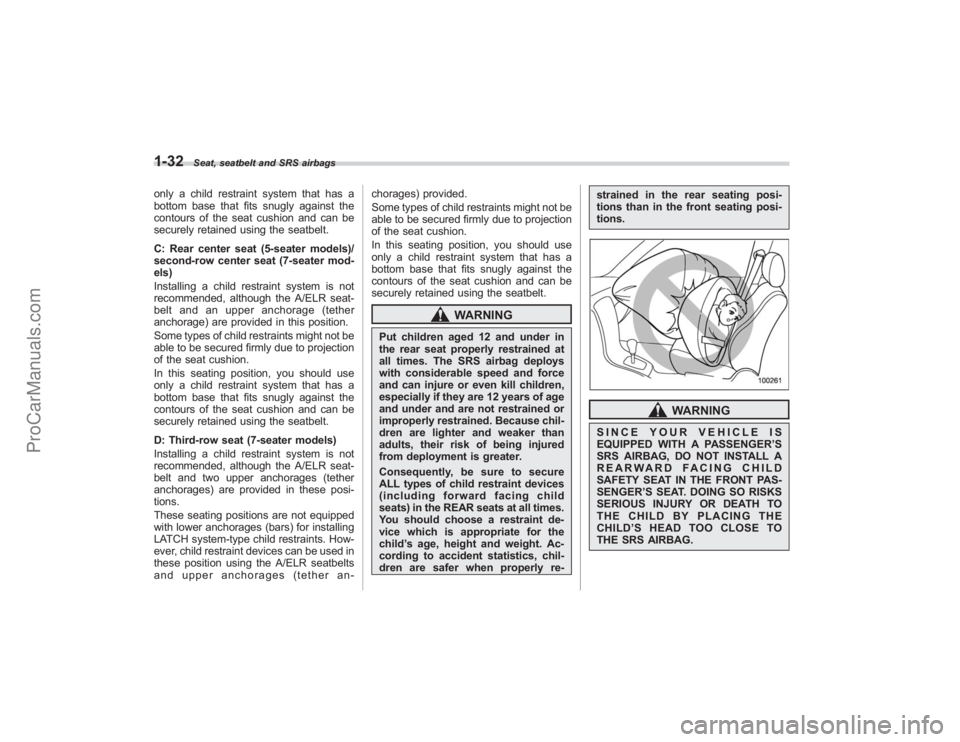
A: Front passenger ’s seat
You should not install a child restraint
system (including a booster seat) due to
the hazard to children posed by the
passenger ’s airbag.
B: Rear outboard seats (5-seater mod-
els)/second-row outboard seats (7-sea-
ter models)
Recommended positions for all types of
child restraint systems.
In these positions, Automatic/Emergency
Locking Retractor (A/ELR) seatbelts and
lower anchorages (bars) are provided for
installing a child restraint system.
Some types of child restraints might not be
able to be secured firmly due to projection
of the seat cushion.
In this seating position, you should use
Seat, seatbelt and SRS airbags
1-31
– CONTINUED –
ProCarManuals.com
Page 56 of 409
1-32
Seat, seatbelt and SRS airbags
only a child restraint system that has a
bottom base that fits snugly against the
contours of the seat cushion and can be
securely retained using the seatbelt.
C: Rear center seat (5-seater models)/
second-row center seat (7-seater mod-
els)
Installing a child restraint system is not
recommended, although the A/ELR seat-
belt and an upper anchorage (tether
anchorage) are provided in this position.
Some types of child restraints might not be
able to be secured firmly due to projection
of the seat cushion.
In this seating position, you should use
only a child restraint system that has a
bottom base that fits snugly against the
contours of the seat cushion and can be
securely retained using the seatbelt.
D: Third-row seat (7-seater models)
Installing a child restraint system is not
recommended, although the A/ELR seat-
belt and two upper anchorages (tether
anchorages) are provided in these posi-
tions.
These seating positions are not equipped
with lower anchorages (bars) for installing
LATCH system-type child restraints. How-
ever, child restraint devices can be used in
these position using the A/ELR seatbelts
and upper anchorages (tether an-chorages) provided.
Some types of child restraints might not be
able to be secured firmly due to projection
of the seat cushion.
In this seating position, you should use
only a child restraint system that has a
bottom base that fits snugly against the
contours of the seat cushion and can be
securely retained using the seatbelt.
WARNING
Put children aged 12 and under in
the rear seat properly restrained at
all times. The SRS airbag deploys
with considerable speed and force
and can injure or even kill children,
especially if they are 12 years of age
and under and are not restrained or
improperly restrained. Because chil-
dren are lighter and weaker than
adults, their risk of being injured
from deployment is greater.
Consequently, be sure to secure
ALL types of child restraint devices
(including forward facing child
seats) in the REAR seats at all times.
You should choose a restraint de-
vice which is appropriate for the
child
’s age, height and weight. Ac-
cording to accident statistics, chil-
dren are safer when properly re- strained in the rear seating posi-
tions than in the front seating posi-
tions.
WARNING
SINCE YOUR VEHICLE IS
EQUIPPED WITH A PASSENGER
’S
SRS AIRBAG, DO NOT INSTALL A
REARWARD FACING CHILD
SAFETY SEAT IN THE FRONT PAS-
SENGER ’S SEAT. DOING SO RISKS
SERIOUS INJURY OR DEATH TO
THE CHILD BY PLACING THE
CHILD’ S HEAD TOO CLOSE TO
THE SRS AIRBAG.
ProCarManuals.com