2008 SUBARU TRIBECA warning
[x] Cancel search: warningPage 73 of 409
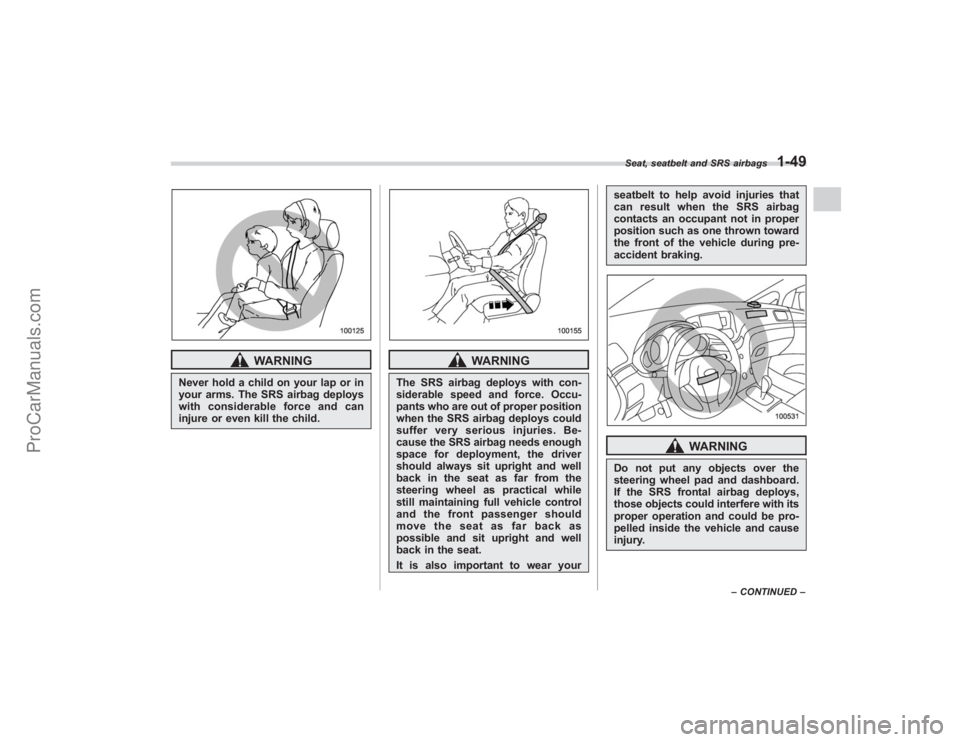
WARNING
Never hold a child on your lap or in
your arms. The SRS airbag deploys
with considerable force and can
injure or even kill the child.
WARNING
The SRS airbag deploys with con-
siderable speed and force. Occu-
pants who are out of proper position
when the SRS airbag deploys could
suffer very serious injuries. Be-
cause the SRS airbag needs enough
space for deployment, the driver
should always sit upright and well
back in the seat as far from the
steering wheel as practical while
still maintaining full vehicle control
and the front passenger should
move the seat as far back as
possible and sit upright and well
back in the seat.
It is also important to wear yourseatbelt to help avoid injuries that
can result when the SRS airbag
contacts an occupant not in proper
position such as one thrown toward
the front of the vehicle during pre-
accident braking.
WARNING
Do not put any objects over the
steering wheel pad and dashboard.
If the SRS frontal airbag deploys,
those objects could interfere with its
proper operation and could be pro-
pelled inside the vehicle and cause
injury.Seat, seatbelt and SRS airbags
1-49
–
CONTINUED –
ProCarManuals.com
Page 74 of 409

1-50
Seat, seatbelt and SRS airbags
WARNING
Do not attach accessories to the
windshield, or fit an extra-wide mir-
ror over the rear view mirror. If the
SRS airbag deploys, those objects
could become projectiles that could
seriously injure vehicle occupants.
! Driver ’s SRS frontal airbag
The driver ’s SRS frontal airbag uses a
dual stage inflator. The inflator operates in
different ways depending on the severity
of impact, backward-forward adjustment
of the driver ’s seat position and whether or
not he/she is wearing the seatbelt.
The backward-forward adjustment of the
driver ’s seat position is monitored by the driver
’s seat position sensor under the
driver ’s seat.
Whether or not the driver is wearing the
seatbelt is monitored by the seatbelt
buckle switch.
Observe the following precautions. Failure
to do so may cause the seatbelt buckle
switch and/or the seat position sensor to
malfunction, preventing the Subaru ad-
vanced frontal airbag system from func-
tioning correctly or causing the system to
fail.
. Do not place articles/metal objects or
install any accessory other than a genuine
SUBARU accessory under the driver ’s
seat. Do not allow the rear seat occupant
to kick the driver ’s seat or push up its
bottom surface with his/her feet.
. Do not place a magnet near the
seatbelt buckle or under the driver ’s seat.
If the seatbelt buckle switch and/or the
driver ’s seat position sensor have failed,
the SRS airbag system warning light will
illuminate. Although the driver ’sSRS
frontal airbag can deploy regardless of
the backward-forward adjustment of the
driver ’s seat position even when the
warning light is on, have the system
inspected by your SUBARU dealer im-
mediately if the SRS airbag system warn-
ing light comes on.
NOTEThe driver ’s SRS side airbag, SRS
curtain airbag and seatbelt preten-
sioner are not controlled by the Subaru
advanced frontal airbag system.
! Front passenger ’s SRS frontal air-
bag
The front passenger ’s SRS frontal airbag
uses a dual stage inflator. The inflator
operates in different ways depending on
the severity of impact.
The total load on the seat is monitored by
the occupant detection system ’s weight
sensor located under the seat.
The system has another sensor that
monitors the tension of the front passen-
ger seatbelt. Using the total seat load and
seatbelt tension data from the sensors,
the occupant detection system determines
whether the front passenger ’s SRS frontal
airbag should or should not be inflated.
The occupant detection system may not
inflate the front passenger ’s SRS frontal
airbag even when the driver ’s SRS frontal
airbag deploys. This is normal.
Observe the following precautions. Failure
to do so may prevent the Subaru ad-
vanced frontal airbag system from func-
tioning correctly or cause the system to
fail.
. Do not apply any strong impact to the
ProCarManuals.com
Page 75 of 409
front passenger’s seat such as by kicking.
. Do not spill liquid on the front passen-
ger ’s seat. If liquid is spilled, wipe it off
immediately.
. Do not remove or disassemble the front
passenger ’s seat.
. Do not install any accessory (such as
an audio amplifier) other than a genuine
SUBARU accessory under the front pas-
senger ’s seat.
. Do not place anything (shoes, umbrel-
la, etc.) under the front passenger ’s seat.
. The front passenger ’s seat must not be
used with the head restraint removed.
. Do not leave any article including a
child restraint system on the front passen-
ger ’s seat or the seatbelt tongue and
buckle engaged when you leave your
vehicle.
. Do not place a magnet near the
seatbelt buckle and the seatbelt retractor.
If the seatbelt buckle switch and/or front
passenger ’s occupant detection system
have failed, the SRS airbag system
warning light will illuminate. Have the
system inspected by your SUBARU deal-
er immediately if the SRS airbag system
warning light comes on.
If your vehicle has sustained impact, this
may affect the proper function of the
Subaru advanced frontal airbag system. Have your vehicle inspected at your
SUBARU dealer.
NOTEThe front passenger
’s SRS side airbag,
SRS curtain airbag and seatbelt pre-
tensioner are not controlled by the
Subaru advanced frontal airbag sys-
tem.
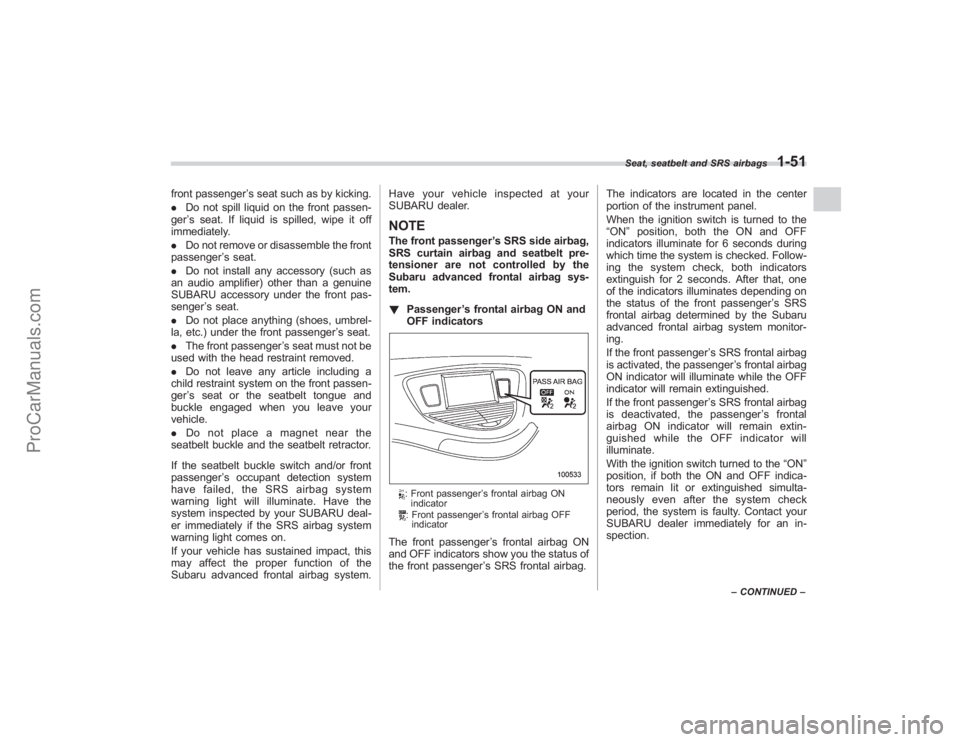
! Passenger ’s frontal airbag ON and
OFF indicators
: Front passenger ’s frontal airbag ON
indicator: Front passenger ’s frontal airbag OFF
indicator
The front passenger ’s frontal airbag ON
and OFF indicators show you the status of
the front passenger ’s SRS frontal airbag. The indicators are located in the center
portion of the instrument panel.
When the ignition switch is turned to the
“
ON ”position, both the ON and OFF
indicators illuminate for 6 seconds during
which time the system is checked. Follow-
ing the system check, both indicators
extinguish for 2 seconds. After that, one
of the indicators illuminates depending on
the status of the front passenger ’s SRS
frontal airbag determined by the Subaru
advanced frontal airbag system monitor-
ing.
If the front passenger ’s SRS frontal airbag
is activated, the passenger ’s frontal airbag
ON indicator will illuminate while the OFF
indicator will remain extinguished.
If the front passenger ’s SRS frontal airbag
is deactivated, the passenger ’s frontal
airbag ON indicator will remain extin-
guished while the OFF indicator will
illuminate.
With the ignition switch turned to the “ON”
position, if both the ON and OFF indica-
tors remain lit or extinguished simulta-
neously even after the system check
period, the system is faulty. Contact your
SUBARU dealer immediately for an in-
spection.
Seat, seatbelt and SRS airbags
1-51
– CONTINUED –
ProCarManuals.com
Page 76 of 409
1-52
Seat, seatbelt and SRS airbags
!Conditions in which front passen-
ger’s SRS frontal airbag is not
activated
The front passenger ’s SRS frontal airbag
will not be activated when any of the
following conditions are met regarding the
front passenger ’s seat:
. The seat is empty.
. The seat is equipped with a rearward
facing child restraint system and an infant
is restrained with it. (See WARNING that
follows.)
. The seat is equipped with a forward
facing child restraint system and a small
child is restrained with it. (See WARNING
that follows.)
. The seat is equipped with a booster
seat and a small child is in the booster
seat. (See WARNING that follows.)
. The seat is relieved of the occupant
load for a time exceeding the predeter-
mined monitoring time period.
. The seat is occupied by a child who
has outgrown a child restraint system
(See WARNING that follows.) or by a
small adult.
. The front passenger ’s occupant detec-
tion system is faulty.
WARNING
NEVER INSTALL A REARWARD FA-
CING CHILD SEAT IN THE FRONT
PASSENGER ’S SEAT EVEN IF THE
FRONT PASSENGER ’S SRS FRON-
TAL AIRBAG IS DEACTIVATED. Be
sure to install it in one of the rear
seating positions recommended in
this Owner ’s Manual in a correct
manner. Also, it is strongly recom-
mended that any forward facing
child seat or booster seat be in-
stalled in one of the rear seating
positions recommended in this
Owner ’s Manual, and that even
children who have outgrown a child
restraint system be also seated in a
REAR seat. This is because children
sitting in the front passenger ’s seat
may be killed or severely injured
should the front passenger ’s SRS
frontal airbag deploy. REAR seats
are the safest place for children.
When the front passenger ’s seat is occu-
pied by a child, observe the following
precautions. Failure to do so may increase
the load on the front passenger ’s seat,
activating the front passenger ’sSRS
frontal airbag even though that seat is
occupied by a child. .
Do not place any article on the seat
other than the child occupant and a child
restraint system.
. Do not place more than one child on
the seat.
. Do not install any accessory such as a
table or TV onto the seatback.
. Do not store a heavy load in the
seatback pocket.
. Do not allow the rear/second-row seat
occupant to place his/her hands or legs on
the front passenger ’s seatback, or allow
him/her to pull the seatback.
! If the front passenger ’s frontal air-
bag ON indicator illuminates and the
OFF indicator extinguishes even
when an infant or a small child is in
a child restraint system (including
booster seat)
Turn the ignition switch to the “LOCK”
position if the front passenger ’s frontal
airbag ON indicator illuminates and the
OFF indicator extinguishes even when an
infant or a small child is in a child restraint
system (including booster seat). Remove
the child restraint system from the seat. By
referring to the child restraint manufac-
turer ’s recommendations as well as the
child restraint system installation proce-
dures in the “Child restraint systems ”
section in this chapter, correctly install
ProCarManuals.com
Page 82 of 409
1-58
Seat, seatbelt and SRS airbags
to deploy if the vehicle is struck from the
side or from behind, or if it rolls onto its
side or roof, or if it is involved in a low-
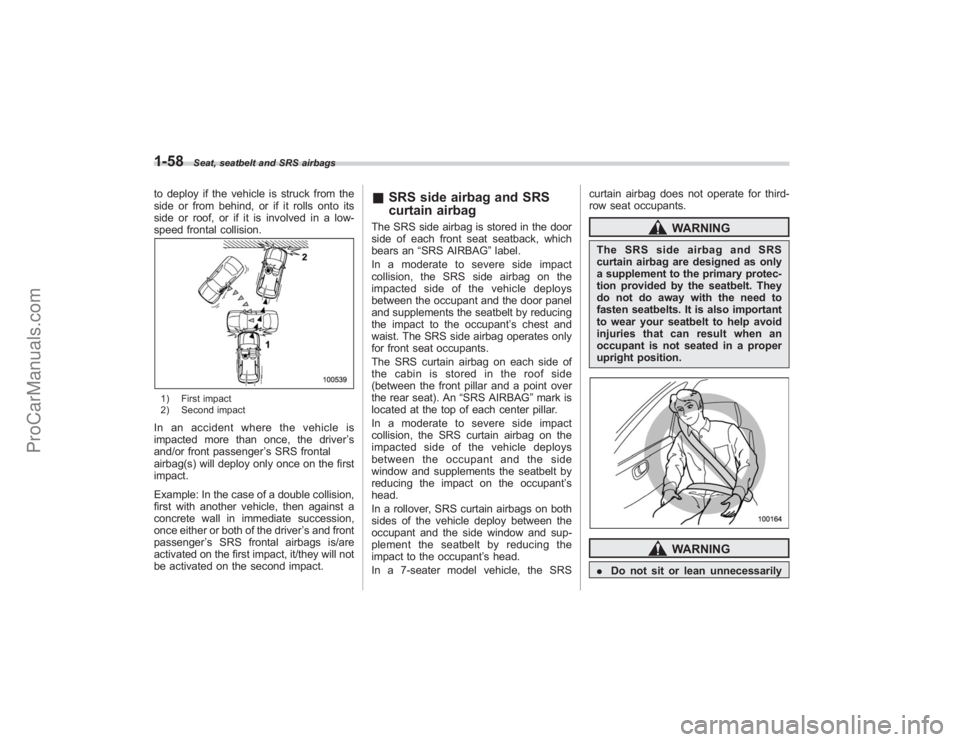
speed frontal collision.1) First impact
2) Second impactIn an accident where the vehicle is
impacted more than once, the driver’s
and/or front passenger ’s SRS frontal
airbag(s) will deploy only once on the first
impact.
Example: In the case of a double collision,
first with another vehicle, then against a
concrete wall in immediate succession,
once either or both of the driver ’s and front
passenger ’s SRS frontal airbags is/are
activated on the first impact, it/they will not
be activated on the second impact.
& SRS side airbag and SRS
curtain airbagThe SRS side airbag is stored in the door
side of each front seat seatback, which
bears an “SRS AIRBAG ”label.
In a moderate to severe side impact
collision, the SRS side airbag on the
impacted side of the vehicle deploys
between the occupant and the door panel
and supplements the seatbelt by reducing
the impact to the occupant ’s chest and
waist. The SRS side airbag operates only
for front seat occupants.
The SRS curtain airbag on each side of
the cabin is stored in the roof side
(between the front pillar and a point over
the rear seat). An “SRS AIRBAG”mark is
located at the top of each center pillar.
In a moderate to severe side impact
collision, the SRS curtain airbag on the
impacted side of the vehicle deploys
between the occupant and the side
window and supplements the seatbelt by
reducing the impact on the occupant ’s
head.
In a rollover, SRS curtain airbags on both
sides of the vehicle deploy between the
occupant and the side window and sup-
plement the seatbelt by reducing the
impact to the occupant ’s head.
In a 7-seater model vehicle, the SRS curtain airbag does not operate for third-
row seat occupants.
WARNING
The SRS side airbag and SRS
curtain airbag are designed as only
a supplement to the primary protec-
tion provided by the seatbelt. They
do not do away with the need to
fasten seatbelts. It is also important
to wear your seatbelt to help avoid
injuries that can result when an
occupant is not seated in a proper
upright position.
WARNING
.
Do not sit or lean unnecessarily
ProCarManuals.com
Page 83 of 409
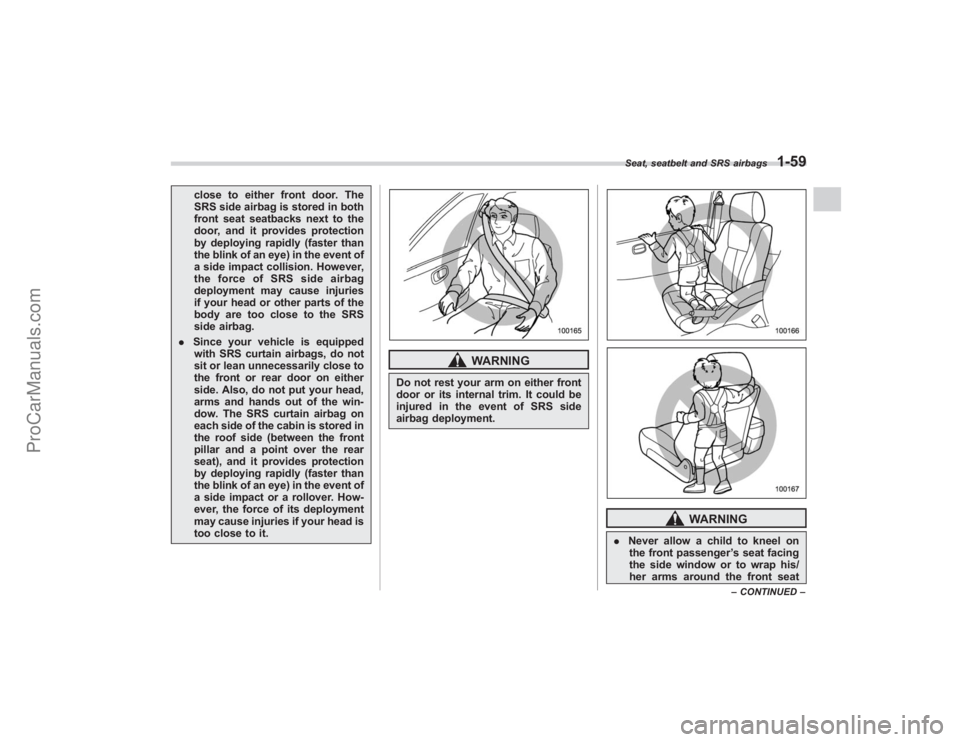
close to either front door. The
SRS side airbag is stored in both
front seat seatbacks next to the
door, and it provides protection
by deploying rapidly (faster than
the blink of an eye) in the event of
a side impact collision. However,
theforceofSRSsideairbag
deployment may cause injuries
if your head or other parts of the
body are too close to the SRS
side airbag.
. Since your vehicle is equipped
with SRS curtain airbags, do not
sit or lean unnecessarily close to
the front or rear door on either
side. Also, do not put your head,
arms and hands out of the win-
dow. The SRS curtain airbag on
each side of the cabin is stored in
the roof side (between the front
pillar and a point over the rear
seat), and it provides protection
by deploying rapidly (faster than
the blink of an eye) in the event of
a side impact or a rollover. How-
ever, the force of its deployment
may cause injuries if your head is
too close to it.
WARNING
Do not rest your arm on either front
door or its internal trim. It could be
injured in the event of SRS side
airbag deployment.
WARNING
. Never allow a child to kneel on
the front passenger ’s seat facing
the side window or to wrap his/
her arms around the front seatSeat, seatbelt and SRS airbags
1-59
– CONTINUED –
ProCarManuals.com
Page 84 of 409
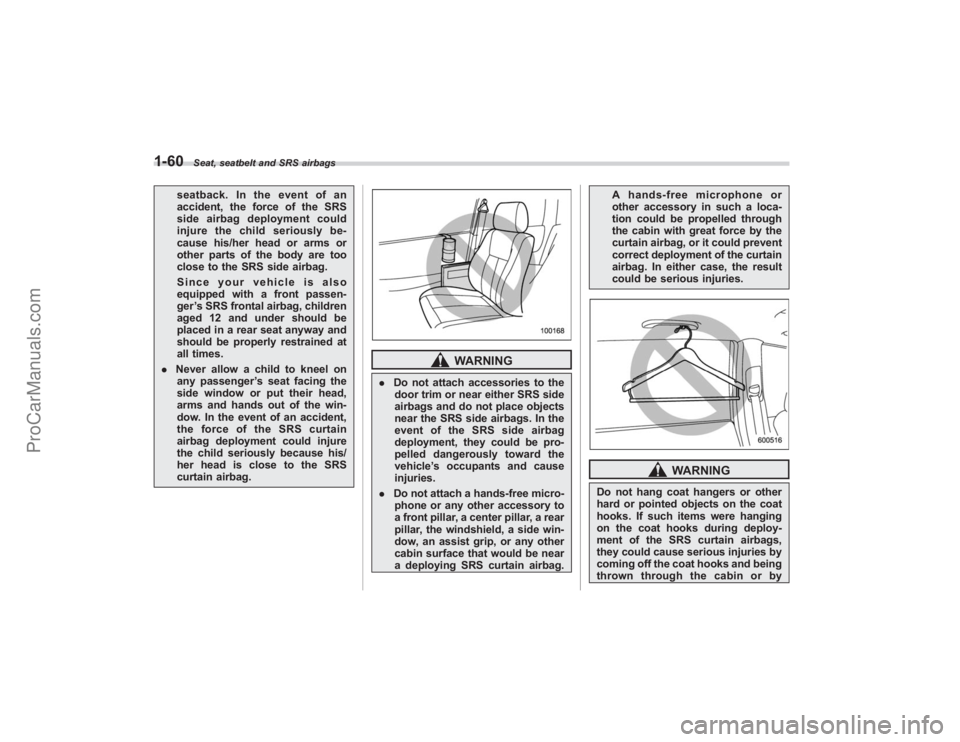
1-60
Seat, seatbelt and SRS airbags
seatback. In the event of an
accident, the force of the SRS
side airbag deployment could
injure the child seriously be-
cause his/her head or arms or
other parts of the body are too
close to the SRS side airbag.
Since your vehicle is also
equipped with a front passen-
ger’s SRS frontal airbag, children
aged 12 and under should be
placed in a rear seat anyway and
should be properly restrained at
all times.
. Never allow a child to kneel on
any passenger ’s seat facing the
side window or put their head,
arms and hands out of the win-
dow. In the event of an accident,
the force of the SRS curtain
airbag deployment could injure
the child seriously because his/
her head is close to the SRS
curtain airbag.
WARNING
. Do not attach accessories to the
door trim or near either SRS side
airbags and do not place objects
near the SRS side airbags. In the
event of the SRS side airbag
deployment, they could be pro-
pelled dangerously toward the
vehicle ’s occupants and cause
injuries.
. Do not attach a hands-free micro-
phone or any other accessory to
a front pillar, a center pillar, a rear
pillar, the windshield, a side win-
dow, an assist grip, or any other
cabin surface that would be near
a deploying SRS curtain airbag. A hands-free microphone or
other accessory in such a loca-
tion could be propelled through
the cabin with great force by the
curtain airbag, or it could prevent
correct deployment of the curtain
airbag. In either case, the result
could be serious injuries.
WARNING
Do not hang coat hangers or other
hard or pointed objects on the coat
hooks. If such items were hanging
on the coat hooks during deploy-
ment of the SRS curtain airbags,
they could cause serious injuries by
coming off the coat hooks and being
thrown through the cabin or by
ProCarManuals.com
Page 85 of 409

preventing deployment of the cur-
tain airbags.
Before hanging clothing on the coat
hooks, make sure there are no sharp
objects in the pockets. Hang cloth-
ing directly on the coat hooks with-
out using hangers.
WARNING
Do not put any kind of cover or
clothes or other objects over either
front seatback and do not attach
labels or stickers to the front seat
surface on or near the SRS side
airbag. They could prevent proper
deployment of the SRS side airbag,
reducing protection available to thefront seat
’s occupant.
! Operation
The SRS side airbag and SRS curtain
airbag can function only when the ignition
switch is in the “ON”position.
The driver ’s and front passenger ’s SRS
side airbags and SRS curtain airbags
deploy independently of each other since
each has its own impact sensor. There-
fore, they may not both deploy in the same
accident. Also, the SRS side airbag and
SRS curtain airbag deploys independently
of the driver ’s and front passenger ’s SRS
frontal airbags in the steering wheel and
instrument panel.
An impact sensor is located in each of the left and right center pillars and rear wheel
houses. In addition, the rollover sensor is
inside the airbag control module. If a
center pillar impact sensor senses an
impact force above a predetermined level
in a side collision, the control module
causes both the SRS side airbag and
curtain airbag on the impacted side to
inflate regardless of whether the rear
wheel house impact sensor on the same
side senses an impact. If it is a rear wheel
house impact sensor alone that senses a
sufficiently strong impact force, the control
module causes only the SRS curtain
airbag on the impacted side to inflate. If
the rollover sensor detects rollover of the
vehicle, the control module inflates the
curtain airbag. After deployment, the SRS
side airbag immediately starts to deflate.
The time required from detection of an
impact to deflation of an SRS side airbag
after deployment is shorter than the blink
of an eye.
The SRS curtain airbag remains inflated
for a while following deployment then
slowly deflates.
The SRS side airbag and SRS curtain
airbag deploy even when no one occupies
the seat on the side on which an impact is
applied.
When the SRS side airbag and SRS
Seat, seatbelt and SRS airbags
1-61
–
CONTINUED –
ProCarManuals.com