2008 NISSAN TEANA boot
[x] Cancel search: bootPage 4397 of 5121
POWER STEERING FLUID
ST-7
< ON-VEHICLE MAINTENANCE >
C
D
E
F
H
I
J
K
L
MA
B
ST
N
O
P
ON-VEHICLE MAINTENANCE
POWER STEERING FLUID
InspectionINFOID:0000000003826225
FLUID LEVEL
1. Check fluid level with engine stopped.
2. Ensure that fluid level is between MIN and MAX.
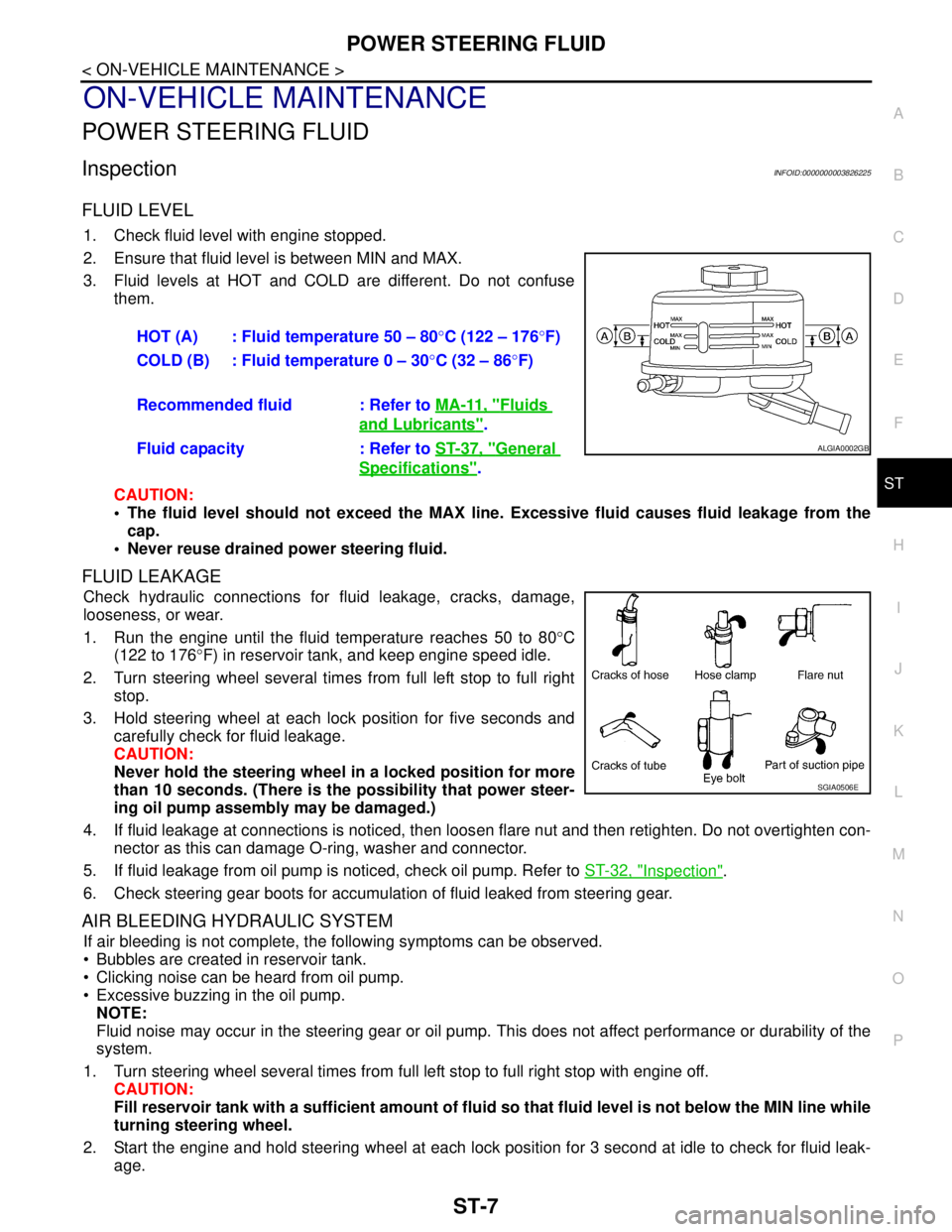
3. Fluid levels at HOT and COLD are different. Do not confuse
them.
CAUTION:
The fluid level should not exceed the MAX line. Excessive fluid causes fluid leakage from the
cap.
Never reuse drained power steering fluid.
FLUID LEAKAGE
Check hydraulic connections for fluid leakage, cracks, damage,
looseness, or wear.
1. Run the engine until the fluid temperature reaches 50 to 80°C
(122 to 176°F) in reservoir tank, and keep engine speed idle.
2. Turn steering wheel several times from full left stop to full right
stop.
3. Hold steering wheel at each lock position for five seconds and
carefully check for fluid leakage.
CAUTION:
Never hold the steering wheel in a locked position for more
than 10 seconds. (There is the possibility that power steer-
ing oil pump assembly may be damaged.)
4. If fluid leakage at connections is noticed, then loosen flare nut and then retighten. Do not overtighten con-
nector as this can damage O-ring, washer and connector.
5. If fluid leakage from oil pump is noticed, check oil pump. Refer to ST-32, "
Inspection".
6. Check steering gear boots for accumulation of fluid leaked from steering gear.
AIR BLEEDING HYDRAULIC SYSTEM
If air bleeding is not complete, the following symptoms can be observed.
Bubbles are created in reservoir tank.
Clicking noise can be heard from oil pump.
Excessive buzzing in the oil pump.
NOTE:
Fluid noise may occur in the steering gear or oil pump. This does not affect performance or durability of the
system.
1. Turn steering wheel several times from full left stop to full right stop with engine off.
CAUTION:
Fill reservoir tank with a sufficient amount of fluid so that fluid level is not below the MIN line while
turning steering wheel.
2. Start the engine and hold steering wheel at each lock position for 3 second at idle to check for fluid leak-
age.HOT (A) : Fluid temperature 50 – 80°C (122 – 176°F)
COLD (B) : Fluid temperature 0 – 30°C (32 – 86°F)
Recommended fluid : Refer to MA-11, "
Fluids
and Lubricants".
Fluid capacity : Refer to ST-37, "
General
Specifications".
ALGIA0002GB
SGIA0506E
Page 4409 of 5121
STEERING GEAR AND LINKAGE
ST-19
< ON-VEHICLE REPAIR >
C
D
E
F
H
I
J
K
L
MA
B
ST
N
O
P
Removal and InstallationINFOID:0000000003806323
REMOVAL
1. Set the vehicle to the straight-ahead position.
2. Remove front tires.
3. Remove splash guards (RH and LH). Refer to EXT-22, "
FENDER PROTECTOR : Exploded View".
4. Remove engine under cover. Refer to EXT-28, "
Exploded View".
5. Remove heat insulator from front floor.
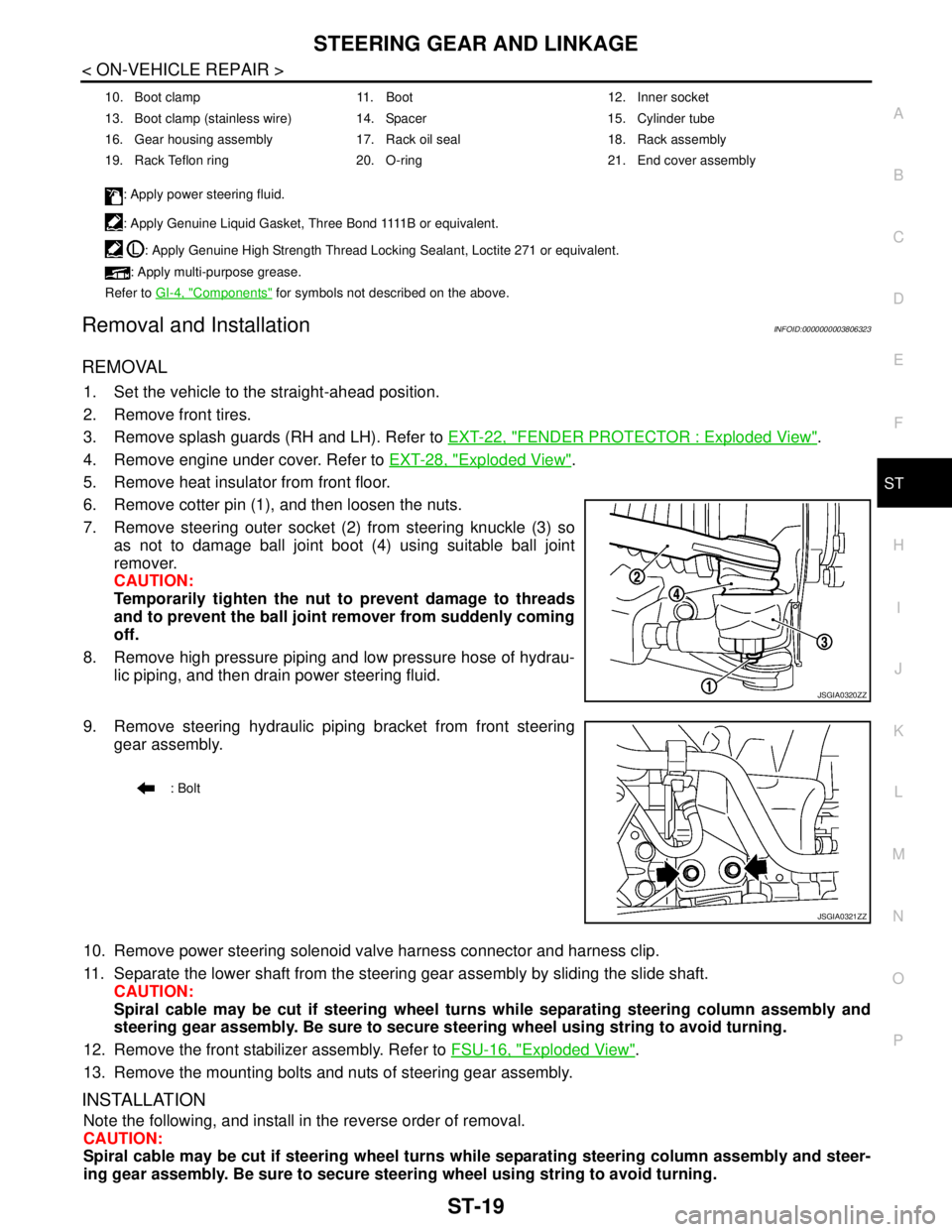
6. Remove cotter pin (1), and then loosen the nuts.
7. Remove steering outer socket (2) from steering knuckle (3) so
as not to damage ball joint boot (4) using suitable ball joint
remover.
CAUTION:
Temporarily tighten the nut to prevent damage to threads
and to prevent the ball joint remover from suddenly coming
off.
8. Remove high pressure piping and low pressure hose of hydrau-
lic piping, and then drain power steering fluid.
9. Remove steering hydraulic piping bracket from front steering
gear assembly.
10. Remove power steering solenoid valve harness connector and harness clip.
11. Separate the lower shaft from the steering gear assembly by sliding the slide shaft.
CAUTION:
Spiral cable may be cut if steering wheel turns while separating steering column assembly and
steering gear assembly. Be sure to secure steering wheel using string to avoid turning.
12. Remove the front stabilizer assembly. Refer to FSU-16, "
Exploded View".
13. Remove the mounting bolts and nuts of steering gear assembly.
INSTALLATION
Note the following, and install in the reverse order of removal.
CAUTION:
Spiral cable may be cut if steering wheel turns while separating steering column assembly and steer-
ing gear assembly. Be sure to secure steering wheel using string to avoid turning.
10. Boot clamp 11. Boot 12. Inner socket
13. Boot clamp (stainless wire) 14. Spacer 15. Cylinder tube
16. Gear housing assembly 17. Rack oil seal 18. Rack assembly
19. Rack Teflon ring 20. O-ring 21. End cover assembly
: Apply power steering fluid.
: A p p l y G e n u i n e L i q u i d G a s k e t , T h r e e B o n d 1111 B o r e q u i v a l e n t .
: Apply Genuine High Strength Thread Locking Sealant, Loctite 271 or equivalent.
: Apply multi-purpose grease.
Refer to GI-4, "
Components" for symbols not described on the above.
JSGIA0320ZZ
: Bolt
JSGIA0321ZZ
Page 4410 of 5121
ST-20
< ON-VEHICLE REPAIR >
STEERING GEAR AND LINKAGE
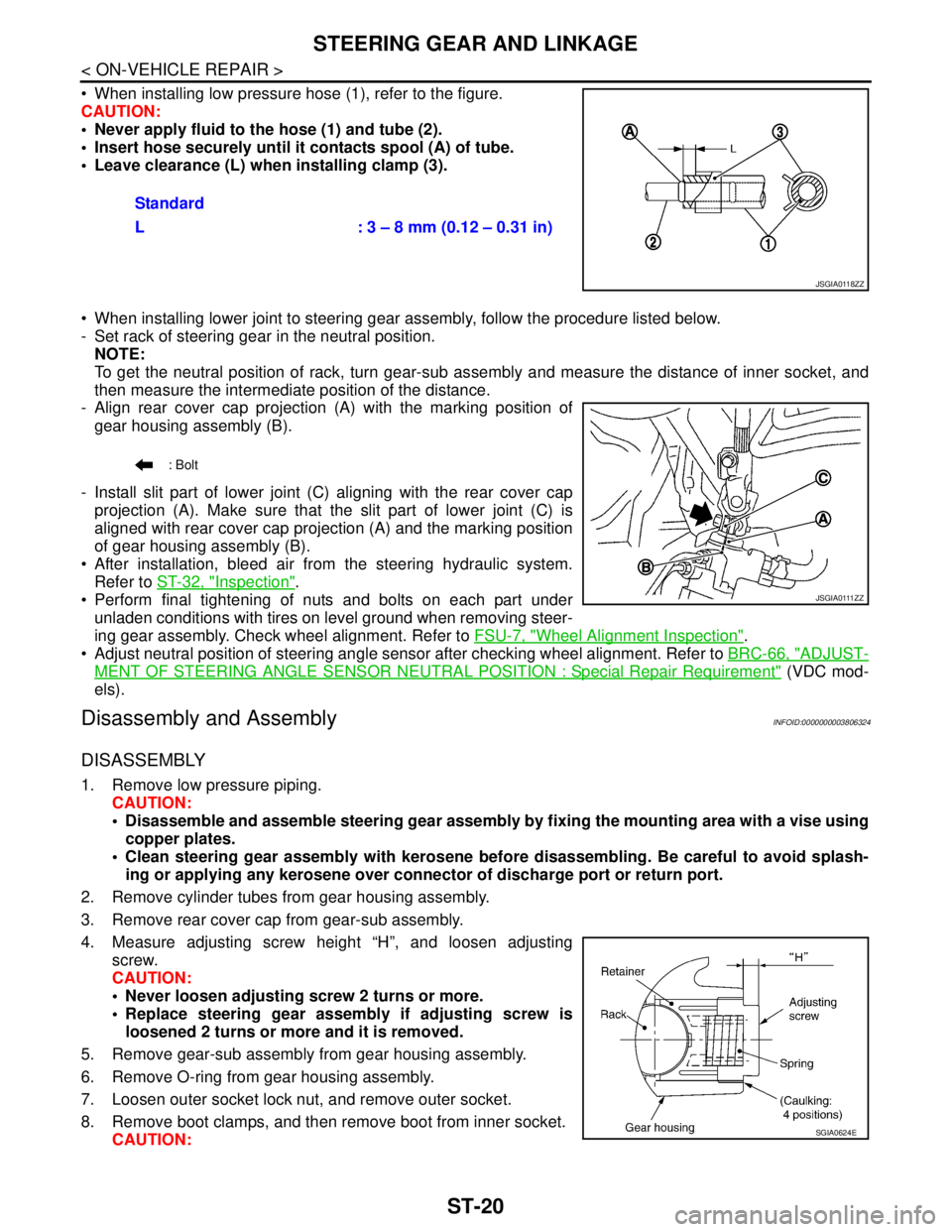
When installing low pressure hose (1), refer to the figure.
CAUTION:
Never apply fluid to the hose (1) and tube (2).
Insert hose securely until it contacts spool (A) of tube.
Leave clearance (L) when installing clamp (3).
When installing lower joint to steering gear assembly, follow the procedure listed below.
- Set rack of steering gear in the neutral position.
NOTE:
To get the neutral position of rack, turn gear-sub assembly and measure the distance of inner socket, and
then measure the intermediate position of the distance.
- Align rear cover cap projection (A) with the marking position of
gear housing assembly (B).
- Install slit part of lower joint (C) aligning with the rear cover cap
projection (A). Make sure that the slit part of lower joint (C) is
aligned with rear cover cap projection (A) and the marking position
of gear housing assembly (B).
After installation, bleed air from the steering hydraulic system.
Refer to ST-32, "
Inspection".
Perform final tightening of nuts and bolts on each part under
unladen conditions with tires on level ground when removing steer-
ing gear assembly. Check wheel alignment. Refer to FSU-7, "
Wheel Alignment Inspection".
Adjust neutral position of steering angle sensor after checking wheel alignment. Refer to BRC-66, "
ADJUST-
MENT OF STEERING ANGLE SENSOR NEUTRAL POSITION : Special Repair Requirement" (VDC mod-
els).
Disassembly and AssemblyINFOID:0000000003806324
DISASSEMBLY
1. Remove low pressure piping.
CAUTION:
Disassemble and assemble steering gear assembly by fixing the mounting area with a vise using
copper plates.
Clean steering gear assembly with kerosene before disassembling. Be careful to avoid splash-
ing or applying any kerosene over connector of discharge port or return port.
2. Remove cylinder tubes from gear housing assembly.
3. Remove rear cover cap from gear-sub assembly.
4. Measure adjusting screw height “H”, and loosen adjusting
screw.
CAUTION:
Never loosen adjusting screw 2 turns or more.
Replace steering gear assembly if adjusting screw is
loosened 2 turns or more and it is removed.
5. Remove gear-sub assembly from gear housing assembly.
6. Remove O-ring from gear housing assembly.
7. Loosen outer socket lock nut, and remove outer socket.
8. Remove boot clamps, and then remove boot from inner socket.
CAUTION:Standard
L : 3 – 8 mm (0.12 – 0.31 in)
JSGIA0118ZZ
: Bolt
J S G I A 0 111 Z Z
SGIA0624E
Page 4411 of 5121
STEERING GEAR AND LINKAGE
ST-21
< ON-VEHICLE REPAIR >
C
D
E
F
H
I
J
K
L
MA
B
ST
N
O
P
Never damage inner socket and gear housing assembly when removing boot. Inner socket and
gear housing assembly must be replaced if inner socket and gear housing assembly are damaged
because it may cause foreign material interfusion.
9. Remove inner socket and spacer from gear housing assembly.
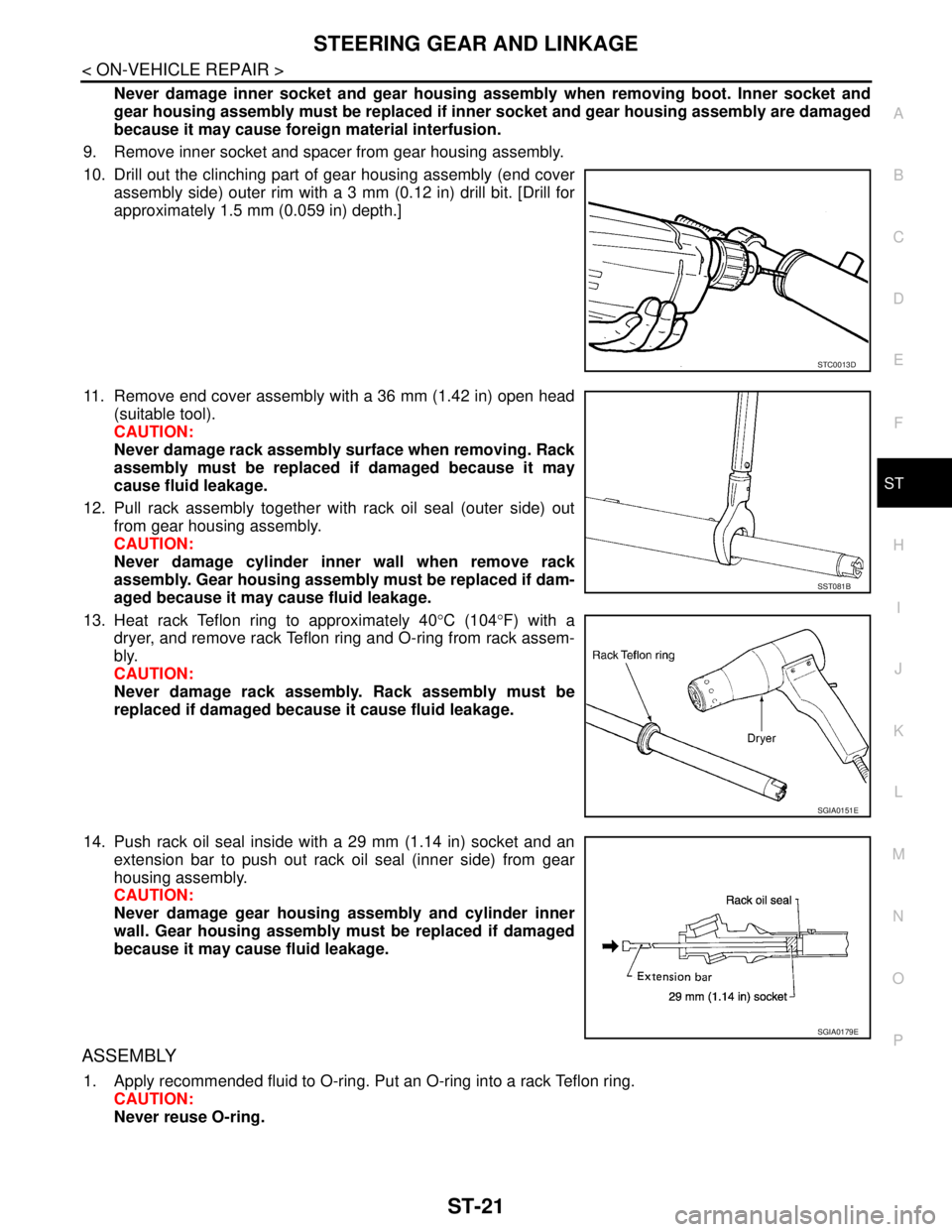
10. Drill out the clinching part of gear housing assembly (end cover
assembly side) outer rim with a 3 mm (0.12 in) drill bit. [Drill for
approximately 1.5 mm (0.059 in) depth.]
11. Remove end cover assembly with a 36 mm (1.42 in) open head
(suitable tool).
CAUTION:
Never damage rack assembly surface when removing. Rack
assembly must be replaced if damaged because it may
cause fluid leakage.
12. Pull rack assembly together with rack oil seal (outer side) out
from gear housing assembly.
CAUTION:
Never damage cylinder inner wall when remove rack
assembly. Gear housing assembly must be replaced if dam-
aged because it may cause fluid leakage.
13. Heat rack Teflon ring to approximately 40°C (104°F) with a
dryer, and remove rack Teflon ring and O-ring from rack assem-
bly.
CAUTION:
Never damage rack assembly. Rack assembly must be
replaced if damaged because it cause fluid leakage.
14. Push rack oil seal inside with a 29 mm (1.14 in) socket and an
extension bar to push out rack oil seal (inner side) from gear
housing assembly.
CAUTION:
Never damage gear housing assembly and cylinder inner
wall. Gear housing assembly must be replaced if damaged
because it may cause fluid leakage.
ASSEMBLY
1. Apply recommended fluid to O-ring. Put an O-ring into a rack Teflon ring.
CAUTION:
Never reuse O-ring.
STC0013D
SST081B
SGIA0151E
SGIA0179E
Page 4415 of 5121
STEERING GEAR AND LINKAGE
ST-25
< ON-VEHICLE REPAIR >
C
D
E
F
H
I
J
K
L
MA
B
ST
N
O
P
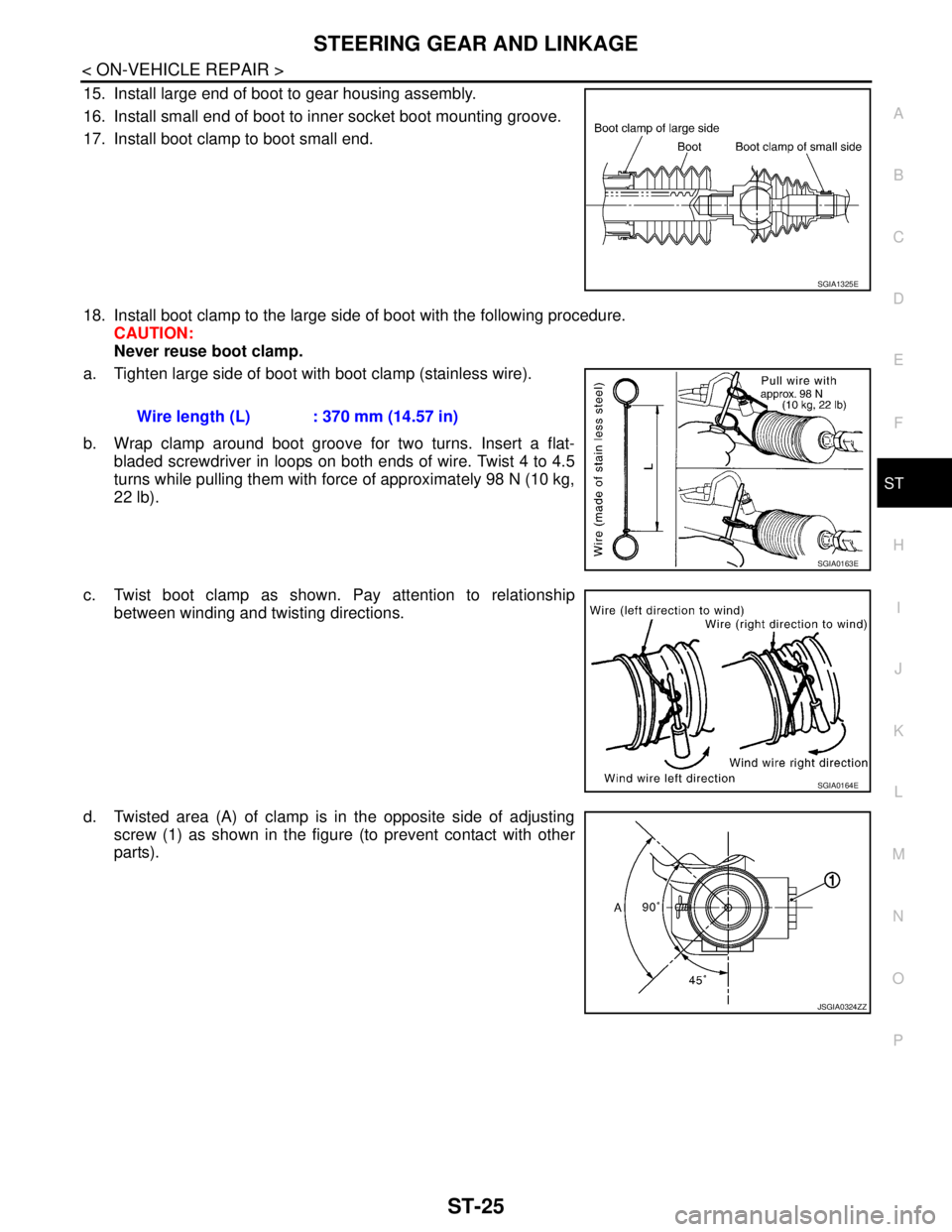
15. Install large end of boot to gear housing assembly.
16. Install small end of boot to inner socket boot mounting groove.
17. Install boot clamp to boot small end.
18. Install boot clamp to the large side of boot with the following procedure.
CAUTION:
Never reuse boot clamp.
a. Tighten large side of boot with boot clamp (stainless wire).
b. Wrap clamp around boot groove for two turns. Insert a flat-
bladed screwdriver in loops on both ends of wire. Twist 4 to 4.5
turns while pulling them with force of approximately 98 N (10 kg,
22 lb).
c. Twist boot clamp as shown. Pay attention to relationship
between winding and twisting directions.
d. Twisted area (A) of clamp is in the opposite side of adjusting
screw (1) as shown in the figure (to prevent contact with other
parts).
SGIA1325E
Wire length (L) : 370 mm (14.57 in)
SGIA0163E
SGIA0164E
JSGIA0324ZZ
Page 4416 of 5121
ST-26
< ON-VEHICLE REPAIR >
STEERING GEAR AND LINKAGE
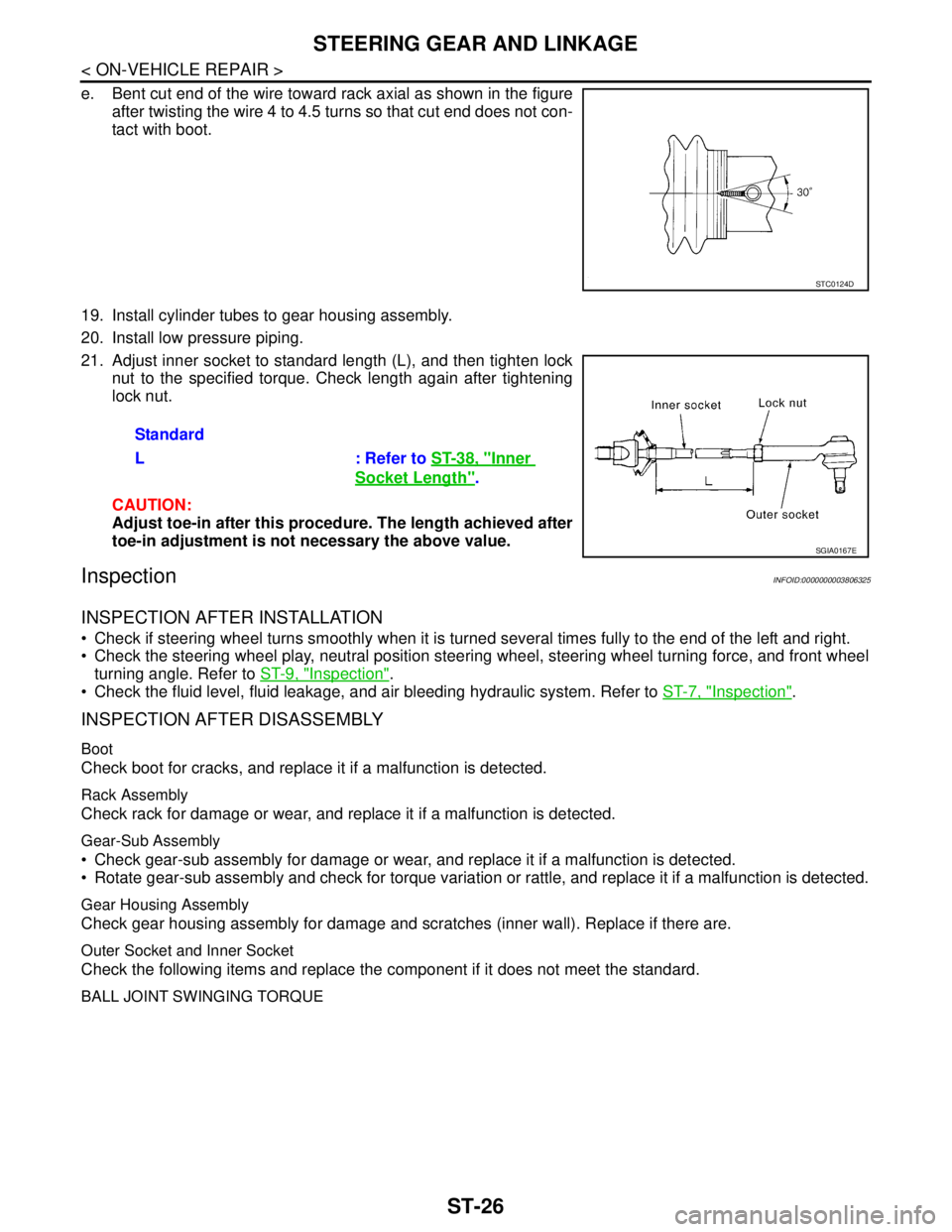
e. Bent cut end of the wire toward rack axial as shown in the figure
after twisting the wire 4 to 4.5 turns so that cut end does not con-
tact with boot.
19. Install cylinder tubes to gear housing assembly.
20. Install low pressure piping.
21. Adjust inner socket to standard length (L), and then tighten lock
nut to the specified torque. Check length again after tightening
lock nut.
CAUTION:
Adjust toe-in after this procedure. The length achieved after
toe-in adjustment is not necessary the above value.
InspectionINFOID:0000000003806325
INSPECTION AFTER INSTALLATION
Check if steering wheel turns smoothly when it is turned several times fully to the end of the left and right.
Check the steering wheel play, neutral position steering wheel, steering wheel turning force, and front wheel
turning angle. Refer to ST-9, "
Inspection".
Check the fluid level, fluid leakage, and air bleeding hydraulic system. Refer to ST-7, "
Inspection".
INSPECTION AFTER DISASSEMBLY
Boot
Check boot for cracks, and replace it if a malfunction is detected.
Rack Assembly
Check rack for damage or wear, and replace it if a malfunction is detected.
Gear-Sub Assembly
Check gear-sub assembly for damage or wear, and replace it if a malfunction is detected.
Rotate gear-sub assembly and check for torque variation or rattle, and replace it if a malfunction is detected.
Gear Housing Assembly
Check gear housing assembly for damage and scratches (inner wall). Replace if there are.
Outer Socket and Inner Socket
Check the following items and replace the component if it does not meet the standard.
BALL JOINT SWINGING TORQUE
STC0124D
Standard
L : Refer to ST-38, "
Inner
Socket Length".
SGIA0167E
Page 4419 of 5121
POWER STEERING OIL PUMP
ST-29
< ON-VEHICLE REPAIR >
C
D
E
F
H
I
J
K
L
MA
B
ST
N
O
P
Removal and InstallationINFOID:0000000003806327
REMOVAL
1. Drain power steering fluid from reservoir tank.
2. Remove front tires.
3. Remove splash guard. Refer to EXT-22, "
FENDER PROTECTOR : Exploded View".
4. Loosen drive belt. Refer to EM-12, "
Removal and Installation".
5. Remove drive belt from oil pump pulley.
6. Remove copper washers and eye bolt (drain fluid from their pipings).
7. Remove suction hose (drain fluid from their pipings).
8. Remove oil pump mounting bolts, and then remove oil pump.
CAUTION:
Never damage drive shaft boot.
INSTALLATION
Note the following, and install in the reverse order of removal.
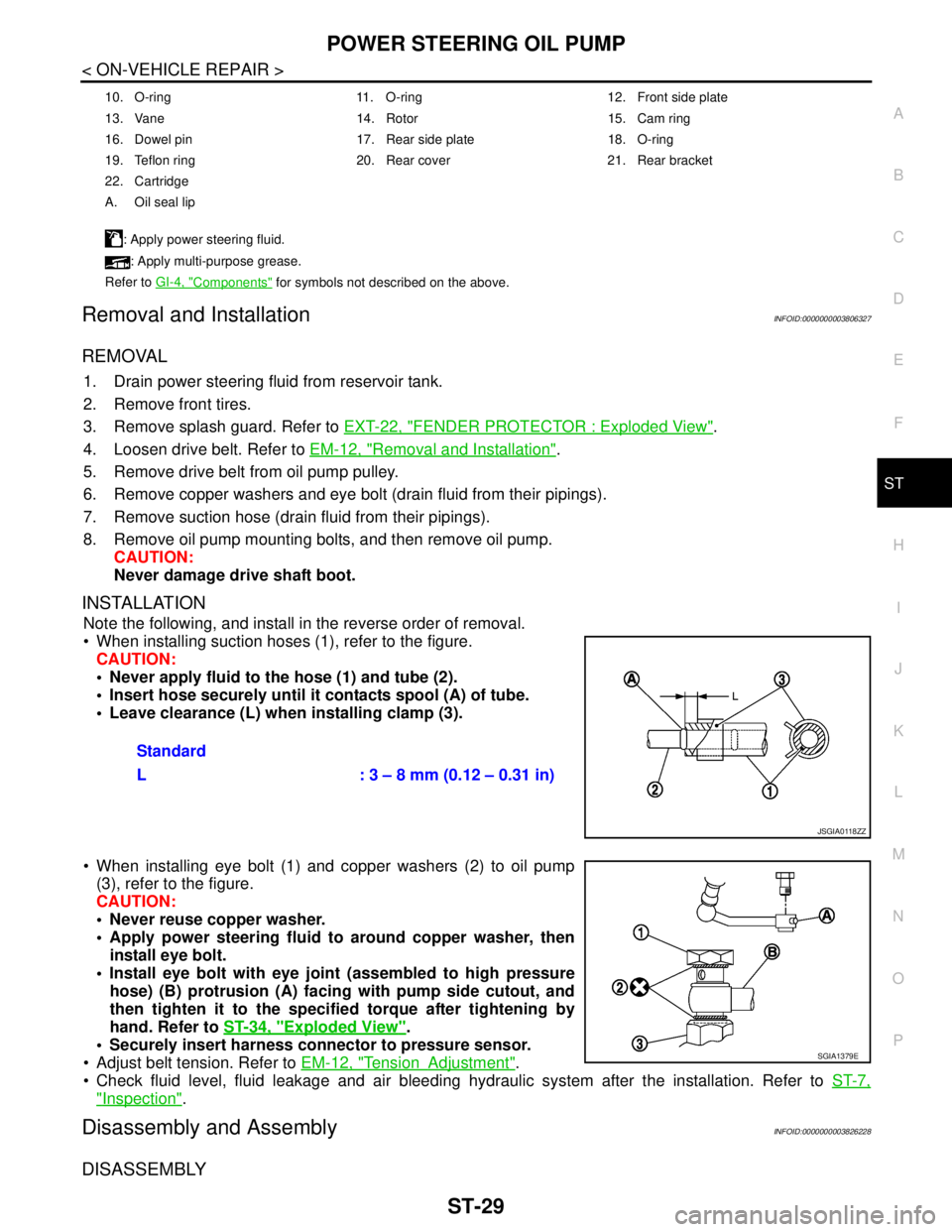
When installing suction hoses (1), refer to the figure.
CAUTION:
Never apply fluid to the hose (1) and tube (2).
Insert hose securely until it contacts spool (A) of tube.
Leave clearance (L) when installing clamp (3).
When installing eye bolt (1) and copper washers (2) to oil pump
(3), refer to the figure.
CAUTION:
Never reuse copper washer.
Apply power steering fluid to around copper washer, then
install eye bolt.
Install eye bolt with eye joint (assembled to high pressure
hose) (B) protrusion (A) facing with pump side cutout, and
then tighten it to the specified torque after tightening by
hand. Refer to ST-34, "
Exploded View".
Securely insert harness connector to pressure sensor.
Adjust belt tension. Refer to EM-12, "
TensionAdjustment".
Check fluid level, fluid leakage and air bleeding hydraulic system after the installation. Refer to ST-7,
"Inspection".
Disassembly and AssemblyINFOID:0000000003826228
DISASSEMBLY
10. O-ring 11. O-ring 12. Front side plate
13. Vane 14. Rotor 15. Cam ring
16. Dowel pin 17. Rear side plate 18. O-ring
19. Teflon ring 20. Rear cover 21. Rear bracket
22. Cartridge
A. Oil seal lip
: Apply power steering fluid.
: Apply multi-purpose grease.
Refer to GI-4, "
Components" for symbols not described on the above.
Standard
L : 3 – 8 mm (0.12 – 0.31 in)
JSGIA0118ZZ
SGIA1379E