Page 1892 of 5121
CAMSHAFT VALVE CLEARANCE
EM-17
< ON-VEHICLE MAINTENANCE >
C
D
E
F
G
H
I
J
K
L
MA
EM
N
P O
CAMSHAFT VALVE CLEARANCE
Inspection and AdjustmentINFOID:0000000003802244
INSPECTION
Perform inspection as follows after removal, installation or replacement of camshaft or valve-related parts, or if
there is unusual engine conditions regarding valve clearance.
In cases of removing/installing or replacing camshaft and valve-
related parts, or of unusual engine conditions due to changes in
valve clearance (found malfunctions during stating, idling or causing
noise), perform inspection as follows:
1. Remove rocker covers (bank 1 and bank 2). Refer to EM-49, "
Exploded View".
2. Measure the valve clearance as follows:
a. Set No. 1 cylinder at TDC of its compression stroke.
Rotate crankshaft pulley clockwise to align timing mark
(grooved line without color) ( ) with timing indicator.
Check that intake and exhaust cam nose on No. 1 cylinder
(engine front side of bank 1) are located as shown in the fig-
ure.
If not, turn crankshaft one revolution (360 degrees) and align
as shown in the figure.
b. Use a feeler gauge, measure the clearance between valve lifter
and camshaft.
: Engine front
JPBIA0164ZZ
SEM727G
: Engine front
JPBIA0044ZZ
Valve clearance : Refer to EM-136, "Camshaft".
SEM139D
Page 1896 of 5121
CAMSHAFT VALVE CLEARANCE
EM-21
< ON-VEHICLE MAINTENANCE >
C
D
E
F
G
H
I
J
K
L
MA
EM
N
P O
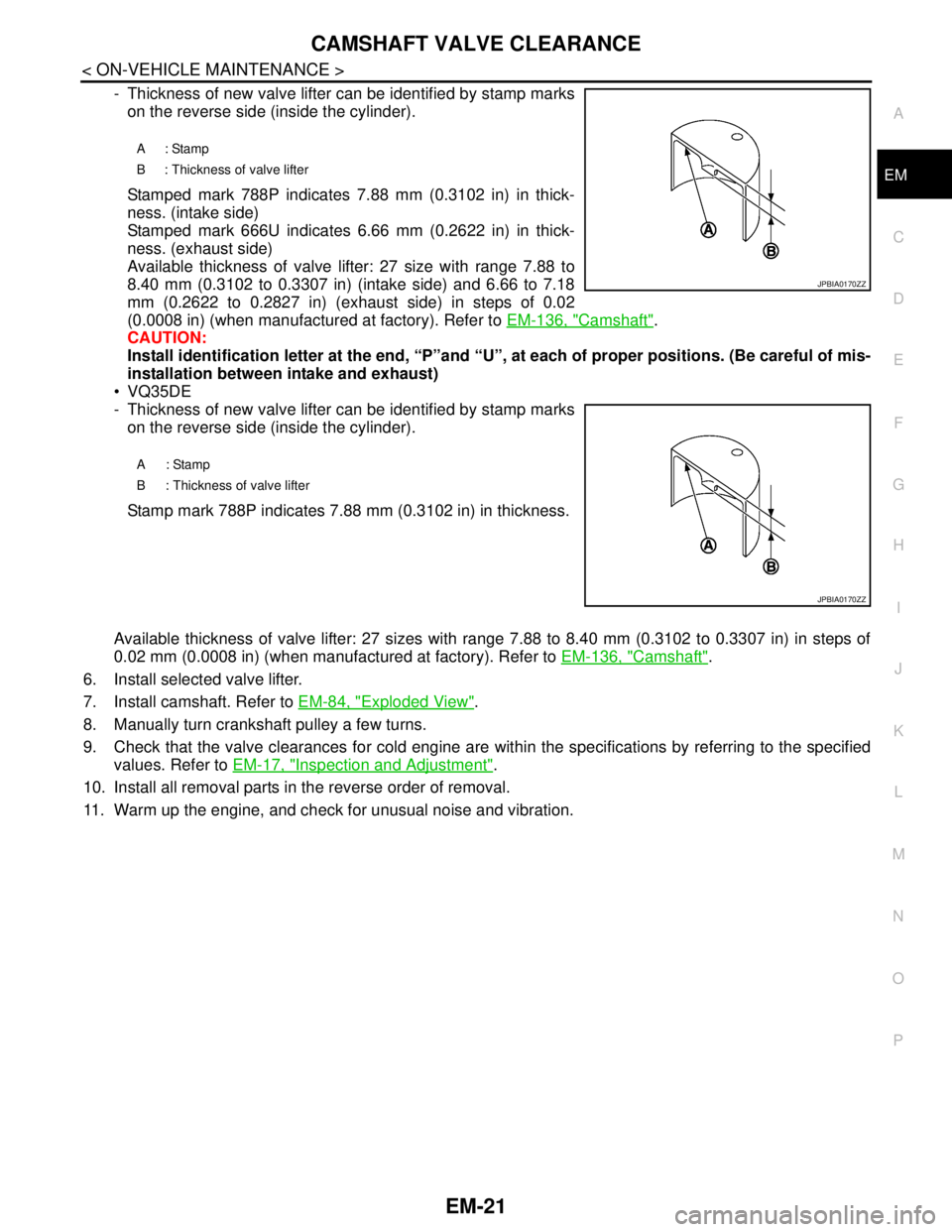
- Thickness of new valve lifter can be identified by stamp marks
on the reverse side (inside the cylinder).
Stamped mark 788P indicates 7.88 mm (0.3102 in) in thick-
ness. (intake side)
Stamped mark 666U indicates 6.66 mm (0.2622 in) in thick-
ness. (exhaust side)
Available thickness of valve lifter: 27 size with range 7.88 to
8.40 mm (0.3102 to 0.3307 in) (intake side) and 6.66 to 7.18
mm (0.2622 to 0.2827 in) (exhaust side) in steps of 0.02
(0.0008 in) (when manufactured at factory). Refer to EM-136, "
Camshaft".
CAUTION:
Install identification letter at the end, “P”and “U”, at each of proper positions. (Be careful of mis-
installation between intake and exhaust)
VQ35DE
- Thickness of new valve lifter can be identified by stamp marks
on the reverse side (inside the cylinder).
Stamp mark 788P indicates 7.88 mm (0.3102 in) in thickness.
Available thickness of valve lifter: 27 sizes with range 7.88 to 8.40 mm (0.3102 to 0.3307 in) in steps of
0.02 mm (0.0008 in) (when manufactured at factory). Refer to EM-136, "
Camshaft".
6. Install selected valve lifter.
7. Install camshaft. Refer to EM-84, "
Exploded View".
8. Manually turn crankshaft pulley a few turns.
9. Check that the valve clearances for cold engine are within the specifications by referring to the specified
values. Refer to EM-17, "
Inspection and Adjustment".
10. Install all removal parts in the reverse order of removal.
11. Warm up the engine, and check for unusual noise and vibration.
A: Stamp
B : Thickness of valve lifter
A: Stamp
B : Thickness of valve lifter
JPBIA0170ZZ
JPBIA0170ZZ
Page 1897 of 5121
EM-22
< ON-VEHICLE MAINTENANCE >
COMPRESSION PRESSURE
COMPRESSION PRESSURE
InspectionINFOID:0000000003802245
1. Warm up engine thoroughly. Then, stop it.
2. Release fuel pressure. Refer to EC-411, "
Inspection".
3. Disconnect fuel pump fuse to avoid fuel injection during measurement. Refer to EC-20,
"ComponentPartsLocation".
4. Remove engine cover. Refer to EM-24, "
Exploded View".
5. Remove ignition coil and spark plug from each cylinder. Refer to EM-49, "
Exploded View".
6. Connect engine tachometer (not required in use of CONSULT-III).
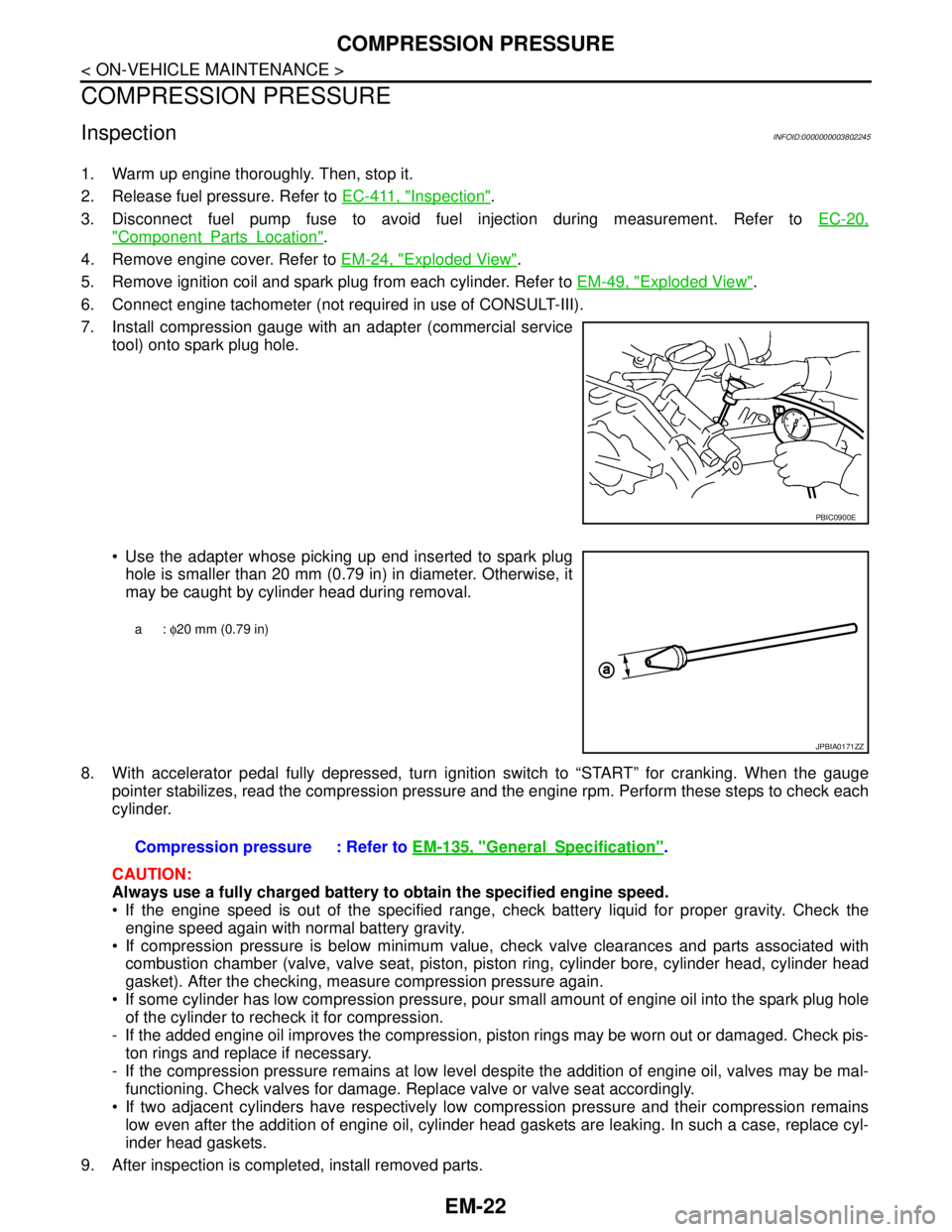
7. Install compression gauge with an adapter (commercial service
tool) onto spark plug hole.
Use the adapter whose picking up end inserted to spark plug
hole is smaller than 20 mm (0.79 in) in diameter. Otherwise, it
may be caught by cylinder head during removal.
8. With accelerator pedal fully depressed, turn ignition switch to “START” for cranking. When the gauge
pointer stabilizes, read the compression pressure and the engine rpm. Perform these steps to check each
cylinder.
CAUTION:
Always use a fully charged battery to obtain the specified engine speed.
If the engine speed is out of the specified range, check battery liquid for proper gravity. Check the
engine speed again with normal battery gravity.
If compression pressure is below minimum value, check valve clearances and parts associated with
combustion chamber (valve, valve seat, piston, piston ring, cylinder bore, cylinder head, cylinder head
gasket). After the checking, measure compression pressure again.
If some cylinder has low compression pressure, pour small amount of engine oil into the spark plug hole
of the cylinder to recheck it for compression.
- If the added engine oil improves the compression, piston rings may be worn out or damaged. Check pis-
ton rings and replace if necessary.
- If the compression pressure remains at low level despite the addition of engine oil, valves may be mal-
functioning. Check valves for damage. Replace valve or valve seat accordingly.
If two adjacent cylinders have respectively low compression pressure and their compression remains
low even after the addition of engine oil, cylinder head gaskets are leaking. In such a case, replace cyl-
inder head gaskets.
9. After inspection is completed, install removed parts.
PBIC0900E
a: φ20 mm (0.79 in)
JPBIA0171ZZ
Compression pressure : Refer to EM-135, "GeneralSpecification".
Page 1898 of 5121
COMPRESSION PRESSURE
EM-23
< ON-VEHICLE MAINTENANCE >
C
D
E
F
G
H
I
J
K
L
MA
EM
N
P O
10. Start the engine, and check that the engine runs smoothly.
11. Perform trouble diagnosis. If DTC appears, erase it. Refer to EC-124, "
Description".
Page 1908 of 5121
INTAKE MANIFOLD
EM-33
< ON-VEHICLE REPAIR >
C
D
E
F
G
H
I
J
K
L
MA
EM
N
P O
Tighten all mounting nuts and bolts to the specified torque in two or
more steps in numerical order shown in the figure.
InspectionINFOID:0000000003802257
INSPECTION AFTER REMOVAL
Surface Distortion
Check the surface distortion of the intake manifold mating surface
with a straightedge (A) and a feeler gauge (B).
If it exceeds the limit, replace intake manifold.
: Engine front
1st step: 7.4 N·m (0.75 kg-m, 5 ft-lb)
2nd step and after: 25.5 N·m (2.6 kg-m, 19 ft-lb)
JPBIA1630ZZ
Limit : Refer to EM-136, "Intake Manifold".
JPBIA0015ZZ
Page 1917 of 5121
EM-42
< ON-VEHICLE REPAIR >
OIL PAN AND OIL STRAINER
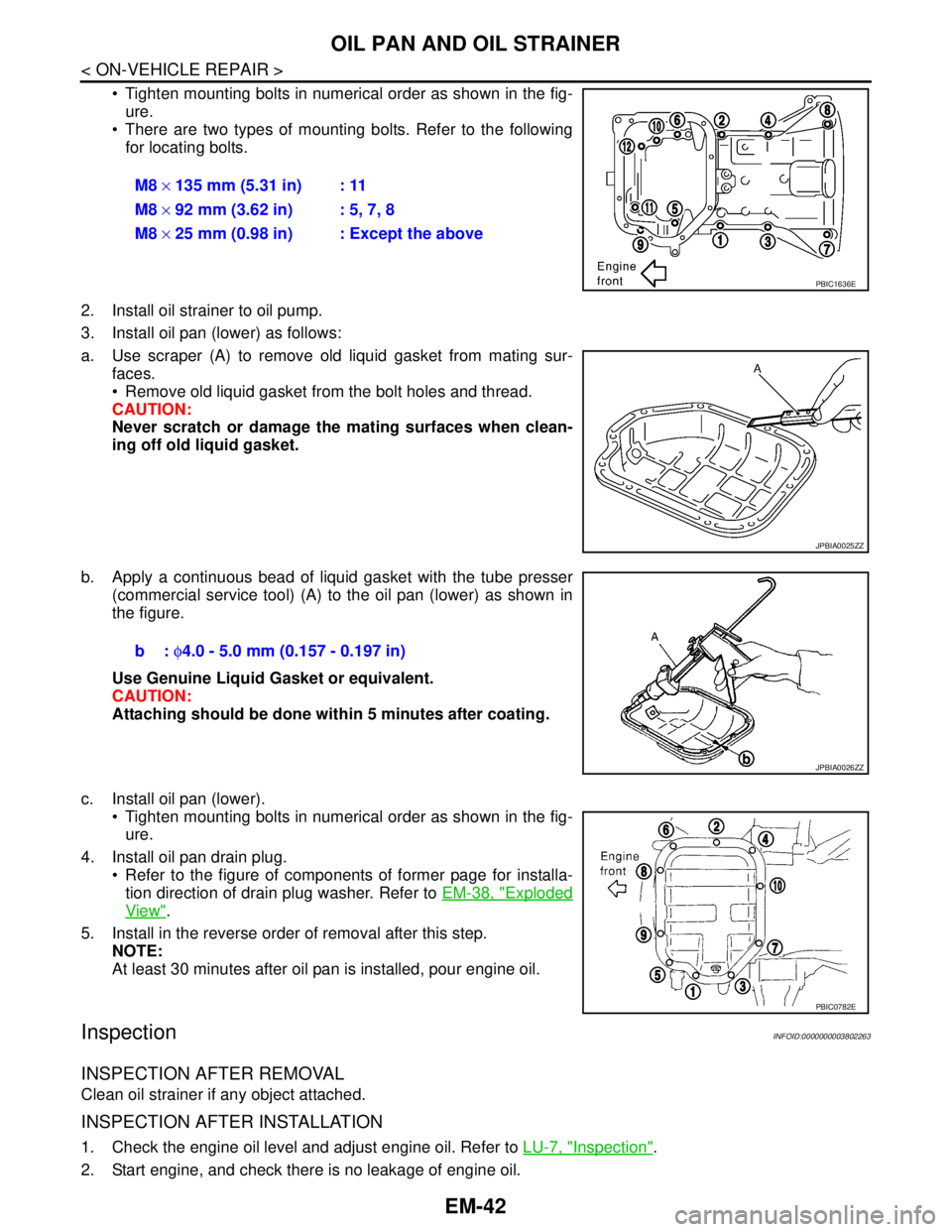
Tighten mounting bolts in numerical order as shown in the fig-
ure.
There are two types of mounting bolts. Refer to the following
for locating bolts.
2. Install oil strainer to oil pump.
3. Install oil pan (lower) as follows:
a. Use scraper (A) to remove old liquid gasket from mating sur-
faces.
Remove old liquid gasket from the bolt holes and thread.
CAUTION:
Never scratch or damage the mating surfaces when clean-
ing off old liquid gasket.
b. Apply a continuous bead of liquid gasket with the tube presser
(commercial service tool) (A) to the oil pan (lower) as shown in
the figure.
Use Genuine Liquid Gasket or equivalent.
CAUTION:
Attaching should be done within 5 minutes after coating.
c. Install oil pan (lower).
Tighten mounting bolts in numerical order as shown in the fig-
ure.
4. Install oil pan drain plug.
Refer to the figure of components of former page for installa-
tion direction of drain plug washer. Refer to EM-38, "
Exploded
View".
5. Install in the reverse order of removal after this step.
NOTE:
At least 30 minutes after oil pan is installed, pour engine oil.
InspectionINFOID:0000000003802263
INSPECTION AFTER REMOVAL
Clean oil strainer if any object attached.
INSPECTION AFTER INSTALLATION
1. Check the engine oil level and adjust engine oil. Refer to LU-7, "Inspection".
2. Start engine, and check there is no leakage of engine oil.M8 × 135 mm (5.31 in) : 11
M8 × 92 mm (3.62 in) : 5, 7, 8
M8 × 25 mm (0.98 in) : Except the above
PBIC1636E
JPBIA0025ZZ
b: φ4.0 - 5.0 mm (0.157 - 0.197 in)
JPBIA0026ZZ
PBIC0782E
Page 1918 of 5121
OIL PAN AND OIL STRAINER
EM-43
< ON-VEHICLE REPAIR >
C
D
E
F
G
H
I
J
K
L
MA
EM
N
P O
3. Stop engine and wait for 10 minutes.
4. Check the engine oil level again. Refer to LU-7, "
Inspection".
Page 1921 of 5121
EM-46
< ON-VEHICLE REPAIR >
FUEL INJECTOR AND FUEL TUBE
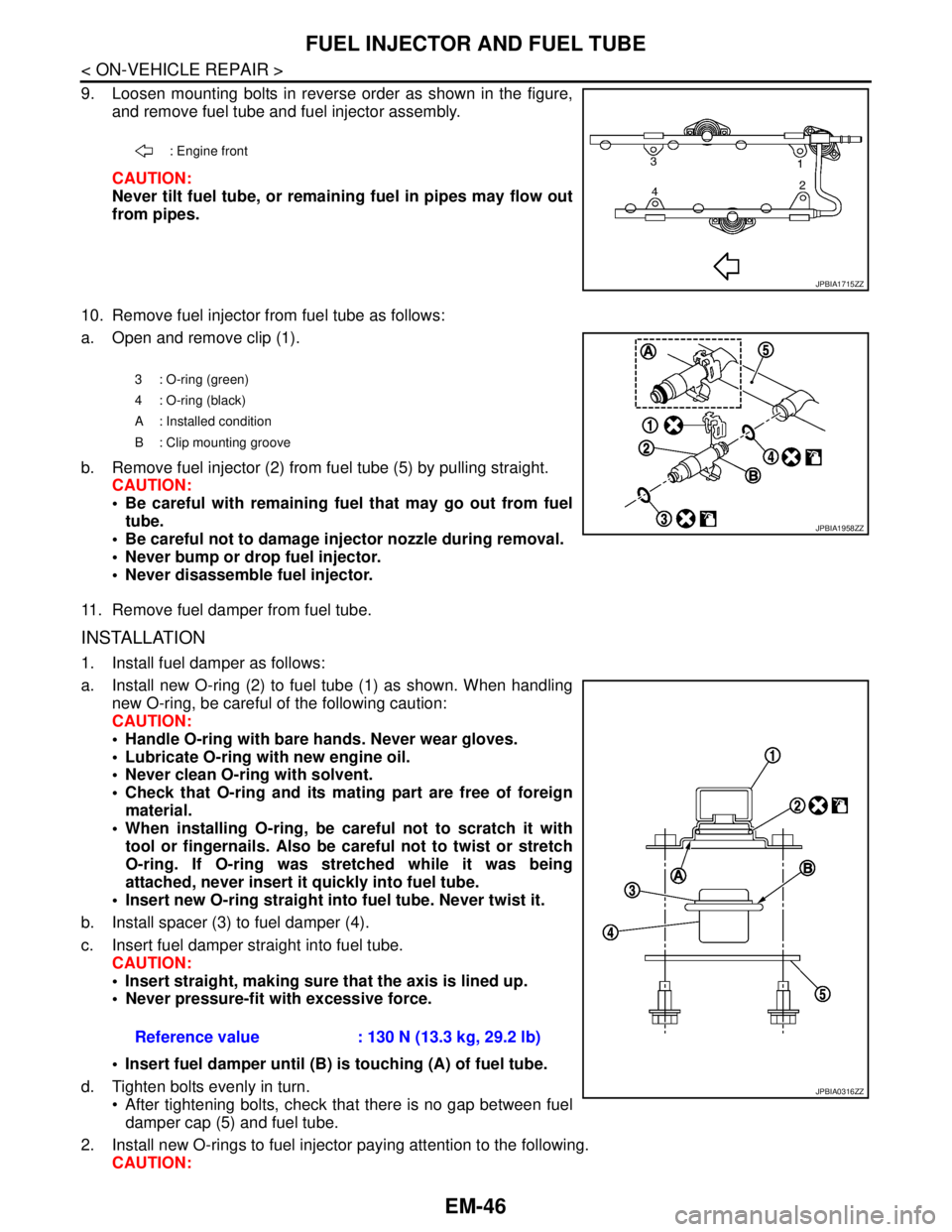
9. Loosen mounting bolts in reverse order as shown in the figure,
and remove fuel tube and fuel injector assembly.
CAUTION:
Never tilt fuel tube, or remaining fuel in pipes may flow out
from pipes.
10. Remove fuel injector from fuel tube as follows:
a. Open and remove clip (1).
b. Remove fuel injector (2) from fuel tube (5) by pulling straight.
CAUTION:
Be careful with remaining fuel that may go out from fuel
tube.
Be careful not to damage injector nozzle during removal.
Never bump or drop fuel injector.
Never disassemble fuel injector.
11. Remove fuel damper from fuel tube.
INSTALLATION
1. Install fuel damper as follows:
a. Install new O-ring (2) to fuel tube (1) as shown. When handling
new O-ring, be careful of the following caution:
CAUTION:
Handle O-ring with bare hands. Never wear gloves.
Lubricate O-ring with new engine oil.
Never clean O-ring with solvent.
Check that O-ring and its mating part are free of foreign
material.
When installing O-ring, be careful not to scratch it with
tool or fingernails. Also be careful not to twist or stretch
O-ring. If O-ring was stretched while it was being
attached, never insert it quickly into fuel tube.
Insert new O-ring straight into fuel tube. Never twist it.
b. Install spacer (3) to fuel damper (4).
c. Insert fuel damper straight into fuel tube.
CAUTION:
Insert straight, making sure that the axis is lined up.
Never pressure-fit with excessive force.
Insert fuel damper until (B) is touching (A) of fuel tube.
d. Tighten bolts evenly in turn.
After tightening bolts, check that there is no gap between fuel
damper cap (5) and fuel tube.
2. Install new O-rings to fuel injector paying attention to the following.
CAUTION:
: Engine front
JPBIA1715ZZ
3 : O-ring (green)
4 : O-ring (black)
A : Installed condition
B : Clip mounting groove
JPBIA1958ZZ
Reference value : 130 N (13.3 kg, 29.2 lb)
JPBIA0316ZZ