2008 MERCEDES-BENZ E-CLASS SALOON tailgate
[x] Cancel search: tailgatePage 201 of 401
Loading and stowing
198seat heating connector
2from the seat
cushion.
i Join the connections for the seat heating,
making sure the connector clicks into
place, when replacing the cushion.
X Pull seat cushion release catch 1and
remove the seat cushion upwards.
! Leave the seat cushion hinge in this posi-
tion. If you fold it back, you could damage
the upholstery. X
Fold the backrest forward. Enlarging the luggage compartment
(Estate)
The left-hand and right-hand rear seats can
be folded down to increase the luggage com-
partment capacity.
If the combined luggage cover and net is fit-
ted with the luggage compartment cover and
safety net, you can only fold the right-hand
backrest forwards on its own or both backr-
ests if you first fold the right-hand backrest
forwards. G
Risk of injury
Do not carry heavy or hard objects inside
the vehicle or in the luggage compartment
unless they are secured.
Otherwise, you and other vehicle occu-
pants could be injured by objects being
thrown around the vehicle in the event of
sharp braking, a sudden change in direction
or an accident.
You must always fold the seat cushions
forward and attach the safety net when
using the luggage compartment enlarge-
ment. G
Risk of poisoning
Always drive with the tailgate closed.
Exhaust fumes could otherwise enter the
vehicle interior.
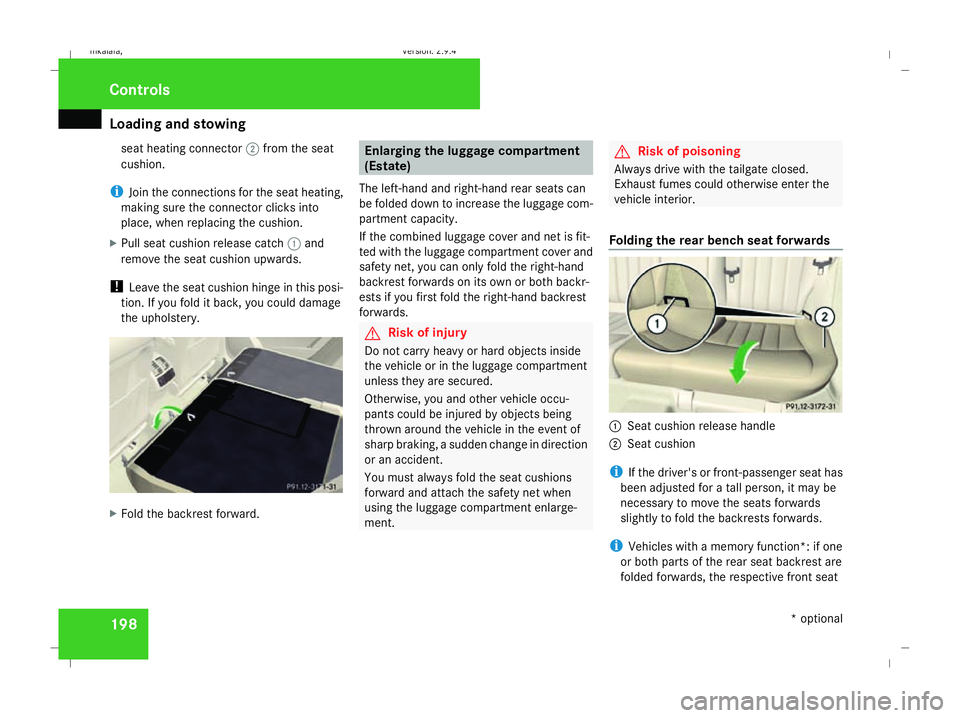
Folding the rear bench seat forwards 1
Seat cushion release handle
2 Seat cushion
i If the driver's or front-passenger seat has
been adjusted for a tall person, it may be
necessary to move the seats forwards
slightly to fold the backrests forwards.
i Vehicles with a memory function*: if one
or both parts of the rear seat backrest are
folded forwards, the respective front seat Controls
* optional
211_AKB; 2; 5, en-GB
mkalafa,
Version: 2.9.4 2008-02-29T16:57:07+01:00 - Seite 198Dateiname: 6515_3416_02_buchblock.pdf; preflight
Page 204 of 401
Loading and stowing
201
Adjusting the backrest position
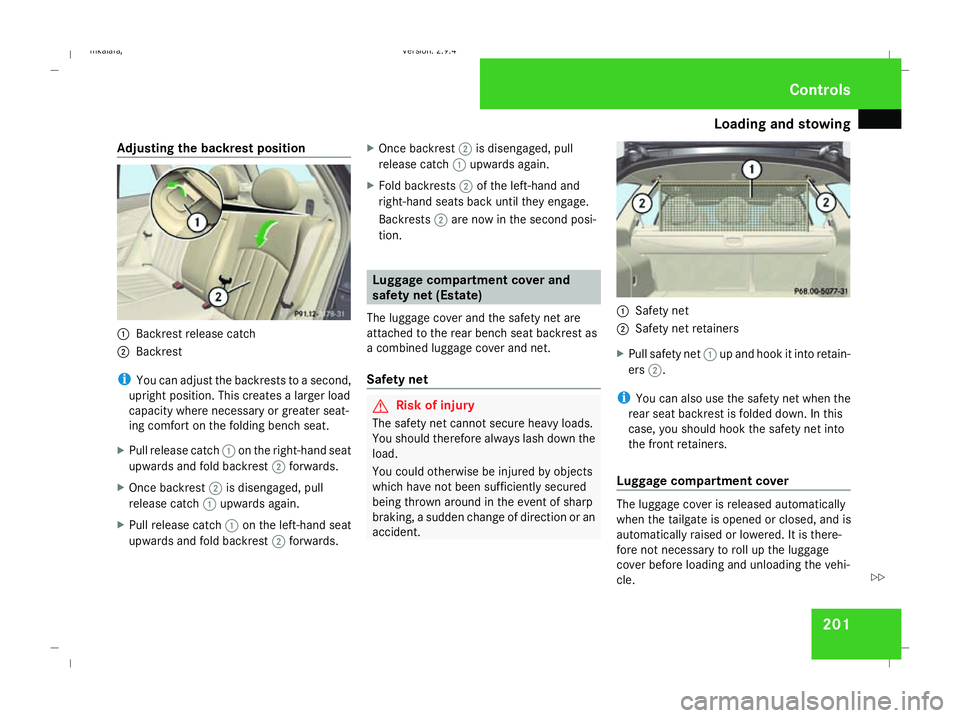
1
Backrest release catch
2 Backrest
i You can adjust the backrests to a second,
upright position. This creates a larger load
capacity where necessary or greater seat-
ing comfort on the folding bench seat.
X Pull release catch 1on the right-hand seat
upwards and fold backrest 2forwards.
X Once backrest 2is disengaged, pull
release catch 1upwards again.
X Pull release catch 1on the left-hand seat
upwards and fold backrest 2forwards. X
Once backrest 2is disengaged, pull
release catch 1upwards again.
X Fold backrests 2of the left-hand and
right-hand seats back until they engage.
Backrests 2are now in the second posi-
tion. Luggage compartment cover and
safety net (Estate)
The luggage cover and the safety net are
attached to the rear bench seat backrest as
a combined luggage cover and net.
Safety net G
Risk of injury
The safety net cannot secure heavy loads.
You should therefore always lash down the
load.
You could otherwise be injured by objects
which have not been sufficiently secured
being thrown around in the event of sharp
braking, a sudden change of direction or an
accident. 1
Safety net
2 Safety net retainers
X Pull safety net 1up and hook it into retain-
ers 2.
i You can also use the safety net when the
rear seat backrest is folded down. In this
case, you should hook the safety net into
the front retainers.
Luggage compartment cover The luggage cover is released automatically
when the tailgate is opened or closed, and is
automatically raised or lowered. It is there-
fore not necessary to roll up the luggage
cover before loading and unloading the vehi-
cle. Controls
211_AKB; 2; 5, en-GB
mkalafa,
Version: 2.9.4
2008-02-29T16:57:07+01:00 - Seite 201 ZDateiname: 6515_3416_02_buchblock.pdf; preflight
Page 257 of 401

Where will I find...?
254 Vehicle tool kit, jack and spare
wheel*
The vehicle tool kit is located in a stowage
compartment underneath the floor of the
boot/luggage compartment. G
Risk of injury
The jack is designed only to raise and hold
the vehicle for a short time while a wheel
is being changed.
If you are carrying out work on the vehicle,
you must use stands.
Make sure that the jack is placed on a firm,
non-slip and level surface. Do not use
wooden blocks or similar objects as a jack
underlay. Otherwise, the jack will not be
able to achieve its load-bearing capacity
due to the restricted height.
Do not start the engine at any time while a
wheel is being changed.
Do not lie under the vehicle when it is being
supported by the jack. If you do not raise
the vehicle as described, it could slip off the
jack (e.g. if the engine is started or a door
or the boot lid/tailgate is opened or closed)
and you could be seriously injured. i
When using the jack, you should also
observe the safety notes in the "Flat tyre"
section (Y page 324).
Saloon X
Fold up the boot floor (Y page 192).
Estate X
Open the luggage compartment floor
(Y page 193).
Vehicles with folding bench seat*
X Open the luggage compartment floor
(Y page 193).
i To reach the vehicle tool kit, the side
cover must first be released. 1
Rotary catch
2 Cover
X Turn rotary catch 1clockwise to the stop
and remove cover 2. Practical advice
* optional
211_AKB; 2; 5, en-GB
mkalafa,
Version: 2.9.4 2008-02-29T16:57:07+01:00 - Seite 254Dateiname: 6515_3416_02_buchblock.pdf; preflight
Page 269 of 401
Display
messages 266 Symbol messages
G
Risk of accident and injury
The operating safety of the vehicle could be impaired if service work is carried out incorrectly. There is a risk that you could lose control of
the vehicle and cause an accident. The safety systems may no longer be able to protect you or others as they are designed to do.
Always have maintenance work carried out at a qualified specialist workshop which has the necessary specialist knowledge and tools to
carry out the work required.
Mercedes-Benz recommends that you use a Mercedes-Benz Service Centre for this purpose.
In particular, work relevant to safety or on safety-related systems must be carried out at a qualified specialist workshop. Display messages Possible cause/consequence Possible solution
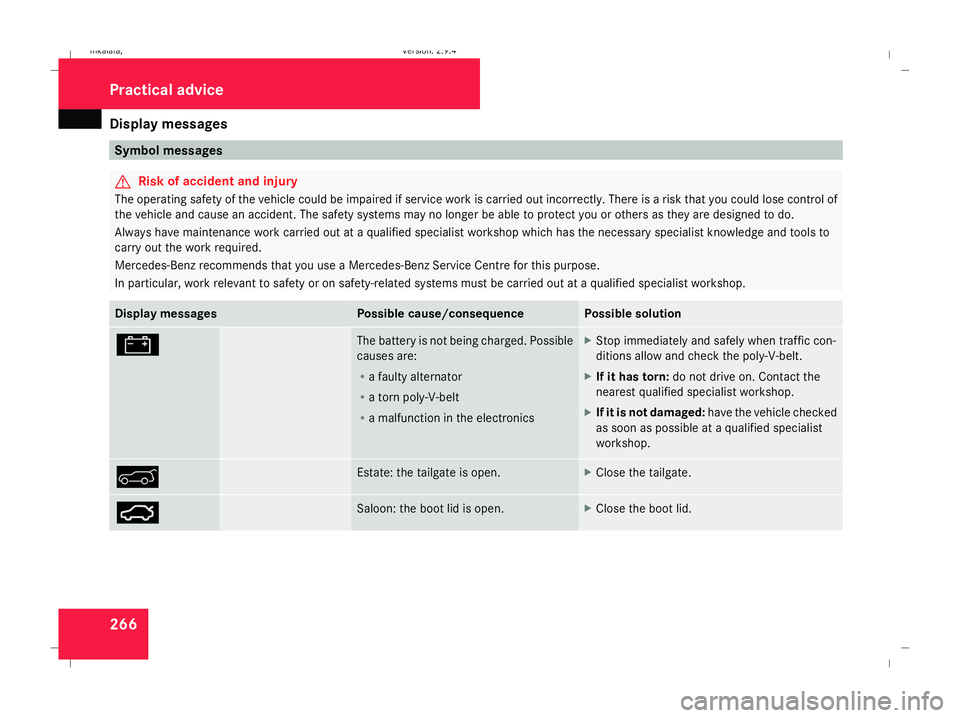
# The battery is not being charged. Possible
causes are:
R
a faulty alternator
R a torn poly-V-belt
R a malfunction in the electronics X
Stop immediately and safely when traffic con-
ditions allow and check the poly-V-belt.
X If it has torn: do not drive on. Contact the
nearest qualified specialist workshop.
X If it is not damaged: have the vehicle checked
as soon as possible at a qualified specialist
workshop. & Estate: the tailgate is open. X
Close the tailgate. Ê Saloon: the boot lid is open. X
Close the boot lid. Practical advi
ce
211_AKB; 2; 5, en-GB
mkalafa,
Version: 2.9.4 2008-02-29T16:57:07+01:00 - Seite 266Dateiname: 6515_3416_02_buchblock.pdf; preflight
Page 310 of 401
Locking/unlocking in an emergency
307Locking the vehicle
If the vehicle can no longer be locked cen-
trally with the key or the KEYLESS GO key*:
X Open the driver's door.
X Close the front-passenger door, the rear
doors and the boot lid/tailgate.
X Press the locking button (Y page 70).
X Check whether the locking knobs on the
doors are still visible. Press the locking
knobs down manually if necessary.
X Close the driver's door.
X Remove the emergency key element from
the key (Y page 306). $
To lock X
Insert the emergency key element into the
lock of the driver's door as far as it will go.
X Turn the emergency key element clockwise
as far as it will go to position $.
i On right-hand-drive vehicles, turn the
emergency key element anti-clockwise.
X Turn the emergency key element back and
remove it.
X Check whether the doors and the boot lid/
tailgate are locked. Opening/closing the boot
To unlock the boot !
The boot lid swings upwards when
opened. Therefore, make sure that there is
enough space above the boot lid.
If the boot can no longer be unlocked with the
key or the KEYLESS GO key*:
X Remove the emergency key element from
the key (Y page 306). Boot lock
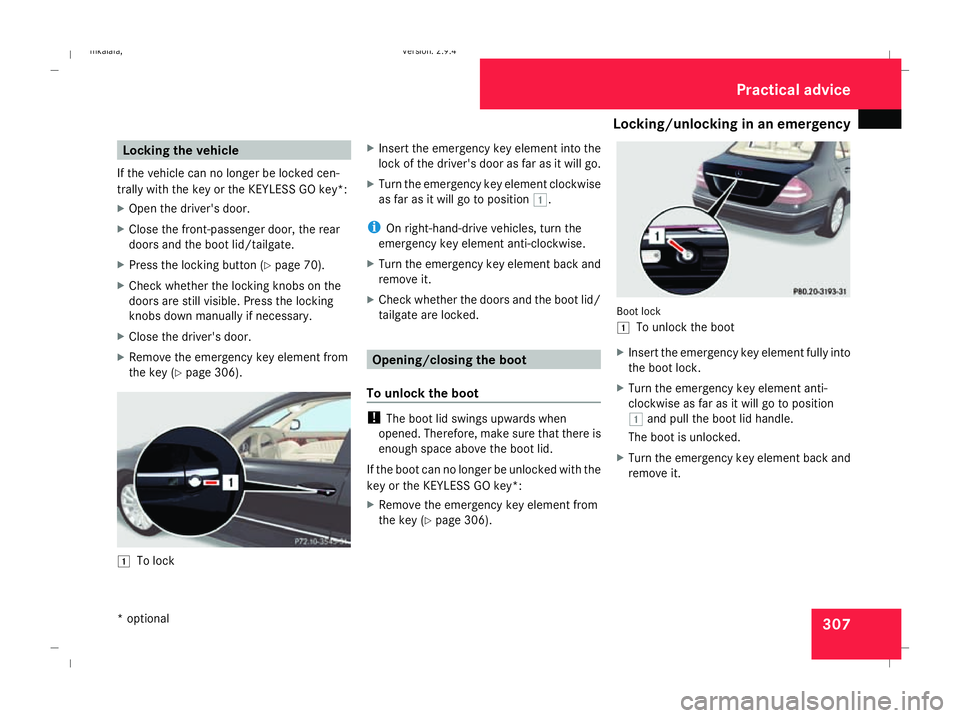
$
To unlock the boot
X Insert the emergency key element fully into
the boot lock.
X Turn the emergency key element anti-
clockwise as far as it will go to position
$ and pull the boot lid handle.
The boot is unlocked.
X Turn the emergency key element back and
remove it. Practical advice
* optional
211_AKB; 2; 5, en-GB
mkalafa,
Version: 2.9.4 2008-02-29T16:57:07+01:00 - Seite 307 ZDateiname: 6515_3416_02_buchblock.pdf; preflight
Page 311 of 401
Locking/unlocking in an emergency
308
Opening the boot manually (remote
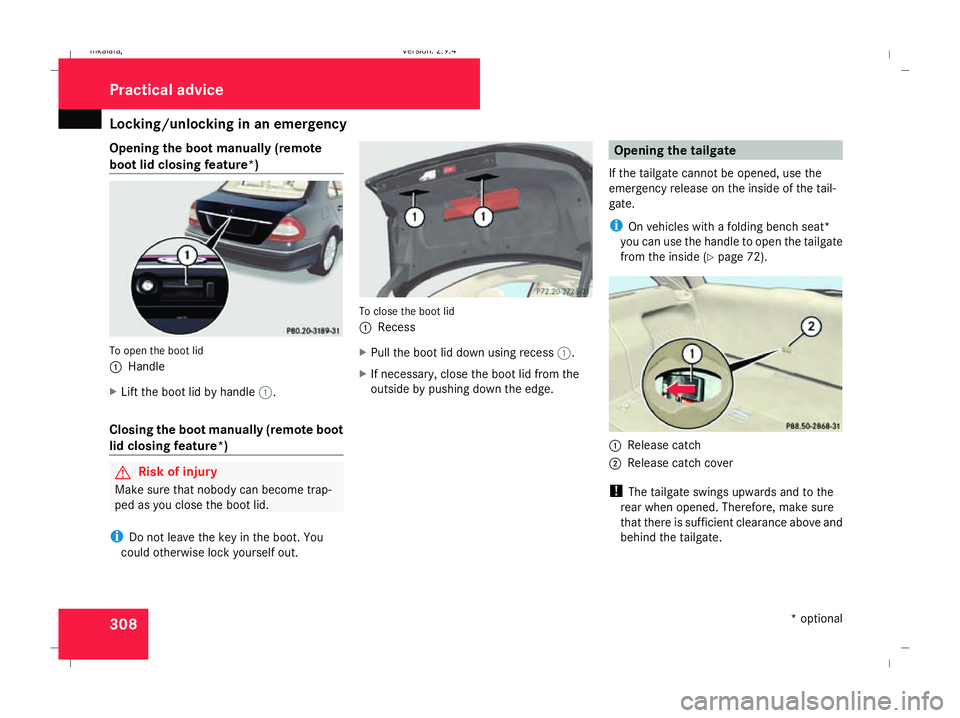
boot lid closing feature*) To open the boot lid
1
Handle
X Lift the boot lid by handle 1.
Closing the boot manually (remote boot
lid closing feature*) G
Risk of injury
Make sure that nobody can become trap-
ped as you close the boot lid.
i Do not leave the key in the boot. You
could otherwise lock yourself out. To close the boot lid
1
Recess
X Pull the boot lid down using recess 1.
X If necessary, close the boot lid from the
outside by pushing down the edge. Opening the tailgate
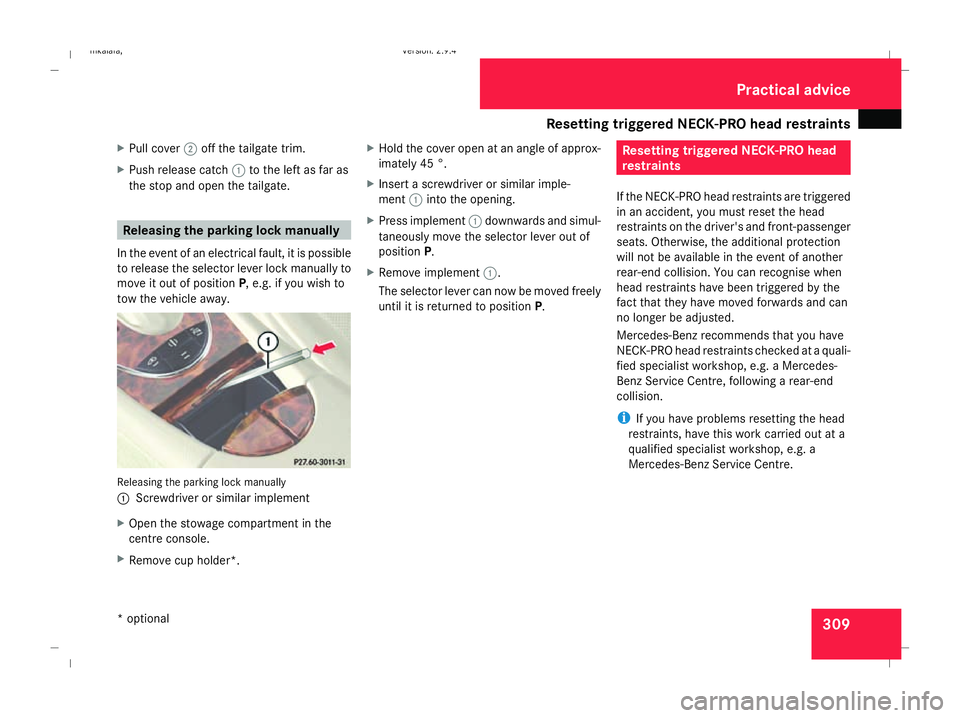
If the tailgate cannot be opened, use the
emergency release on the inside of the tail-
gate.
i On vehicles with a folding bench seat*
you can use the handle to open the tailgate
from the inside (Y page 72). 1
Release catch
2 Release catch cover
! The tailgate swings upwards and to the
rear when opened. Therefore, make sure
that there is sufficient clearance above and
behind the tailgate. Practical advice
* optional
211_AKB; 2; 5, en-GB
mkalafa,
Version: 2.9.4 2008-02-29T16:57:07+01:00 - Seite 308Dateiname: 6515_3416_02_buchblock.pdf; preflight
Page 312 of 401
Resetting triggered NECK-PRO head restraints
309
X
Pull cover 2off the tailgate trim.
X Push release catch 1to the left as far as
the stop and open the tailgate. Releasing the parking lock manually
In the event of an electrical fault, it is possible
to release the selector lever lock manually to
move it out of position P, e.g. if you wish to
tow the vehicle away. Releasing the parking lock manually
1 Screwdriver or similar implement
X Open the stowage compartment in the
centre console.
X Remove cup holder*. X
Hold the cover open at an angle of approx-
imately 45 °.
X Insert a screwdriver or similar imple-
ment 1into the opening.
X Press implement 1downwards and simul-
taneously move the selector lever out of
position P.
X Remove implement 1.
The selector lever can now be moved freely
until it is returned to position P. Resetting triggered NECK-PRO head
restraints
If the NECK-PRO head restraints are triggered
in an accident, you must reset the head
restraints on the driver's and front-passenger
seats. Otherwise, the additional protection
will not be available in the event of another
rear-end collision. You can recognise when
head restraints have been triggered by the
fact that they have moved forwards and can
no longer be adjusted.
Mercedes-Benz recommends that you have
NECK-PRO head restraints checked at a quali-
fied specialist workshop, e.g. a Mercedes-
Benz Service Centre, following a rear-end
collision.
i If you have problems resetting the head
restraints, have this work carried out at a
qualified specialist workshop, e.g. a
Mercedes-Benz Service Centre. Practical advice
* optional
211_AKB; 2; 5, en-GB
mkalafa
, Version: 2.9.4 2008-02-29T16:57:07+01:00 - Seite 309 ZDateiname: 6515_3416_02_buchblock.pdf; preflight
Page 321 of 401
Flat tyre
318 Make sure that the jack is placed on a firm,
non-slip, level surface. Do not use wooden
blocks or similar as jacking supports. Oth-
erwise, the jack will not be able to achieve
its load-bearing capacity due to the restric-
ted height.
Do not start the engine at any time while
the wheel is being changed.
Do not lie under the vehicle when it is being
supported by the jack. If you do not raise
the vehicle as described, it could slip off the
jack (e.g. if the engine is started or a door
or the boot lid/tailgate is opened or closed)
and you could sustain serious injuries. Using the TIREFIT kit
You can use the TIREFIT kit to seal small
punctures, particularly those in the tyre tread.
You can use TIREFIT in outdoor temperatures
down to -20 °C. G
Risk of accident
In the following situations, your safety is at
particular risk and TIREFIT is unable to pro-
vide breakdown assistance: R
if there are cuts or punctures in the tyre
greater than 4 mm
R if the wheel rim is damaged
R if you have driven at very low tyre pres-
sures or on a flat tyre
Do not drive any further. Consult a qualified
specialist workshop which has the neces-
sary specialist knowledge and tools to carry
out the work required.
Mercedes-Benz recommends that you use
a Mercedes-Benz Service Centre for this
purpose. In particular, work relevant to
safety or on safety-related systems must be
carried out at a qualified specialist work-
shop.
X Do not remove any foreign objects which
have penetrated the tyre, e.g. screws or
nails.
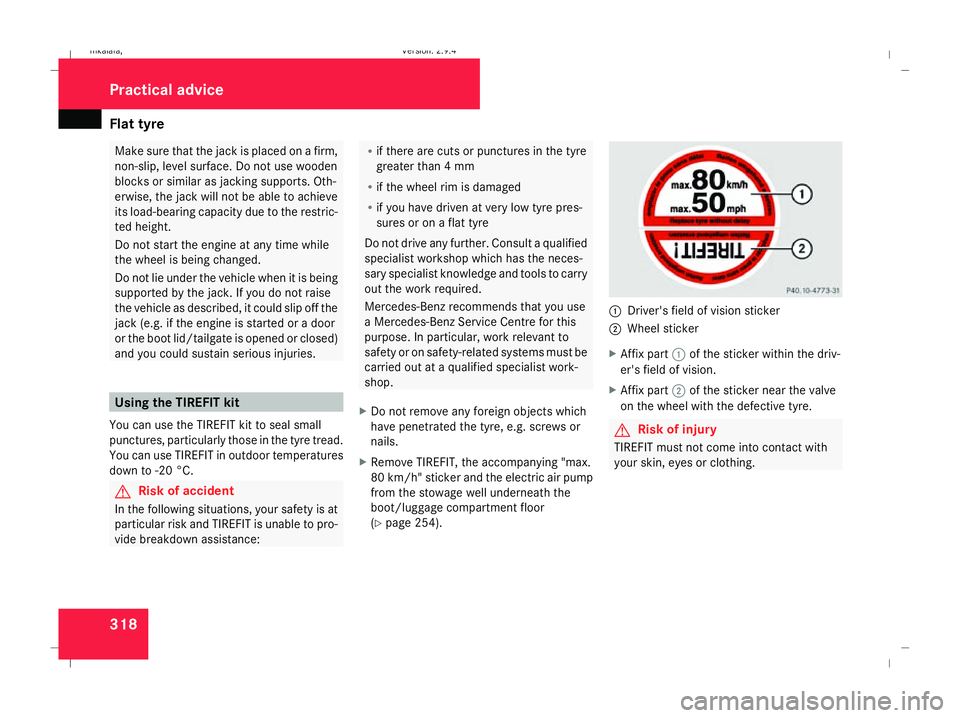
X Remove TIREFIT, the accompanying "max.
80 km/h "sticker and the electric air pump
from the stowage well underneath the
boot/luggage compartment floor
(Y page 254). 1
Driver's field of vision sticker
2 Wheel sticker
X Affix part 1of the sticker within the driv-
er's field of vision.
X Affix part 2of the sticker near the valve
on the wheel with the defective tyre. G
Risk of injury
TIREFIT must not come into contact with
your skin, eyes or clothing. Practical advice
211_AKB; 2; 5, en-GB
mkalafa
, Version: 2.9.4 2008-02-29T16:57:07+01:00 - Seite 318Dateiname: 6515_3416_02_buchblock.pdf; preflight