2008 MERCEDES-BENZ CLS COUPE engine oil
[x] Cancel search: engine oilPage 198 of 329
Engine compartment
195Engine oil
Depending on how it is driven, the vehicle
consumes a maximum of 0.8 l oil per 1,000
km. The oil consumption may be higher than
this when the vehicle is new or if you fre-
quently drive at high engine speeds. You can
only estimate the oil consumption after you
have driven a considerable distance.
You will find further information about engine
oil in the "Technical data" section
(Y page 314).
Checking the engine oil level To do so:
R
the vehicle should be parked on level
ground
R the engine should be switched off for at
least five minutes if the engine was at nor-
mal operating temperature
R the engine should be switched off for at
least 30 minutes if the engine was not at
operating temperature (i.e. if you only star-
ted the engine briefly) Using the oil dipstick
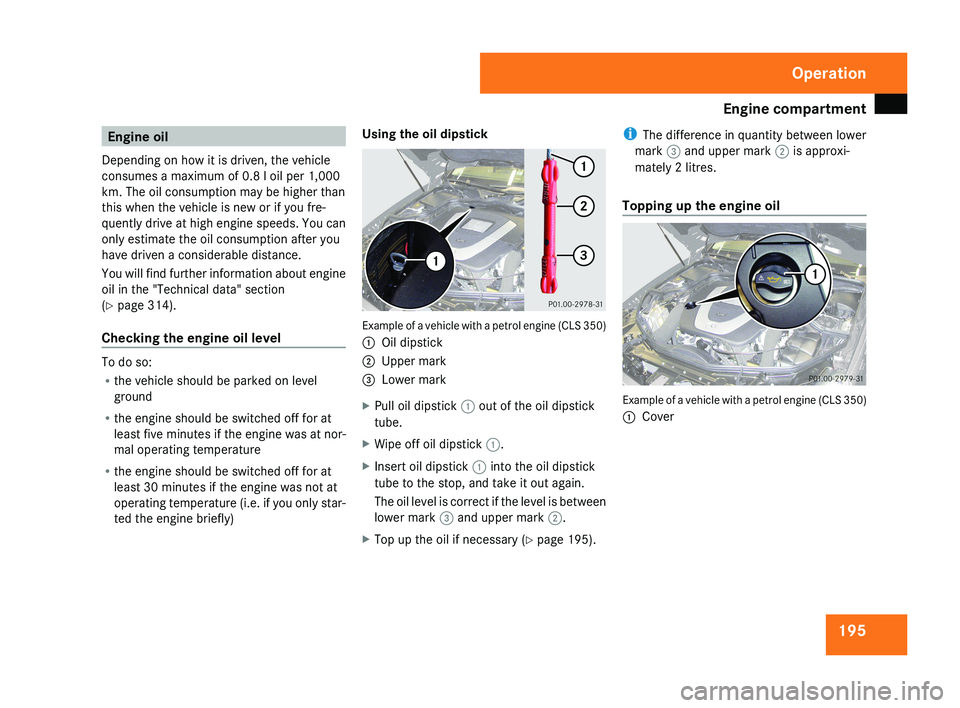
Example of a vehicle with a petrol engine (CLS 350)
1
Oil dipstick
2 Upper mark
3 Lower mark
X Pull oil dipstick 1 out of the oil dipstick
tube.
X Wipe off oil dipstick 1.
X Insert oil dipstick 1 into the oil dipstick
tube to the stop, and take it out again.
The oil level is correct if the level is between
lower mark 3 and upper mark 2.
X Top up the oil if necessary ( Y page 195).i
The difference in quantity between lower
mark 3 and upper mark 2 is approxi-
mately 2 litres.
Topping up the engine oil Example of a vehicle with a petrol engine (CLS 350)
1
Cover Operation
219_AKB; 2; 4, en-GB
mkalafa,
2007-11-13T09:28:36+01:00 - Seite 195
Page 199 of 329
Engine compartment
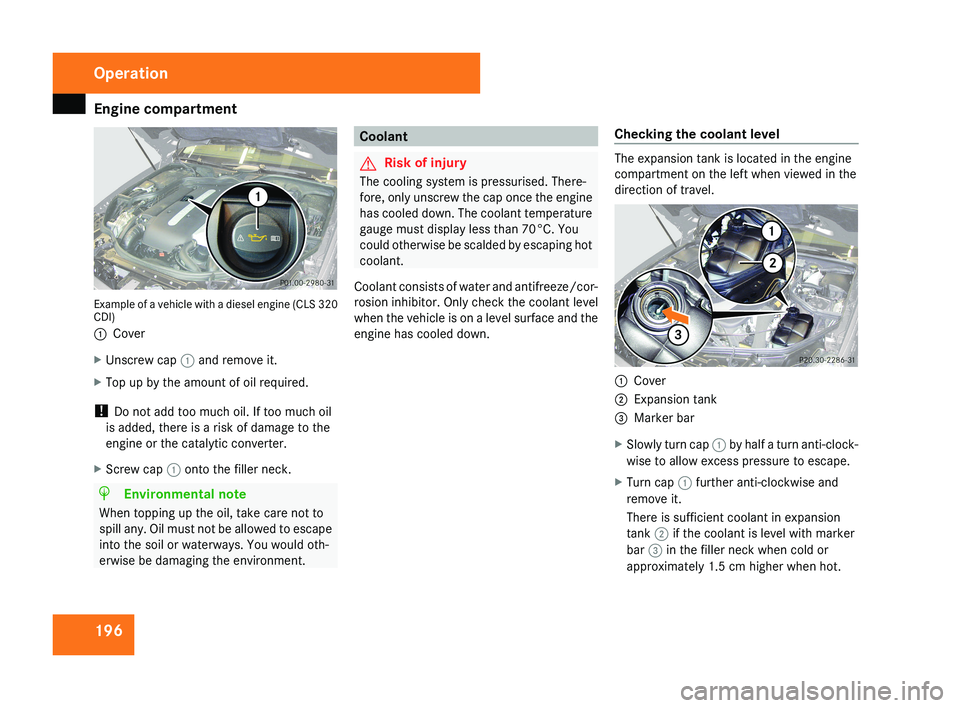
196Example of a vehicle with a diesel engine (CLS 320
CDI)
1
Cover
X Unscrew cap 1 and remove it.
X Top up by the amount of oil required.
! Do not add too much oil. If too much oil
is added, there is a risk of damage to the
engine or the catalytic converter.
X Screw cap 1 onto the filler neck.
H Environmental note
When topping up the oil, take care not to
spill any. Oil must not be allowed to escape
into the soil or waterways. You would oth-
erwise be damaging the environment.
Coolant
G Risk of injury
The cooling system is pressurised. There-
fore, only unscrew the cap once the engine
has cooled down. The coolant temperature
gauge must display less than 70°C. You
could otherwise be scalded by escaping hot
coolant.
Coolant consists of water and antifreeze/cor-
rosion inhibitor. Only check the coolant level
when the vehicle is on a level surface and the
engine has cooled down. Checking the coolant levelThe expansion tank is located in the engine
compartment on the left when viewed in the
direction of travel.
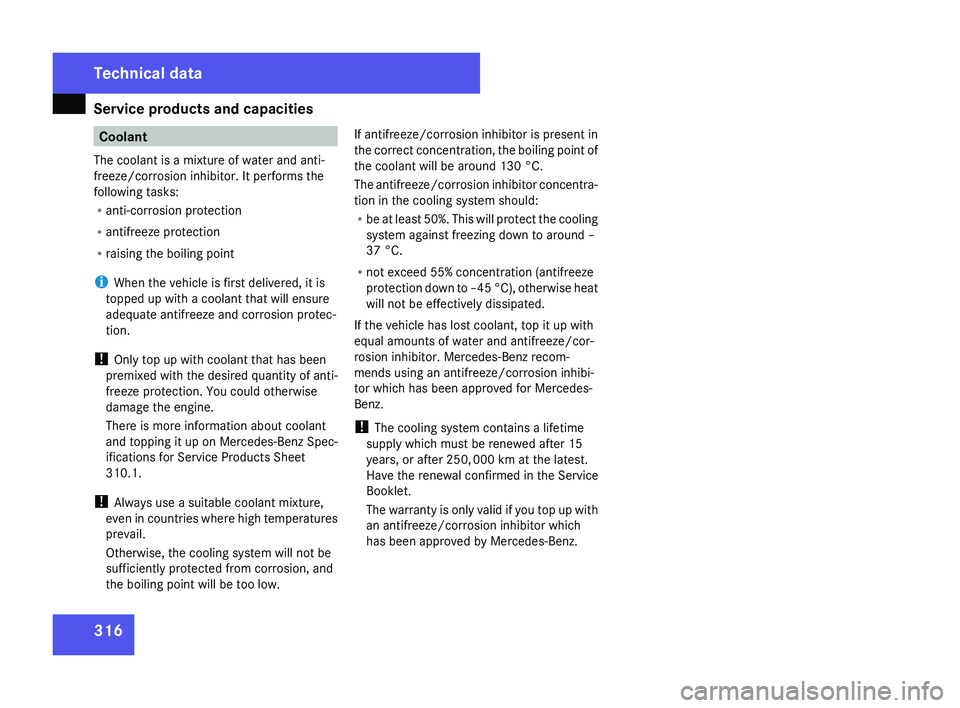
1
Cover
2 Expansion tank
3 Marker bar
X Slowly turn cap 1 by half a turn anti-clock-
wise to allow excess pressure to escape.
X Turn cap 1 further anti-clockwise and
remove it.
There is sufficient coolant in expansion
tank 2 if the coolant is level with marker
bar 3 in the filler neck when cold or
approximately 1.5 cm higher when hot.
Operation
219_AKB; 2; 4, en-GB
mkalafa,
2007-11-13T09:28:36+01:00 - Seite 196
Page 240 of 329

Display messages
237Display messages Possible cause/consequence Possible solution
N Check engine oil
level when next
refuelling The engine oil level has dropped to a crit-
ical level. X
Check the engine oil level (Y page 195) and top
up the engine oil if necessary.
X Have the engine checked for leaks if the engine
oil needs topping up more often than usual. ± Display malfunc-
tion Consult work-
shop One or more electronic systems are
unable to deliver information to the on-
board computer. The following systems
may have failed:
R
Coolant temperature gauge
R Rev counter
R Cruise control or Speedtronic display X
Visit a qualified specialist workshop. H Tyre pressure Cau-
tion Tyre defect One or more tyres are losing air rapidly.
The affected wheel is highlighted in the
tyre pressure display of the tyre pressure
monitor*. X
Stop the vehicle without making any sudden
steering
or braking manoeuvres. Pay attention
to the traffic conditions as you do so.
X Repair or change the tyre (Y page 276). Practical advice
* optional
219_AKB; 2; 4, en-GB
mkalafa,
2007-11-13T09:28:36+01:00 - Seite 237 Z
Page 260 of 329

Troubleshooting
257Automatic transmission
Problem Possible cause/consequence Suggested solutions
The transmission has problems
shifting gear The transmission is losing oil. X
Have the transmission checked at a qualified specialist workshop
immediately. The acceleration ability is deteri-
orating.
The transmission no longer
changes gear. The transmission is in emergency
mode.
It is only possible to shift into
2nd gear and reverse gear. X
Stop the vehicle.
X Move the selector lever to P.
X Turn the key to position 0 in the ignition lock.
X Wait at least 10 seconds before restarting the engine.
X Move the selector lever to position D or R.
If D
is selected, the transmission shifts into 2nd gear; if R is selec-
ted, the transmission shifts into reverse gear.
X Have the transmission checked at a qualified specialist workshop
immediately. Practical advice
219_AKB; 2; 4, en-GB
mkalafa,
2007-11-13T09:28:36+01:00 - Seite 257
Page 314 of 329

Service products and capacities
311Service products and capacities
Notes on service products and capaci-
ties
Service products are:
R fuels (e.g. petrol, diesel)
R lubricants
(e.g. engine oil, transmission oil)
R coolant
R brake fluid
R windscreen washer fluid
Mercedes-Benz recommends that you only
use those products which have been tested
and specially approved by Mercedes-Benz for
your vehicle and are listed in the Mercedes-
Benz Owner's Manual in the relevant chapter
since:
R parts and service products are matched
R damage caused by the use of non-approved
service products is not covered by the war-
ranty
You can recognise service products approved
by Mercedes-Benz by the following inscrip-
tion on the containers:
R MB-Freigabe (e.g. MB-Freigabe 229.51)
R MB Approval (e.g. MB Approval 229.51) Other designations or recommendations that
relate
to a level of quality or a specification in
accordance with an MB Approval have not
necessarily been approved by Mercedes-
Benz.
You can obtain further information from any
Mercedes-Benz Service Centre. G
Risk of injury
When handling, storing and disposing of
any service products, please observe the
relevant regulations, as you could other-
wise endanger yourself and others.
Keep
service products away from children.
To protect your health, do not allow service
products to come into contact with your
eyes or open wounds. See a doctor imme-
diately if any service product is swallowed. H
Environmental note
Dispose of service products in an environ-
mentally-responsible manner. Fuels
G
Risk of explosion
Fuel is highly flammable. Fire, naked flames
and
smoking are therefore prohibited when
handling fuels.
Before refuelling, turn off the engine and
the auxiliary heating*. G
Risk of injury
Do not allow fuel to come into contact with
skin or clothing.
Allowing fuels to come into direct contact
with your skin or inhaling fuel vapours is
damaging to your health.
Tank capacity Total capacity 80 l
Of which reserve
fuel
On AMG vehicles Approx. 8 – 9 l
Approx. 14 l !
Do
not use petrol to refuel vehicles with a
diesel engine. Do not use diesel to refuel
vehicles with a petrol engine. Never mix
diesel with petrol. Even small amounts of Technical data
* optional
219_AKB; 2; 4, en-GB
mkalafa,
2007-11-13T09:28:36+01:00 - Seite 311 Z
Page 317 of 329

Service products and capacities
314 Engine oil
A list of engine oils tested and approved in accordance with the Mercedes-Benz Specifications for Service Products is available from any
Mercedes-Benz Service Centre. Approval by Mercedes-Benz is also often indicated by the MB Sheet number on the oil container. The table
shows which MB Sheet number applies to which engine: CLS 280
CLS 350
50
CLS 350 CGI 50 CLS 500 CLS 63 AMG CLS 320 CDI
MB Sheet num-
ber 229.3/229.5 229.3/229.5 229.3/229.5
229.5
51 –
MB Sheet num-
ber
(vehicles
without
a diesel particle
filter) 52 – – – – 228.3/228.5/
228.51
229.3/229.31/ 229.5/229.51 MB Sheet num-
ber
(vehicles with a
diesel
particle fil-
ter) – – – – 228.51/229.31/
229.51 i
In the event that the:
50 Only for certain countries.
51 Restriction: only SAE XW-40
engine oils may be used.
52 Only for certain countries. Technical data
219_AKB; 2; 4, en-GB
mkalafa,
2007-11-13T09:28:36+01:00 - Seite 314
Page 318 of 329

Service products and capacities
315
R
engine oil brand
R grade (MB Sheet number)
R SAE classification (viscosity)
is not available, you can use another min-
eral
or synthetic engine oil which has been
approved by Mercedes-Benz. Mixing oils reduces the benefits of high-
grade engine oil.
! Do
not use lubricant additives, since they
lead to increased wear and damage to the
mechanical assemblies. The use of lubri- cant additives will result in a restriction of
your warranty.
! Engine oils for vehicles without a diesel
particle
filter may also be used temporarily
in vehicles with a diesel particle filter if the
engine oil listed is not available. You must
then have an oil change carried out as soon
as possible.
Capacities The following values refer to an oil change including the oil filter.
Engine with oil filter CLS 280
CLS 350
53
CLS 350 CGI 53 CLS 500
CLS 320 CDI CLS 63 AMG
Replacement amount 8.0 l 8.0 l 8.5 l 8.8 l
53
Only for certain countries. Technical data
219_AKB; 2; 4, en-GB
mkalafa,
2007-11-13T09:28:36+01:00 - Seite 315
Page 319 of 329
Service products and capacities
316 Coolant
The coolant is a mixture of water and anti-
freeze/corrosion inhibitor. It performs the
following tasks:
R anti-corrosion protection
R antifreeze protection
R raising the boiling point
i When the vehicle is first delivered, it is
topped up with a coolant that will ensure
adequate antifreeze and corrosion protec-
tion.
! Only top up with coolant that has been
premixed
with the desired quantity of anti-
freeze protection. You could otherwise
damage the engine.
There is more information about coolant
and topping it up on Mercedes-Benz Spec-
ifications for Service Products Sheet
310.1.
! Always use a suitable coolant mixture,
even in countries where high temperatures
prevail.
Otherwise, the cooling system will not be
sufficiently protected from corrosion, and
the boiling point will be too low. If antifreeze/corrosion inhibitor is present in
the
correct concentration, the boiling point of
the coolant will be around 130 °C.
The antifreeze/corrosion inhibitor concentra-
tion in the cooling system should:
R be at least 50%. This will protect the cooling
system against freezing down to around –
37 °C.
R not exceed 55% concentration (antifreeze
protection down to –45 °C), otherwise heat
will not be effectively dissipated.
If the vehicle has lost coolant, top it up with
equal amounts of water and antifreeze/cor-
rosion inhibitor. Mercedes-Benz recom-
mends using an antifreeze/corrosion inhibi-
tor which has been approved for Mercedes-
Benz.
! The cooling system contains a lifetime
supply which must be renewed after 15
years, or after 250, 000 km at the latest.
Have the renewal confirmed in the Service
Booklet.
The warranty is only valid if you top up with
an antifreeze/corrosion inhibitor which
has been approved by Mercedes-Benz. Technical data
219_AKB; 2; 4, en-GB
mkalafa,
2007-11-13T09:28:36+01:00 - Seite 316